
AC Withstanding Voltage Tester Calibration…
Accuracy across the range
How AC Withstanding Voltage Tester calibration works
- Intake & visual inspection
- Environmental stabilization
- As-found measurement
- Comparison to NIST-traceable standards
- Adjustment if required
- As-left results & certificate
Your calibration, covered
In-lab vs on-site calibration
In-lab calibration
- Accredited bench with full reference standards
- Best achievable measurement uncertainties
- Pickup & return logistics handled
- Ideal for precision and reference work
On-site calibration
- We calibrate the AC Withstanding Voltage Tester at your facility
- No shipping risk or transit downtime
- As-found data captured before any move
- Ideal for fixed, large or sensitive assets
In-depth guide
Ensuring electrical safety is not just a regulatory hurdle; it is a fundamental pillar of manufacturing integrity. At the heart of this process lies the AC Withstanding Voltage Tester, commonly known as a Hipot tester. However, the reliability of your safety tests is only as good as the accuracy of your equipment. This is where AC withstanding voltage tester calibration becomes critical. In this complete guide, we will explore the technical nuances of Hipot tester calibration services, the necessity of NIST traceable voltage tester calibration, and how ISO 17025 accreditation protects your business from liability.
Understanding the AC Withstanding Voltage Tester
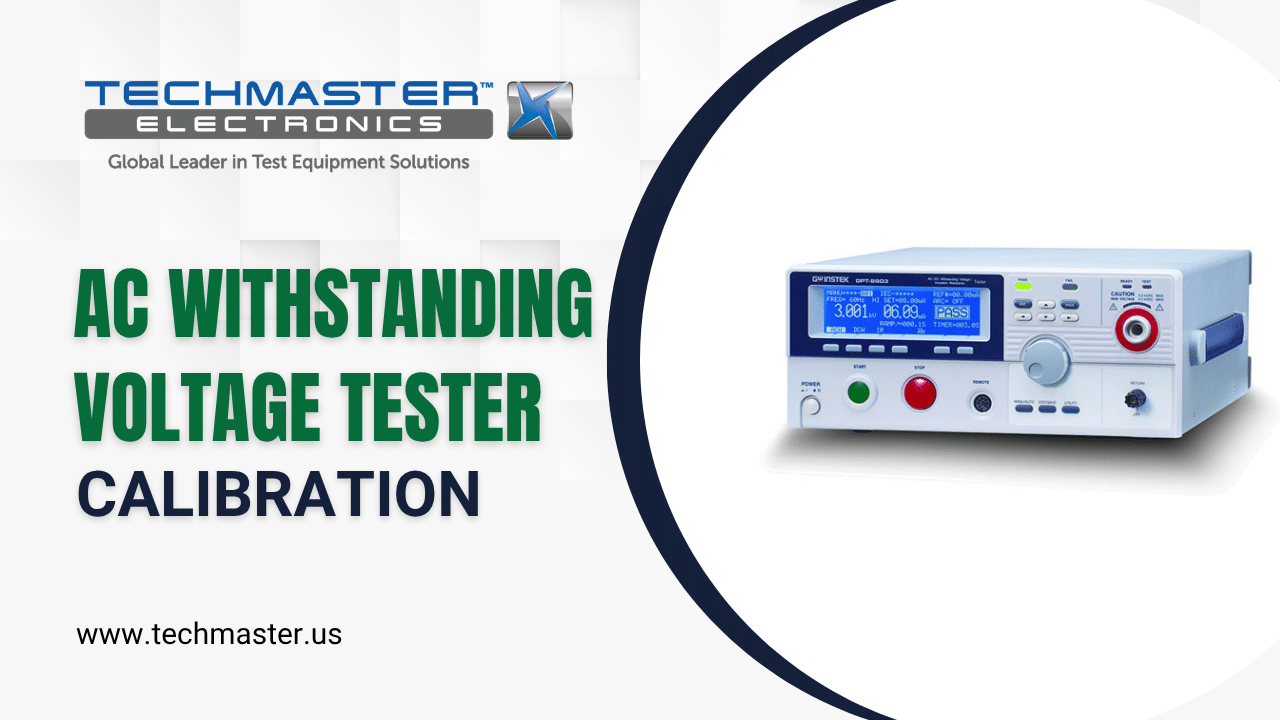
Before we discuss calibration, we must understand the device’s role. An AC Withstanding Voltage Tester applies a high-voltage AC load to a device under test (DUT) to ensure the insulation can handle overvoltage transients.
Core Applications in Industry
-
Consumer Electronics: Testing appliances to prevent electrical shock to users.
-
Aerospace & Defense: Validating wire harnesses and connectors under extreme stress.
-
Medical Devices: Meeting stringent IEC 60601-1 standards for patient safety.
-
Automotive EV: Checking battery insulation and high-voltage cabling.
Without regular calibration, a “Pass” result might be a false negative, potentially leading to catastrophic product failures or legal repercussions.
Why Calibration Is Non-Negotiable
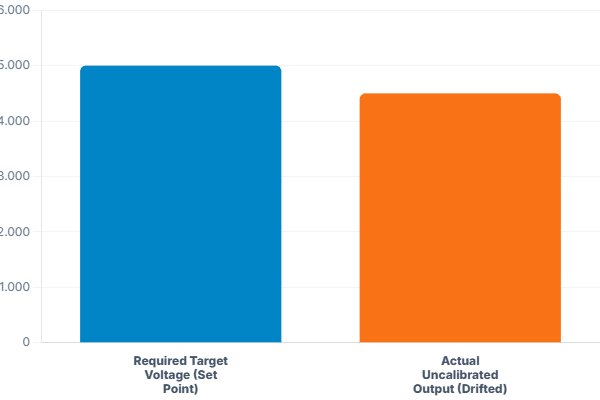
You might ask, “If my tester turns on and displays a number, why calibrate it?” The answer lies in drift. Over time, internal components like transformers, capacitors, and resistors age.
1. Regulatory Compliance
Most international standards, such as UL, CSA, and IEC, require that the test equipment used for safety validation be calibrated annually. If an auditor finds an expired calibration sticker on your Hipot tester, your entire production batch could be quarantined.
2. Accuracy and Precision
A tester might indicate it is outputting $5000V$, but due to component wear, it might only be outputting $4500V$. This $10\%$ discrepancy means you are not actually stressing the insulation to the required level, rendering the test invalid.
3. Liability Protection
In the event of an electrical accident involving your product, having a NIST traceable voltage tester calibration certificate serves as legal proof that you maintained your equipment to the highest professional standards.
The Technical Process: How Hipot Calibration Works
The 4-Step Calibration Protocol
A rigorous, standardized process utilizing precision load banks and high-voltage probes to guarantee test validity.
Technicians assess leads, probes, and grounding terminals for fraying or carbon tracking. Safety and physical integrity form the baseline.
A calibrated High Voltage Meter measures actual output against the set point across multiple ranges (e.g., 1kV, 2.5kV, 5kV).
Using a precision load bank, failure conditions are simulated to ensure the “Current Trip” settings engage at the exact milliampere (mA) threshold.
Because standards often require voltage to be held for precisely 60 seconds, internal timers are verified against NIST-traceable chronometers.
Calibrating an AC withstanding voltage tester is a complex procedure that requires specialized high-voltage probes and precision load banks.
Step 1: Visual and Physical Inspection
The technician begins by checking the leads, probes, and grounding terminals for any signs of fraying or carbon tracking. Safety is the first priority.
Step 2: Voltage Accuracy Verification
Using a calibrated High Voltage Meter (Kilo-voltmeter), the technician measures the actual output against the set point on the tester. We typically test multiple points across the range (e.g., $1kV, 2.5kV, 5kV$).
Step 3: Current Leakage Measurement
The tester must accurately trip when it detects leakage current. We use a precision load bank to simulate a failure and ensure the “Current Trip” settings engage at the exact milliampere ($mA$) threshold.
Step 4: Timer Accuracy
Since many standards require the voltage to be held for exactly 60 seconds, we verify the internal timer against a NIST-traceable stopwatch.
Addressing the “Ghost” of Stray Capacitance
One of the most nuanced challenges in AC withstanding voltage tester calibration involves the management of stray capacitance. Unlike DC testing, AC Hipot testing inherently encounters capacitive reactance from both the internal circuitry and the high-voltage test leads. Consequently, a proficient metrologist does not merely verify the output voltage; they must account for the ‘reactive current’ that can inadvertently mask true leakage. If your service provider fails to compensate for these parasitic effects, your tester might trigger ‘nuisance trips’, falsely rejecting safe products, or, more dangerously, fail to detect a genuine insulation breakdown due to a shifted phase angle. This technical precision is precisely why ISO 17025 accredited hipot calibration remains indispensable. It ensures that the critical relationship between voltage and current is accurately characterized, rather than merely estimated, protecting your production yield from ghost failures.
Load Regulation and Guard Circuit Integrity
In addition, the stability of a tester under fluctuating load conditions serves as a definitive benchmark for high-quality Hipot tester calibration services. In a rigorous manufacturing environment, the impedance of the Device Under Test (DUT) rarely remains static. Therefore, a comprehensive calibration protocol must include ‘Load Regulation Testing.’ This procedure confirms that the AC voltage remains stable even as the leakage current approaches the programmed trip limit. Also, verifying the integrity of the ‘Guard Circuit’, the specialized system designed to bypass stray currents, is a vital safety step that discount labs frequently overlook. By insisting on NIST traceable voltage tester calibration that incorporates load sensitivity analysis, you are doing more than satisfying an auditor; you are stress-testing the primary safety infrastructure of your facility against unpredictable real-world variables.
The Significance of ISO 17025 Accredited Hipot Calibration
Not all calibration services are created equal. When you choose ISO 17025 accredited hipot calibration, you are opting for a laboratory that has been independently audited for technical competence.
What ISO 17025 Provides:
-
Uncertainty Budgets: You receive a report detailing the exact margin of error in the measurements.
-
Traceability: A clear “paper trail” back to national standards (NIST).
-
Standardized Procedures: The lab follows rigorous, repeatable methods rather than “best guesses.”
FAQ: Frequently Asked Questions
How often should I calibrate my AC withstanding voltage tester?
Most manufacturers recommend a 12-month calibration interval. However, if the device is used in a high-volume production line or has been dropped, more frequent checks are advisable.
What is the difference between NIST traceable and ISO 17025?
NIST traceable means the equipment used to calibrate your device can be traced back to the National Institute of Standards and Technology. ISO 17025 goes a step further by certifying that the process and the technicians also meet international quality standards.
Can I calibrate a Hipot tester in-house?
While some large firms have internal metrology labs, most companies prefer third-party Hipot tester calibration services. This is because high-voltage calibration equipment is expensive to maintain and requires specialized safety training.
Conclusion: Securing Your Quality Standards
Calibrating your AC withstanding voltage tester is more than a maintenance task; it is a commitment to safety and excellence. By utilizing NIST traceable voltage tester calibration and ensuring your provider has ISO 17025 accreditation, you protect your brand, your employees, and your customers.
Don’t leave your electrical safety to chance. Regular calibration ensures that your equipment remains a reliable shield against electrical failure.
Frequently asked questions
What is AC Withstanding Voltage Tester Calibration?
How often should a AC Withstanding Voltage Tester be calibrated?
What standards apply to AC Withstanding Voltage Tester Calibration?
What is included on the certificate?
Can you calibrate the AC Withstanding Voltage Tester on-site?
Need AC Withstanding Voltage Tester calibration?
ANAB-accredited, NIST-traceable, fast turnaround, in-lab or on-site across the USA.
Contact us for a quoteReferences & industry standards
- ISO/IEC 17025 testing & calibration laboratory requirements
- NIST calibration services and measurement traceability
- NIST Fundamental Electrical Measurements
- A2LA / ANAB accreditation for calibration laboratories
External standards bodies. Techmaster Electronics is an ISO/IEC 17025-accredited, NIST-traceable calibration laboratory.

Khanh Nguyen is the Marketing Manager at Techmaster Electronics, a B2B marketing leader covering the test, measurement, and ISO/IEC 17025 accredited calibration industry across the US and Vietnam markets.