
TL;DR: The benefits of accredited calibration come down to proof. An ISO/IEC 17025 accredited calibration gives you an independently verified certificate with measurement data and stated uncertainty, evidence that survives customer audits, regulatory inspections, and legal challenges. Non-accredited calibration relies on the lab’s own word. The seven benefits below explain when the accredited certificate pays for itself, and the real costs when it’s missing.
“Calibrated” is not one thing. A bare sticker from an uncredited shop and an endorsed ISO/IEC 17025 certificate both count as “calibrated”, until an auditor, a customer, or a regulator asks you to prove your measurements. This guide covers the seven concrete benefits of using accredited calibration services for electronics, drawn from what we see across audits at Techmaster Electronics, an ANAB-accredited ISO/IEC 17025:2017 laboratory (certificate AC-1736).
What does “accredited calibration” actually mean?
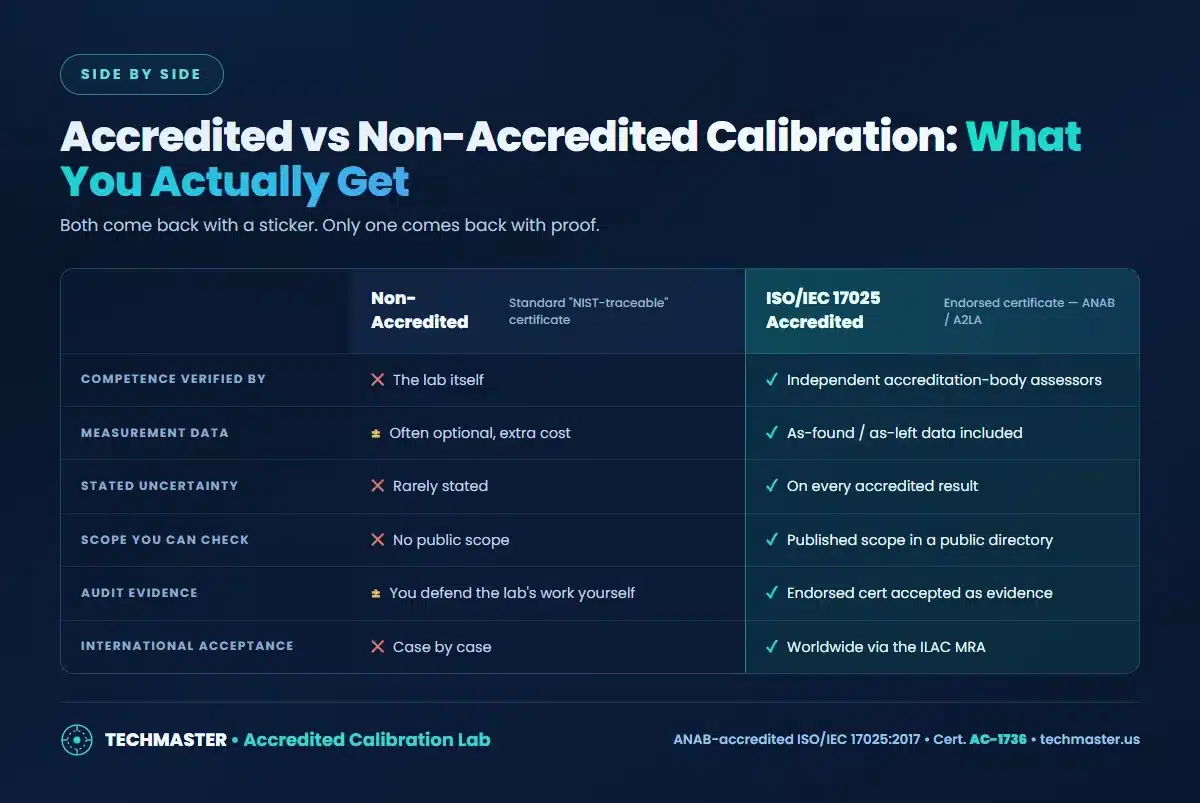
Accredited calibration means the lab’s technical competence has been independently verified against ISO/IEC 17025:2017 by an accreditation body, in the US, mainly ANAB or A2LA. Assessors audit the lab’s measurement methods, standards, uncertainty budgets, and staff, then publish a scope of accreditation listing exactly what the lab is approved to calibrate. An accredited (endorsed) certificate carries the accreditation body’s symbol and includes measurement data with stated uncertainty. Non-accredited “NIST-traceable” calibration can be perfectly competent work, but nobody outside the lab has verified it. That difference drives every benefit below.
What are the benefits of using accredited calibration services?
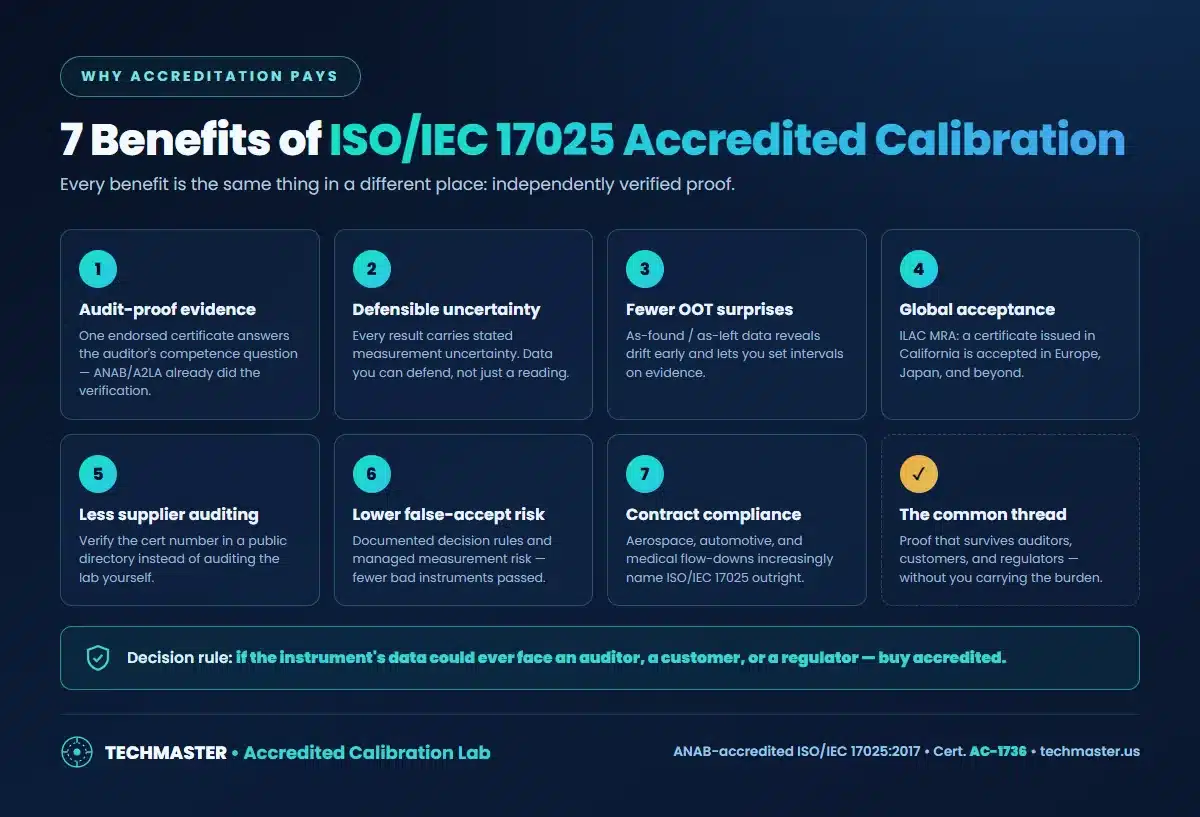
1. Audit-proof evidence of competence
When an ISO 9001, ISO 13485, or IATF 16949 auditor asks how you know your instruments measure correctly, an endorsed certificate from an accredited lab answers the question in one document. The verification work was already done by ANAB or A2LA assessors, you inherit it.
2. Defensible measurement uncertainty
Accredited certificates state the measurement uncertainty for each result. If a customer disputes your test data, you can show not just the reading but how good the reading is. Without uncertainty, a calibration result is an opinion.
3. Fewer out-of-tolerance surprises
Accredited calibrations include as-found and as-left data. Trend that data and you can see drift building before an instrument fails, and set calibration intervals based on evidence instead of habit.
4. Global acceptance through the ILAC MRA
ANAB and A2LA are signatories to the ILAC Mutual Recognition Arrangement, so an accredited certificate issued in California is accepted by customers and regulators in Europe, Japan, and nearly everywhere else. One calibration, worldwide validity.
5. Reduced supplier-audit burden
Many quality systems require you to qualify your calibration supplier. With an accredited lab, most of that qualification is already done: verify the certificate number and scope in the public directory and file the printout. Auditing a non-accredited lab yourself costs days.
6. Lower false-accept risk
ISO/IEC 17025:2017 requires labs to apply documented decision rules and manage measurement risk. Combined with a healthy test uncertainty ratio, that means fewer good instruments failed, and, far more important, fewer bad instruments passed into production.
7. Contract and regulatory compliance
Aerospace primes, automotive OEMs, medical device regulations, and defense flow-downs increasingly name ISO/IEC 17025 explicitly. An accredited certificate isn’t an upgrade there, it’s the ticket to bid.
What does non-accredited calibration really cost?
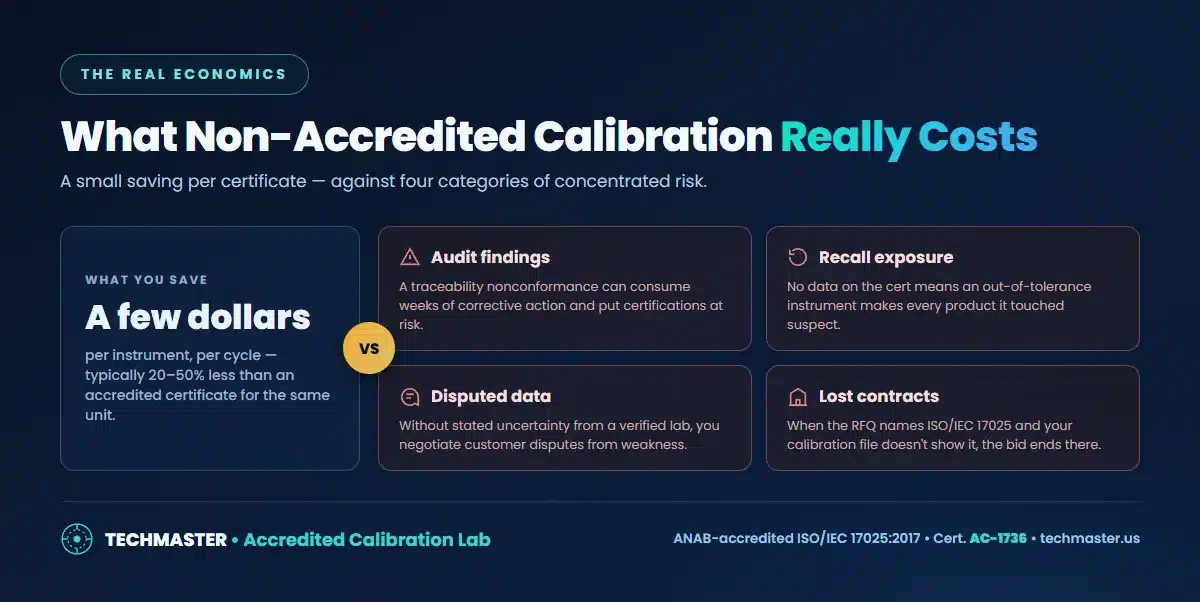
The quote is smaller; the exposure is bigger. A non-accredited calibration saves tens of dollars per instrument and concentrates risk in four places, each of which dwarfs the saving:
- Audit findings. A major nonconformance on measurement traceability can consume weeks of corrective-action work and put certifications at risk.
- Retest and recall exposure. If an instrument turns up out of tolerance and your certificates carry no data, you can’t bound the damage, every product it touched since the last calibration is suspect.
- Disputed data. Customer rejects your test results? Without stated uncertainty from a verified lab, you’re negotiating from weakness.
- Lost contracts. When the RFQ requires ISO/IEC 17025 and your calibration file doesn’t show it, the bid is over before pricing matters.
When is non-accredited calibration good enough?
For instruments that never touch product acceptance or regulated data, a standard NIST-traceable calibration from a competent lab is a reasonable choice, think shop-floor meters used for troubleshooting, or teaching equipment. The decision rule most quality managers use: if the instrument’s data could ever face an auditor, a customer, or a regulator, buy accredited. If it only ever informs an internal decision you could re-verify cheaply, traceable may do. See our 12-point checklist for choosing a calibration service for the full decision framework.
How much more does accredited calibration cost?
Typically 20–50% over a standard traceable calibration for the same instrument, driven by the data reporting and the lab’s accreditation overhead. Against the cost of one failed audit or one unbounded recall, the delta is rounding error. Get itemized quotes stating the certificate level so you compare like for like.
Frequently asked questions
Is ISO/IEC 17025 accredited calibration required by ISO 9001?
ISO 9001 requires measurement traceability but does not mandate accredited calibration. In practice, many auditors and customers treat an accredited certificate as the cleanest evidence of compliance, and sector schemes such as IATF 16949, AS9100 flow-downs, and ISO 13485 expectations increasingly expect it.
What is the difference between NIST-traceable and accredited calibration?
NIST-traceable means the lab’s standards trace to national standards on the lab’s own assurance. Accredited calibration adds independent verification: an accreditation body has audited the lab’s methods and uncertainties, and the endorsed certificate includes measurement data and stated uncertainty.
How do I know if a lab is really accredited?
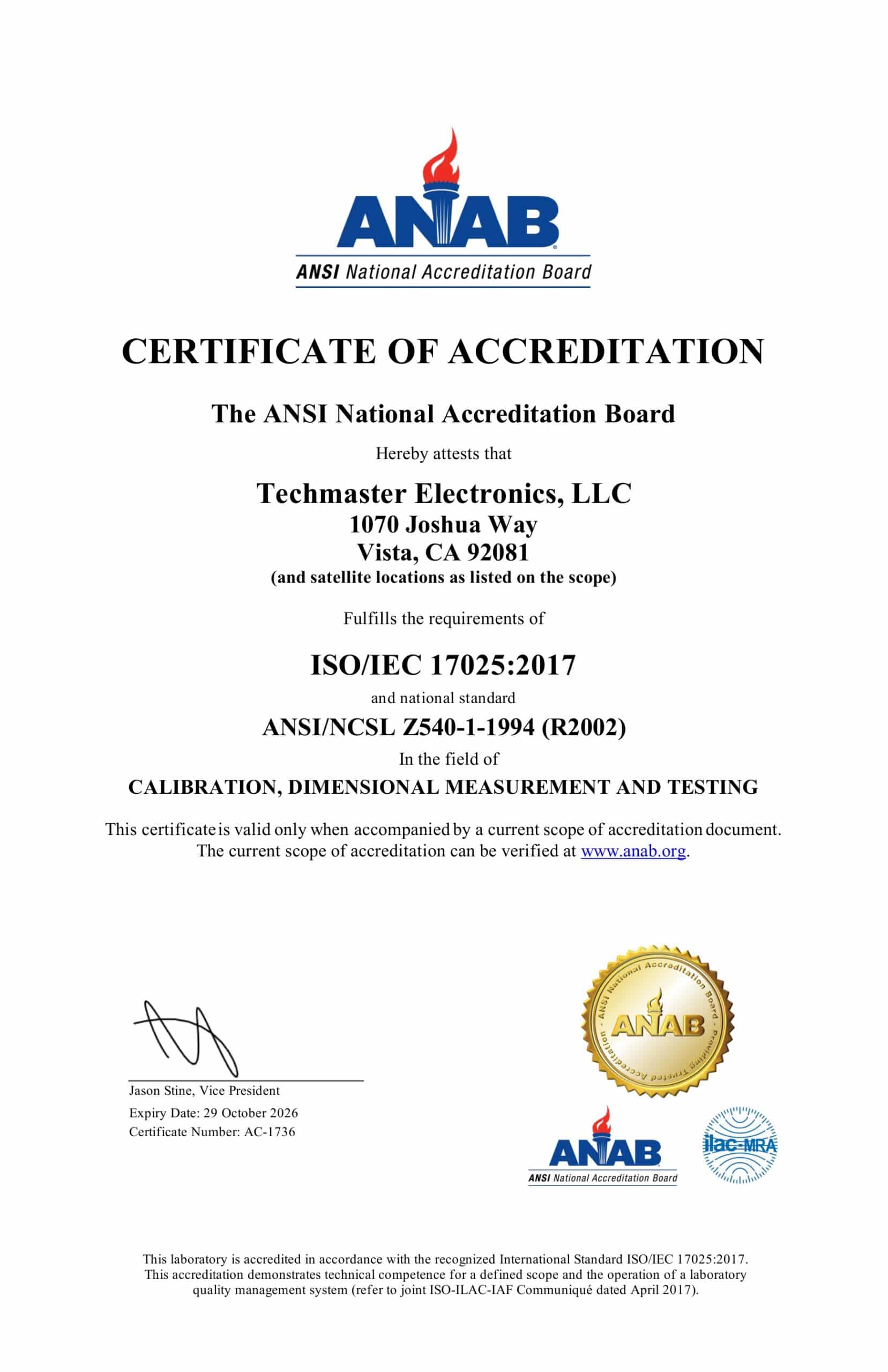
Ask for the certificate number and look it up in the ANAB or A2LA public directory, then check that the scope covers your instrument types and ranges. Techmaster Electronics, for example, is verifiable under ANAB certificate AC-1736.
Does accredited calibration take longer?
Not necessarily. Turnaround depends on the lab, not the certificate level. Techmaster Electronics runs a 5-day standard turnaround with 1–2 day expedite options on accredited calibration across eight calibration fields.
The bottom line
Accredited calibration buys you independently verified proof: endorsed certificates, real measurement data, stated uncertainty, and worldwide acceptance. Non-accredited calibration saves a little money and leaves you carrying the proof burden yourself, at exactly the moments you can least afford it. Compare providers in our guide to the best calibration services in the USA, or read about Techmaster’s accredited calibration services.
Get an accredited calibration quote
ANAB-accredited ISO/IEC 17025:2017 (Cert. AC-1736) • 4 accredited US labs • 5-day standard, 1–2 day expedite • in-lab or on-site.
Request a quoteReferences & industry standards
- ISO/IEC 17025 testing & calibration laboratory requirements
- NIST calibration services and measurement traceability
- A2LA / ANAB accreditation for calibration laboratories
External standards bodies. Techmaster Electronics is an ISO/IEC 17025-accredited, NIST-traceable calibration laboratory.

Khanh Nguyen is the Marketing Manager at Techmaster Electronics, a B2B marketing leader covering the test, measurement, and ISO/IEC 17025 accredited calibration industry in the United States.