
Particle counts tell you what the room is doing today. A HEPA filter leak test tells you whether the last line of defense is physically intact. A cleanroom can pass its ISO 14644-1 particle count on a quiet afternoon while a pinhole in a ceiling filter waits for the next pressure swing. That is why quality managers in pharmaceutical compounding, medical device assembly and semiconductor fabs treat the installed filter leak test as its own deliverable rather than a footnote to room certification.
This guide explains how the test works, which method applies to which filter, what the 0.01% number actually means, and what to put in your protocol so the result survives an audit. It reflects how accredited cleanroom certification is performed in the field, and it links to the standards you will be asked to cite.
What is a HEPA filter integrity test?
Filter manufacturers factory-test every HEPA and ULPA element, but the filter does not stay in the factory. It is shipped, lifted, clamped into a grid or housing, and pressurized for years. Each step can damage the media or compromise the seal. The installed-filter test is the only verification that the as-installed system performs the way the filter data sheet promises.
Two separate questions are answered by one scan. First, is the media itself free of pinholes and edge leaks where the media pack meets the frame? Second, is the seal between the filter frame and the grid, housing or gel channel tight? A particle count in the room cannot reliably answer either, because room air is diluted by supply volume, mixed with recirculated air and affected by personnel activity.
The test is commonly written into contracts and quality systems through ISO 14644-3 test methods, referenced alongside ISO 14644-1 classification. For aseptic processing, the U.S. regulation 21 CFR 211.42 requires an air supply filtered through high-efficiency particulate air filters under positive pressure, which is why installed filter leak testing is a standard expectation in drug manufacturing, although the regulation itself does not prescribe a test method.
Aerosol photometer or particle counter: which method applies?
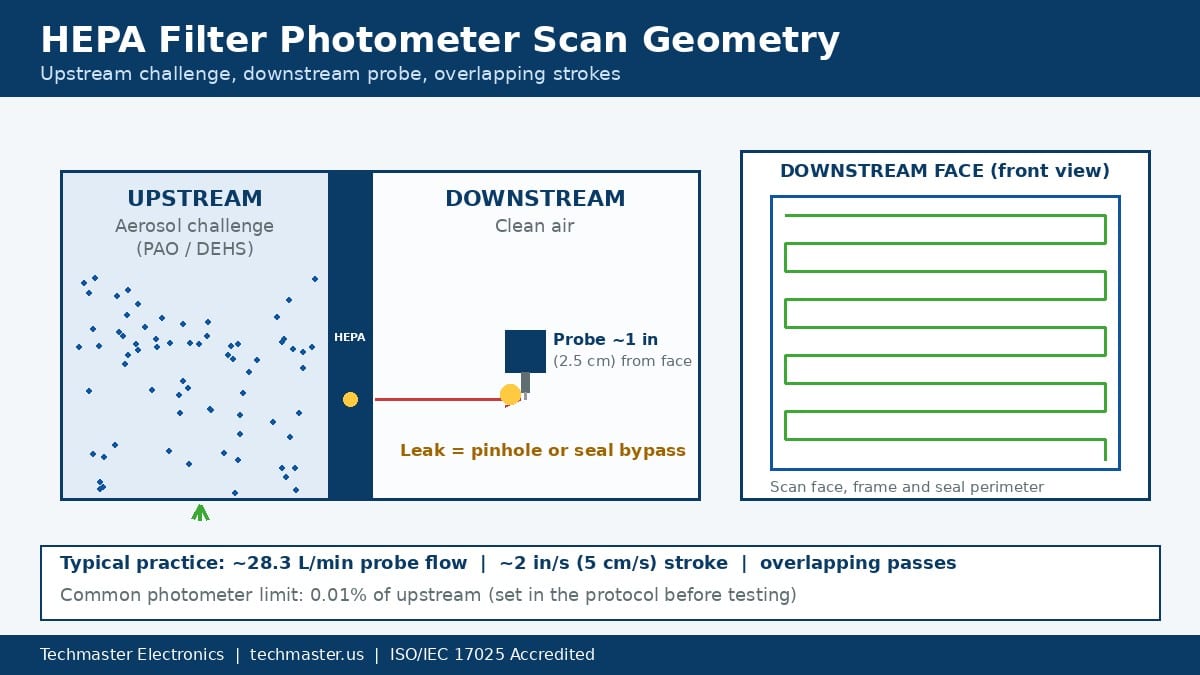
The photometer is a light-scattering instrument that reports concentration as a percentage of a reference upstream value. It handles a dense polydisperse challenge aerosol and responds quickly to a leak while the probe moves. A discrete particle counter counts individual particles, so it needs a much lighter challenge to avoid saturating the optics, and it needs a long enough sample to be statistically meaningful at each position.
| Factor | Aerosol photometer | Discrete particle counter |
|---|---|---|
| Typical filters | HEPA (H13, H14) | ULPA (U15 and higher) and very high efficiency media |
| Output | Percent of upstream concentration | Particle counts and local penetration |
| Challenge aerosol | Dense PAO or DEHS, set by upstream reference | Light, diluted challenge with dilution system |
| Scan speed | Fast; reads continuously | Slower; sampling time limits speed |
| Main risk | Contaminating a very clean filter with oil mist | Counter saturation and poor statistics at low counts |
| Instrument verification | Reference zero, 100% upstream, linearity | Counting efficiency, zero count, flow rate |
Whichever instrument you choose, it must carry a current calibration with traceability, and that is a documentation point auditors check. Techmaster does not calibrate particle counters, so confirm that your photometer or counter has a valid calibration from its manufacturer or an authorized service provider before it enters the cleanroom. For related instrument questions, see our guide to the handheld particle counter for cleanroom and semiconductor work.
How is the filter scan performed?
The procedure follows a repeatable sequence that a good protocol writes down step by step:
- Verify the instrument. Record the photometer calibration status, check zero with a clean-air filter and confirm the reference scale.
- Confirm the airflow. The filter should run at design face velocity, because leaks behave differently at low flow. Airflow readings come from a calibrated instrument; see our post on airflow meter calibration for why that reading matters.
- Introduce the challenge. Generate the aerosol upstream of the filter bank and wait for it to mix evenly.
- Take the upstream reference. Sample upstream and set the photometer to read 100% on that concentration.
- Scan downstream. Sweep the probe across the face in overlapping passes, then along the entire perimeter frame and seal. A photometer reading is the percent of upstream, so any spike is directly comparable to the limit.
- Log and mark. Record every position above the limit, mark it, and repeat the scan on that spot to confirm it is a true leak and not a transient.
The probe is the part people skip. An isokinetic-style probe sampling at the standard sample flow of about 28.3 L/min (1 cfm) is typical for a photometer. A probe held too far away smears a leak into the surrounding air, so the same hole reads lower. A probe moved too fast skips pinholes. Those two habits cause most false passes.
What leak limit decides pass or fail?
A reading of 0.01% means one ten-thousandth of the challenge is passing through that spot. If the upstream reference is set to 100%, a leak limit of 0.01% is a display reading of 0.01. An H14 filter (99.995% efficient at its most penetrating particle size) allows about 0.005% penetration across the face, so a local 0.01% reading is already above what a healthy H14 media pack should deliver in one spot. The local-leak limit applies per spot whatever the filter grade, because it is a leak limit, not the overall efficiency of the filter.
Different contracts, standards and customer specifications set different limits, so write the limit into the protocol rather than relying on habit. Where the specification is silent, 0.01% is the number most certifiers and quality managers treat as the working default for photometer scanning of HEPA filters.
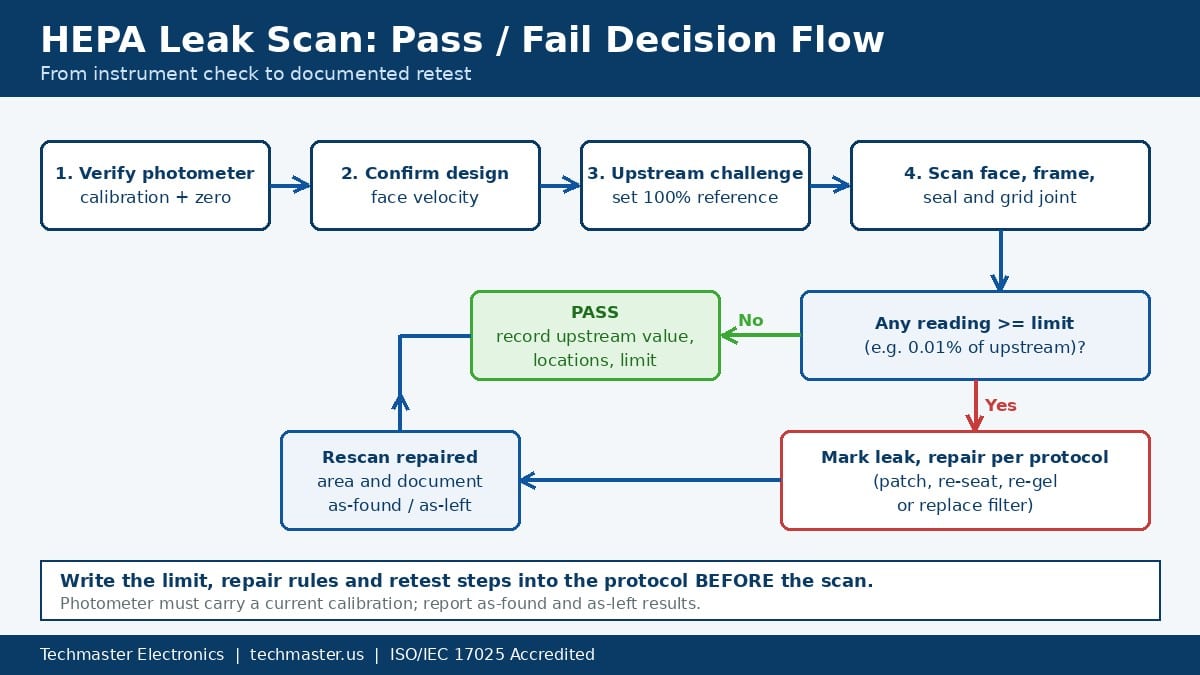
When a leak is found, the corrective path is also written in advance. Small media pinholes can often be sealed with a compatible silicone patch if the protocol allows it, frame leaks may be fixed by re-seating or re-gelling the seal, and a filter with damage beyond the repair rules is replaced. After any repair, the repaired area is rescanned to confirm it now passes, and the result is documented with the original failure.
How do you set the upstream aerosol challenge?
The upstream concentration sets the sensitivity of the entire test. A challenge that is too low leaves a real leak below the photometer noise floor, so the scan passes a filter that does not deserve to pass. A challenge that is too high wastes aerosol and can load a filter. For that reason the protocol records the upstream concentration, the generator type and the time allowed for mixing, and the report states the number rather than just the word pass.
Uniformity matters too. If the aerosol is stratified, a filter in a poorly mixed corner sees less challenge, and the same pinhole produces a smaller reading. Introduce the aerosol far enough upstream, allow mixing time, and sample at representative upstream ports. Filters in ductwork or terminal housings with a dedicated upstream test port are far easier to certify than ceiling modules that require improvised access, which is a point to raise early with facility engineers.
How often should HEPA filters be leak tested?
The interval depends on the application, not only the ISO class. Facilities working under USP <797> recertify controlled air environments every six months, and that certification routinely includes a filter leak test. Aseptic manufacturers often run their own schedule from a documented risk assessment. A semiconductor or electronics cleanroom with stable operations may follow the longer interval.
| Trigger | Leak test needed? | Reason |
|---|---|---|
| New installation or commissioning | Yes | Baseline proof the filter and seal were installed intact |
| Filter replaced or housing opened | Yes | Disturbed seal and media |
| Ceiling or structural work above the room | Yes | Vibration and dust can break seals |
| Scheduled recertification | Yes | Standard interval or risk-based schedule |
| Unexplained rise in particle counts | Yes | Rule out a filter leak before chasing other causes |
The leak test also sits next to other certification tests: airflow velocity, pressure differentials, and recovery. If you are building a full certification plan, our posts on the cleanroom recovery test in ISO 14644-3 and differential pressure sensor calibration cover the neighboring measurements.
Why do installed HEPA filters fail?
| Failure mode | Typical location | Usual action |
|---|---|---|
| Gasket or seal bypass | Perimeter between frame and grid | Re-seat, replace gasket, tighten clamps |
| Media pinhole | Face of the pleat pack | Patch per protocol or replace filter |
| Media-to-frame leak | Where the pack meets the frame | Per protocol; often replace the filter |
| Gel channel disturbed | Knife-edge filter seal | Re-gel or re-seat the filter |
| Housing or ceiling leak | Grid joints, light fixtures, penetrations | Seal with approved material, then rescan |
Not every positive reading is the filter. A leak at a ceiling light fixture or sprinkler penetration is a room construction defect, and replacing the filter will not fix it. A good certifier documents the location precisely so facilities can send the right trade, and recertifies the spot after the fix.
What should you ask a certifier before the test?
Before you accept a cleanroom certification, check five things. First, the standards cited should be named, not just implied. Second, the accreditation should be current and verifiable: Techmaster holds ISO/IEC 17025 accreditation from ANAB (certificate AC-1736), and our accreditation page shows what is covered. Third, the photometer should have a calibration that traces to national standards. Fourth, the report should include upstream concentration, scan limit and every flagged location. Fifth, it should define who may repair a leak and who must witness the rescan.
Techmaster is an ISO/IEC 17025 accredited laboratory founded in 1989, and our cleanroom certification services cover HEPA and ULPA integrity testing, airflow, pressure and recovery; see our accreditation page for the exact accredited scope. You can review the discipline on our clean room calibration and certification page and the broader environmental testing services hub. For the outside references, the ISO 14644-1 classification standard, the eCFR text of 21 CFR 211.42 and ANAB are the primary sources.
The same discipline applies to containment devices. A biosafety cabinet has its own HEPA filter and its own scan, covered in our post on biological safety cabinet certification.
Key Takeaways
- An installed HEPA filter leak test is a separate pass/fail verification from the room particle count and cannot be replaced by it.
- Photometer scanning suits most HEPA filters; ULPA filters usually need a discrete particle counter method.
- The common photometer limit is 0.01% of upstream concentration, but the limit must be written in the protocol before testing.
- Probe distance and scan speed cause most false passes: stay near one inch and roughly 2 inches per second.
- Document upstream concentration, aerosol type, instrument calibration, flagged locations, repairs and the rescan.
- Retest after every filter change, housing disturbance or unexplained rise in particle counts.
Frequently asked questions
What is the difference between a HEPA leak test and a particle count?
A particle count measures how clean the room air is at the sampling points on the day of the test. A HEPA leak test checks the installed filter and seal itself by challenging it with aerosol and scanning the downstream face. A room can pass a count while a filter leak still exists.
What is a DOP or PAO test?
DOP and PAO are names for the challenge aerosol used in a HEPA leak test. DOP (dioctyl phthalate) was the traditional oil, while PAO (polyalphaolefin) and DEHS are the common replacements today. The aerosol is generated upstream so a photometer can detect any penetration downstream.
What is an acceptable HEPA filter leak percentage?
For photometer scanning, a local leak of 0.01% of the upstream concentration is the common acceptance limit. A reading above that value is treated as a failed leak. The limit should be stated in the written protocol before the test starts, since some customers and standards specify stricter values.
Can a leaking HEPA filter be repaired instead of replaced?
Often yes, when the protocol allows it. Small pinholes in the media can sometimes be sealed with a compatible silicone patch, and frame or gasket leaks may be fixed by re-seating or re-gelling the filter. The repaired spot must be rescanned and pass. Damage beyond the repair rules means replacing the filter.
Do I need a calibrated photometer for the test?
Yes. The photometer must have a current calibration, and the report should reference it. Techmaster does not calibrate particle counters, so confirm your instrument calibration with the manufacturer or an authorized service provider before testing. Auditors commonly ask for the certificate during review of cleanroom certification records.
How often does a cleanroom need HEPA filter leak testing?
Test at commissioning, after any filter change or housing disturbance, and on a schedule set by your standard and risk assessment. ISO 14644-2:2015 lists 24 months as the maximum interval for installed filter leakage testing, an optional test in its schedule, while compounding and aseptic sites often certify every 6 to 12 months.
Need a documented HEPA filter leak test?
Techmaster Electronics is an ISO/IEC 17025 accredited laboratory (ANAB certificate AC-1736) serving the United States since 1989. Tell us your cleanroom class, filter count and standard, and we will quote the certification scope.
Request a Cleanroom Certification Quote
Khanh Nguyen is the Marketing Manager at Techmaster Electronics, a B2B marketing leader covering the test, measurement, and ISO/IEC 17025 accredited calibration industry in the United States.