
Airflow Meter Calibration
Why calibration intervals matter
How Airflow Meter calibration works
- Intake & visual inspection
- Environmental stabilization
- As-found measurement
- Comparison to NIST-traceable standards
- Adjustment if required
- As-left results & certificate
Your calibration, covered
In-lab vs on-site calibration
In-lab calibration
- Lab bench with full reference standards
- Best achievable measurement uncertainties
- Pickup & return logistics handled
- Ideal for precision and reference work
On-site calibration
- We calibrate the Airflow Meter at your facility
- No shipping risk or transit downtime
- As-found data captured before any move
- Ideal for fixed, large or sensitive assets
In-depth guide
Imagine a pharmaceutical cleanroom where the ventilation fails by just 5%, or a high-tech laboratory where toxic fumes aren’t being properly evacuated. In these environments, an airflow meter isn’t just a tool; it is a guardian of safety and quality. However, even the most sophisticated sensors drift over time. This is where airflow meter calibration becomes the backbone of your operational integrity.
If you are searching for anemometer calibration services, you likely understand that “close enough” is never enough. Whether you are managing HVAC systems, industrial exhaust, or aerospace wind tunnels, maintaining NIST traceable airflow calibration ensures your data is defensible, your systems are efficient, and your facility remains compliant with global standards.
What is an Airflow Meter? Applications and Importance
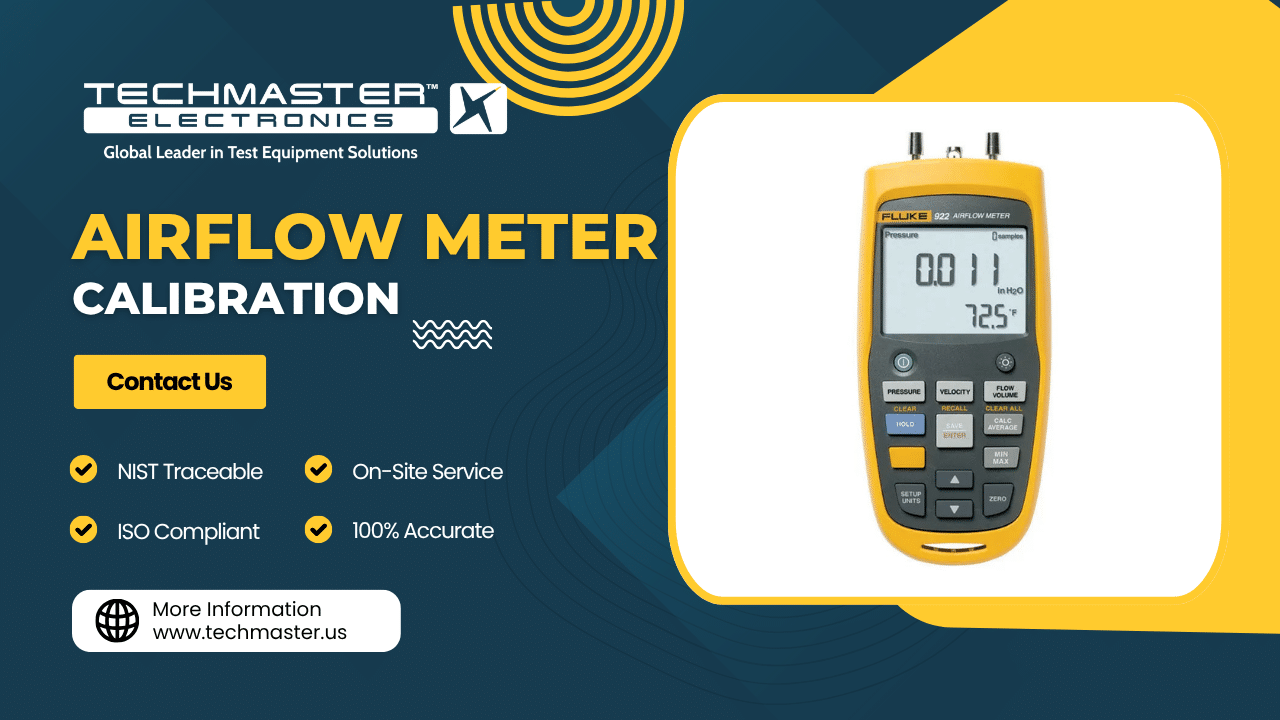
An airflow meter (often referred to as an anemometer) measures the velocity or volume of air moving through a specific area. These devices range from simple handheld vanes used by HVAC technicians to complex thermal mass flow meters integrated into automated industrial processes.
Core Applications:
-
HVAC/R Systems: Balancing air distribution to ensure occupant comfort and energy efficiency.
-
Cleanrooms & Laboratories: Maintaining precise pressure differentials to prevent contamination.
-
Environmental Monitoring: Tracking wind speeds for weather stations and safety assessments.
-
Automotive & Aerospace: Testing aerodynamics and engine air intake performance.
Without regular on-site airflow calibration laboratory checks, these devices can provide “ghost readings”, data that looks correct on a screen but fails to reflect reality.
The Science of Precision: Airflow Meter Calibration Explained
Calibration is the process of comparing the readings of your device against a “master” instrument with a known, higher level of accuracy. To achieve true reliability, this master instrument must be part of an unbroken chain of comparisons back to a national standard, this is what we call NIST traceable airflow calibration.
Why NIST Traceability Matters
NIST-traceable calibration ensures your measurements align with global benchmarks and provides defensible data for audits.
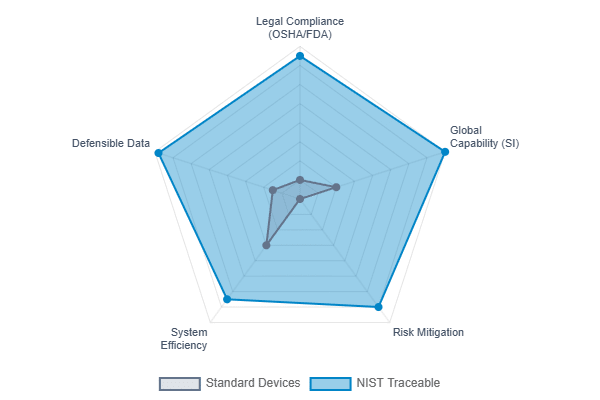
The National Institute of Standards and Technology (NIST) sets the benchmark for measurement in the United States. When you utilize anemometer calibration services that are NIST-traceable, you gain:
-
Legal Compliance: Essential for OSHA, FDA, and ISO audits.
-
Global Compatibility: Ensures your measurements align with international SI units.
-
Risk Mitigation: Protects your business from the liability of inaccurate environmental data.
On-Site vs. Laboratory Calibration: Choosing the Right Path
Depending on your industry, you may choose between shipping your gear to a fixed facility or hosting an on-site airflow calibration laboratory team.
1. In-Laboratory Calibration
This takes place in a controlled environment where variables like humidity, ambient temperature, and vibration are strictly managed. It is ideal for high-precision instruments that require the lowest possible measurement uncertainty.
2. On-Site Airflow Calibration
For many facilities, downtime is not an option. On-site services bring the “lab” to you.
-
Minimal Downtime: No shipping delays or risks of transit damage.
-
In-Situ Testing: Technicians can sometimes test the meter within its actual working environment, accounting for local turbulence or duct configurations.
Step-by-Step: The Calibration Process
Step-by-Step Calibration Sequence
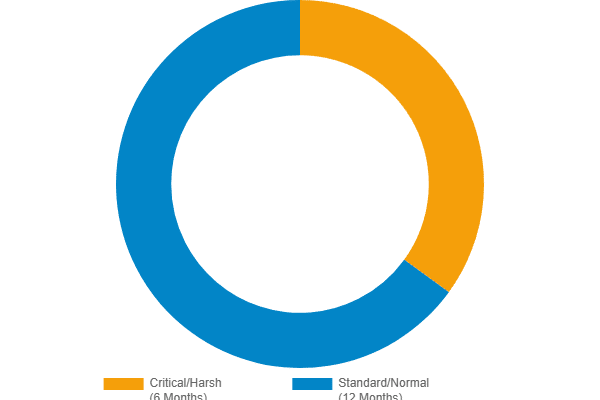
Recommended Intervals
Calibration frequency depends on the criticality of your specific environment.
A professional calibration service doesn’t just “check” a box. It involves a rigorous technical sequence:
-
As-Found Testing: Recording the device’s accuracy before any adjustments.
-
Cleaning & Inspection: Ensuring sensors are free from dust or corrosion that could skew results.
-
Adjustment: Fine-tuning the internal electronics or software to align with the reference standard.
-
As-Left Testing: A final verification to confirm the device meets its specified tolerance.
-
Certification: Issuing a detailed report containing the measurement data, uncertainty values, and traceability statements.
The Role of ISO/IEC 17025 in Airflow Calibration
Achieving high-accuracy airflow meter calibration requires more than just a reference standard; it demands a rigorous quality management system. ISO/IEC 17025 accreditation ensures that a laboratory possesses the technical competence to produce valid results, specifically regarding measurement uncertainty and NIST traceability. For laboratory managers and engineers, selecting an accredited facility is crucial for maintaining compliance with global safety standards and ensuring that critical HVAC or cleanroom measurements remain within strict legal tolerances. Adhering to these rigorous calibration standards guarantees that your airflow sensors provide the high-level precision necessary for critical industrial operations.
FAQ: Common Questions About Airflow Measurement
1. How often should I calibrate my airflow meter?
A: Most manufacturers recommend an annual interval. However, if the device is used in harsh industrial environments or for critical safety monitoring, a 6-month cycle may be necessary.
2. Can I calibrate my anemometer myself?
A: While some devices have “zeroing” functions, true calibration requires specialized wind tunnels or flow calibrators that are themselves calibrated to NIST standards. Self-calibration usually lacks the traceability required for professional audits.
3. What is the difference between velocity and volumetric flow?
A: Velocity is the speed of air (e.g., feet per minute), while volumetric flow is the amount of air moving through a space (e.g., cubic feet per minute). Calibration must account for the specific parameter your process relies on.
4. Where can I get a NIST traceable calibration for my airflow sensor?
You can obtain NIST traceable calibration at ISO/IEC 17025 accredited laboratories. These facilities use reference standards directly linked to the National Institute of Standards and Technology (NIST). Ensure the provider issues a formal certificate of calibration documenting the unbroken chain of traceability for your specific sensor model.
5. What is the difference between factory and accredited airflow calibration?
Factory calibration typically ensures a device meets the manufacturer’s internal specifications using their own benchmarks. Accredited calibration (e.g., ISO 17025) is performed by an independent, audited lab and includes a rigorous assessment of measurement uncertainty, global recognition of results, and verified traceability to international standards.
6. How often should an industrial airflow meter be recalibrated for ISO compliance?
For standard ISO compliance, industrial airflow meters are typically recalibrated annually (every 12 months). However, frequency should be adjusted based on usage intensity, environmental harshness, and historical stability. Critical applications or high-precision cleanroom environments may require a 6-month interval to maintain accuracy.
7. Best lab for anemometer calibration with fast turnaround time?
The best lab for fast turnaround is one that offers expedited on-site calibration or a guaranteed 3-5 day in-lab service. Look for providers with an extensive scope of accreditation (ISO 17025) and dedicated wind tunnel facilities to ensure speed doesn’t compromise technical precision.
Conclusion: Investing in Accuracy
In industrial measurement, your decisions are only as good as your data. Airflow meter calibration is not merely a maintenance task; it is an investment in the longevity of your equipment and the safety of your environment. By partnering with a provider that offers NIST traceable airflow calibration, you ensure that every reading is a fact, not a guess.
Ready to verify your accuracy? Don’t let sensor drift compromise your operations. Contact our expert team today to schedule your on-site airflow calibration and experience the confidence that comes with professional certification.
Frequently asked questions
What is Airflow Meter Calibration?
How often should a Airflow Meter be calibrated?
What standards apply to Airflow Meter Calibration?
What is included on the certificate?
Can you calibrate the Airflow Meter on-site?
Need Airflow Meter calibration?
NIST-traceable calibration, fast turnaround, in-lab or on-site across the USA.
Contact us for a quoteReferences & industry standards
- ISO/IEC 17025 testing & calibration laboratory requirements
- NIST calibration services and measurement traceability
- NIST RF electromagnetics metrology
- A2LA / ANAB accreditation for calibration laboratories
External standards bodies. Techmaster Electronics is an ISO/IEC 17025-accredited, NIST-traceable calibration laboratory.

Khanh Nguyen is the Marketing Manager at Techmaster Electronics, a B2B marketing leader covering the test, measurement, and ISO/IEC 17025 accredited calibration industry in the United States.