
A Class II biological safety cabinet protects three things at once: the operator, the product and the environment. It does that with a carefully balanced curtain of inflow air at the front, HEPA-filtered downflow over the work surface and filtered exhaust. If any one of those drifts, the cabinet can look and sound normal while it no longer protects anything.
Biological safety cabinet certification checks each of those airflows and the filters against NSF/ANSI 49, and records the results for your biosafety program.
The field tests in NSF/ANSI 49
| Test | What it checks |
|---|---|
| Inflow velocity | Air entering through the front opening, which keeps aerosols inside the cabinet and protects the operator |
| Downflow velocity | The filtered air moving down over the work surface, which protects the product; measured on a grid and checked for uniformity |
| HEPA filter leak test | An aerosol challenge upstream of the supply and exhaust filters, scanned with a photometer to find leaks in the media, seals or frame |
| Airflow smoke pattern | Smoke shows that air at the front opening moves into the cabinet and does not escape or reflux onto the work surface |
| Site installation checks | Exhaust connection, alarms and the cabinet’s position relative to doors and supply diffusers |
When certification is required
The CDC/NIH guidance in Biosafety in Microbiological and Biomedical Laboratories (BMBL) calls for Class II cabinets to be certified when they are installed, at least once a year after that, and whenever they are moved or repaired. Moving a cabinet, even across the same room, can damage filter seals and change the airflow balance. Replacing a filter or motor always calls for recertification before use.
Cabinet class and type matter
Class II cabinets come in several types. A1 and A2 cabinets recirculate most of their air and exhaust the rest, while B1 and B2 cabinets are hard-ducted to the building exhaust. The type changes what the test has to confirm. For a B2 cabinet, for example, the building exhaust must be proven to carry the full exhaust load, and the cabinet alarm must respond if it fails. The certification report should name the cabinet’s class, type and the acceptance values used.
Preparing for certification
- Decontaminate the cabinet if filters or internal panels will be accessed, and provide the decontamination record.
- Remove stored equipment and materials from the work area.
- Have the manufacturer’s nominal inflow and downflow values available, along with the previous report.
- Plan for the cabinet to be out of use during testing.
Related containment testing
Cabinets are often certified on the same visit as fume hoods and cleanroom spaces. See fume hood testing and cleanroom testing and certification.
Accreditation and certificates
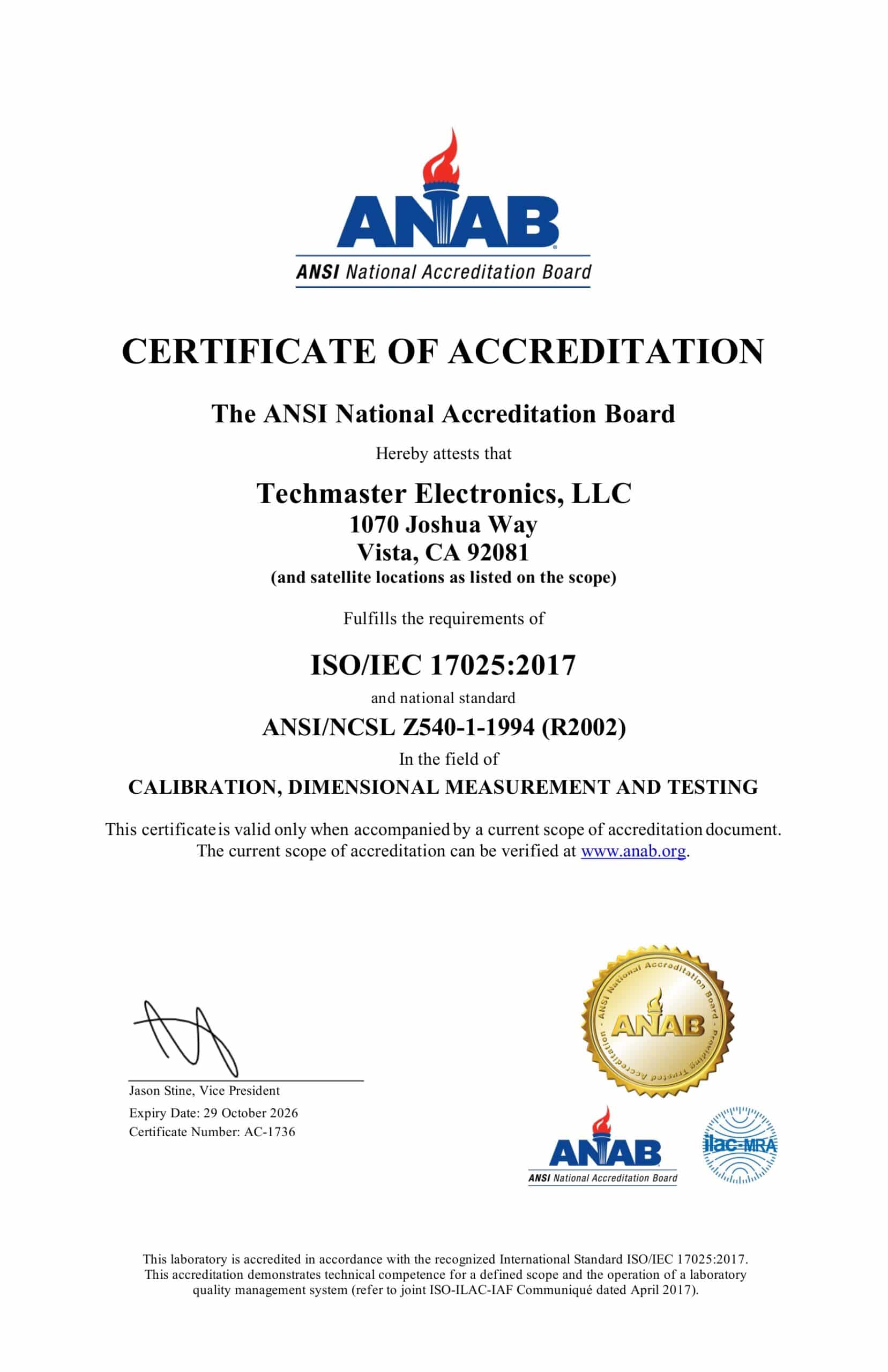
Biological safety cabinet field testing to NSF/ANSI 49 is on Techmaster’s ANAB ISO/IEC 17025 scope (certificate AC-1736), so certificates carry the ANAB accreditation symbol along with as-found and as-left data and measurement uncertainty.
Biosafety Cabinet Certification Requirements
Certification requirements for Class II biosafety cabinets come from a few sources that labs usually combine:
- NSF/ANSI 49 defines the cabinet design standard and the field test methods: inflow and downflow velocity, HEPA filter leak testing, smoke patterns and site installation checks.
- BMBL (CDC/NIH) calls for certification at installation, at least annually, and after the cabinet is moved or repaired.
- Your institutional biosafety committee or quality system may add requirements, such as certification after every filter change or more frequent checks for BSL-3 work.
- Accreditation and inspection bodies for clinical and research labs expect to see the current certification report and a dated label on the cabinet.
Who can certify a biosafety cabinet?
NSF International runs an accreditation program for biosafety cabinet field certifiers, which tests individual technicians on the NSF/ANSI 49 field methods. Some institutions require an NSF-accredited field certifier, and others accept qualified technicians working to the standard under an accredited quality system. Check your own biosafety policy before booking, and ask any provider which credentials their technicians hold for your cabinets.
What the certification report should contain
- Cabinet manufacturer, model, serial number, class and type.
- Measured inflow and downflow velocities with the acceptance values, and the method used.
- HEPA filter leak scan results for supply and exhaust filters.
- Smoke pattern and alarm test results, and any corrective work.
- The identity and calibration status of the test instruments, such as the thermal anemometer and aerosol photometer.
Keep the report with the cabinet’s records and make sure the label on the cabinet matches it. A missing or expired label is one of the most common findings in biosafety inspections.
Frequently asked questions
How often does a biological safety cabinet need certification?
What tests are part of BSC certification?
What is the difference between Class II A2 and B2 cabinets?
Is Techmaster's BSC certification accredited?
Related calibration guides
References & industry standards
- ISO/IEC 17025 testing & calibration laboratory requirements
- NIST calibration services and measurement traceability
- A2LA / ANAB accreditation for calibration laboratories
External standards bodies. Techmaster Electronics is an ISO/IEC 17025-accredited, NIST-traceable calibration laboratory.
Accredited calibration at Techmaster
Techmaster Electronics is an ANAB-accredited (Certificate AC-1736) ISO/IEC 17025:2017 calibration laboratory with five US labs, NIST-traceable standards and a full measurement-uncertainty budget on every certificate — in-lab or nationwide on-site, with 5-business-day standard turnaround and expedite options. See our calibration services or request a quote.

Khanh Nguyen is the Marketing Manager at Techmaster Electronics, a B2B marketing leader covering the test, measurement, and ISO/IEC 17025 accredited calibration industry in the United States.