
The recall report shows nine digital multimeters due in March. Production says it cannot lose nine meters at once, so someone suggests pushing half the due dates into April. That is the moment many quality managers find out that nobody has ever sized the spare pool. The plant owns whatever spares it happened to buy, and calibration downtime gets handled with overdue labels and favors.
This guide gives a simple way to work out how many spare instruments a fleet needs to cover calibration downtime, how staggered recall changes the answer, how much to hold back for units that come back out of tolerance, and when test equipment rental is cheaper and cleaner than owning another unit. Founded in 1989, Techmaster Electronics calibrates, sells and rents test equipment in the United States. We are an ISO/IEC 17025 calibration laboratory accredited by ANAB under Certificate AC-1736, with accredited laboratories in Vista and Santa Clara, California, Orlando, Florida, and San Antonio, Texas.
What counts as calibration downtime?
When people plan spares, they tend to use the lab’s quoted turnaround. That number covers the time the instrument spends at the lab. Your production line sees a longer gap. A typical in-lab calibration has seven stages:
- Pull and pack: the instrument is taken out of use, tagged, boxed with its accessories and logged out.
- Ship to the lab: ground freight across states can take several days.
- Queue: the instrument waits for a bench and a qualified technician.
- Bench time: as-found measurements, adjustment if needed and as-left measurements. Minutes for a handheld meter, hours for a multi-port network analyzer.
- Adjustment or repair loop: only for some units, but it is the stage that turns a one-week absence into a three-week one, because a repair needs a quote and your approval.
- Ship back.
- Receive and release: your team reviews the certificate, checks the results against your tolerances and updates the recall record before the instrument goes back on the line.
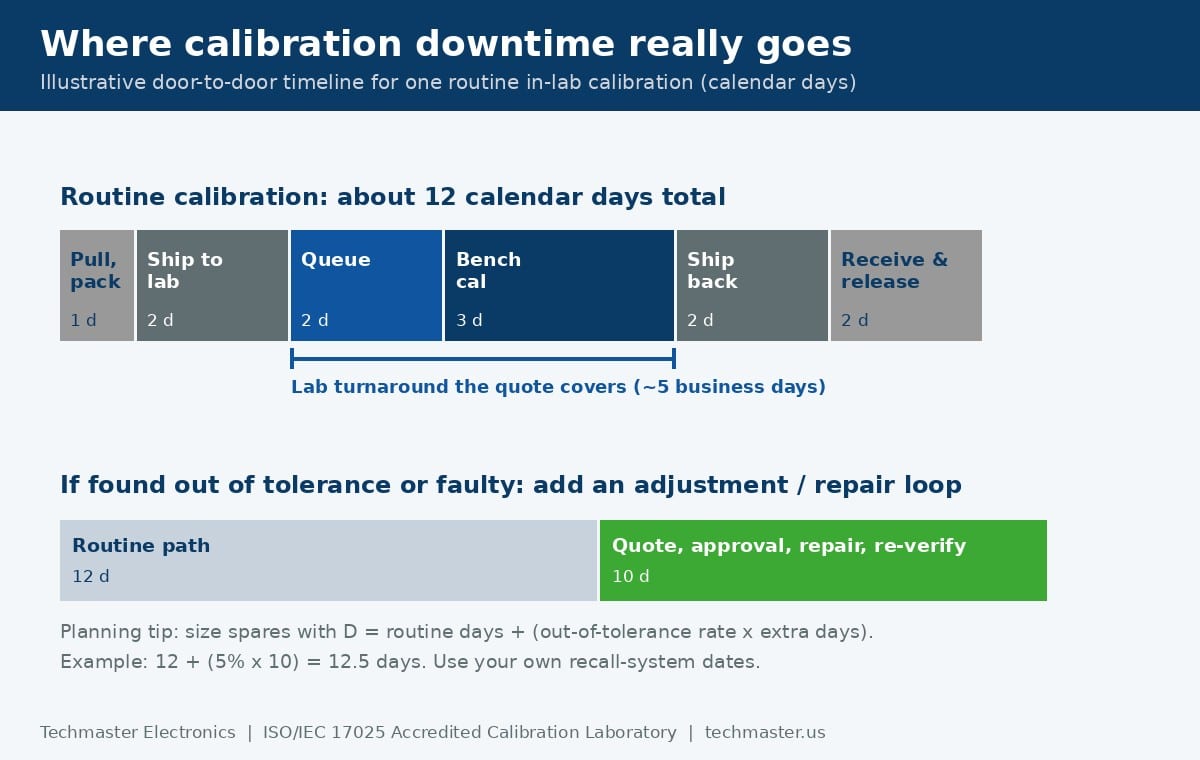
Techmaster’s published standard in-lab turnaround is 5 business days, with 1 to 2 day expedite available, as described in our guide to calibration turnaround times and how to cut downtime. Five business days at the lab is about seven calendar days. Add two shipping legs and an internal receiving step and a realistic planning figure for a routine calibration is 10 to 14 calendar days door to door. Measure your own number from the dates in your recall system, because that is the figure that belongs in the sizing formula below.
How many spare instruments do you need to cover calibration downtime?
The average is a direct use of Little’s law from queueing theory: the number of items in a system equals the rate they arrive multiplied by the time each one spends there. Each instrument leaves once per interval and stays away for the downtime, so:
Average units out = N × D ÷ I, where N is the number of instruments of that type, D is downtime in calendar days and I is the calibration interval in days.
The average is not the number of spares to buy. On some days you will have none out and on others you will have three. If due dates are spread evenly through the year, each unit is away on any given day with probability D ÷ I, and the count of units out follows a binomial distribution. That lets you choose a coverage level, such as “enough spares for 95% of working days”, and read off the number.
Two rules make the result usable:
- Size by interchangeable group, not by asset list. A spare covers only instruments it can replace on the same measurement. Ten bench meters and thirty handheld meters are two pools, not one.
- Use your real downtime. If your recall data shows instruments are typically away for 18 days, use 18. A short planning figure is the main reason spare pools come up short.
What does spare pool sizing look like for real fleets?
The table uses the formula above and a binomial distribution, assuming due dates are spread evenly and the downtime figures shown. Change the inputs to match your own records.
| Instrument group | Fleet (N) | Interval (I) | Downtime (D) | Average out | Spares for 95% of days | Spares for 99% of days |
|---|---|---|---|---|---|---|
| Handheld digital multimeters | 40 | 365 days | 12 days | 1.3 | 3 | 4 |
| Handheld digital multimeters, larger site | 120 | 365 days | 12 days | 3.9 | 7 | 9 |
| Click-type torque wrenches | 25 | 365 days | 10 days | 0.7 | 2 | 3 |
| Click-type torque wrenches, 6-month interval | 25 | 182 days | 10 days | 1.4 | 3 | 5 |
| Bench oscilloscopes | 6 | 365 days | 14 days | 0.2 | 1 | 2 |
| Spectrum analyzer | 1 | 365 days | 14 days | 0.04 | 0 (rent for the gap) | 1 |
Illustrative inputs, not customer data. “Spares for 95% of days” is the smallest number of spares that covers the units out on at least 95% of days under a binomial model with probability D ÷ I per unit. Evenly spread due dates make the real count steadier than this model, so the figures lean slightly conservative.
Three patterns stand out. First, halving the interval doubles the average units out, so a decision to shorten torque wrench intervals from 12 to 6 months is also a decision to hold more spares. Second, pools grow more slowly than fleets: tripling the multimeter fleet from 40 to 120 raises the 95% spare count from 3 to 7, not to 9. Third, small groups are dominated by rounding. For one or two units of a model, the choice is really between owning a whole extra instrument and renting one for two weeks a year.
Our own records show where the large interchangeable pools sit. In Techmaster’s 10-year history of 381,916 calibrations, digital and true RMS multimeters account for 7,713 calibrations, torque wrenches 4,269, DC power supplies 3,228 and oscilloscopes 2,732, while spectrum analyzers account for 815 and network analyzers 595. These are counts of calibrations, not fleet sizes, but they match what we see: general-purpose electrical and mechanical tools are owned in numbers that justify a spare pool, while high-value RF instruments are owned one or two at a time.
Why does sending the whole fleet at once break the math?
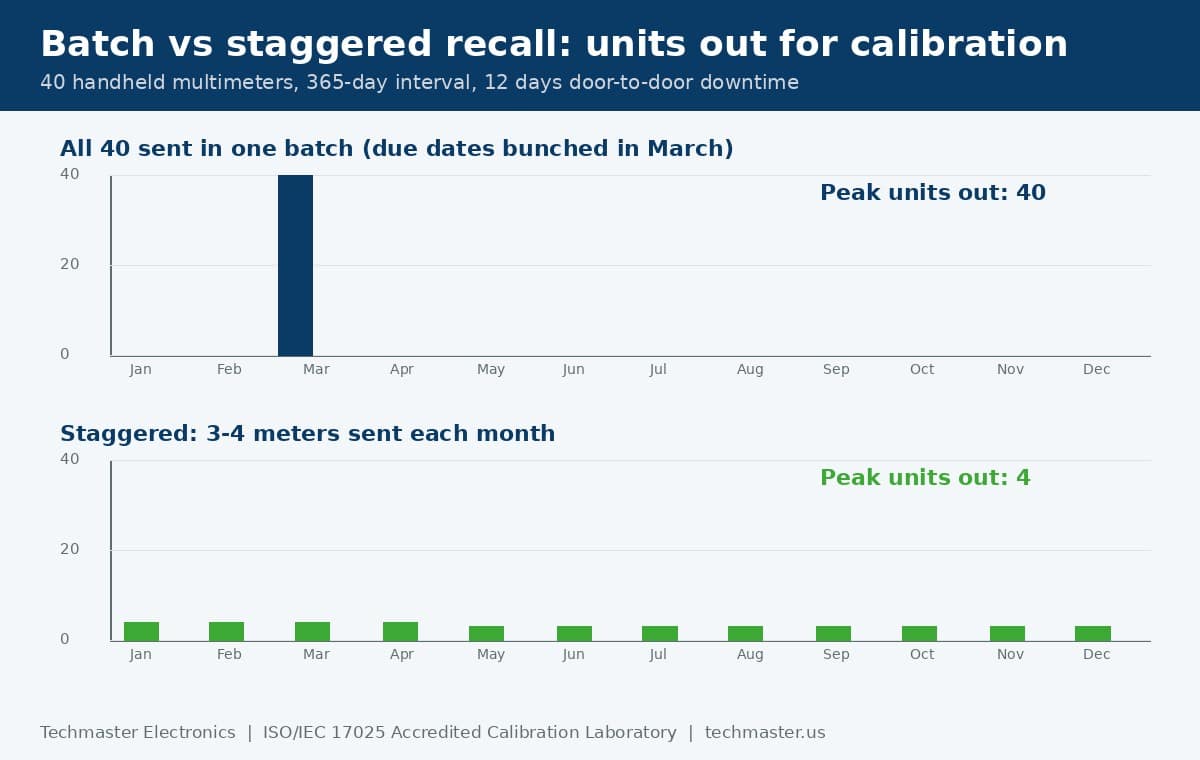
Batch due dates are common. They come from a single capital purchase, a site move, a new contract that brought in a set of instruments, or a past decision to send everything during a shutdown. With 40 meters due in the same week, the peak is 40 units out for about 12 days, and no realistic spare pool covers that.
The fix is to spread the due dates, and the safe direction is earlier. Calibrating some units a few weeks or months early shortens their first interval and moves them into a different month for every cycle after. Pushing due dates later is a different matter: an instrument used past its due date is an overdue instrument, and your procedure has to say what happens then. Our guide to overdue calibration, grace periods and impact assessment covers that case.
A practical staggering plan:
- Split each interchangeable group into 4 to 12 batches, one per month or quarter.
- Pull the first batches forward and calibrate them early. The extra cost is a few months of interval, once.
- Keep planned shutdowns for the instruments you cannot release at all during production, such as fixtured or integrated test systems.
- Record the new due dates in your calibration recall system so the stagger holds.
Shifting due dates earlier does not change the interval itself. Intervals should still come from evidence, as described in ILAC G24:2022, Guidelines for the determination of recalibration intervals of measuring equipment, and in our guide on how to set calibration intervals with ILAC G24.
How much buffer should you hold for out-of-tolerance returns?
Write downtime as D = routine days + (out-of-tolerance rate × extra days). With 12 routine days, a 5% rate and 10 extra days, D becomes 12.5. For the 40-meter fleet in the table, the 95% spare count stays at 3, but the 99% count rises from 4 to 5. The average hardly changes; the bad weeks get worse.
Use your own as-found history to set the rate. A group with frequent out-of-tolerance results also needs an impact assessment each time: ISO 9001:2015 clause 7.1.5.2 asks you to determine whether the validity of earlier results was affected when equipment is found unfit for its purpose. See ISO 9001:2015 on iso.org. That assessment takes engineering time while the unit is away, which is one more reason to keep the spare pool sized for the tail.
Two ways to shorten the out-of-tolerance loop:
- Pre-approve a repair limit on the purchase order, so a repair under a set amount does not stop and wait for a quote approval.
- Ask for as-found data on every certificate, so the impact assessment can start the day the certificate arrives. Our article on as-found vs as-left calibration data explains what to look for.
When should you rent test equipment instead of owning a spare?
An owned spare is a full instrument on your books. It has a purchase price, a calibration cost every interval, storage and a recall record, and for a one-unit group it sits unused about 96% of the year. For a model you own in large numbers, that idle time is shared across the pool and the spare earns its keep. For a single vector network analyzer or spectrum analyzer, it usually does not.
| Situation | Better choice | Why |
|---|---|---|
| Large interchangeable group (DMMs, torque tools, gauges) | Own a spare pool | Several units are out at once on many days, so spares are used often. |
| One or two units of a high-value model | Rent for the calibration window | The spare would be idle more than 90% of the year and need its own calibration. |
| Annual shutdown when everything goes out together | Rent for the shutdown, stagger the rest | A one-time peak is cheaper to rent than to own. |
| Unit out for an open-ended repair | Rent until the repair is decided | Repair time is uncertain and may end in replacement. |
| Spare would need different software, fixtures or firmware | Own the identical model, or rent the same model | A substitute that is not equivalent creates a new validation task. |
For the cost side, our rent vs buy test equipment break-even analysis includes calibration cost in the comparison. Techmaster’s sales and rentals of calibrated test equipment cover 10 equipment categories, including electrical test equipment such as multimeters, power supplies and oscilloscopes and RF and microwave test equipment such as spectrum and network analyzers. When you rent to cover a calibration gap, ask for the rental unit’s certificate to be in date for the whole rental term.
What must you check before a spare or rental goes into production?
Spare test equipment that sat on a shelf for eleven months, or a rental that arrived yesterday, is new to the process. Before it takes the place of a unit out for calibration, check:
- Equivalent capability. Same model, or one whose specifications meet or beat the original on the ranges and functions used. Check the test uncertainty ratio if your acceptance limits are tight.
- Calibration status. The certificate is current, will stay current for the time the unit will be used, and covers the ranges you need. A limited calibration may not.
- Software and fixtures. Automated test programs, drivers, firmware and fixtures work with the substitute. A different firmware revision can change remote command behavior.
- Measurement system impact. If the measurement is part of a gage R&R study or a validated process, decide whether the substitute needs its own study.
- Records. The spare’s ID is recorded against the measurements it makes, so a later out-of-tolerance finding can be traced to the right results.
The clause reference is from ISO/IEC 17025:2017, General requirements for the competence of testing and calibration laboratories. Our checklist for calibration of used or rented test equipment on arrival covers the incoming check in more detail.
How does Techmaster Electronics help keep a fleet in service?
- Accredited calibration: ISO/IEC 17025 accredited calibration services across 12 disciplines, including electrical calibration of multimeters, power supplies and oscilloscopes. Check the parameters and ranges on our ANAB accreditation and scope.
- Accredited laboratories: Vista and Santa Clara, California, Orlando, Florida, and San Antonio, Texas.
- Rentals and sales: new, rental and refurbished calibrated test equipment in 10 categories.
- Repair: evaluation and quote before work, and calibration before the instrument is returned.
- One quote for calibration and cover: send your recall list with a quote request so calibration and any rental cover can be quoted together.
Key takeaways
- Average units out for calibration = fleet size × downtime days ÷ interval days.
- Use door-to-door downtime from your recall records, not only the lab’s turnaround.
- Size spares to a coverage level such as 95% or 99% of days, separately for each interchangeable group.
- Shorter intervals mean more spares. Halving the interval doubles the average units out.
- Batch due dates defeat any spare pool. Stagger them by calibrating some units early, never by running them overdue.
- Use test equipment rental to cover calibration downtime when you own only one or two units of a model.
- Verify every spare or rental before it goes into service, as ISO/IEC 17025 clause 6.4.4 requires.
Frequently asked questions
How do I calculate how many spare instruments I need?
Multiply the number of interchangeable instruments by the days each one is out of service for calibration, then divide by the calibration interval in days. That is the average number away at once. Round up to a coverage level, for example the number that covers 95% of days, using a binomial model or the table in this article.
Is it acceptable to delay calibration to avoid downtime?
Using an instrument past its due date makes it overdue, and your procedure must say what happens then. The safer way to spread workload is to calibrate some instruments early, which shortens one interval and moves those units into a different month for every later cycle.
How long is a test instrument usually out for calibration?
Plan for the whole door-to-door time, not only the lab turnaround. Techmaster’s published standard in-lab turnaround is 5 business days with 1 to 2 day expedite. With shipping both ways and a receiving review, 10 to 14 calendar days is a realistic routine figure. Measure your own from recall records.
Should I rent or buy a spare for calibration downtime?
Rent when you own only one or two units of a model, when the instrument is expensive, or when the gap is short and predictable. Own spares when a large interchangeable group regularly has several units out at the same time, so the spares are used often enough to justify their own purchase and calibration cost.
Does a spare instrument need its own calibration?
Yes. A spare is a measuring instrument like any other and needs a current calibration, a unique ID and a recall record. Under ISO/IEC 17025 clause 6.4.4 it must be verified against specified requirements before it is placed into service, even if it has been sitting on a shelf.
Can Techmaster supply a rental while my instrument is being calibrated?
Techmaster Electronics rents calibrated test equipment in 10 categories, from multimeters and power supplies to RF and microwave instruments. Tell us the make, model and dates when you send your instrument in, and we can check rental availability and quote for the calibration window.
Planning next year’s calibration schedule?
Send us your recall list. Techmaster Electronics is an ISO/IEC 17025 calibration laboratory accredited by ANAB (AC-1736), founded in 1989, with accredited labs in Vista and Santa Clara CA, Orlando FL and San Antonio TX, and rentals of calibrated test equipment to cover the gap.
Request a calibration or rental quoteToll Free 1-866-779-5695
Calibration labs near you: Techmaster Electronics is an ISO/IEC 17025 accredited calibration laboratory (ANAB Certificate AC-1736) with accredited labs in Vista, CA, Santa Clara, CA, Orlando, FL and San Antonio, TX, plus a lab in Holly Springs, NC. Accredited parameters vary by lab; compare locations or request a quote.

Khanh Nguyen is the Marketing Manager at Techmaster Electronics, a B2B marketing leader covering the test, measurement, and ISO/IEC 17025 accredited calibration industry in the United States.