
TL;DR: A calibration recall system needs six components: a master instrument list, unique IDs and status labels, defined intervals, forward-looking alerts (30/14/7 days), an escalation-and-quarantine rule for overdue units, and a filed evidence trail. Overdue instruments are a process failure, not a people failure, build the system and the due dates take care of themselves.
Every ISO 9001 and AS9100 audit tests the same thing in the first five minutes: pick an instrument off the bench, read its label, and ask for the record. Here is the system that passes that test every time, whether it lives in a spreadsheet or dedicated software.
What are the six components of a recall system?
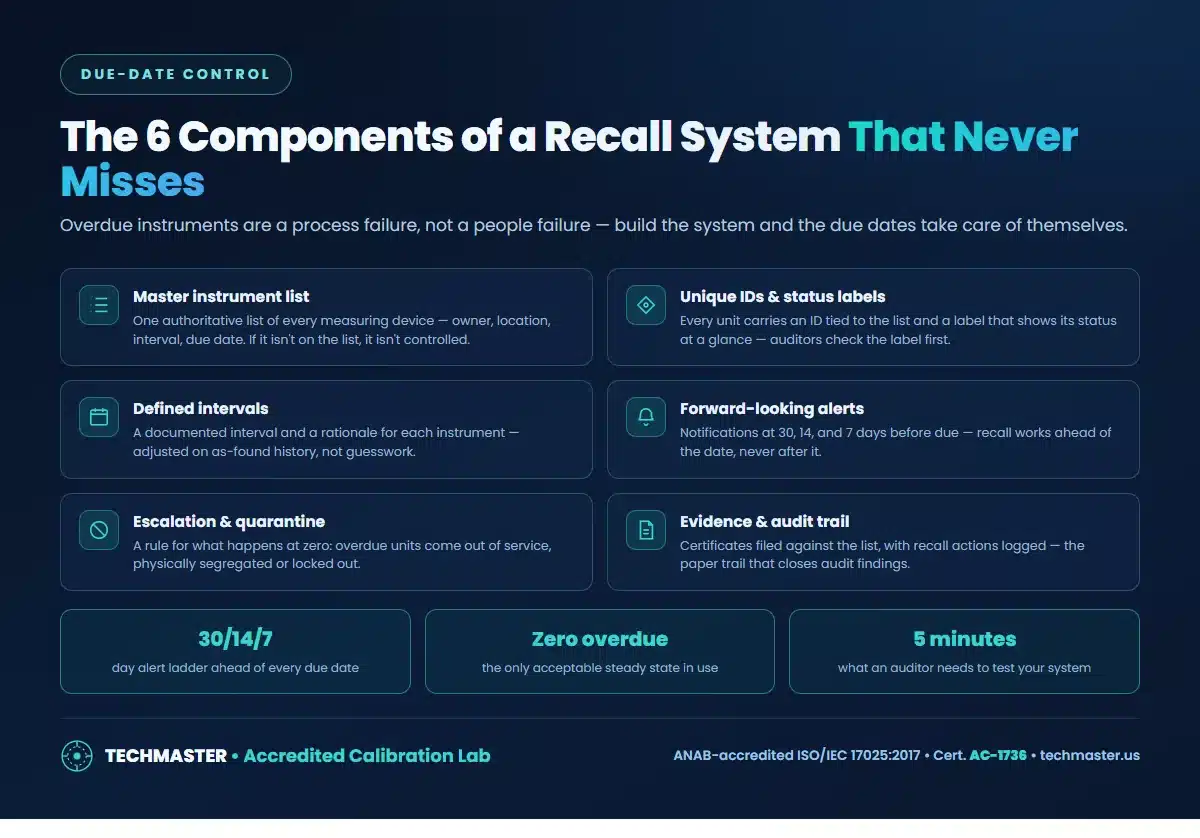
The master instrument list is the foundation: every measuring device, its owner, location, interval, and due date, in one authoritative place. If it isn’t on the list, it isn’t controlled, and untracked instruments are the most common audit finding. Unique IDs and status labels tie the physical unit to the list; the label is what the auditor reads first. Intervals come from the evidence-based interval guide: start at 12 months, adjust on as-found history. Alerts fire ahead of the date, never after. The escalation rule answers the hard question, what happens at zero: overdue units come out of service and are physically segregated. And the evidence trail files every certificate against the list, the fields covered in how to read a calibration certificate.
Spreadsheet or software?
Under ~50 instruments, a disciplined spreadsheet plus a weekly review meeting genuinely works. Past that, the failure modes compound: a broken date formula, one owner on vacation, a second site with its own copy. Dedicated calibration-management tools (or the calibration module of your asset system) add automatic alerts, audit logs, and certificate storage. Your calibration lab can help too, Techmaster tracks due dates for managed accounts and sends recall notices ahead of each cycle, which turns the alert ladder into someone else’s job.
What auditors actually test
Auditors rarely read your procedure first. They sample: an instrument from the bench, its label, its list entry, its certificate, then one overdue-handling case if any exists. The six components above map one-to-one onto that test. The deeper requirements behind it are covered in calibration requirements for ISO 9001, and an overdue unit found in use is handled exactly like the out-of-tolerance playbook: quarantine, as-found data, impact assessment.
Frequently asked questions
What is a calibration recall system?
A calibration recall system is the process that guarantees every measuring instrument is recalibrated before its due date: one master instrument list, unique IDs and status labels, defined intervals, forward-looking alerts, an escalation rule that removes overdue units from service, and a filed evidence trail.
Is a spreadsheet good enough for calibration recall?
Up to roughly 50 instruments, a disciplined spreadsheet with owner, interval, due date, and a weekly review works. Beyond that, missed formulas and single-owner risk make dedicated calibration-management or asset-management software the safer choice. Auditors accept either, what they test is whether anything is overdue.
What happens if an overdue instrument was used in production?
Treat it like an out-of-tolerance event: quarantine the unit, calibrate it and get as-found data, then assess the impact of every measurement made after the due date. If the as-found data is in tolerance, the assessment closes quickly; if not, product may need re-inspection or recall.
How far ahead should calibration alerts fire?
A 30/14/7-day ladder works for most fleets: 30 days out to schedule and budget, 14 days to arrange shipping or onsite service, 7 days as the final escalation. Instruments sent to an external lab need the lead time of that lab’s turnaround built in.
The bottom line
Zero overdue instruments in use is the only acceptable steady state, and it is a systems outcome, not a heroics outcome. Build the list, label the fleet, set the 30/14/7 ladder, write the quarantine rule, and pick a calibration partner whose turnaround doesn’t eat your margin, using the 12-point checklist.
Get an accredited calibration quote
ANAB-accredited ISO/IEC 17025:2017 (Cert. AC-1736) • 5 US labs • 5-day standard, 1–2 day expedite • in-lab or on-site.
Request a quoteReferences & industry standards
- ISO/IEC 17025 testing & calibration laboratory requirements
- NIST calibration services and measurement traceability
- NIST RF electromagnetics metrology
- A2LA / ANAB accreditation for calibration laboratories
External standards bodies. Techmaster Electronics is an ISO/IEC 17025-accredited, NIST-traceable calibration laboratory.

Khanh Nguyen is the Marketing Manager at Techmaster Electronics, a B2B marketing leader covering the test, measurement, and ISO/IEC 17025 accredited calibration industry across the US and Vietnam markets.