
TL;DR: Most electronic test equipment should start on a 12-month calibration interval. From there, let the as-found data decide: instruments that arrive comfortably in tolerance for 2–3 consecutive cycles can extend to 16–24 months; any out-of-tolerance result should shorten the interval to 6–8 months and trigger an impact assessment. Contracts, regulations, and OEM requirements override everything.
“How often should we calibrate?” is really two questions: what does your quality system require, and what does your instrument’s drift history show? This guide gives you the default answer, the evidence-based adjustment rules, and the overrides that beat both.
What is the standard calibration interval for test equipment?
Twelve months is the industry default for DMMs, oscilloscopes, signal generators, power supplies, and most RF instruments. It’s the interval most OEMs recommend, most quality systems assume, and most calibration labs print on the sticker unless told otherwise. But the default is a starting point, not a law, ISO/IEC 17025 itself deliberately leaves interval-setting to the instrument owner.
How do you adjust the interval with as-found data?
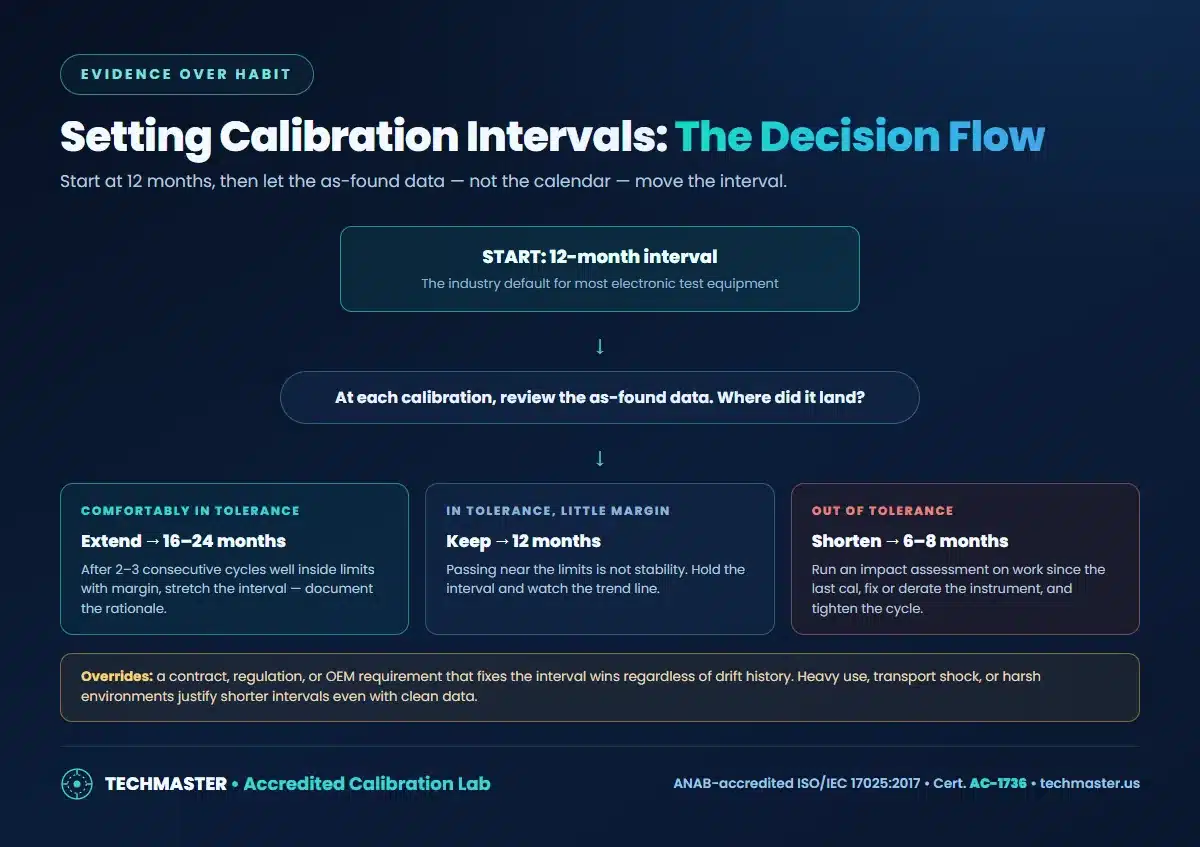
Every calibration returns an as-found reading: where the instrument measured before adjustment. That number is your drift evidence, and it drives three simple rules:
- Comfortably in tolerance, 2–3 cycles running → extend. Move to 16 or 24 months and document the rationale. This is where accredited calibration pays for itself, the data is on the certificate.
- In tolerance but near the limits → hold at 12 months. Passing with no margin is not stability; watch the trend.
- Out of tolerance → shorten to 6–8 months and run an impact assessment on everything the instrument measured since its last good calibration. See our out-of-tolerance response playbook.
This only works if your certificates include as-found/as-left data, one of the benefits of accredited calibration, where data comes standard.
What overrides the drift data?
Three things fix the interval regardless of how stable the instrument is: contract flow-downs (aerospace and defense programs often specify intervals), regulatory requirements (medical device and automotive schemes), and OEM requirements tied to warranty or performance specs. Conversely, heavy use, frequent transport, and harsh environments justify shorter intervals even with clean history, drift between calibrations is invisible until the next one.
How do you manage due dates across a fleet?
Recall management is where intervals fail in practice: the interval was right, but nobody shipped the instrument. Use a lab that tracks your inventory and sends due-date reminders, and batch due dates so instruments rotate in groups, Techmaster Electronics customers get recall scheduling plus free local pickup in Silicon Valley, Southern California, and Orlando, with a 5-day standard turnaround and 1–2 day expedite options so recalled instruments aren’t gone long.
Frequently asked questions
How often should a multimeter be calibrated?
Most multimeters start on a 12-month calibration interval. If as-found data shows the meter repeatedly arriving well within tolerance, the interval can often be extended to 16–24 months with documented rationale; any out-of-tolerance finding should shorten it.
Can I extend my calibration interval to save money?
Yes, if the as-found data supports it and no contract or regulation fixes the interval. The accepted approach is 2–3 consecutive in-tolerance cycles with comfortable margin before extending, with the decision documented in your quality system.
What happens if an instrument misses its calibration due date?
Treat measurements made after the due date as unverified: quarantine the instrument, calibrate it, and review the as-found data. If it comes back in tolerance, the late period is usually defensible; if not, run an out-of-tolerance impact assessment.
Does calibration frequency depend on usage?
Yes. Heavy daily use, transport between sites, and harsh environments accelerate drift, justifying shorter intervals. A rarely used bench standard in a controlled lab can often support a longer interval, the as-found trend is the deciding evidence.
The bottom line
Start at 12 months, adjust on as-found evidence, respect the contractual overrides, and make sure recall management actually gets instruments to the lab. For the full vendor-selection framework, see the 12-point checklist for choosing a calibration service.
Get an accredited calibration quote
ANAB-accredited ISO/IEC 17025:2017 (Cert. AC-1736) • 4 accredited US labs • 5-day standard, 1–2 day expedite • in-lab or on-site.
Request a quoteReferences & industry standards
- ISO/IEC 17025 testing & calibration laboratory requirements
- NIST calibration services and measurement traceability
- A2LA / ANAB accreditation for calibration laboratories
External standards bodies. Techmaster Electronics is an ISO/IEC 17025-accredited, NIST-traceable calibration laboratory.

Khanh Nguyen is the Marketing Manager at Techmaster Electronics, a B2B marketing leader covering the test, measurement, and ISO/IEC 17025 accredited calibration industry in the United States.