
TL;DR: A certificate that arrives in the box documents the seller’s process, not yours, it was issued before packing, shipping and handling. For any measurement that matters, calibrate on receipt or run a documented incoming check: verify the certificate’s date, issuing lab and level, inspect connectors and function, then onboard the asset into your recall system on day one. For rentals, verify on every delivery rather than assuming.
Buying used or renting is smart economics, it’s also the most common way an uncontrolled instrument enters a controlled process. Here’s the incoming check that closes that gap, and why it costs almost nothing.
Why isn’t the seller’s certificate enough?
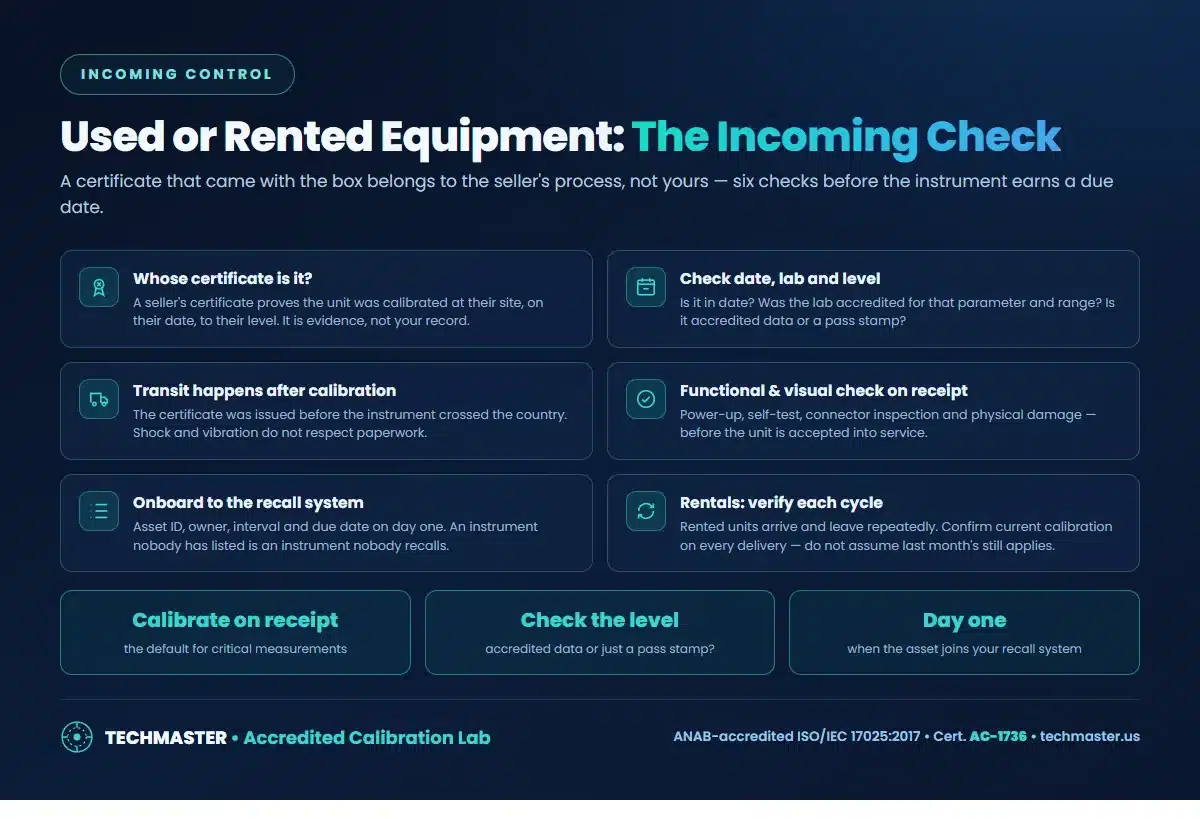
Three reasons, none of them about honesty. It documents someone else’s moment in time: the instrument was calibrated at their site, on their date, then packed and moved, and transit is where damage happens, as covered in shipping test equipment. The level may not match your need: plenty of resale paperwork is a functional check or a pass stamp rather than accredited calibration with data, the difference is explained in calibration vs verification and how to read a certificate. And the issuing lab may not have been accredited for that parameter and range, which you can check against its scope (how to verify).
The incoming check, in order
Read the certificate: date, laboratory, accreditation status, and whether it carries data or just a verdict. Power up, run self-test, inspect the case and every connector, especially on RF instruments, where a damaged precision connector is both a measurement problem and a hazard to your other ports. Confirm against a known reference if you have one. Then onboard it: asset ID, owner, interval, due date, into the master list your recall system runs on. An instrument nobody listed is an instrument nobody recalls, and it’s the one auditors find on the bench.
When you should simply recalibrate on arrival
Recalibrate on receipt whenever the instrument feeds regulated product, customer specifications, or an uncertainty budget, the same logic that governs medical, aerospace and automotive programs, where supplier-supplied paperwork rarely satisfies the requirement on its own. The cost is modest against the alternative: an OOT discovery months later that pulls every measurement made since arrival into question (the playbook). Typical pricing by instrument type is in the cost guide.
Frequently asked questions
Does used test equipment need calibration before use?
For any measurement that matters, yes. A seller’s certificate documents the instrument’s condition at their site on their date, before it was packed and shipped to you. Calibrating on receipt, or at minimum performing a documented incoming check, is what makes the instrument’s status your record rather than someone else’s claim.
Is the calibration certificate that came with my used instrument valid?
It may be perfectly genuine and still not be enough. Check three things: whether it is still in date, whether the issuing laboratory was accredited for that parameter and range, and whether it contains actual measurement data or only a pass statement. Many resale certificates are functional checks, not accredited calibrations.
Does rented test equipment need calibration?
Reputable rental companies supply calibrated instruments with current certificates, and for many uses that is sufficient. Verify the certificate on every delivery rather than assuming, units cycle between customers constantly, and transit between rentals is exactly when damage occurs. For regulated or contract work, confirm the certificate level meets your requirement before the unit goes into service.
What should an incoming check for used equipment include?
Power-up and self-test, visual and connector inspection, verification of the supplied certificate’s date, laboratory and level, functional confirmation against a known reference where practical, and immediate onboarding into your calibration recall system with an asset ID, interval and due date.
The bottom line
Treat every incoming instrument, bought, used, or rented, as uncontrolled until your own check says otherwise, and give it a due date the day it arrives. Techmaster calibrates, repairs, sells and rents electronic test equipment, and can calibrate an incoming unit to accredited level before it goes into service. Vendor criteria: the 12-point checklist.
Get an accredited calibration quote
ANAB-accredited ISO/IEC 17025:2017 (Cert. AC-1736) • 5 US labs • 5-day standard, 1–2 day expedite • in-lab or on-site.
Request a quote
Khanh Nguyen is the Marketing Manager at Techmaster Electronics, a B2B marketing leader covering the test, measurement, and ISO/IEC 17025 accredited calibration industry across the US and Vietnam markets.