
TL;DR: Medical device calibration answers to two nearly identical clauses, ISO 13485 clause 7.6 and FDA 21 CFR 820.72. Both require documented procedures with accuracy limits, defined intervals, traceability to national standards, status identification, records of who calibrated what, and a documented product-impact evaluation for every out-of-tolerance finding. Accreditation isn’t named in either, but an accredited certificate is the fastest evidence of supplier competence.
An FDA investigator reads calibration records differently than a registrar: the question isn’t just “is it calibrated,” it’s “what did you ship using it, and how do you know that was fine?” Here’s what both regulators require, and the records that answer them.
What do ISO 13485 and 21 CFR 820.72 require?
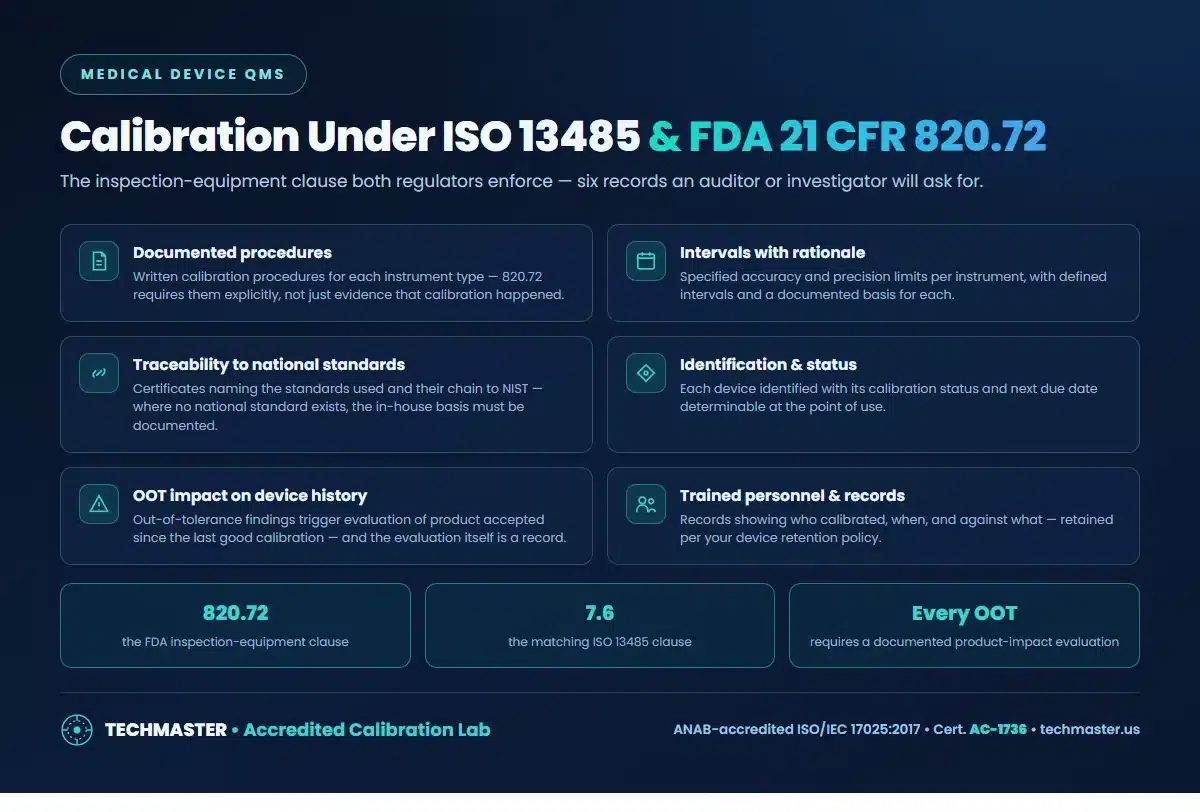
Documented procedures are explicit in 820.72, not just evidence that calibration occurred, but written procedures with specified accuracy and precision limits. Intervals must be defined with a rationale, per the interval guide. Traceability means certificates naming the standards used and their chain to NIST, see what NIST-traceable actually means, and note that where no national standard exists, the in-house basis must itself be documented. Status identification at the point of use, and personnel records, complete the set. The whole thing runs on the same infrastructure as any calibration recall system, medical simply raises the evidentiary bar.
The clause that catches manufacturers out
Both standards require assessing the validity of previous measurements when equipment is found out of tolerance. In a device context that reaches shipped product: which lots were accepted using that instrument since its last good calibration, and does the as-found data change their disposition? This is why as-found data matters more than the pass stamp, a certificate without as-found readings leaves you unable to perform the evaluation at all. The mechanics are in the out-of-tolerance playbook, and the distinction between as-found and as-left is covered in calibration vs verification vs adjustment.
Choosing a calibration lab for a medical QMS
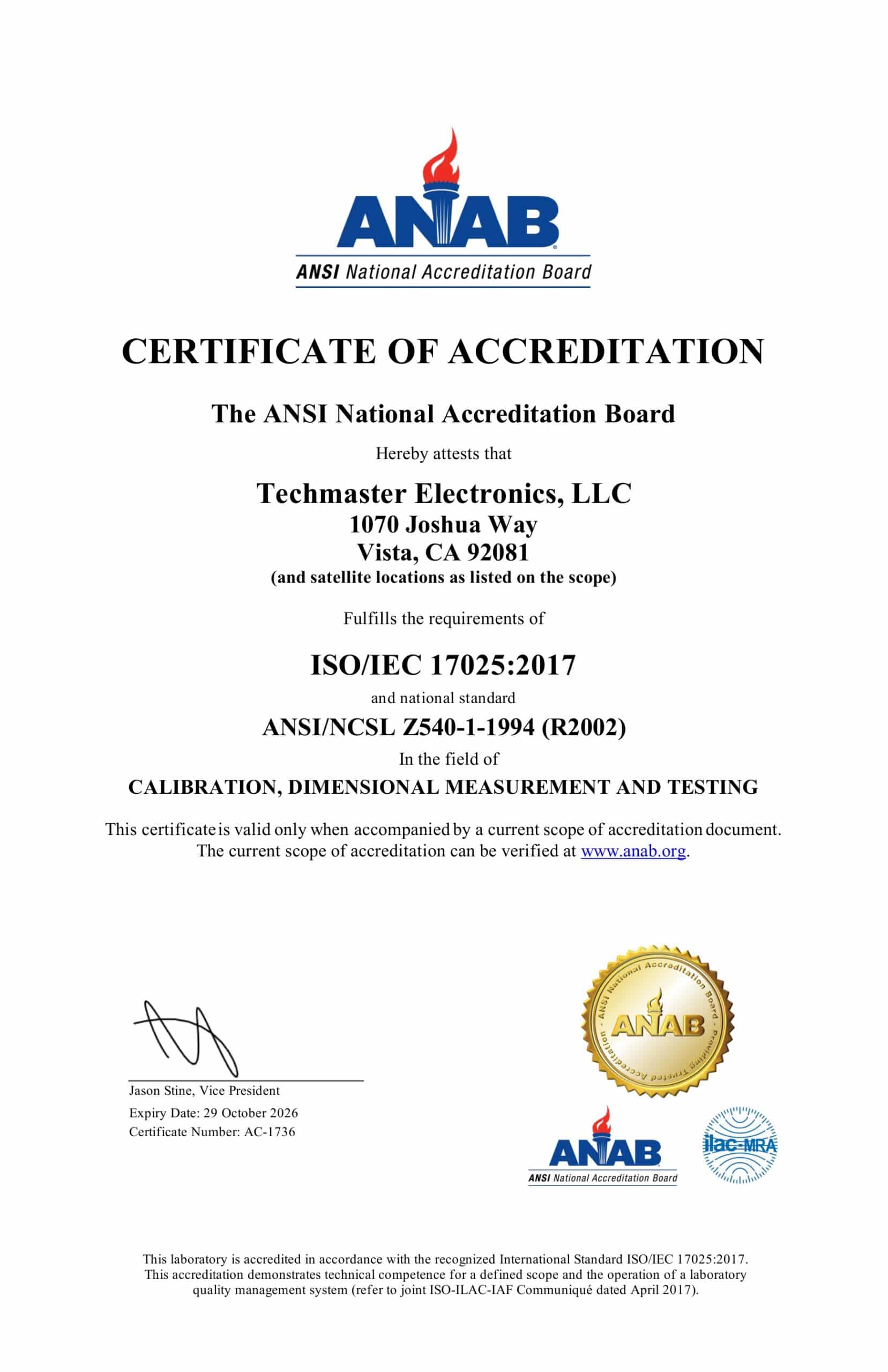
Supplier control is where auditors spend their time. An ISO/IEC 17025 accredited scope, verified in the accreditation body’s directory, is the cleanest objective evidence, how to check one is in what is ISO/IEC 17025 accreditation. Ask for endorsed certificates carrying as-found/as-left data and uncertainty by default, not on request. Techmaster is ANAB-accredited to ISO/IEC 17025:2017 (Cert. AC-1736) across eight calibration fields and supplies full-data certificates as standard.
Frequently asked questions
What does FDA 21 CFR 820.72 require for calibration?
The inspection, measuring, and test equipment clause requires documented calibration procedures with specified accuracy and precision limits, calibration at prescribed intervals against standards traceable to national standards (or a documented in-house basis where none exist), identification of each device with its calibration status, and records identifying the equipment, the date, and the person who performed it.
Does ISO 13485 require accredited calibration?
ISO 13485 clause 7.6 requires traceable calibration and records, not accreditation specifically. In practice most medical device manufacturers require ISO/IEC 17025 accredited calibration for critical instruments because an accredited certificate is objective evidence of the lab’s competence, the simplest way to satisfy supplier control during an audit or inspection.
What happens if inspection equipment is found out of tolerance?
Both standards require you to assess and document the validity of previous measurements made with that equipment. In a device context that means evaluating product accepted since the last known-good calibration, documenting the conclusion in the device history record, and taking action on affected product. The evaluation is itself a required record.
How often must medical device inspection equipment be calibrated?
Neither the FDA nor ISO 13485 sets a fixed interval, you set it and justify it. Twelve months is the common starting point, adjusted on documented as-found history and criticality. What regulators check is that the interval is defined, followed, and supported by evidence.
The bottom line
Under ISO 13485 and 21 CFR 820.72, calibration is a product-quality control, not a maintenance chore, and as-found data is what makes the record defensible. Vet the lab that produces it with the 12-point checklist. The regulated-industry sibling of this post is AS9100 calibration requirements.
Get an accredited calibration quote
ANAB-accredited ISO/IEC 17025:2017 (Cert. AC-1736) • 4 accredited US labs • 5-day standard, 1–2 day expedite • in-lab or on-site.
Request a quoteReferences & industry standards
- ISO/IEC 17025 testing & calibration laboratory requirements
- NIST calibration services and measurement traceability
- A2LA / ANAB accreditation for calibration laboratories
External standards bodies. Techmaster Electronics is an ISO/IEC 17025-accredited, NIST-traceable calibration laboratory.

Khanh Nguyen is the Marketing Manager at Techmaster Electronics, a B2B marketing leader covering the test, measurement, and ISO/IEC 17025 accredited calibration industry in the United States.