
How Often Should You Calibrate an Oscilloscope? A Complete guide
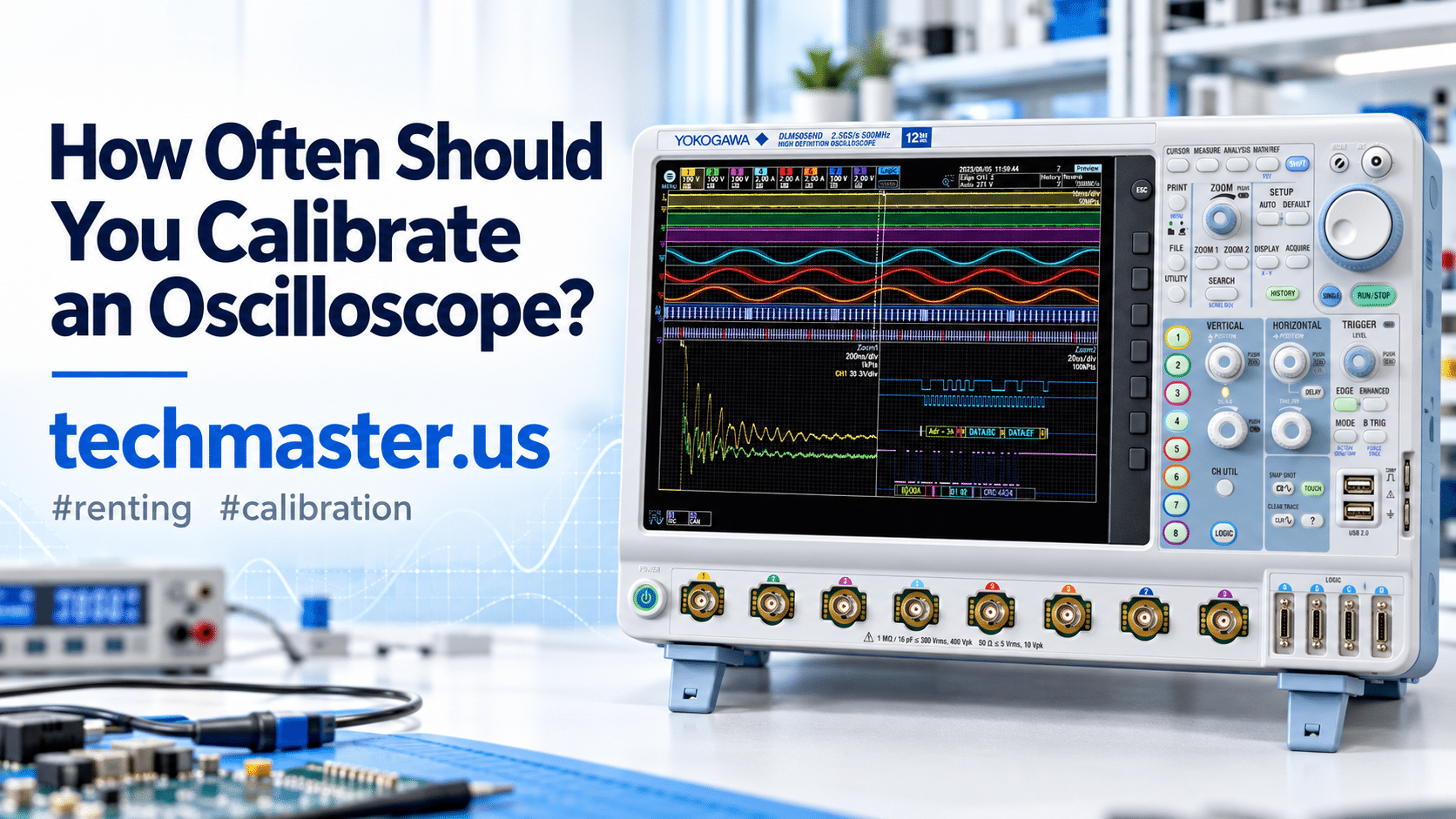
Bench oscilloscopes serve as the daily workhorses of electronics testing. They provide engineers and technicians with a clear window into dynamic electrical signals. For example, whether you debug a complex digital circuit, analyze power supply noise, or check RF signals, you rely entirely on the displayed waveform. However, like any precision electronic instrument, their performance naturally degrades over time.
Therefore, when lab managers ask how often calibrate oscilloscope tasks must happen, they ask a critical question. They want to ensure risk management, measurement integrity, and regulatory compliance. In addition, maintaining the accuracy of your test and measurement equipment goes beyond best practice. It acts as a mandatory requirement for manufacturing, research, and quality assurance. In this article, we will examine the technical reasons behind instrument drift. Next, we will discuss industry standards. Finally, we will help you determine the best calibration frequency for your bench oscilloscopes.
1. What Is Oscilloscope Calibration?
Oscilloscope calibration represents a highly controlled and documented process. Specifically, technicians compare the measurement parameters of your oscilloscope against a known, highly accurate reference standard. Because oscilloscopes measure multiple domains at once, their calibration covers many vital facets.
A thorough calibration procedure evaluates several critical parameters:
-
Vertical Accuracy (Amplitude): This ensures the displayed voltage levels exactly match the incoming signal. Therefore, technicians test DC gain accuracy and offset accuracy across all channels and voltage scales.
-
Horizontal Accuracy (Timebase): This step verifies the timing and frequency measurements. Specifically, it checks the internal clock or crystal oscillator that controls the screen’s sweep speed.
-
Bandwidth and Frequency Response: This confirms that the oscilloscope maintains a flat frequency response. It also proves the device accurately measures signals up to its maximum rated bandwidth.
-
Triggering: This ensures the instrument reliably triggers on specific voltage thresholds, pulse widths, or complex digital patterns.
During a Calibration service, metrologists use specialized multiproduct calibrators and leveled sine wave generators. They use these advanced tools to verify these exact parameters. Consequently, if the metrologist finds the oscilloscope out of tolerance, they make physical or software adjustments. These adjustments bring the instrument back into the manufacturer’s original specifications.
2. Why Knowing How Often to Calibrate an Oscilloscope Matters
The Strict Foundation of Quality Control
Measurement accuracy forms the strict foundation of quality control. Operating an uncalibrated oscilloscope introduces unseen risks into your engineering and production environments. Therefore, understanding why and how often calibrate oscilloscope intervals must occur directly impacts your organization’s bottom line.
Measurement Accuracy & Traceability
When your oscilloscope reads a 3.3V logic high, you must know it is exactly 3.3V. Over time, drift in vertical amplifiers or attenuator networks can lead to false readings. Conversely, traceable calibration ensures your instrument’s measurements firmly anchor to the International System of Units (SI). Recognized national metrology institutes carefully maintain these critical SI standards.
Compliance & Quality Standards
Many industries operate under strict quality management systems, such as ISO 9001, AS9100, or IATF 16949. For these sectors, maintaining a documented calibration schedule remains absolutely mandatory. Failing to calibrate electrical test equipment on time causes severe problems, including failed audits, lost certifications, and halted production lines.
Reducing Risk & Product Recalls
A drifting timebase can cause engineers to miscalculate timing tolerances in high-speed digital buses. Consequently, a flawed product might pass quality control based on faulty oscilloscope measurements. As a result, the product will likely fail in the field, leading to costly product recalls, expensive warranty claims, and heavy reputational damage.
Operational Reliability
Regularly scheduled calibration acts as preventative maintenance. Additionally, it allows laboratory managers to track an instrument’s historical performance. They can then identify degrading components before those parts fail completely. Thus, managers ensure maximum operational uptime for their teams.
3. Common Applications for Bench Oscilloscopes
Because oscilloscopes visualize voltage over time, they appear everywhere across numerous high-tech industries. Also, the specific application often dictates the required oscilloscope calibration interval.
-
Electronics Manufacturing: Factories use oscilloscopes on production floors for pass/fail testing. They also verify power supply outputs and ensure signal integrity on printed circuit boards (PCBs).
-
Aerospace and Defense: Engineers need them to test avionics, radar systems, and communication equipment. In these sensitive fields, component failure is never an option.
-
Automotive: The rapid rise of electric vehicles (EVs) increased testing demands. Now, technicians heavily use oscilloscopes to monitor CAN bus communications, sensor outputs, and battery management systems.
-
Medical Device Manufacturing: Teams use them to design and verify critical diagnostic equipment. Naturally, this vital process requires strict regulatory compliance.
-
Research and Development: R&D labs constantly push the limits of technology. Therefore, they need oscilloscopes with high bandwidths and pristine accuracy to test new processors.
4. Calibration Standards and Traceability
Strict International Standards
When seeking electrical test equipment calibration, you must look for services that follow strict international standards to ensure validity.
ISO/IEC 17025 Accreditation
ISO/IEC 17025 stands as the global quality standard for testing and calibration laboratories. Therefore, an ISO 17025 oscilloscope calibration guarantees that the laboratory actively demonstrates technical competence. In addition, it proves the lab operates a robust quality management system and employs highly trained metrologists.
NIST-Traceable Calibration
In the United States, labs usually establish traceability through the National Institute of Standards and Technology (NIST). Specifically, a NIST traceable calibration means an unbroken chain of documented measurements exists. This chain links your oscilloscope directly back to NIST standards. In the end, labs provide this documentation as a detailed calibration certificate to prove measurement integrity.
Measurement Uncertainty
A professional calibration provider always calculates and reports measurement uncertainty. In reality, no measurement is truly absolute. Instead, uncertainty defines the mathematical margin of doubt linked to the calibration result. Knowing this exact margin is vital for engineers who work with extremely tight signal tolerances.
Visualizing Metrology
The Unbroken Chain of Traceability
Measurement Uncertainty
5. Common Issues Found During Oscilloscope Calibration
Why does an oscilloscope drift in the first place? Surprisingly, even stationary bench oscilloscopes sitting in climate-controlled labs experience degradation. Common issues discovered during calibration include:
-
Timebase Drift: The internal quartz oscillators that control horizontal timing age over time. Subsequently, this aging causes the oscillator’s frequency to drift, which causes inaccurate timing measurements.
-
Attenuator Wear: The relays and mechanical switches inside vertical attenuator circuits face physical wear from repeated use. This wear alters the input impedance and causes amplitude errors.
-
Component Aging: Capacitors dry out and resistors change value due to thermal cycling. This cycling happens when you turn the equipment on and off over many months. Consequently, this aging limits bandwidth flatness.
-
Input Protection Degradation: Users occasionally subject oscilloscopes to heavy overvoltage conditions. Internal protection circuits usually prevent complete failure. However, repeated stress alters the input characteristics, causing errors at higher frequencies.
-
Environmental Stress: Fluctuations in lab temperature and humidity deeply affect sensitive analog front-end components.
6. How Often Should This Equipment Be Calibrated?
Determining the Ideal Calibration Frequency
You must balance manufacturer recommendations with your specific daily operations. While the industry standard typically sits at a 12-month interval, several variables should influence your final decision.
Manufacturer Recommendations
The vast majority of oscilloscope makers recommend a 1-year (12-month) calibration interval. This timeframe acts as the baseline period. Over this specific time, they guarantee the instrument will stay within its published limits.
Frequency of Use
An oscilloscope used 24/7 on a busy factory line faces intense electrical and thermal stress. Conversely, an R&D lab might only use theirs occasionally. High-usage environments often shorten intervals to 6 months to reduce risk.
Criticality of Measurements
Perhaps your organization builds aerospace components or life-saving medical devices. In these unique cases, the cost of a false measurement stays exceptionally high. Quality managers often enforce tighter calibration cycles for absolute certainty.
Environmental Conditions
Engineers design bench oscilloscopes for clean, temperature-controlled spaces. However, if you use your instrument on a dusty factory floor or in an area with high temperature swings, the unit will drift much faster than it would in a clean lab.
Historical Drift Data
ISO/IEC 17025 guidelines suggest adjusting intervals based on historical performance. If your oscilloscope consistently passes year after year, you might safely extend the interval. Conversely, if it frequently requires adjustment, you must shorten it.
7. What to Look for in a Calibration Provider
Not all calibration labs can handle modern, high-bandwidth bench oscilloscopes. Therefore, when you select a partner for your oscilloscope calibration frequency plan, evaluate them on these criteria:
-
Scope of Accreditation: First, verify that their ISO/IEC 17025 scope covers the specific parameters of your oscilloscope. You must especially check its maximum bandwidth capability.
-
Technical Capability: Next, ensure the lab uses modern calibrators designed specifically for oscilloscopes. These tools must easily generate clean, fast edges and leveled sine waves.
-
Turnaround Time: Equipment downtime costs a lot of money on a busy production line. Therefore, look for a provider that offers guaranteed turnaround times, typically around 5 to 7 business days.
-
Quality of Documentation: A compliant provider always issues comprehensive certificates. These documents must include before-and-after data, measurement uncertainties, and a clear statement of traceability.
-
On-Site Service Options: Sending out dozens of oscilloscopes creates massive logistical challenges. Fortunately, many top-tier providers offer on-site calibration services to bring their standards directly to your facility.
8. Keep Your Lab Running: Test Equipment Renting Services
We clearly know that sending your primary bench oscilloscope out for annual calibration disrupts ongoing projects. Sometimes, it even halts entire production lines. To eliminate this costly downtime, Techmaster Electronics offers comprehensive test equipment renting services.
Perhaps you need a temporary replacement while your primary unit sits in our lab. Or, you might require a specialized, high-bandwidth oscilloscope for a short-term R&D project. Either way, our rental inventory has you fully covered. Renting ensures your team stays highly productive. Additionally, it preserves your capital budgets. Most importantly, it guarantees you work with freshly calibrated, top-tier instruments.
9. Why Choose Techmaster Electronics?
When you need to maintain the accuracy of critical test equipment, you need a trusted leader in the metrology industry. Therefore, Techmaster Electronics stands ready to assist you. We provide reliable ISO 17025 oscilloscope calibration for all major brands. These respected brands include Tektronix, Keysight, Rohde & Schwarz, and Teledyne LeCroy.
Our state-of-the-art laboratories in the US feature top-tier calibrators. We can easily handle standard bench oscilloscopes and high-bandwidth RF models alike. In addition, we pride ourselves on delivering accurate, highly documented, and NIST-traceable results. These precise results satisfy the most rigorous quality audits. We proudly offer fast turnaround times, optional on-site services, and deep customer support. In the end, Techmaster Electronics ensures your measurement instruments perform exactly as the maker intended.
10. Conclusion
An oscilloscope is only as valuable as the accuracy of the waveform it displays. You must thoroughly understand the variables that cause instrument drift. Also, following a strict calibration schedule remains completely vital. This organized schedule protects your product quality, maintains compliance, and reduces operational risk. A 12-month interval serves as the standard starting point. However, your specific daily environment and industry needs should truly dictate how often calibrate oscilloscope services happen. By partnering with an accredited metrology lab, you ensure your test equipment remains a reliable tool for your ongoing success.
11. Frequently Asked Questions (FAQ)
Frequently Asked Questions
Frequently asked questions
What is oscilloscope calibration?
Oscilloscope Calibration is the documented comparison of a oscilloscope against NIST-traceable reference standards under ISO/IEC 17025. It quantifies the oscilloscope’s error and measurement uncertainty and confirms it performs within tolerance, with as-found and as-left data on the certificate.
How often should a oscilloscope be calibrated?
Most quality systems calibrate a oscilloscope every 12 months, or sooner after repair, overload, or before critical measurements. Set your interval from the manufacturer spec and your ISO 9001 / 13485 / AS9100 program and drift history.
Is Techmaster’s oscilloscope calibration ISO 17025 accredited?
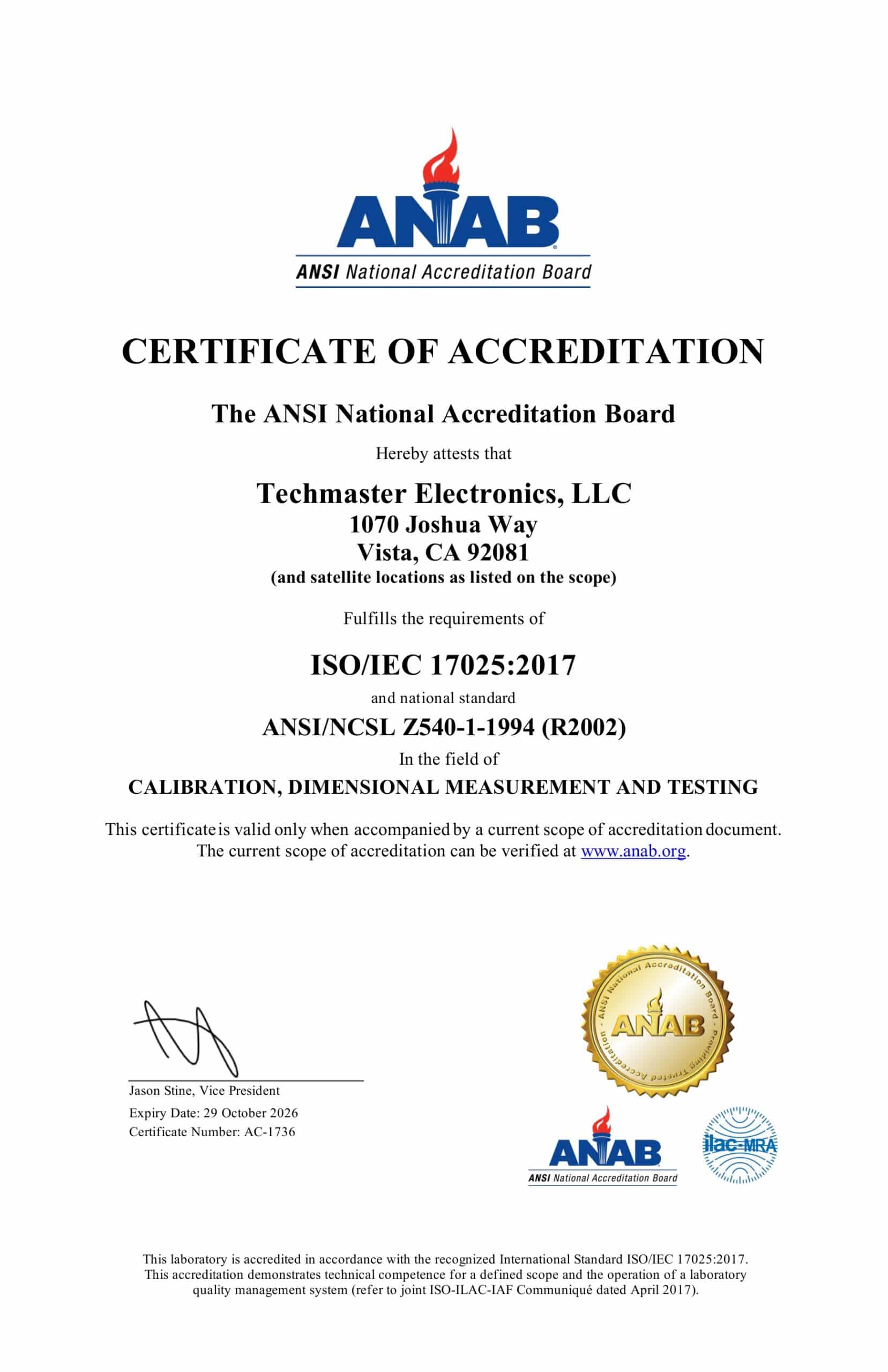
Yes. Techmaster Electronics is ISO/IEC 17025:2017 accredited by ANAB (Certificate AC-1736). Every oscilloscope calibration is NIST-traceable and issued with a full measurement-uncertainty budget.
What is the turnaround for oscilloscope calibration?
Standard turnaround is 5 business days, with 1–2 business-day expedite available. On-site calibration removes shipping time entirely for oscilloscopes that can’t leave the floor.
Do you calibrate oscilloscopes on-site or in-lab?
Both. Techmaster runs five US labs (Vista CA, Santa Clara CA, Orlando FL, San Antonio TX, Holly Springs NC) and offers nationwide on-site oscilloscope calibration to minimize downtime.
References & industry standards
- ISO/IEC 17025 testing & calibration laboratory requirements
- NIST calibration services and measurement traceability
- NIST Fundamental Electrical Measurements
- A2LA / ANAB accreditation for calibration laboratories
External standards bodies. Techmaster Electronics is an ISO/IEC 17025-accredited, NIST-traceable calibration laboratory.

Khanh Nguyen is the Marketing Manager at Techmaster Electronics, a B2B marketing leader covering the test, measurement, and ISO/IEC 17025 accredited calibration industry in the United States.