
Rent vs Buy DC Power Supply: What Makes Sense for Your Lab?
Every electronic test laboratory needs a reliable source of clean power. Engineers rely on accurate tools to build and test new products. Therefore, the choice to rent vs buy dc power supply equipment impacts your budget and project timeline directly. Facility managers must weigh initial costs against long-term maintenance needs. In addition, strict measurement accuracy remains a top priority for any quality team. This guide helps you compare the financial and technical benefits of both options. In the end, you will learn how to make the right choice for your engineering team.
1. What Is a Bench DC Power Supply?
A bench DC power supply delivers stable direct current to a device under test. Engineers use this specific tool to control voltage and current exactly. Consequently, they can test delicate parts safely without causing electrical damage. Standard wall adapters provide fixed power. Conversely, bench power supplies let users dial in precise power levels.
Modern units offer advanced safety features. For example, they include over-voltage protection and over-current protection. In addition, you can program these devices for automated factory tests. As a result, they act as the backbone of any modern electronics lab. You can find two main types on the market. First, linear power supplies offer very low electrical noise. Second, switching power supplies provide high power in a smaller box. Both types require careful maintenance and regular checks.
2. Why the “Rent vs Buy DC Power Supply” Decision Matters
Making the Right Equipment Choice
This equipment choice affects your daily operations and your company finances. You must look beyond the initial price tag. Let us explore the main factors you need to consider.
Financial Impact and Cash Flow
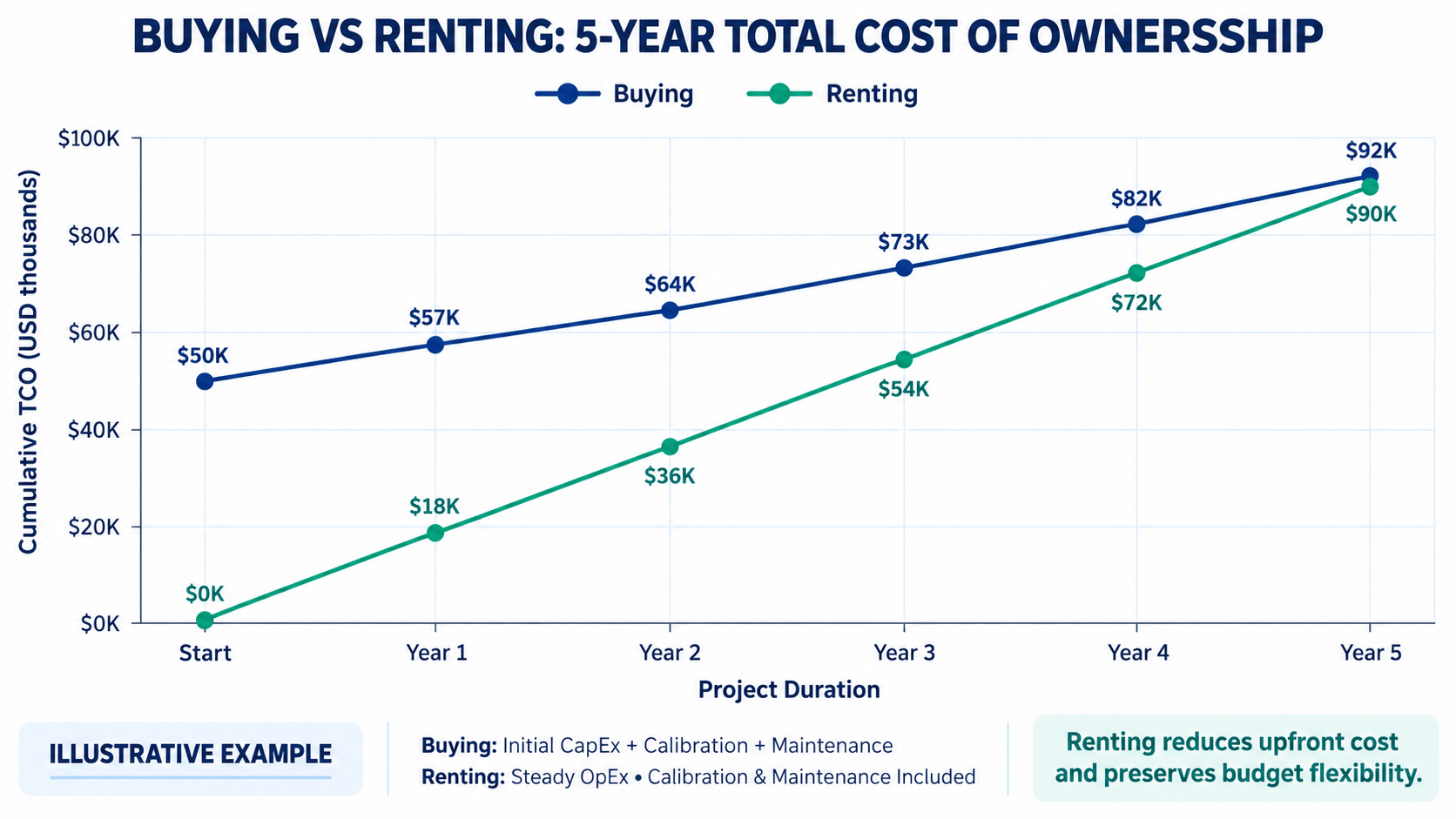
Buying test gear ties up your cash immediately. A high-quality unit requires a large capital expense. On the other hand, renting shifts the cost to your operating budget. As a result, you preserve cash for other important business needs. In addition, rental costs often provide helpful tax deductions for your business.
Keeping Up with Technology
Technology changes very fast in the electronics industry. Thus, a test equipment rental vs purchase strategy helps you stay current. Buying a unit locks you into older technology for years. However, renting allows you to upgrade your lab as new testing standards emerge. Consequently, your team always works with the latest tools.
Project Length and Usage Rates
Short projects strongly favor the rental approach. For instance, you might need a power supply for a three-month research project. Renting saves you money in this exact scenario. However, some labs run automated tests all day and night. Therefore, buying the equipment makes more sense for permanent, long-term setups.
Managing Maintenance
Every owned tool adds work for your quality department. When you buy a device, you must schedule its annual service. In addition, you must pay for repairs if it breaks. Meanwhile, a rented unit arrives fully serviced. Therefore, renting removes the hidden costs of lab maintenance and downtime.
3. Common Applications
Many different industries rely on highly accurate power devices. Teams use them in factories, field service trucks, and research labs. Here are a few common examples.
-
Aerospace Manufacturing: Engineers test flight control systems with precise power. In addition, they simulate extreme power drops to check system safety.
-
Automotive Industry: Car makers test large electric vehicle batteries. Specifically, they need clean power to test engine control units.
-
Electronics Labs: Technicians power sensitive microchips during design stages. Therefore, they need stable power to prevent chip damage.
-
Medical Device Production: Factories build life-saving devices like heart monitors. Consequently, they require perfect power delivery to meet federal rules.
-
Telecommunications: Field crews test network switches and radio towers. As a result, they need portable, reliable power sources on the go.
4. Calibration Standards and Traceability
Measurement accuracy keeps your products safe and functional. Therefore, you must test your equipment on a regular schedule. Bad power units can ruin expensive prototypes quickly. In addition, they can cause defective products to leave your factory. As a result, global quality standards require strict testing rules for all lab tools.
You should always seek an ISO 17025 accredited calibration. This international standard proves the lab follows strict technical rules. Auditors check the lab environment, the staff training, and the testing methods. In addition, your business needs a NIST traceable calibration certificate. This specific document links your local test results to national standards. Consequently, your clients and auditors will trust your measurement data completely.
5. Common Issues Found During Calibration
Internal parts wear out slowly over time. Heat and regular use cause components to degrade. Consequently, a bench dc power supply calibration spots these hidden faults early. Technicians look for several common problems during a routine check.
First, technicians often find voltage drift. Internal sensors shift as they age. Thus, the unit outputs a different voltage than you actually requested. Second, old capacitors add electrical noise to the power line. This specific noise harms sensitive test parts. Third, the unit might fail under a heavy load. When a device draws extra power, the voltage might drop sharply. Finally, the front display screens can show the wrong numbers. Therefore, engineers might record bad data without realizing the error. Regular service fixes these exact issues.
6. How Often Should This Equipment Be Calibrated?
You must test your tools regularly to keep them accurate. Most manufacturers suggest testing the unit every 12 months. This yearly schedule acts as the baseline for most labs. However, you might need a shorter cycle based on your specific work.
For instance, heavy daily use requires testing every six months. In addition, harsh environments speed up wear and tear. Heat, dust, and humidity damage internal parts faster. Also, some medical and aerospace rules demand more frequent checks. Therefore, you must follow your internal quality manual closely. Always check historical drift data to adjust your exact schedule.
7. What to Look for in a Calibration Provider
Choosing the Right Metrology Partner
You need a metrology partner you can fully trust. Choosing the right lab protects your business and your products. Here are four key factors to verify:
Official Accreditation
First, check their official accreditation status. They must have a current ISO/IEC 17025 certificate.
Turnaround Times
Second, ask about their standard turnaround times. You simply cannot afford long delays in a busy factory.
Detailed Data Reports
Third, request detailed data reports for your tools. The lab should show exact measurement numbers, not just a simple pass mark.
On-Site Service
Fourth, look for labs that offer on-site service. Mobile technicians can test heavy tools right on your factory floor. As a result, you save money on shipping costs.
8. Why Choose Techmaster Electronics?
Techmaster Electronics supports quality-driven labs across the country. We run multiple certified labs in the United States. In addition, we provide a complete Calibration service for complex electronic tools. Our experienced team helps aerospace, medical, and technology companies stay compliant every day.
We offer fast turnaround times and very clear data reports. You can trust our technicians to handle your sensitive gear properly. If you decide to rent, our massive rental fleet stands ready. We fully certify every unit before we ship it to your door. Consequently, your engineering team can start testing on day one. Also, we offer flexible leasing plans to fit your specific budget.
Making the best equipment decision takes careful thought and planning. Buying builds long-term value for permanent test stations. Conversely, renting gives you speed, flexibility, and immediate audit compliance. Whichever path you pick, you must keep your tools accurate. Regular service protects your test data and your company reputation. Therefore, partner with a proven lab to keep your operations running smoothly.
9. FAQ Section
Frequently Asked Questions
Frequently asked questions
What is dc power supply calibration?
DC Power Supply Calibration is the documented comparison of a DC power supply against NIST-traceable reference standards under ISO/IEC 17025. It quantifies the DC power supply’s error and measurement uncertainty and confirms it performs within tolerance, with as-found and as-left data on the certificate.
How often should a DC power supply be calibrated?
Most quality systems calibrate a DC power supply every 12 months, or sooner after repair, overload, or before critical measurements. Set your interval from the manufacturer spec and your ISO 9001 / 13485 / AS9100 program and drift history.
Is Techmaster’s DC power supply calibration ISO 17025 accredited?
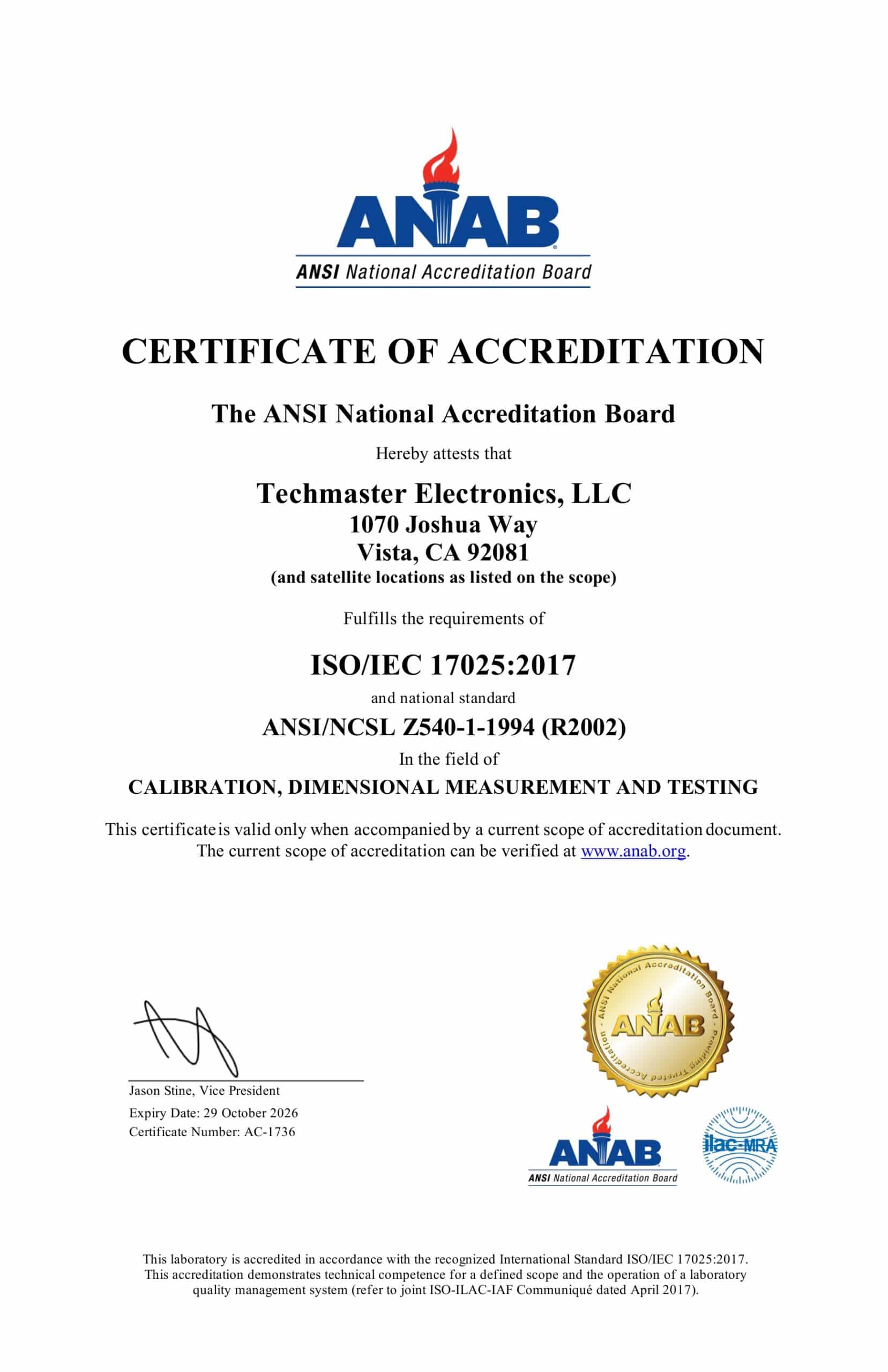
Yes. Techmaster Electronics is ISO/IEC 17025:2017 accredited by ANAB (Certificate AC-1736). Every DC power supply calibration is NIST-traceable and issued with a full measurement-uncertainty budget.
What is the turnaround for DC power supply calibration?
Standard turnaround is 5 business days, with 1–2 business-day expedite available. On-site calibration removes shipping time entirely for DC power supplys that can’t leave the floor.
Do you calibrate DC power supplys on-site or in-lab?
Both. Techmaster runs five US labs (Vista CA, Santa Clara CA, Orlando FL, San Antonio TX, Holly Springs NC) and offers nationwide on-site DC power supply calibration to minimize downtime.
References & industry standards
- ISO/IEC 17025 testing & calibration laboratory requirements
- NIST calibration services and measurement traceability
- NIST Fundamental Electrical Measurements
- A2LA / ANAB accreditation for calibration laboratories
External standards bodies. Techmaster Electronics is an ISO/IEC 17025-accredited, NIST-traceable calibration laboratory.

Khanh Nguyen is the Marketing Manager at Techmaster Electronics, a B2B marketing leader covering the test, measurement, and ISO/IEC 17025 accredited calibration industry in the United States.