
TL;DR: Calibration management software earns its keep past roughly 50 instruments, across multiple sites, or in regulated environments. The eight features that decide a tool: complete asset register, alert ladder with escalation, status enforcement, searchable certificate storage, as-found history for interval analysis, audit trail with e-signature, integration and bulk import, and multi-site role permissions. If one accredited lab covers most of your fleet, having the lab manage recall is a legitimate alternative to buying anything.
The software question usually arrives right after an audit finding. Before comparing vendors, get clear on what the tool has to do at three moments: 30 days before a due date, at zero, and on audit day.
What features actually matter?
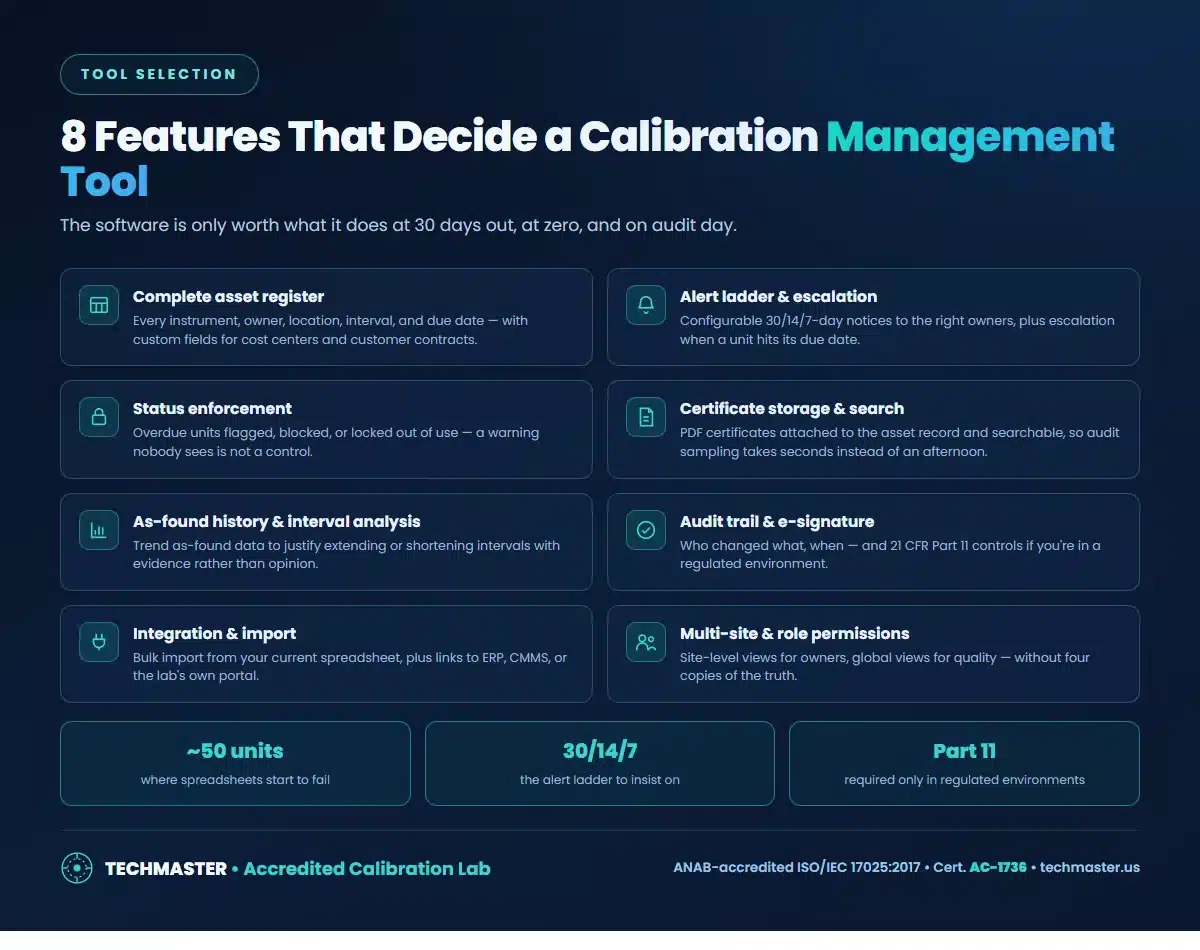
The asset register and alert ladder are table stakes, but status enforcement is what separates a database from a control: a warning nobody sees is not a control, so the tool should flag, block, or lock out overdue units. Certificate storage with search turns audit sampling from an afternoon into seconds. As-found history is the quietly valuable one: trending as-found data is what lets you extend intervals with evidence rather than opinion, exactly as described in the interval guide. Add an audit trail (with Part 11 controls if you’re in an FDA-regulated environment), bulk import so migration isn’t a project, and role permissions so multi-site doesn’t mean four copies of the truth.
When is a spreadsheet still fine?
Under about 50 instruments with a single site and one accountable owner, a spreadsheet plus a weekly review genuinely passes audits, the six components in how to build a recall system don’t require software, they require discipline. The failure modes that push you off a spreadsheet are predictable: a broken date formula, one owner on leave, a second site with its own copy, or a regulated customer asking for an audit trail.
The third option: let the lab track it
Buying software isn’t the only answer. Many accredited labs manage due dates for their customers, holding the instrument list, tracking intervals, and sending recall notices ahead of each cycle. It works best when a single lab covers most of your fleet, which is one more argument for the vendor consolidation lever in the calibration budget guide. Techmaster does this for managed accounts across its 5 US labs.
Frequently asked questions
Do I need calibration management software?
Under roughly 50 instruments, a disciplined spreadsheet with a weekly review usually passes audits. Past that, or across multiple sites, or in a regulated environment needing audit trails and e-signatures, dedicated software pays for itself in avoided overdue instruments and faster audit sampling.
What features matter most in calibration management software?
A complete asset register, a configurable alert ladder with escalation, status enforcement that actually blocks overdue units, searchable certificate storage, as-found history for interval analysis, an audit trail, bulk import and integrations, and multi-site role permissions.
Can my calibration lab manage due dates for me?
Many accredited labs do. For managed accounts, the lab holds the instrument list, tracks intervals, and sends recall notices ahead of each cycle, which removes the alert ladder from your plate entirely. It works best when one lab covers most of your fleet, so the list stays in one place.
Does calibration software need 21 CFR Part 11 compliance?
Only in FDA-regulated environments where the records are electronic. If you’re a medical device or pharma manufacturer keeping calibration records electronically, Part 11 controls, audit trails, e-signatures, access control, are required. Outside those industries they’re a nice-to-have, not a requirement.
The bottom line
Pick the tool by what it does at 30 days out, at zero, and on audit day, not by its dashboard. And weigh the lab-managed option honestly: for many fleets it delivers the same outcome with no license to renew. Vendor criteria are in the 12-point checklist.
Get an accredited calibration quote
ANAB-accredited ISO/IEC 17025:2017 (Cert. AC-1736) • 4 accredited US labs • 5-day standard, 1–2 day expedite • in-lab or on-site.
Request a quoteReferences & industry standards
- ISO/IEC 17025 testing & calibration laboratory requirements
- NIST calibration services and measurement traceability
- A2LA / ANAB accreditation for calibration laboratories
External standards bodies. Techmaster Electronics is an ISO/IEC 17025-accredited, NIST-traceable calibration laboratory.

Khanh Nguyen is the Marketing Manager at Techmaster Electronics, a B2B marketing leader covering the test, measurement, and ISO/IEC 17025 accredited calibration industry in the United States.