TL;DR: IATF 16949 is prescriptive where ISO 9001 is general. Externally calibrated equipment must come from a laboratory with an ISO/IEC 17025 accredited scope covering the work (or a customer-approved alternative); an internal lab needs a defined scope in the quality system. Records must carry as-found data and revision levels, out-of-tolerance findings require customer notification when suspect product shipped, and MSA studies sit alongside, not instead of, calibration.
Automotive suppliers get caught by the same three things: an unaccredited lab on the approved list, an internal lab with no defined scope, and MSA treated as a substitute for calibration. Here’s what auditors actually verify.
What does IATF 16949 require for calibration?
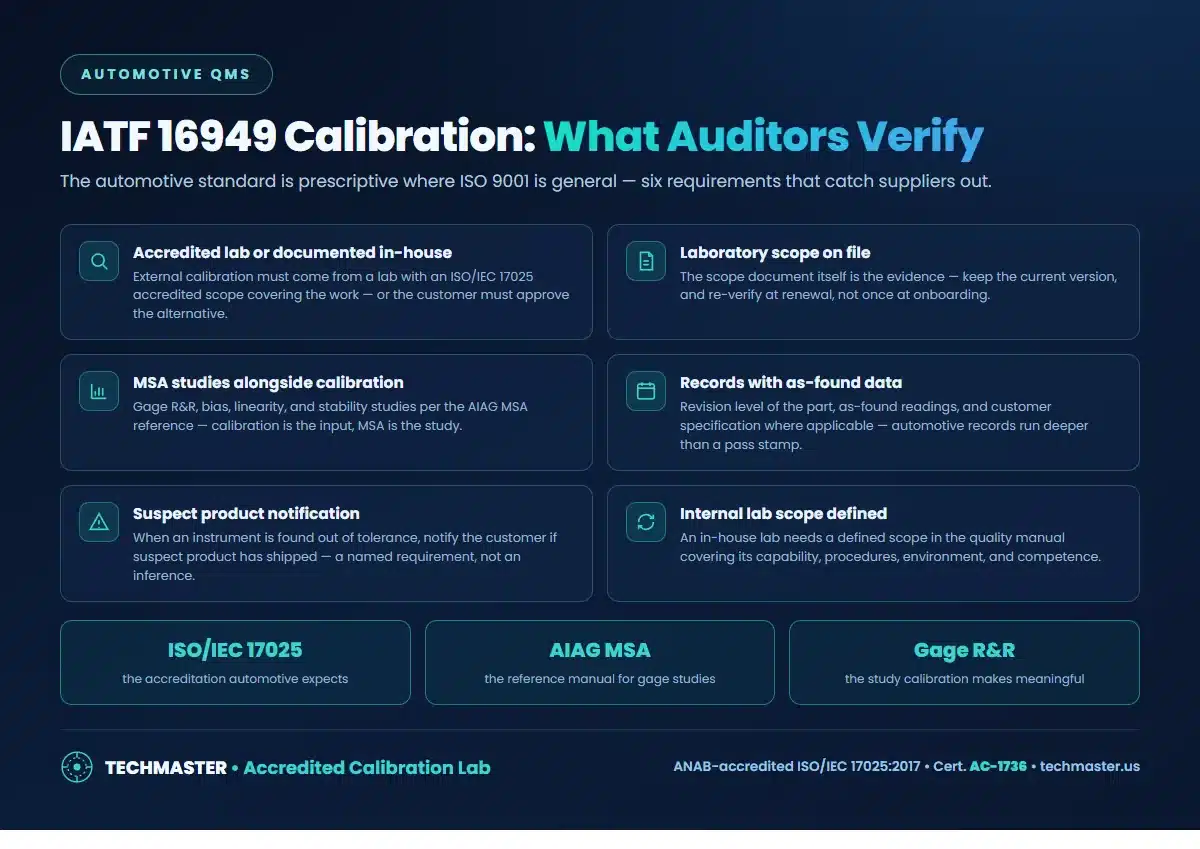
The core requirement is laboratory scope: external calibration comes from a lab whose ISO/IEC 17025 accreditation actually covers the parameter and range being calibrated. That means keeping the current scope document on file and re-checking it at renewal, not filing it once at onboarding. An internal laboratory is permitted, but its scope must be defined in the quality system, with procedures, environment, and competence to match. Records go deeper than the ISO 9001 baseline in clause 7.1.5: revision level, as-found readings, customer specification, and documented action when a unit is out of specification.
Where MSA meets calibration
These are complementary, and conflating them is a finding. Calibration establishes that the instrument reads true against a traceable standard. MSA, Gage R&R, bias, linearity, stability, per the AIAG reference manual, establishes how the measurement system behaves in your process, operators included. A gage that passes R&R while out of calibration is repeatably wrong; a calibrated gage with poor R&R is unusable in production. You need both, and calibration is the input that makes the MSA meaningful. The vocabulary distinctions behind this are in calibration vs verification vs adjustment and the calibration terms glossary.
The suspect-product requirement
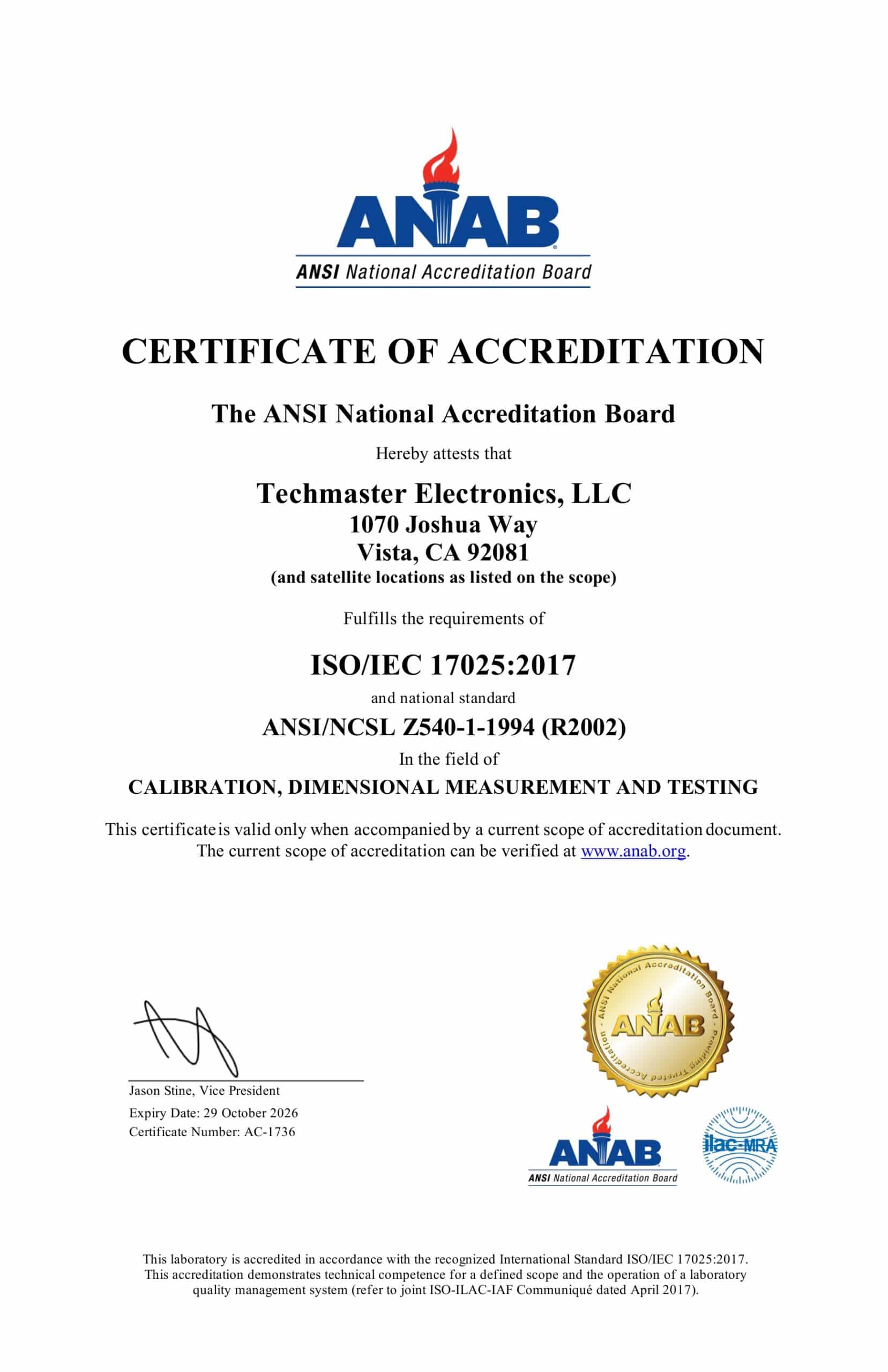
When equipment is found out of specification, automotive requires assessment of the validity of prior measurements and customer notification if suspect product has shipped. Build that into your out-of-tolerance procedure now, not during the event, and insist your lab supplies as-found data on every certificate, since without it the assessment can’t be made. Techmaster supplies as-found/as-left data on accredited certificates as standard, under ANAB certificate AC-1736.
Frequently asked questions
Does IATF 16949 require ISO/IEC 17025 accredited calibration?
Yes, in effect. IATF 16949 requires external laboratory services to come from a laboratory whose scope of ISO/IEC 17025 accreditation covers the calibration being performed, or, where an accredited laboratory is not available, from a source the customer has approved. The accredited scope document is the evidence, and it should be kept current on file.
What is the difference between calibration and MSA?
Calibration compares an instrument to a traceable standard and documents the result. MSA, measurement systems analysis, studies how the whole measurement system behaves in your process, including operators and method: Gage R&R, bias, linearity, and stability. Calibration is an input to MSA; it does not replace it, and MSA does not replace calibration.
What calibration records does IATF 16949 expect?
Records deeper than a pass stamp: the instrument identification and revision level, as-found readings against specification, the standard used, the customer specification where applicable, and evidence of action taken when equipment was found out of specification, including notification when suspect product may have shipped.
Does an internal calibration laboratory satisfy IATF 16949?
It can, but the internal laboratory needs a defined scope in the quality system covering its capability, documented procedures, environmental controls, and personnel competence. Anything outside that defined scope must go to an accredited external laboratory.
The bottom line
Verify your calibration lab’s accredited scope covers the work, define your internal lab’s scope, keep as-found data, and treat MSA as a companion to calibration rather than a replacement. Related reading for other regulated verticals: AS9100 and ISO 13485 / FDA.
Get an accredited calibration quote
ANAB-accredited ISO/IEC 17025:2017 (Cert. AC-1736) • 4 accredited US labs • 5-day standard, 1–2 day expedite • in-lab or on-site.
Request a quoteReferences & industry standards
- ISO/IEC 17025 testing & calibration laboratory requirements
- NIST calibration services and measurement traceability
- A2LA / ANAB accreditation for calibration laboratories
External standards bodies. Techmaster Electronics is an ISO/IEC 17025-accredited, NIST-traceable calibration laboratory.

Khanh Nguyen is the Marketing Manager at Techmaster Electronics, a B2B marketing leader covering the test, measurement, and ISO/IEC 17025 accredited calibration industry in the United States.