
A laboratory fume hood is the main protection between a chemist and the vapors they work with. A hood can look normal, with the fan running and the monitor reading green, and still let contaminants spill into the room. Drafts from a door, a sash raised too high or an exhaust system that has been rebalanced can all cause it.
Fume hood testing measures how much air the hood pulls and how well it contains what is released inside it, and documents the result so safety officers and auditors can rely on it.
What a fume hood test includes
| Test | What it shows |
|---|---|
| Face velocity | The average speed of air entering the sash opening, measured on a grid across the face. Many lab ventilation programs target around 80 to 120 feet per minute, with your own safety program setting the exact limit. |
| Flow visualization (smoke) | Smoke released around the face, the work surface and the sash shows where air rolls back out, stalls or reverses. |
| Containment (tracer gas) | The ANSI/ASHRAE 110 test releases a tracer gas inside the hood and measures how much reaches the breathing zone of a mannequin standing at the sash. |
| Sash and monitor checks | Confirms the airflow monitor and alarm agree with measured flow, and that the sash stops and labels are correct. |
Why face velocity alone is not enough
Face velocity is easy to measure, so it is often the only number recorded. But a hood can meet its face velocity target and still leak. Turbulence from a nearby supply diffuser, a person walking past, or large equipment inside the hood can all push contaminants out through the opening. That is why the ASHRAE 110 method adds smoke visualization and a tracer gas test: they measure containment directly, rather than inferring it from airflow.
As-installed, as-used and routine testing
ASHRAE 110 distinguishes when a hood is tested: as manufactured in the factory, as installed in your building, and as used with your equipment and sash habits. For an operating lab, the as-installed and as-used results are the ones that reflect real protection. Most safety programs then verify face velocity and run smoke checks every year, and repeat the full evaluation after any change to the exhaust system, the room supply air or the hood itself.
Preparing for a test
- Clear the hood of unnecessary equipment and chemicals, or tell the technician what must stay in place.
- Keep lab doors in their normal position and the HVAC in normal operation.
- Have the hood’s design sash height and any previous reports available.
- Plan for the hood to be out of use while it is tested.
Related cleanroom and containment testing
Fume hood testing is often scheduled with other containment work on the same visit. See biological safety cabinet certification and cleanroom testing and certification.
Accreditation and certificates
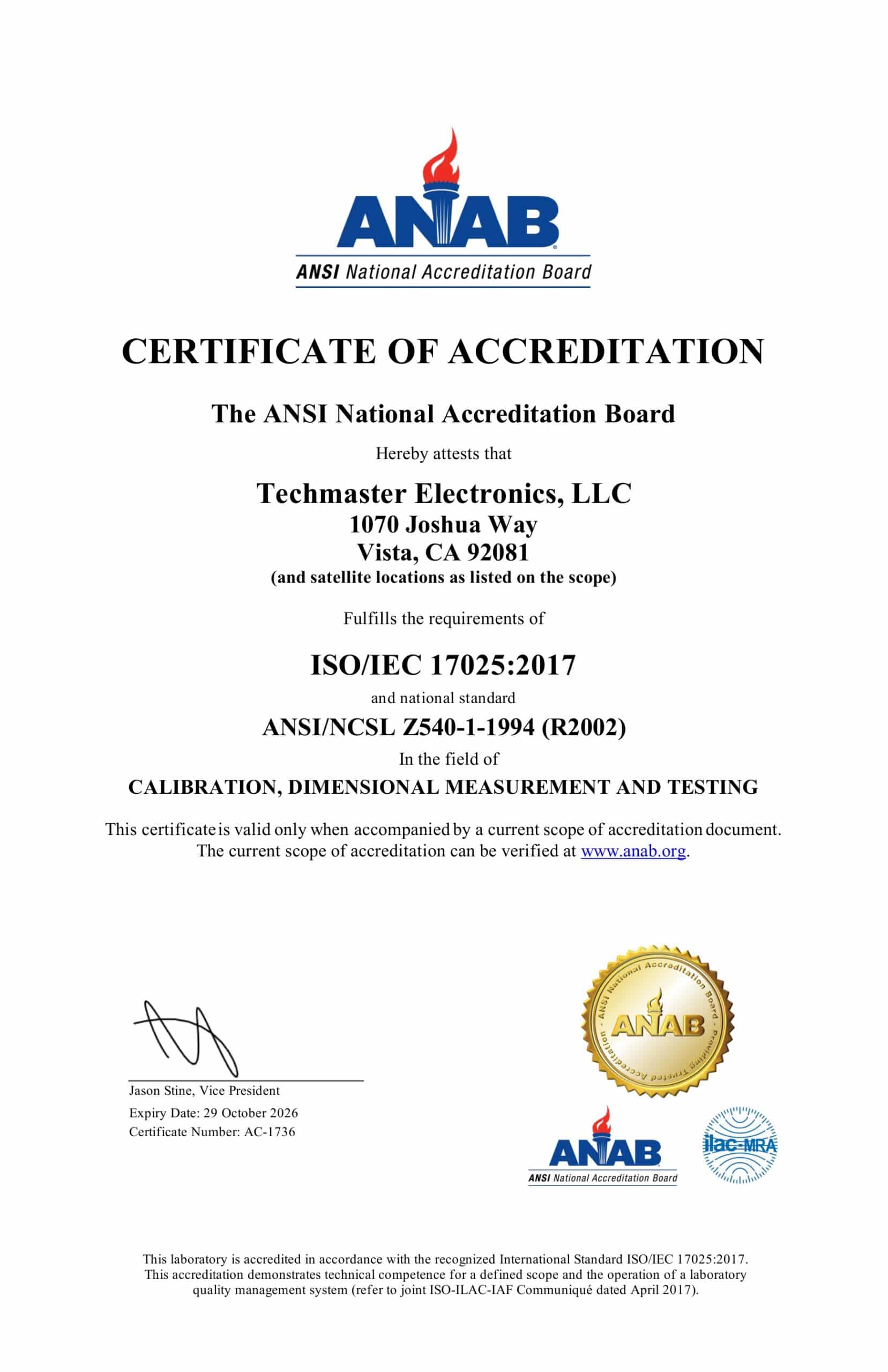
Fume hood testing to ANSI/ASHRAE 110 (face velocity, smoke pattern and containment) is on Techmaster’s ANAB ISO/IEC 17025 scope (certificate AC-1736), so certificates carry the ANAB accreditation symbol along with as-found and as-left data and measurement uncertainty.
Frequently asked questions
What is ASHRAE 110?
What face velocity should a fume hood have?
How often should fume hoods be tested?
Is Techmaster's fume hood testing accredited?
Related calibration guides
References & industry standards
- ISO/IEC 17025 testing & calibration laboratory requirements
- NIST calibration services and measurement traceability
- A2LA / ANAB accreditation for calibration laboratories
External standards bodies. Techmaster Electronics is an ISO/IEC 17025-accredited, NIST-traceable calibration laboratory.
Accredited calibration at Techmaster
Techmaster Electronics is an ANAB-accredited (Certificate AC-1736) ISO/IEC 17025:2017 calibration laboratory with five US labs, NIST-traceable standards and a full measurement-uncertainty budget on every certificate — in-lab or nationwide on-site, with 5-business-day standard turnaround and expedite options. See our calibration services or request a quote.

Khanh Nguyen is the Marketing Manager at Techmaster Electronics, a B2B marketing leader covering the test, measurement, and ISO/IEC 17025 accredited calibration industry in the United States.