
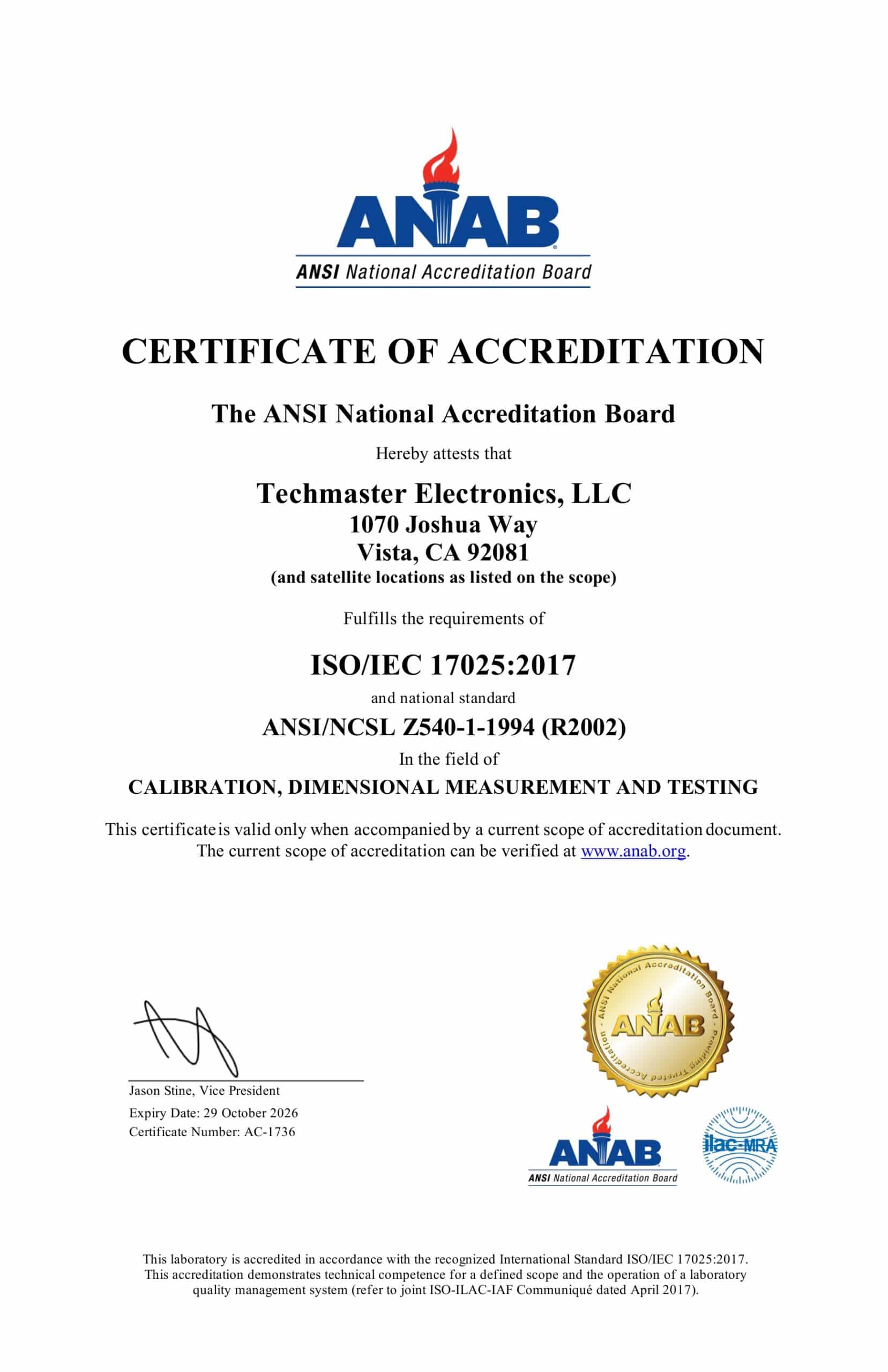
Finding the Best Handheld Particle Counter for Cleanroom & Semiconductor Applications
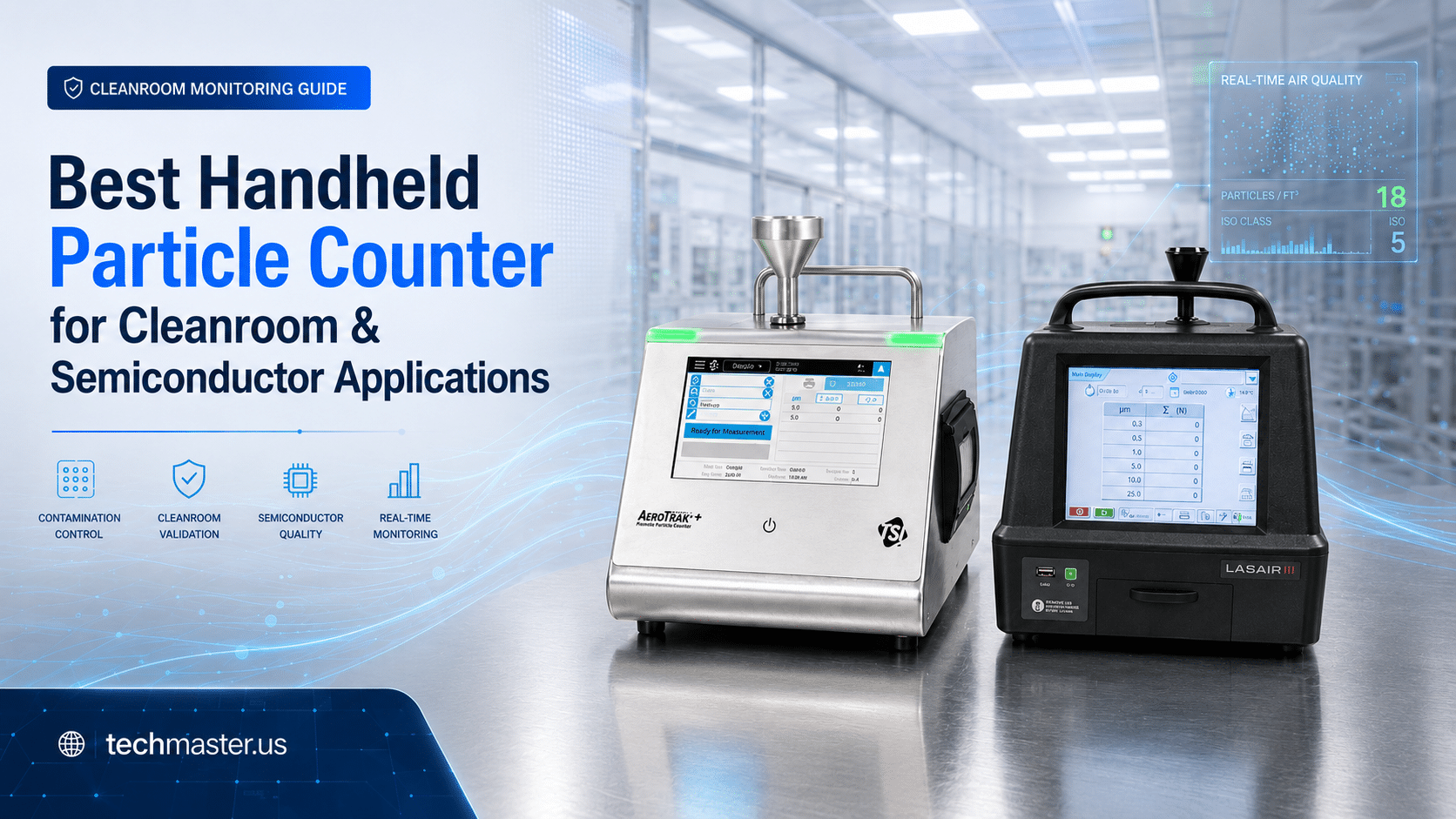
Note on particle counters: This page is for general information only. Techmaster does not calibrate particle counters of any make or model, and particle counters are not on our ANAB ISO/IEC 17025 scope (certificate AC-1736). Techmaster only performs calibration services that are covered by our scope. For particle counter calibration, please contact your instrument’s manufacturer or its authorized service provider, and follow any service requirements they specify. If you prefer, send us your request and, with your permission, we will forward it to the manufacturer. See what is on our accredited scope.
Invisible airborne contaminants pose a massive threat to high-tech manufacturing. Facilities operating in the semiconductor and sterile pharmaceutical sectors must maintain incredibly strict air quality standards. A single microscopic particle can bridge a microchip circuit or contaminate a sterile batch, leading to millions of dollars in losses. Consequently, quality managers must utilize precise, reliable environmental monitoring equipment.
Selecting the best handheld particle counter for cleanroom & semiconductor environments is a critical strategic decision. Quality engineers need reliable tools that offer absolute precision, robust data integrity, and operator ergonomics. In this complete guide, we will explore the core technology behind these instruments. We will evaluate the top brands in the market to help you make an informed choice. In addition, we will detail the critical maintenance and calibration procedures required to keep these sensitive instruments performing flawlessly over their lifespan.
1. What Is a Handheld Particle Counter?
A handheld particle counter serves as a highly mobile, compact diagnostic tool. Industrial hygienists and cleanroom operators use it to detect, size, and count airborne particulate matter in real-time. These devices operate using the principle of laser light scattering.
Specifically, the unit features an internal vacuum pump that draws a precise, controlled volume of ambient air into a specialized sample chamber. Inside this chamber, a high-intensity laser diode illuminates the airflow. As microscopic particles cross the laser beam, they scatter the light. A highly sensitive photodetector then captures this scattered light energy. By analyzing the intensity and frequency of the light pulses, the instrument calculates both the exact size of the particles and their overall concentration in the environment.
Unlike heavy stationary monitoring systems, manufacturers design handheld models for extreme mobility. Technicians easily carry them to conduct rapid spot-checks, identify localized contamination events, and verify standard [cleanroom particle monitoring]([INSERT URL]) protocols across multiple facility zones.
2. Why the Best Handheld Particle Counter for Cleanroom & Semiconductor Matters
3. Suggested Best Handheld Particle Counters for Cleanroom & Semiconductor
When conducting a comprehensive [portable particle counter comparison]([INSERT URL]), several brands consistently lead the industry. The “best” instrument ultimately depends on your facility’s specific workflows and compliance demands. Here are the top recommendations for cleanroom and semiconductor applications:
3.1 Lighthouse Worldwide Solutions (ApexZ Series)
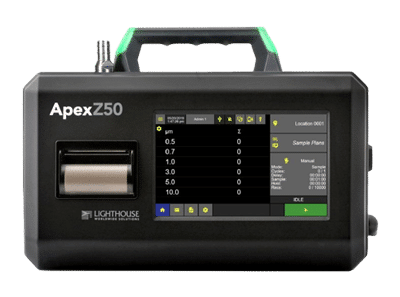
Lighthouse consistently leads the market in operator ergonomics and user interface design. The ApexZ series represents a top choice for semiconductor facilities requiring fast, multi-zone monitoring.
-
Key Strengths: Lighthouse engineers these devices with highly responsive color touchscreens and intuitive menus. They feature hot-swappable batteries, allowing operators to work continuous shifts without powering down the device. In addition, their enclosures withstand harsh cleaning agents like Vaporized Hydrogen Peroxide (VHP).
-
Best For: Facilities prioritizing extreme mobility, user-friendly operation, and smooth wireless Wi-Fi integration into Laboratory Information Management Systems (LIMS).
3.2 Particle Measuring Systems (HandiLaz and Lasair Series)
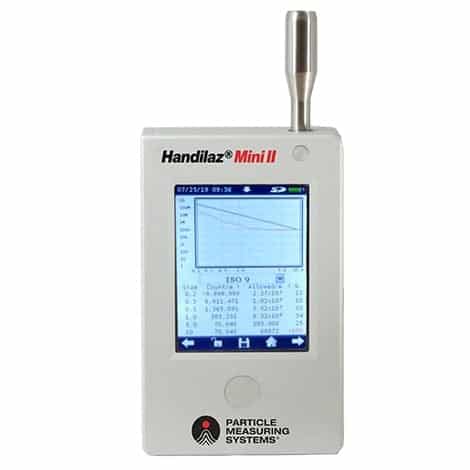
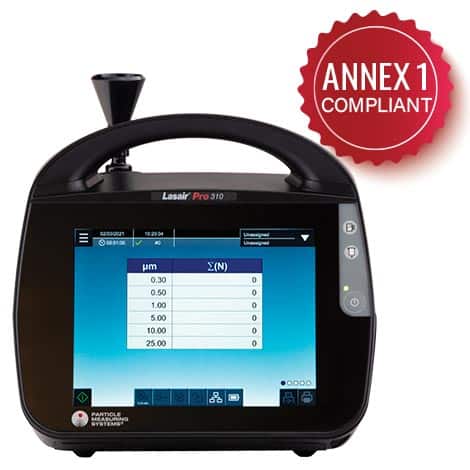
Particle Measuring Systems (PMS) anchors itself deeply in pharmaceutical, life science, and high-tier semiconductor compliance.
-
Key Strengths: PMS focuses heavily on unshakeable data security. Their instruments emphasize strict FDA 21 CFR Part 11 compliance. They generate highly secure, encrypted audit trails and often feature advanced NFC user authentication to restrict unauthorized access.
-
Best For: Highly regulated environments where data integrity, audit-ready reporting, and strict user access controls are the highest priorities.
3.3 TSI Incorporated (AeroTrak Series)
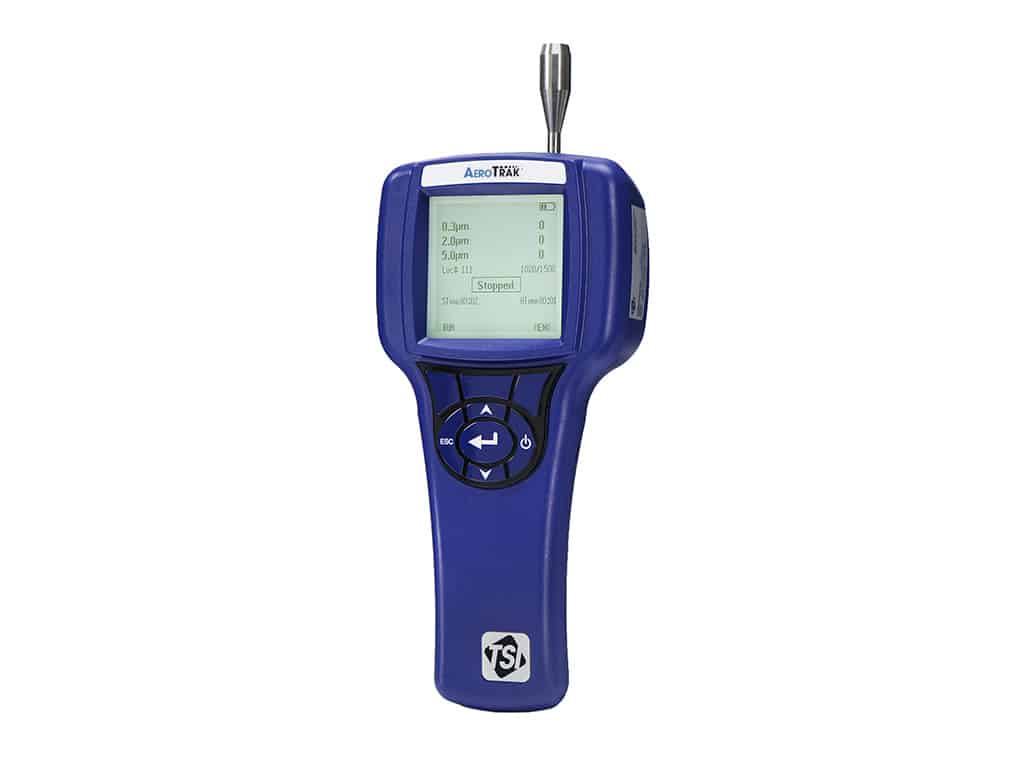
TSI holds a massive legacy in aerosol science and fluid dynamics. Their AeroTrak handheld particle counters deliver exceptional laser accuracy and reliable mechanical performance.
-
Key Strengths: TSI provides incredibly robust internal pumps and highly accurate laser diodes. Researchers and standardization bodies frequently cite TSI technology in academic literature, cementing their reputation for pure measurement precision.
-
Best For: Pure engineering environments and research laboratories that demand rugged durability and scientifically rigorous particulate data.
4. Common Applications
Facilities deploy portable particle counters across numerous quality-driven and highly regulated sectors to maintain environmental control:
-
Semiconductor Manufacturing: Quality managers heavily monitor photolithography and wafer fabrication zones. Even a 0.1µm particle can ruin a valuable silicon wafer.
-
Pharmaceutical and Biotech Cleanrooms: Lab technicians routinely verify sterile compounding areas, fill-finish lines, and isolation wards to prevent dangerous biological or particulate contamination.
-
Aerospace and Defense: Engineers require ultra-clean environments when assembling sensitive optical arrays, satellites, and precision navigation equipment.
-
Medical Device Manufacturing: Facilities must prove their assembly environments remain sterile to secure FDA approval for implantable devices.
-
HVAC and HEPA Filter Testing: Industrial hygienists utilize handheld counters to track down duct leaks, verify filter efficiency, and optimize general indoor air quality.
5. Calibration Standards and Traceability
Even the most expensive particle counter loses its value if its data proves inaccurate. To maintain absolute particle counter accuracy, you must subject your fleet to rigorous, accredited calibration.
Metrology experts calibrate these instruments according to the stringent ISO 21501-4 standard. This standard dictates specific testing methodologies for sizing resolution, counting efficiency, flow rate accuracy, and false count limits. In addition, your laboratory must perform NIST-traceable calibrations. This guarantees that technicians trace all reference materials, such as precision Polystyrene Latex (PSL) calibration spheres, directly back to the National Institute of Standards and Technology. Relying on an ISO/IEC 17025 accredited laboratory ensures you receive audit-ready certificates complete with documented measurement uncertainty.
6. Common Issues Found During Calibration
Because technicians constantly move handheld instruments around busy facilities, the devices face significant physical and environmental stress. During routine maintenance, metrologists frequently uncover several common performance issues:
-
Laser Diode Degradation: The internal laser naturally loses intensity over thousands of hours of operation. Consequently, the instrument begins to miss smaller particles or under-size them, leading to false passing grades for your cleanroom.
-
Flow Rate Drift: The internal vacuum pump experiences mechanical wear over time. If the pump degrades, the instrument samples an incorrect volume of air. This issue produces wildly inaccurate particle concentration calculations.
-
Contaminated Optical Pathways: Using the device in heavily contaminated environments without properly utilizing a zero-count purge filter leaves chemical films on internal mirrors. Therefore, the device distorts the light scattering process and records false positive counts.
-
Mechanical and Sensor Damage: Accidental drops loosen internal optical alignments. In addition, heavy impacts can damage the sensitive photodetector, resulting in intermittent power failures and corrupted data logs.
7. How Often Should This Equipment Be Calibrated?
To maintain regulatory compliance and ensure flawless environmental data, you must calibrate handheld particle counters annually (every 12 months).
However, specific facility factors often compel quality managers to shorten this calibration interval:
-
High Usage Frequency: An instrument operating continuously across multiple daily shifts experiences faster laser degradation than a unit reserved for weekly audits.
-
Harsh Environments: Sampling air that contains high chemical vapors or heavy abrasive dust necessitates semi-annual maintenance schedules.
-
Internal QMS Requirements: Many aerospace and pharmaceutical Quality Management Systems (QMS) enforce strict 6-month calibration cycles. By shortening the interval, facilities aggressively mitigate the risk of an out-of-tolerance failure, which could trigger a catastrophic product recall.
8. What to Look for in a Calibration Provider
Selecting a highly qualified calibration laboratory requires careful vendor evaluation. When auditing a potential metrology partner, you should look for several critical indicators of technical competence:
-
ISO/IEC 17025 Accreditation: This globally recognized accreditation proves the laboratory utilizes validated procedures, maintains strict environmental controls, and employs highly trained metrologists.
-
ISO 21501-4 Capability: The lab must physically possess the primary reference standards, sophisticated aerosol generators, and precision PSL spheres required to perform fully compliant airborne particle counter calibration.
-
Documented Measurement Uncertainty: Your provider must explicitly state the measurement uncertainty on every calibration certificate. Auditors will reject certificates lacking this crucial metric.
-
Turnaround Time: You should seek a laboratory that offers rapid processing to minimize disruption to your facility’s environmental monitoring schedule.
-
On-Site Service Capabilities: If you manage a large fleet of monitoring equipment, look for providers that can deploy technicians directly to your facility, effectively eliminating shipping risks and equipment downtime.
9. Why Choose Techmaster Electronics?
Proven Industrial Expertise
When your production yield and regulatory compliance rely on the absolute precision of your environmental data, you need a metrology partner with proven industrial expertise. Techmaster Electronics is an ISO/IEC 17025 accredited calibration laboratory for test and measurement equipment. It does not calibrate particle counters; for ISO 21501-4 calibration, use the manufacturer or its authorized service provider.
Techmaster does not calibrate particle counters. Contact your instrument’s manufacturer or its authorized service provider.
At Techmaster Electronics, we prioritize absolute measurement accuracy, strict NIST traceability, and superior customer convenience. Whether you need rapid turnaround inside our state-of-the-art laboratories or reliable on-site support at your manufacturing plant, we deliver the audit-ready documentation you require. In the end, we partner with you to keep your cleanrooms compliant, your data secure, and your production lines moving.
10. Conclusion
Determining the best handheld particle counter for cleanroom & semiconductor applications requires you to evaluate your specific facility needs. Brands like Lighthouse offer unmatched ergonomics and connectivity, while Particle Measuring Systems champions pharmaceutical data integrity. TSI provides unparalleled aerosol science legacy. However, regardless of the brand you select, routine maintenance remains completely non-negotiable. In the end, only accredited, ISO 21501-4 compliant calibration ensures your instrument continues to deliver the precise, reliable data necessary to protect your cleanrooms and pass rigorous regulatory audits.
11. FAQ Section
Frequently Asked Questions
Expert answers on selecting, maintaining, and calibrating handheld particle counters for strictly controlled cleanroom environments.
Ready for Expert Support?
Contact Techmaster Electronics today to discuss your calibration requirements and keep your measurement equipment accurate, reliable, and compliant.
Related reading: what an ISO 21501-4 calibration certificate must show
References & industry standards
- ISO/IEC 17025 testing & calibration laboratory requirements
- NIST calibration services and measurement traceability
- NIST Time and Frequency Division
- A2LA / ANAB accreditation for calibration laboratories
External standards bodies. Techmaster Electronics is an ISO/IEC 17025-accredited, NIST-traceable calibration laboratory.
Frequently asked questions
What is handheld particle counter calibration?
Handheld Particle Counter Calibration is the documented comparison of a handheld particle counter against NIST-traceable reference standards. It quantifies the handheld particle counter’s error and measurement uncertainty and confirms it performs within tolerance, with as-found and as-left data on the certificate.
How often should a handheld particle counter be calibrated?
Most quality systems calibrate a handheld particle counter every 12 months, or sooner after repair, overload, or before critical measurements. Set your interval from the manufacturer spec and your ISO 9001 / 13485 / AS9100 program and drift history.
Does Techmaster calibrate handheld particle counters?
No. Techmaster Electronics is ISO/IEC 17025:2017 accredited by ANAB (Certificate AC-1736), but particle counters are not on that scope, and Techmaster does not calibrate particle counters of any make or model. For calibration, contact your instrument’s manufacturer or its authorized service provider.
How long does handheld particle counter calibration take?
Turnaround is set by the manufacturer or authorized provider that performs the calibration, so ask them before you ship. Techmaster does not calibrate particle counters.
Where should I send a handheld particle counter for calibration?
To the instrument’s manufacturer or one of its authorized service providers, following any service requirements they specify. Techmaster does not calibrate particle counters; if you send us your request, with your permission we will forward it to the manufacturer.

Khanh Nguyen is the Marketing Manager at Techmaster Electronics, a B2B marketing leader covering the test, measurement, and ISO/IEC 17025 accredited calibration industry across the US and Vietnam markets.