
Expert DC Electronic Load Calibration Services in the US
Modern electronics manufacturing demands absolute precision in every single phase. Product developers design highly complex power systems for global consumers. Engineers rely on programmable DC electronic loads every single day. They use these critical instruments to test power supplies and batteries. Solar panel designers also depend heavily on these versatile laboratory devices. These machines emulate real-world power demands perfectly on the test bench.
However, natural electrical component drift degrades measurement accuracy over time. Thermal stress from heavy industrial usage accelerates this internal component drift significantly. Inaccurate readings ultimately cause false passes and dangerous product failures. Defective products severely compromise your entire quality assurance process. Partnering with a trusted metrology lab prevents these massive costly issues. You need reliable dc electronic load calibration services to maintain your production quality.
Sometimes, you absolutely cannot afford any test equipment downtime. Production lines must keep moving to meet strict customer deadlines. Techmaster Electronics proudly offers a convenient electronic load rental service. You can rent temporary replacement units instantly from our massive equipment inventory. This smart strategy keeps your R&D projects running smoothly. Your engineers continue working while our metrology experts calibrate your primary instruments.
1. What Is DC Electronic Load Calibration?
Technicians perform calibration to ensure your equipment measures electrical power correctly. They compare your electronic load against a highly accurate reference standard. Metrologists verify that the instrument operates perfectly within original equipment manufacturer (OEM) specifications. They utilize high-precision digital multimeters and highly stable reference power supplies. The laboratory carefully controls temperature and humidity during the entire calibration process.
A thorough dc electronic load calibration procedure evaluates several core operating modes.
-
Constant Current (CC): Technicians ensure the load draws the exact specified current smoothly. They verify stability regardless of sudden input voltage fluctuations.
-
Constant Voltage (CV): Experts verify the load sinks enough current accurately. The instrument must maintain the precise programmed voltage level without drifting.
-
Constant Resistance (CR): Metrologists check the complex internal control loops thoroughly. These internal loops safely simulate a fixed physical resistance for the device under test.
-
Constant Power (CP): The lab validates the dynamic internal hardware feedback mechanisms. The load must adjust current continuously to draw a constant overall wattage.
2. Why DC Electronic Load Calibration Services Matter
The Hidden Risks of Skipping Calibration
Skipping routine equipment calibration introduces major hidden risks into your facility. Professional calibration guarantees that your critical test equipment performs perfectly. This rigorous metrology process impacts your business success in several vital ways.
Measurement Accuracy and Traceability
Traceable calibration gives real mathematical meaning to your complex test results. You gain absolute certainty in your daily electrical measurement data. A 1000W product test must reflect exactly 1000W of actual power draw.
Strict Regulatory Compliance
Aerospace and medical device industries operate under strict quality management systems. Auditors demand strictly calibrated testing equipment on the active production floor. Proper laboratory calibration helps you avoid failed audits and revoked industry certifications.
Product Safety and Quality
Accurate laboratory measurements prevent dangerously defective batteries from reaching consumers. You stop dangerous thermal runaways and electrical fires right at the factory level. Safe products build strong consumer trust in your global manufacturing brand.
Risk Reduction & Cost Savings
Routine calibration costs far less than disastrous global product recalls. You proactively protect your brand reputation and avoid massive warranty claims. Accurate product testing stops expensive production delays and cuts manufacturing waste.
Don’t compromise on quality. Calibrate regularly to secure your success.
3. Common Applications for DC Electronic Loads
Industries everywhere utilize DC electronic loads for rigorous product stress testing. Different high-tech sectors have incredibly unique and demanding electrical testing requirements.
-
Electric Vehicles (EV) and Automotive: Automotive engineers test high-voltage EV battery packs daily. They validate onboard chargers (OBC) and high-power DC-DC converters safely. High current requirements make routine EV equipment calibration absolutely essential.
-
Aerospace and Defense: Defense contractors validate critical aircraft power buses rigorously. Satellite power systems demand uncompromising electrical reliability in harsh environments. Aerospace equipment requires meticulous measurement uncertainty calculations during routine calibration.
-
Alternative Energy: Solar manufacturers map the I-V curves of photovoltaic cells accurately. Engineers evaluate massive energy storage systems using high-power DC loads.
-
Consumer Electronics and IT: Hardware developers test modern smartphone batteries and USB-C adapters carefully. Server farm architects validate massive power supplies for modern data centers. Electronic loads remain ubiquitous in every hardware development laboratory globally.
4. Calibration Standards and Traceability
Selecting the Right Metrology Standards
Standard basic calibrations do not provide enough data for critical compliance audits. You must select the right metrology standards for your sensitive testing equipment. Techmaster provides an ISO/IEC 17025 accredited calibration for your vital test instruments.
Elite Laboratory Accreditation
The ISO/IEC 17025 international standard signifies extreme technical competence and strict quality control. Quality auditors heavily respect this accreditation globally.
NIST Traceability
You absolutely need a NIST traceable calibration to guarantee measurement accuracy. This documentation trace creates an unbroken chain of accurate measurement comparisons.
Comprehensive Documentation
Your final certificate should display clear measurement uncertainties prominently. It must also include detailed as-found and as-left measurement data for your records.
✓ Choose the highest level of certainty for your critical testing environments.
5. Common Issues Found During Calibration
DC electronic loads purposefully dissipate massive amounts of electrical power. This core operational function naturally generates intense heat and severe electrical stress. Internal components wear down mechanically and electrically over extended testing periods. Metrologists frequently uncover several common problems during their routine calibration processes.
-
Thermal Drift: High internal temperatures alter delicate internal resistor values over time. This problematic drift causes the load to sink incorrect amounts of current.
-
Setpoint Errors: The programmed current may deviate from the actual physical capability. This dangerous discrepancy leads directly to flawed product stress testing.
-
Readback Degradation: Internal measurement circuits often lose accuracy and report false data. The load acts correctly physically but displays wrong numbers to the human operator.
-
Low Current Offset: High-power loads struggle with precise accuracy at their lowest settings. Metrologists identify zero-offset errors that skew delicate low-power product tests.
-
Slew Rate Issues: The instrument may switch between dynamic current levels too slowly. This electrical lag masks critical transient response issues in your power supplies.
6. How Often Should You Calibrate This Equipment?
Determining the Right Calibration Interval
Quality managers must determine the correct calibration interval for their laboratories. Most equipment manufacturers highly recommend an annual, 12-month calibration cycle. However, you should definitely adjust this interval based on several important factors.
Operating Environment & Usage
High ambient heat or continuous 24/7 usage demands much shorter calibration cycles. Heavy daily usage degrades internal electrical components significantly faster than occasional use.
Quality System Compliance
Your company’s internal ISO 9001 quality manual might dictate strict maintenance timelines. You must follow these internal rules to maintain your overall business compliance.
Historical Performance
Actively review the historical performance of your instrument. If your device consistently drifts, calibrate it more frequently. Highly stable devices might qualify for carefully extended intervals eventually.
💡 Regularly audit your calibration schedule to balance risk management and operational costs.
7. What to Look for in a Calibration Provider
Selecting the right metrology laboratory actively protects your entire manufacturing process. You must evaluate potential calibration partners very carefully before signing service contracts.
First, verify their precise ISO/IEC 17025 accreditation scope online. Ensure they can safely handle the high current requirements of your heavy units. Many basic commercial labs lack the high-current shunts needed for large loads. Next, review their average measurement uncertainty and calculated Test Uncertainty Ratio (TUR).
Choose a professional provider that guarantees rapid, reliable turnaround times. Fast metrology service minimizes your expensive production downtime efficiently. Finally, ask if they provide comprehensive and easily accessible digital certificates. You need immediate online access to these documents during surprise quality audits.
8. Why Choose Techmaster Electronics?
Techmaster Electronics fiercely protects your quality control process with precise metrology solutions. We proudly provide a world-class Calibration service for top manufacturing facilities nationwide. Our experienced metrologists specialize in precise electronic test equipment calibration for all industries.
We easily handle complex electronic loads from Keysight, Chroma, and BK Precision. Our state-of-the-art metrology laboratories deliver accurate, NIST-traceable results every single time. We prioritize deep technical expertise and highly dedicated customer support daily.
Our professional team offers rapid turnaround times to keep your business running. You can even request our expert technicians for convenient on-site laboratory calibration. Partner with Techmaster Electronics to keep your critical test instruments operating at peak performance.
9. Conclusion
DC electronic loads verify the absolute safety and reliability of modern power systems. However, their immense industrial value depends entirely on their fundamental measurement accuracy. Uncalibrated test equipment silently exposes your business to massive financial liabilities. Defective products ruin your brand reputation quickly in competitive modern markets.
You actively protect your product quality by scheduling routine, highly accredited calibration. Contact Techmaster Electronics today to discuss your precise calibration requirements and keep your measurement equipment accurate, reliable, and perfectly compliant.
10. FAQ Section
References & industry standards
- ISO/IEC 17025 testing & calibration laboratory requirements
- NIST calibration services and measurement traceability
- A2LA / ANAB accreditation for calibration laboratories
External standards bodies. Techmaster Electronics is an ISO/IEC 17025-accredited, NIST-traceable calibration laboratory.
Frequently asked questions
What is dc electronic load calibration?
DC Electronic Load Calibration is the documented comparison of a DC electronic load against NIST-traceable reference standards under ISO/IEC 17025. It quantifies the DC electronic load’s error and measurement uncertainty and confirms it performs within tolerance, with as-found and as-left data on the certificate.
How often should a DC electronic load be calibrated?
Most quality systems calibrate a DC electronic load every 12 months, or sooner after repair, overload, or before critical measurements. Set your interval from the manufacturer spec and your ISO 9001 / 13485 / AS9100 program and drift history.
Is Techmaster’s DC electronic load calibration ISO 17025 accredited?
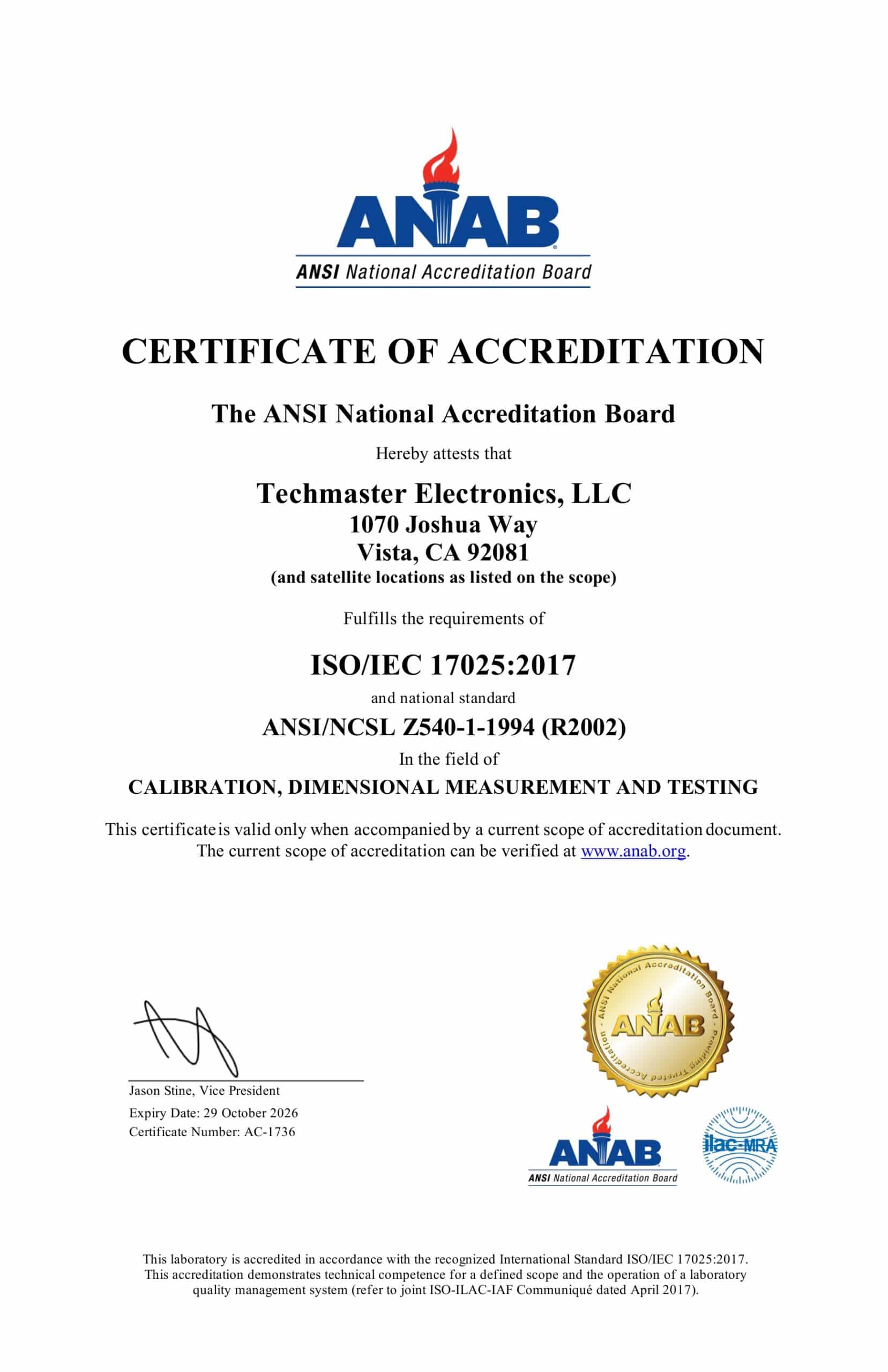
Yes. Techmaster Electronics is ISO/IEC 17025:2017 accredited by ANAB (Certificate AC-1736). Every DC electronic load calibration is NIST-traceable and issued with a full measurement-uncertainty budget.
What is the turnaround for DC electronic load calibration?
Standard turnaround is 5 business days, with 1–2 business-day expedite available. On-site calibration removes shipping time entirely for DC electronic loads that can’t leave the floor.
Do you calibrate DC electronic loads on-site or in-lab?
Both. Techmaster runs five US labs (Vista CA, Santa Clara CA, Orlando FL, San Antonio TX, Holly Springs NC) and offers nationwide on-site DC electronic load calibration to minimize downtime.

Khanh Nguyen is the Marketing Manager at Techmaster Electronics, a B2B marketing leader covering the test, measurement, and ISO/IEC 17025 accredited calibration industry across the US and Vietnam markets.