
What is a test uncertainty ratio (TUR)?
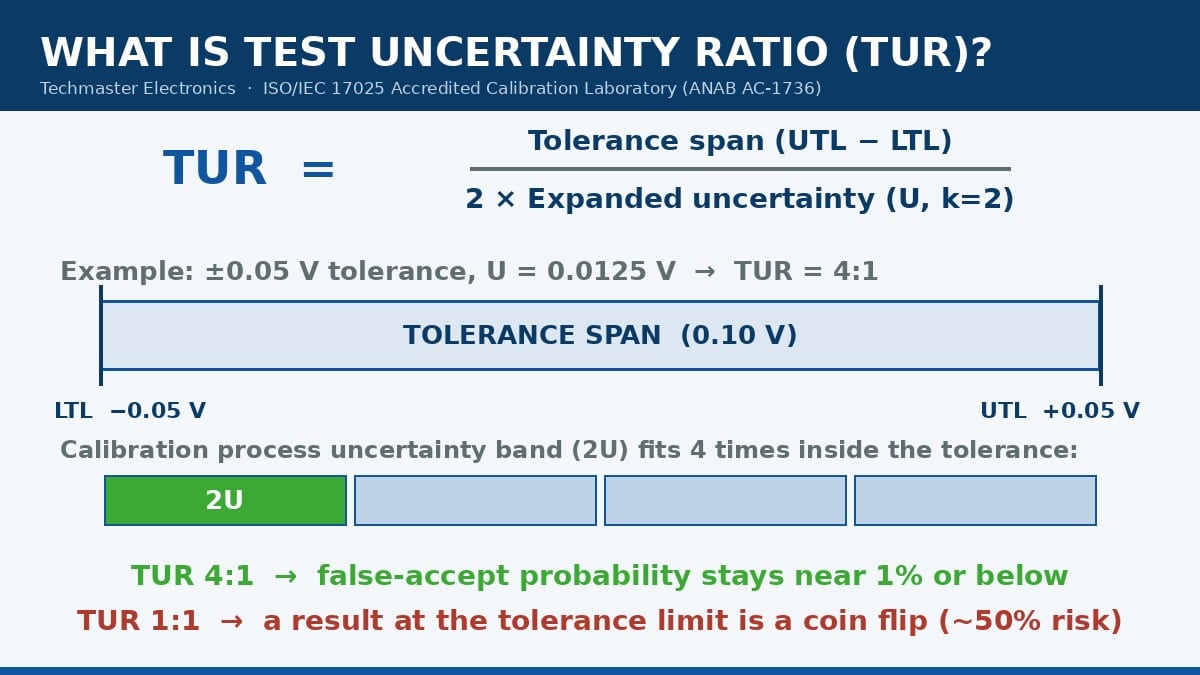
Every calibration compares your unit under test against a reference standard, and that comparison is never perfect. The lab’s reference standards, environment, technique, and resolution all contribute to a quantified expanded measurement uncertainty (U). TUR expresses how much “room” that uncertainty leaves inside your tolerance:
TUR = (Upper tolerance limit − Lower tolerance limit) ÷ 2U
Example: a digital multimeter point with a tolerance of ±0.05 V (a 0.10 V span) calibrated with an expanded uncertainty of 0.0125 V gives TUR = 0.10 ÷ (2 × 0.0125) = 4:1. If the lab’s uncertainty were 0.025 V, the TUR would drop to 2:1, and the confidence behind each “Pass” drops with it.
TUR only exists on calibrations that report measured values and uncertainties, one reason accredited work matters. Techmaster Electronics documents uncertainties on every accredited certificate issued under our ANAB ISO/IEC 17025 accreditation, Certificate AC-1736, from laboratories in Vista CA, Santa Clara CA, Orlando FL, and San Antonio TX.
Why does a 4:1 TUR matter for false-accept risk?
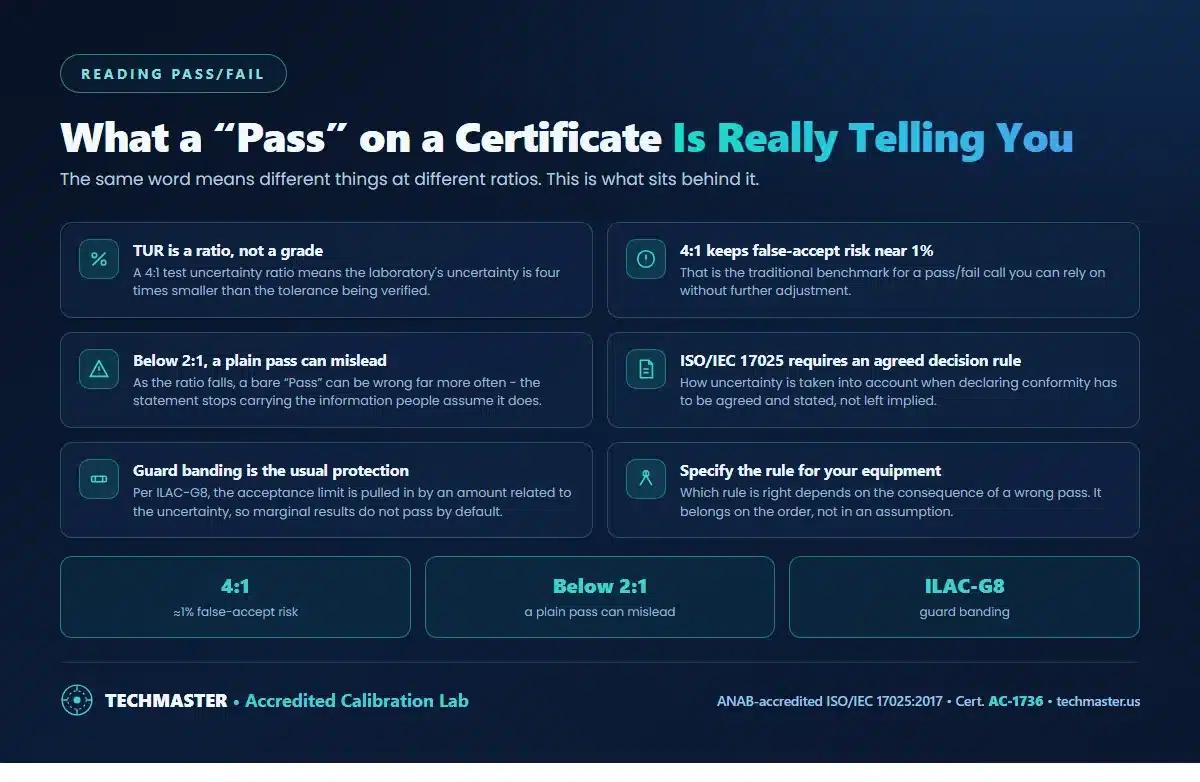
False-accept risk is the quality manager’s real enemy. A false accept means an instrument goes back on your bench with a “Pass” sticker while it is genuinely outside tolerance, and every product it measures inherits that error. That is exactly the scenario that triggers the reverse-traceability investigations we described in our guide to out-of-tolerance calibration results and what to do next.
The relationship between TUR and risk is not linear, it collapses quickly below 2:1. Indicative values for a measurement that falls exactly at the tolerance limit:
| TUR | Approx. worst-case false-accept behavior near a limit | Practical reading |
|---|---|---|
| 10:1 | Negligible | Ideal, rarely economical for high-accuracy DUTs |
| 4:1 | ≤ ~1–2% PFA with simple acceptance in typical processes | Industry benchmark (basis of ANSI/NCSL Z540.3 practice) |
| 3:1 | Rising risk; guard banding recommended | Acceptable with a documented decision rule |
| 2:1 | Marked risk for results near limits | Guard banding strongly recommended |
| 1:1 | Up to ~50% for a result exactly at the limit | A bare “Pass” is statistically meaningless at the limit |
Modern instruments make high TURs harder to achieve: a 6½-digit DMM or a high-end spectrum analyzer can be nearly as accurate as the standards testing it. That is why the conversation has shifted from “demand 4:1 everywhere” to “agree on a decision rule that manages risk when 4:1 is impossible.”
What is a decision rule under ISO/IEC 17025 and ILAC-G8?
Before 2017, most certificates simply said Pass or Fail with no explanation of how uncertainty was handled. The 2017 revision of ISO/IEC 17025 changed that: any statement of conformity must identify the decision rule applied. The international reference for choosing one is ILAC-G8:09/2019, Guidelines on Decision Rules and Statements of Conformity, which defines the main families of rules:
| Decision rule | How it works | Risk profile |
|---|---|---|
| Simple acceptance (shared risk) | Pass if the measured value is inside the tolerance limits; uncertainty is not subtracted | Up to ~50% false-accept risk for results exactly at a limit; customer shares the risk |
| Guarded acceptance (guard band w = U) | Acceptance limits are pulled inside the tolerance by the expanded uncertainty | PFA typically ≤ 2.5% for any result accepted; conservative |
| Guarded acceptance (custom w, e.g., Z540.3 method) | Guard band sized to cap PFA at a target (commonly 2%) | Managed, quantified risk; standard in US defense/aerospace work |
| Guarded rejection | Rejection limits pushed outside tolerance; only clear failures are rejected | Minimizes false rejects; used when unnecessary rework is the bigger cost |
| Non-binary statements | Results near limits reported as “conditional pass/fail” with uncertainty | Full transparency; pushes the final call to the customer’s quality system |
The key word in the standard is agreed. If your purchase order is silent, most labs default to simple acceptance, which quietly transfers the risk near tolerance limits to you.
How does guard banding actually work?
Think of it as a safety margin carved out of the tolerance. With a tolerance of ±1.0 unit and an expanded uncertainty of 0.25 unit, a guard band of w = U produces acceptance limits of ±0.75. A reading of +0.9 would “pass” under simple acceptance but falls in the guard band zone under guarded acceptance, exactly the reading most likely to be a false accept.
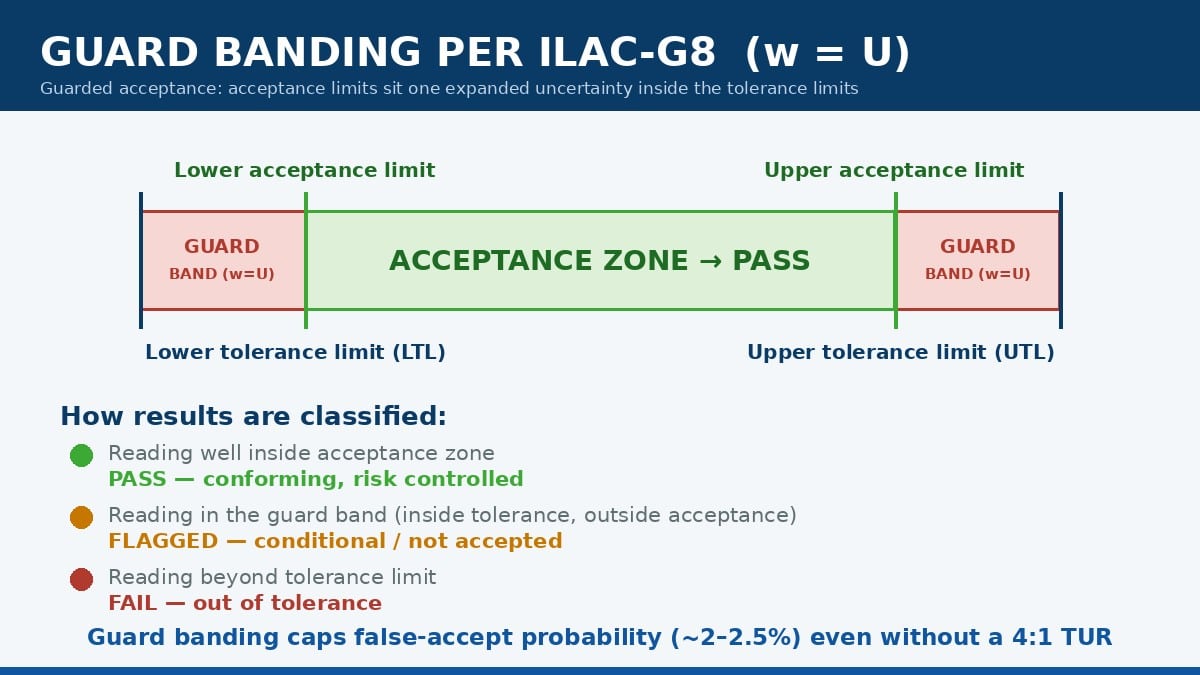
Guard banding is also the practical bridge when a 4:1 TUR cannot be achieved. Rather than pretending the uncertainty doesn’t exist, the lab quantifies it and tightens the acceptance criteria accordingly, keeping the false-accept probability at a known, documented level even at 2:1 or 1.5:1. The method behind ANSI/NCSL Z540.3’s well-known “2% PFA” requirement is a guard-banding calculation; our comparison of Z540 versus ISO/IEC 17025 calibration levels explains when each framework applies.
Which decision rule should you specify for your equipment?
Practical guidance our calibration engineers give quality managers:
- Regulated industries (medical, aerospace, defense): specify guarded acceptance and reference the governing standard (21 CFR 820, AS9100, Z540.3). Auditors increasingly ask to see the decision rule in your supplier agreements.
- Legal metrology and product release testing: guarded acceptance with w = U, the conservative default in ILAC-G8.
- General electronic test equipment: simple acceptance is acceptable when TUR ≥ 4:1; ask the lab to flag any point where TUR falls below 4:1.
- R&D and non-critical monitoring: non-binary reporting can be the most honest choice, you get measured values plus uncertainties and apply your own criteria.
Whatever you choose, put it in writing on the PO or quality agreement. Across the 381,916 calibrations Techmaster has performed in the last ten years, the single most common gap we see in supplier audits is a missing or undocumented decision rule, an easy finding to close.
How does Techmaster state conformity on its certificates?
Our ISO/IEC 17025 accredited calibration services span eight accredited calibration fields across twelve service disciplines, RF/microwave, electrical, calibrators, EMC-EMI, vibration, time & frequency, medical, clean rooms, thermodynamic, chemical, dimensional, and mass/mechanical, with accredited scope verified through the ANSI National Accreditation Board (ANAB) under Certificate AC-1736. Three deliverable levels let you match rigor to risk: Traceable (certificate), Z540 (certificate + data), and ISO/IEC 17025 accredited (certificate + data + uncertainties, the only level on which TUR and guard banding can be evaluated).
If your current certificates show only “Pass” with no uncertainty data, you cannot compute a TUR, cannot verify the decision rule, and cannot defend the result in an audit, a strong reason to move critical instruments to accredited calibration.
Key takeaways
- TUR = tolerance span ÷ 2× expanded uncertainty; 4:1 remains the practical benchmark.
- Below 2:1, a bare “Pass” near a tolerance limit carries major false-accept risk, up to ~50% at the limit itself.
- ISO/IEC 17025:2017 requires an agreed, stated decision rule for every statement of conformity; ILAC-G8:09/2019 is the reference guide.
- Guard banding (acceptance limits tightened by w = U or a PFA-based calculation) keeps risk quantified when high TURs are impossible.
- Specify your decision rule on the purchase order, silence usually defaults to simple acceptance and shifts the risk to you.
- Only accredited calibrations with reported uncertainties (like Techmaster’s ANAB AC-1736 work) let you verify TUR and decision rules at all.
Frequently asked questions
What is a good test uncertainty ratio?
A TUR of 4:1 or better is the traditional benchmark: the calibration process uncertainty is at least four times smaller than the tolerance being verified, keeping false-accept probability near 1% or less in typical processes. When 4:1 is not achievable, common with high-accuracy modern instruments, a documented guard-banding decision rule manages the risk instead.
What is the difference between TUR and TAR?
Test accuracy ratio (TAR) compares your tolerance to the reference standard’s accuracy specification only. TUR compares it to the full expanded measurement uncertainty of the calibration process, which also includes environment, technique, resolution, and repeatability. TUR is the more honest figure and the one ILAC-G8-aligned laboratories use.
Does ISO/IEC 17025 require a 4:1 TUR?
No. ISO/IEC 17025:2017 does not mandate any specific TUR. It requires the laboratory to document and apply a decision rule agreed with the customer whenever it issues a statement of conformity, and to state that rule on the certificate. The 4:1 figure comes from historical practice and from ANSI/NCSL Z540-based programs.
What is a false accept in calibration?
A false accept occurs when an instrument that is truly out of tolerance measures inside the acceptance limits and is declared “Pass.” The instrument returns to service while producing errors larger than your tolerance allows. Guard banding exists specifically to cap the probability of this event at a known level, commonly 2%.
What guard band should I ask my calibration lab to use?
The conservative ILAC-G8 default is a guard band equal to the expanded uncertainty (w = U), which limits false-accept probability to roughly 2.5% for any accepted result. US defense and aerospace programs typically use the ANSI/NCSL Z540.3 approach, sizing the guard band so the probability of false accept does not exceed 2%.
Where is the decision rule shown on a calibration certificate?
On an ISO/IEC 17025:2017 accredited certificate that includes a statement of conformity, the decision rule must be identified on the certificate itself, usually near the conformity statement or in the notes section. If your certificate declares Pass/Fail but names no decision rule, ask the laboratory which rule was applied and have it documented.
Need certificates you can defend in an audit?
Techmaster Electronics, ISO/IEC 17025 accredited calibration laboratory (ANAB Cert. AC-1736), serving the United States since 1989 from labs in Vista CA, Santa Clara CA, Orlando FL, and San Antonio TX. We report uncertainties and apply the decision rule your quality system requires.
Request a Calibration Quote
Related reading: how to read an ISO/IEC 17025 calibration certificate, required elements, uncertainty, and red flags
Related reading: How to set and adjust calibration intervals using End-of-Period Reliability
Related reading: proficiency testing and interlaboratory comparisons in ISO/IEC 17025 calibration labs
Related reading: What a CMC means on an ISO/IEC 17025 accreditation scope
Related reading: Calibration vs Gage R&R (MSA): what’s the difference and do you need both?
Related reading: how to build a measurement uncertainty budget for ISO/IEC 17025 calibration
Related reading: LISN calibration and CISPR 16-1-2 impedance verification
Related reading: gage block calibration: ISO 3650 grades and the 20 °C thermal soak rule
Related reading: Noise dosimeter calibration for OSHA 29 CFR 1910.95 hearing conservation compliance
Related reading: how antenna factor uncertainty affects your radiated emissions margin
Related reading: typical uncertainties in accredited accelerometer calibration
Related reading: How to run intermediate checks between calibrations under ISO/IEC 17025 clause 6.4.10

Khanh Nguyen is the Marketing Manager at Techmaster Electronics, a B2B marketing leader covering the test, measurement, and ISO/IEC 17025 accredited calibration industry across the US and Vietnam markets.