
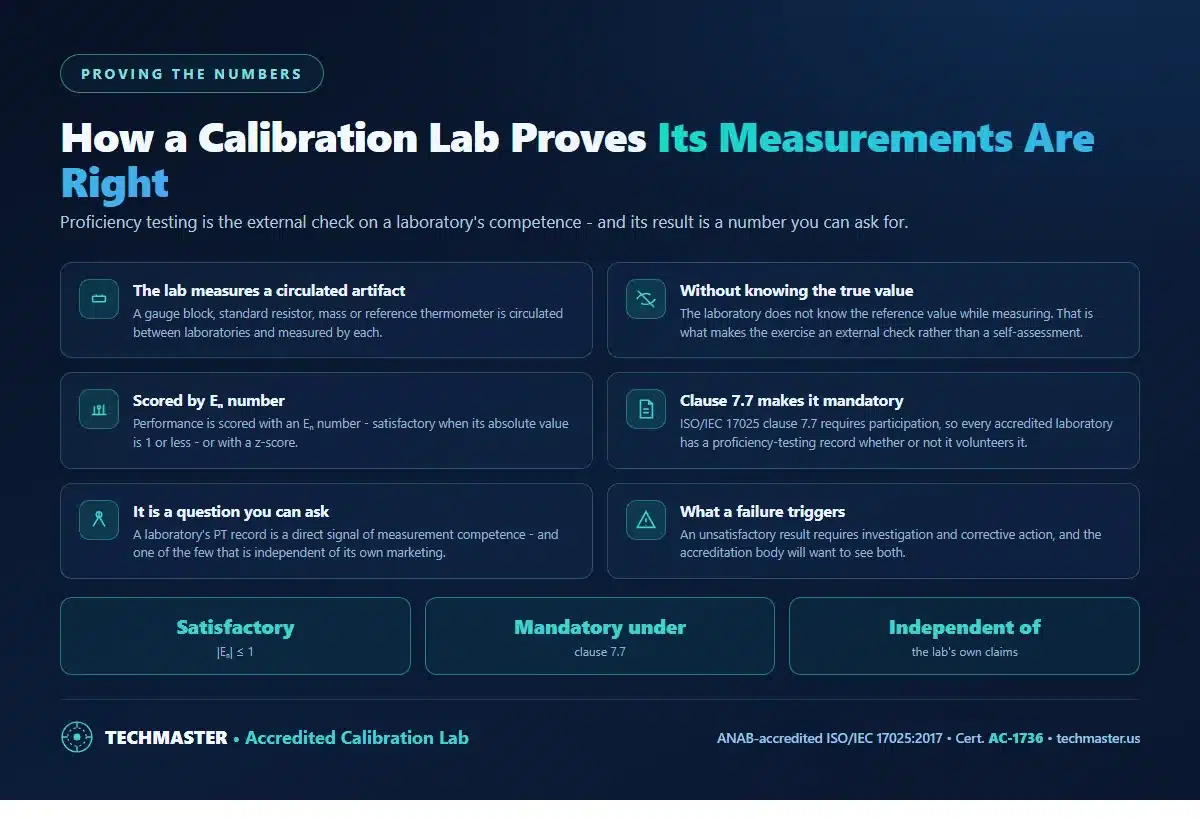
Short answer: Proficiency testing (PT) is how an ISO/IEC 17025 calibration lab proves its measurements are right by measuring the same artifact as other labs and comparing results to an independent reference. Performance is scored with an En number (satisfactory when |En| ≤ 1) or a z-score. Clause 7.7 makes participation mandatory, so a lab’s PT record is a direct signal of measurement competence.
What is proficiency testing in an ISO/IEC 17025 calibration lab?
Accreditation to ISO/IEC 17025 tells a customer that a laboratory has a competent quality system on paper. Proficiency testing (PT) tells them the numbers coming out of that system are actually correct. As ANAB, Techmaster’s accreditation body, states plainly, proficiency testing “is widely recognized as an essential tool for demonstrating the competence of conformity assessment bodies”, and it “can be an indicator of an underlying or emerging problem.” That second half matters: a PT round is one of the few mechanisms that can catch a drifting reference standard or a flawed procedure before it reaches your certificate.
Techmaster Electronics has operated as an ANAB-accredited ISO/IEC 17025 calibration laboratory (Cert. AC-1736) since 1989. Across a 10-year internal dataset of 381,916 calibrations spanning 4,913 manufacturers, the disciplines that carry the highest measurement risk, RF and microwave, electrical, dimensional, and mass, are exactly the ones where regular PT participation separates a genuinely capable lab from one that merely holds a certificate.
Proficiency testing vs interlaboratory comparison: what is the difference?
The distinction is practical, not pedantic. A full proficiency-testing scheme is organized by a provider accredited to ISO/IEC 17043, the standard for the competence of proficiency testing providers. The provider establishes the assigned (reference) value, distributes the artifact on a defined schedule, collects results, and issues objective performance scores. A less formal interlaboratory comparison, for example, two accredited labs round-robining a shared standard between themselves, is valuable and permitted, but the lab, not an independent body, owns the reference value and the statistics.
For a calibration laboratory, accredited PT is the gold standard because it removes the lab from any role in judging its own result. When PT is unavailable for a niche parameter, which happens in specialized RF and microwave work, a documented bilateral or multilateral ILC becomes the accepted alternative. Both feed the same objective in the lab’s ISO/IEC 17025 calibration program: continuous, external proof of competence.
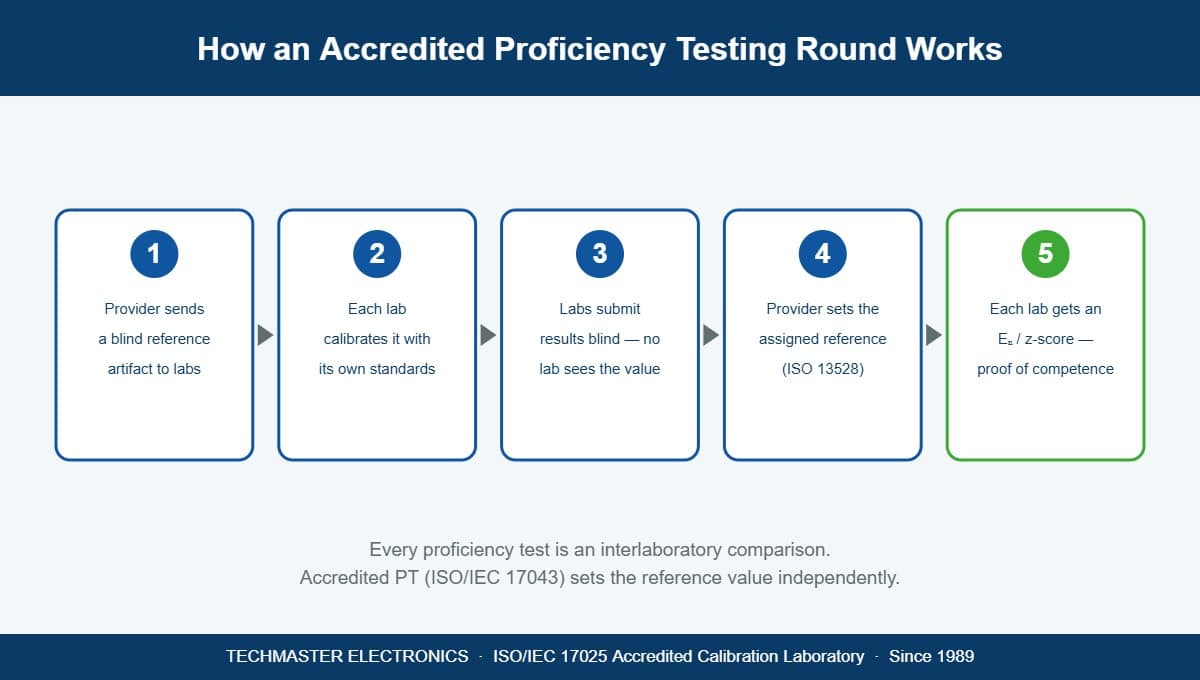 How an accredited proficiency-testing round works, from blind artifact to objective performance score.
How is a calibration lab’s proficiency test result scored?
The En number is powerful because it tests two things at once: whether the measured value is close to the reference, and whether the lab’s stated measurement uncertainty was honest. A lab can be near the reference value yet still fail if it under-declared its uncertainty, the En formula, En = (xlab − xref) / √(Ulab² + Uref²), punishes an over-optimistic uncertainty budget. That is why En ties directly to the uncertainty figures you see on a certificate; if you are unsure how to read those, see our guide on how to read an ISO/IEC 17025 calibration certificate.
| Score | Value | Interpretation | Required action |
|---|---|---|---|
| En number | |En| ≤ 1.0 | Satisfactory, result agrees within declared uncertainties | None; retain as evidence of competence |
| En number | |En| > 1.0 | Unsatisfactory, disagreement exceeds combined uncertainty | Investigate; corrective action required |
| z-score | |z| ≤ 2.0 | Satisfactory | None |
| z-score | 2.0 < |z| < 3.0 | Questionable, warning signal | Review process; monitor closely |
| z-score | |z| ≥ 3.0 | Unsatisfactory, action signal | Investigate; corrective action required |
The statistical models behind these scores, how the assigned value and the standard deviation for proficiency assessment are determined, are defined in ISO 13528. ANAB and the wider accreditation community treat a satisfactory En or z-score as objective evidence that a specific calibration parameter is under control.
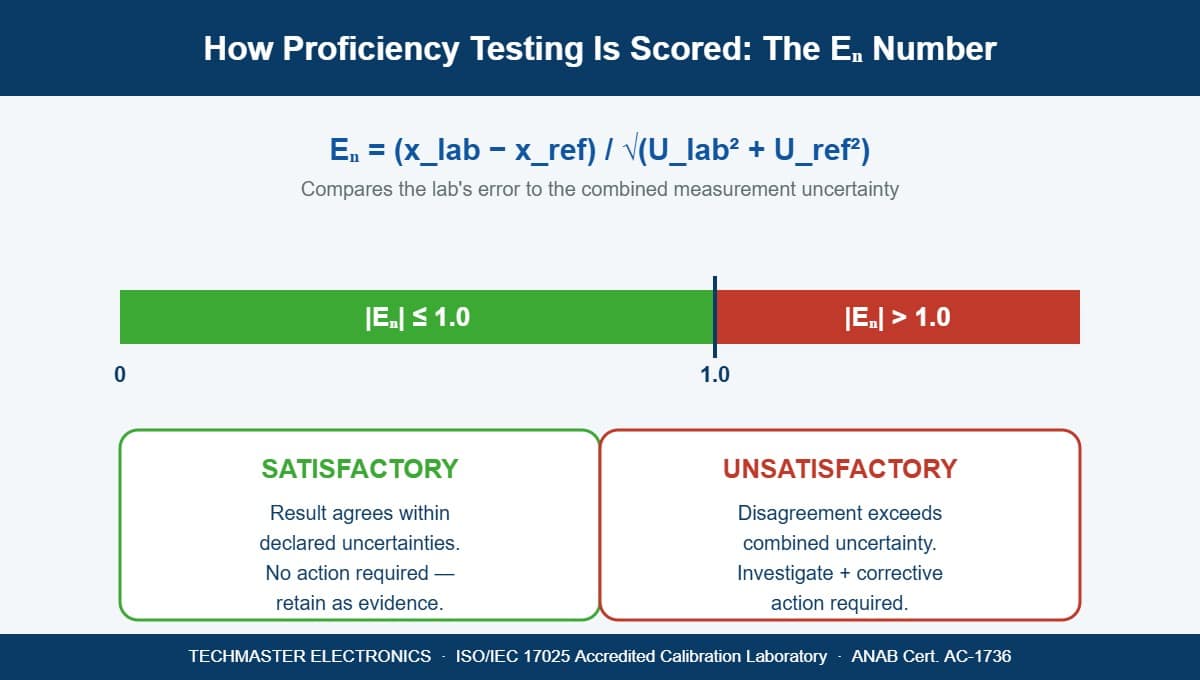 How the En number scores a calibration proficiency test against the lab’s declared measurement uncertainty.
What does ISO/IEC 17025 clause 7.7 actually require?
Clause 7.7 splits validity monitoring into two streams. Clause 7.7.1 covers internal activities the lab controls itself; clause 7.7.2 covers external activities that bring in an independent yardstick. A robust lab runs both continuously, because each catches problems the other misses. The table below maps the two streams to concrete tools a calibration lab uses.
| Clause 7.7 stream | Purpose | Examples in a calibration lab |
|---|---|---|
| Internal (7.7.1) | Detect drift and error using the lab’s own resources | Check standards, control charts, intermediate checks, repeat calibration of retained artifacts, staff cross-checks |
| External (7.7.2) | Confirm results against an independent reference | Accredited proficiency testing (ISO/IEC 17043 provider), interlaboratory comparisons, replicate measurement against a higher-echelon standard |
The requirement to participate in external comparisons is reinforced across the accreditation system. ILAC guidance documents and ANAB policy both set expectations for how often a lab must take part and for which measurement parameters, and an assessor will ask to see the plan, the results, and the corrective actions for any unsatisfactory score. A lab that cannot produce that evidence has a nonconformity against ISO/IEC 17025, regardless of how good its paperwork otherwise looks.
Why should proficiency testing matter when you choose a lab?
For a quality manager, the connection to your own risk is concrete. Every measurement Techmaster returns to you flows downstream into your product acceptance decisions. If the lab that calibrated your reference standard is quietly biased, that bias propagates through your entire measurement chain, and you may only discover it during a failed audit or a customer return. Across Techmaster’s 10-year record of 381,916 calibrations, consistent satisfactory En-number results in high-risk disciplines such as RF/microwave and electrical are the practical proof behind ISO 17025 clause 7.7, the evidence that turns an accredited certificate into demonstrated performance. This is the same reason decision rules and guardbanding exist on the acceptance side; the two ideas are complementary, and we cover the customer half in our guide to test uncertainty ratio and calibration decision rules.
Concretely, three questions separate a strong lab from a weak one: Does the lab participate in accredited PT for the parameters you care about, not just the easy ones? Are its most recent scores satisfactory? And when a score was unsatisfactory, can it show you the investigation and corrective action that followed? A lab confident in its metrology will answer all three without hesitation.
Key takeaways
- Proficiency testing is an external, blind check that proves an ISO/IEC 17025 lab’s measurements are correct, not just that its paperwork is compliant.
- Every proficiency test is an interlaboratory comparison, but accredited PT (run by an ISO/IEC 17043 provider) is the gold standard because the reference value is set independently.
- Calibration PT is scored with the En number: satisfactory only when |En| ≤ 1.0, which also tests whether the lab’s declared uncertainty is honest.
- ISO/IEC 17025 clause 7.7 makes external comparison mandatory; accreditation bodies review the PT record at every assessment.
- When choosing a lab, ask which parameters it runs PT on, how recent the results are, and how it resolved any failure.
What happens when a lab fails a proficiency test?
The instinct might be to view any PT failure as damning, but the opposite is closer to the truth. PT exists precisely to surface problems, and how a lab responds is more revealing than the raw score. A disciplined response mirrors the process a lab and its customers follow after any nonconformity, the same reverse-traceability and impact-assessment logic covered in our article on out-of-tolerance calibration results and what to do next. If a lab’s reference standard was found to be the culprit, the lab must ask which customer calibrations relied on that standard since it was last verified.
Techmaster’s four ANAB-accredited U.S. laboratories, Vista and Santa Clara, California; Orlando, Florida; and San Antonio, Texas, treat every external comparison as a live control on measurement quality, not a compliance formality. That discipline is what an accredited certificate is meant to represent. You can see the full scope of disciplines on our ISO/IEC 17025 calibration services hub.
Frequently asked questions
Is proficiency testing mandatory for ISO/IEC 17025 accreditation?
Yes. ISO/IEC 17025:2017 clause 7.7.2 requires laboratories to monitor performance by comparison with other laboratories, and accreditation bodies such as ANAB require participation in proficiency testing or interlaboratory comparisons for accredited measurement parameters. An assessor reviews the lab’s PT plan and results at every assessment, and gaps are treated as nonconformities.
What is a good En number in proficiency testing?
A satisfactory En number is any value where |En| is less than or equal to 1.0. This means the lab’s result agrees with the independent reference value within the combined measurement uncertainty of both. An |En| greater than 1.0 is unsatisfactory and requires the lab to investigate and take corrective action, even if the raw measurement looked close to the reference.
What is the difference between proficiency testing and an interlaboratory comparison?
An interlaboratory comparison is any exercise where multiple labs measure the same item and compare results. Proficiency testing is a formal, structured interlaboratory comparison run by a provider accredited to ISO/IEC 17043, with an independently assigned reference value and objective scoring. Every proficiency test is an interlaboratory comparison, but only accredited PT gives the independence that makes the result strong external evidence.
How often must a calibration lab participate in proficiency testing?
Frequency is set by accreditation-body policy and depends on the measurement parameter, its risk, and PT availability. Accreditation bodies generally expect participation across the scope of accreditation over a defined cycle, prioritizing higher-risk parameters. Where accredited PT does not exist for a niche parameter, a documented interlaboratory comparison is the accepted alternative for satisfying ISO/IEC 17025 clause 7.7.2.
Does a proficiency test failure invalidate my past calibrations?
Not automatically, but it must be investigated. The lab is required to assess whether the issue affected previously reported customer results. If a reference standard or procedure was at fault, the lab performs a reverse-traceability review of calibrations that relied on it and notifies affected customers where results may have been impacted. A well-run lab documents this whole process.
How can I verify a calibration lab’s proficiency testing performance?
Ask the lab directly which parameters it participates in, request recent proficiency-testing summaries or En/z-score results, and ask how any unsatisfactory result was resolved. You can also confirm the lab’s accreditation and scope through its accreditation body, for Techmaster, ANAB, under Cert. AC-1736. A confident, accredited lab shares this evidence readily.
Want a calibration lab that proves its numbers?
Techmaster Electronics has calibrated test equipment for U.S. manufacturers since 1989 across four ANAB-accredited ISO/IEC 17025 laboratories. Ask us about our proficiency-testing and interlaboratory-comparison record for your parameters.
Request a Calibration QuoteRelated reading: What a CMC means on an ISO/IEC 17025 accreditation scope
Related reading: How to run intermediate checks between calibrations under ISO/IEC 17025 clause 6.4.10

Khanh Nguyen is the Marketing Manager at Techmaster Electronics, a B2B marketing leader covering the test, measurement, and ISO/IEC 17025 accredited calibration industry across the US and Vietnam markets.