
What is a LISN, and why does it need calibration?
Most EMC engineers think of the LISN as plumbing, a box that sits between the wall and the product. It is not. It is the standard in a conducted-emissions measurement, in exactly the same sense that a gauge block is the standard in a dimensional measurement. The reason conducted emissions are reproducible from lab to lab at all is that everyone agrees the mains looks like a specific complex impedance across 9 kHz to 30 MHz. That agreement is what CISPR 16-1-2 codifies, and a LISN either delivers it or it does not.
Three things make LISNs drift in ways that are invisible on the bench. First, the 50 µH inductor is a wound component operating at elevated current; thermal cycling and DC bias shift its effective inductance and, worse, its self-resonance. Second, the feed-through and coupling capacitors age, electrolytic and film parts lose capacitance and gain ESR, which moves the low-frequency corner where the network transitions from inductive to resistive. Third, and most commonly in the labs Techmaster services, the 50 Ω termination and the RF output connector degrade from repeated connect/disconnect cycles, adding contact resistance that shows up as a small, uniform attenuation error across the whole band.
None of these failure modes produce a symptom the operator will notice. The instrument still powers up. The receiver still shows a spectrum. The numbers are simply wrong, usually low, which is the dangerous direction.
What exactly gets calibrated on a LISN?
This is the single most common gap we find when a new EMC customer sends in equipment. A previous provider issued a certificate showing voltage division factor only, a scalar measurement, easy to make with a network analyzer and a single through path, and skipped the impedance sweep entirely. That certificate proves the signal path works. It proves nothing about whether the EUT is seeing a compliant load.
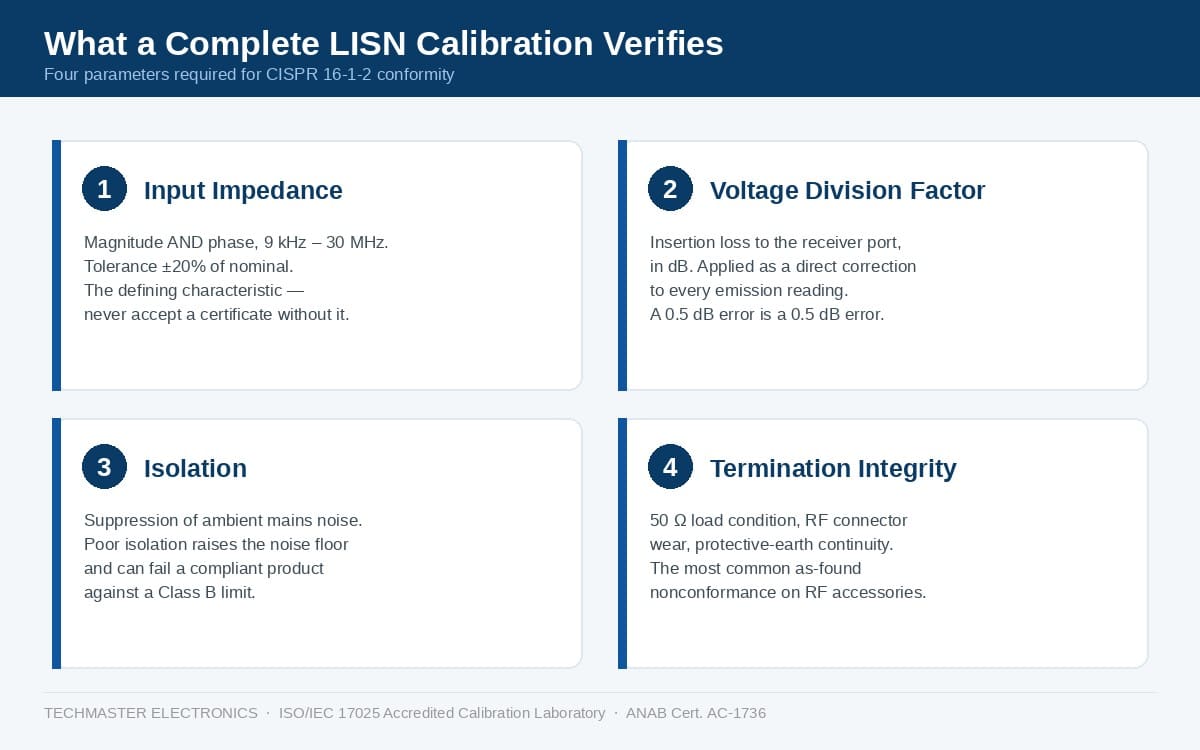
The four required checks
Input impedance (magnitude and phase). Measured at the EUT port with the mains port terminated as the standard specifies and the receiver port terminated in 50 Ω. This is the defining characteristic of the network and requires a calibrated vector network analyzer with a proper low-frequency calibration kit, many general-purpose VNAs have degraded accuracy below 100 kHz, which is exactly where the LISN impedance curve is changing fastest.
Voltage division factor (VDF). The ratio between the voltage at the EUT terminal and the voltage delivered to the receiver, expressed in dB and applied as a correction to every measurement. A VDF error is a direct, one-for-one error in your reported emission level.
Isolation. How well the network suppresses ambient noise arriving from the building mains. Poor isolation raises your noise floor and can push a compliant product over a limit that it never actually exceeded.
Termination and safety integrity. Continuity of protective earth, the discharge path, and the condition of the 50 Ω load. This is partly a metrology check and partly a safety check, a LISN with a failed earth bond is a hazard, not just a measurement problem.
What impedance tolerance does CISPR 16-1-2 require?
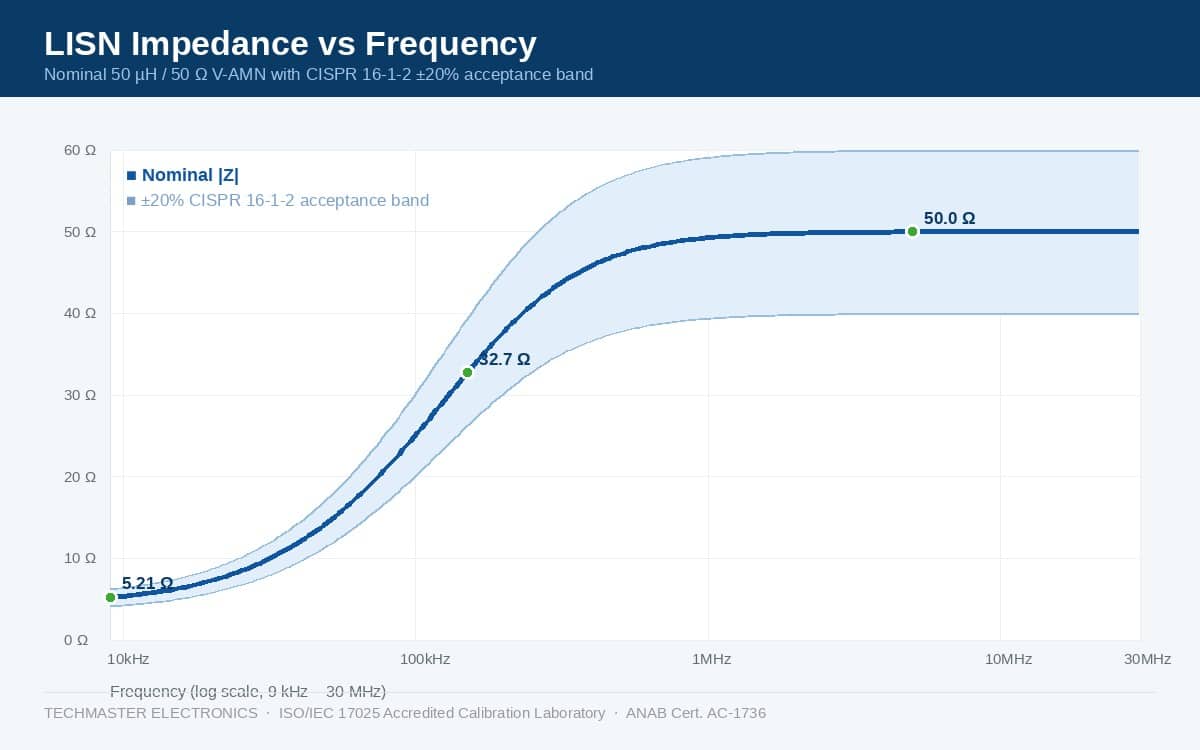
The nominal values follow directly from the network model: a 50 µH inductor in series with 5 Ω, presented in parallel with the 50 Ω receiver-side load. The table below gives the computed nominal magnitude and phase at common check frequencies, together with the ±20% acceptance window a calibration laboratory applies. Use it as a sanity check on any certificate you receive, the shape of the curve should look like this regardless of manufacturer.
| Frequency | Nominal |Z| (Ω) | Nominal phase (°) | ±20% acceptance band (Ω) |
|---|---|---|---|
| 9 kHz | 5.21 | 26.5 | 4.17 – 6.26 |
| 10 kHz | 5.36 | 28.9 | 4.29 – 6.43 |
| 50 kHz | 14.41 | 56.4 | 11.53 – 17.29 |
| 100 kHz | 25.11 | 51.2 | 20.09 – 30.13 |
| 150 kHz | 32.71 | 43.4 | 26.17 – 39.26 |
| 500 kHz | 47.21 | 17.5 | 37.77 – 56.66 |
| 1 MHz | 49.26 | 9.0 | 39.41 – 59.11 |
| 5 MHz | 49.97 | 1.8 | 39.98 – 59.96 |
| 10 MHz | 49.99 | 0.9 | 39.99 – 59.99 |
| 30 MHz | 50.00 | 0.3 | 40.00 – 60.00 |
Reading the curve: if a certificate shows the impedance already flat at 50 Ω down at 150 kHz, the network is not behaving as a 50 µH/50 Ω AMN, the most likely cause is an open or badly degraded series inductor path. Conversely, an impedance that keeps climbing past 50 Ω in the upper HF range points to inductor self-resonance, usually from a rewound or damaged coil.
Note also that the FCC’s own rules are written around this hardware. 47 CFR § 15.107 specifies conducted limits explicitly “as measured using a 50 µH/50 ohms LISN”, the regulator is not just regulating the emission, it is regulating the measurement network that defines it. An out-of-tolerance LISN is therefore not merely a lab quality issue; it undermines the regulatory basis of the test report.
What happens to your test data when a LISN drifts?
The arithmetic is unforgiving. Reported emission voltage scales with the impedance the noise current develops across, so a ratio error of 0.8 in impedance is 20·log₁₀(0.8) ≈ −1.94 dB in the report. Stack that against a VDF error of another 0.5 dB from a degraded connector and you have roughly 2.4 dB of unaccounted bias, larger than the measurement uncertainty most EMC labs declare for conducted emissions, and pointed in the direction that produces false passes.
The consequences compound backward through time. When a LISN is found out of tolerance at its scheduled calibration, every conducted-emissions report issued since its last in-tolerance calibration becomes suspect. That is a reverse-traceability exercise: identifying affected reports, assessing whether the observed drift could have changed a pass/fail outcome, and notifying customers where it could. Labs that keep tight intervals and good as-found data get through that exercise in an afternoon. Labs that do not can find themselves recalling a year of certifications, a process we walk through in detail in our guide to reverse traceability and calibration recall impact analysis.
This is why as-found data matters more on a LISN than on almost any other EMC asset. A certificate that only reports as-left values tells you the instrument is good going forward. It tells you nothing about the twelve months of test reports behind you.
How often should a LISN be calibrated?
The 12-month default is not written into CISPR 16-1-2 as a hard requirement; it comes from accreditation practice and from ISO/IEC 17025 clause 6.4, which requires equipment to be calibrated when measurement accuracy affects the validity of results. For a LISN, it plainly does.
Where a documented interval-analysis program adds value is at the margins. A LISN in a high-throughput commercial EMC lab, plugged and unplugged dozens of times a day, carrying rated current for hours, accumulates connector and thermal wear far faster than an identical unit in a design lab used a few times a month. ILAC G24, Guidelines for the determination of recalibration intervals of measuring equipment, sets out the reliability-based methods for making that adjustment defensibly, and it is the document your assessor will expect you to cite if you propose anything other than 12 months.
Practical triggers for an out-of-cycle calibration
Regardless of the scheduled interval, send a LISN in immediately after any of the following: an overcurrent or mains transient event; a dropped or physically damaged enclosure; a failed inter-lab comparison or proficiency test on conducted emissions; replacement of the RF output connector or termination; or an unexplained shift in your reference-source verification. Techmaster’s ten-year calibration dataset, 381,916 calibrations across 4,913 manufacturers, shows connector-related failures dominating the as-found nonconformances on RF-port accessories, which is exactly the class of fault a scheduled annual interval is least likely to catch in time.
How do decision rules apply to a LISN calibration certificate?
ISO/IEC 17025:2017 clause 7.8.6 requires that when a laboratory issues a statement of conformity, it documents the decision rule employed and accounts for the risk associated with that rule. ILAC G8:09/2019, Guidelines on Decision Rules and Statements of Conformity, is the reference document. In practice, for a LISN, this means your certificate should tell you whether “PASS” means the measured value fell inside the tolerance limits ignoring uncertainty (simple acceptance), or inside a guard-banded window.
The distinction matters most at the band edges. Near 9 kHz, VNA uncertainty is at its worst and the nominal impedance is at its smallest absolute value, so a measurement sitting at 6.1 Ω against a 6.26 Ω upper limit is a genuinely marginal result, the kind of case where a guard-banded rule and simple acceptance can disagree. If you are unclear how to read the pass/fail logic on your own certificates, our explainer on test uncertainty ratio (TUR) and decision rules on a calibration certificate covers the framework in full.
Techmaster performs LISN and EMC accessory calibration as part of its EMC and EMI calibration services, alongside EMI receiver calibration and ESD simulator calibration for immunity testing, because a compliant conducted-emissions setup depends on the receiver, the network, and the reference source all being traceable together. Our accreditation details, including ANAB Certificate AC-1736 and the current scope, are published on our ISO/IEC 17025 accreditation page, and the full discipline list sits on the Techmaster calibration services hub. Traceability for electromagnetic quantities in the United States ultimately runs to NIST electromagnetic measurement calibration services.
- The LISN’s impedance, not its attenuation, is the measurement reference in a conducted-emissions test, a certificate showing only voltage division factor is incomplete for CISPR 16-1-2.
- CISPR 16-1-2 allows ±20% on impedance magnitude from 9 kHz to 30 MHz; nominal |Z| rises from about 5.2 Ω at 9 kHz to a flat 50 Ω above 5 MHz.
- A 20% impedance error is roughly 1.9 dB of bias in your reported emission level, typically in the false-pass direction.
- Twelve months is the default interval; ILAC G24 allows reliability-based adjustment with documented as-found history.
- Insist on as-found data. Without it, an out-of-tolerance finding puts every report since the last calibration into an unbounded recall assessment.
- Your certificate must state the decision rule used for any pass/fail statement, per ISO/IEC 17025:2017 clause 7.8.6 and ILAC G8.
Frequently asked questions
Is a LISN calibration the same as a LISN verification?
No. A verification is an in-house functional check, typically confirming the voltage division factor against a known source, and produces no traceable uncertainty statement. A calibration is performed by an accredited laboratory against traceable standards, reports measured values with uncertainty, and supports a statement of conformity. Verification between calibrations is good practice; it does not replace calibration.
Can a LISN be calibrated on site at our EMC lab?
Impedance sweeps require a vector network analyzer with a low-frequency-capable calibration kit and a controlled setup, so on-site LISN calibration is possible but demands careful ambient control and adequate bench space. Techmaster offers on-site calibration for EMC assets where equipment cannot be released; most customers find laboratory calibration gives lower uncertainty and faster turnaround for LISNs specifically.
What is the difference between a LISN, an AMN, and a CDN?
LISN and AMN (Artificial Mains Network) are the same device, AMN is the CISPR term, LISN the common North American usage. A CDN (Coupling/Decoupling Network) is a different device used for immunity testing under IEC 61000-4-6 to inject disturbance onto cables; it has its own impedance requirements and its own calibration, and cannot be substituted for a LISN in an emissions measurement.
Does a 5 µH/50 Ω or 250 µH LISN follow the same tolerance?
The ±20% magnitude tolerance principle applies, but the nominal impedance curve is entirely different because the series inductance differs. A 5 µH/50 Ω network is used for automotive and higher-frequency work; 250 µH networks appear in older military and MIL-STD-461 setups. Always calibrate against the nominal curve for the specific network type, applying the 50 µH curve to a 5 µH LISN will produce a meaningless certificate.
How long does LISN calibration take at Techmaster?
Standard turnaround is five business days from receipt. Expedited service with a one-to-two business day turnaround is available on many EMC assets for a nominal fee, contact your account manager or email sales@techmaster.us to schedule. Techmaster has operated as an accredited calibration provider since 1989 and maintains ISO/IEC 17025 accreditation under ANAB Certificate AC-1736 at its Vista CA, Santa Clara CA, Orlando FL, and San Antonio TX laboratories.
What should I check on the LISN calibration certificate before filing it?
Confirm five things: the impedance sweep is present with both magnitude and phase, as-found data is reported alongside as-left, the frequency range covers 9 kHz to 30 MHz, measurement uncertainty is stated for each parameter, and the decision rule behind any pass/fail statement is documented. If any of the five is missing, the certificate will not fully support an ISO/IEC 17025 or A2LA-style EMC lab assessment.
Need your LISN back in tolerance, with as-found data?
ISO/IEC 17025 accredited EMC calibration from four US laboratories. Five-day standard turnaround, expedite available.
Request a Calibration QuoteRelated reading: EMC antenna calibration: antenna factor, ANSI C63.5 methods and recalibration intervals
Related reading: how EMC chamber site validation and instrument calibration intervals differ

Khanh Nguyen is the Marketing Manager at Techmaster Electronics, a B2B marketing leader covering the test, measurement, and ISO/IEC 17025 accredited calibration industry in the United States.