
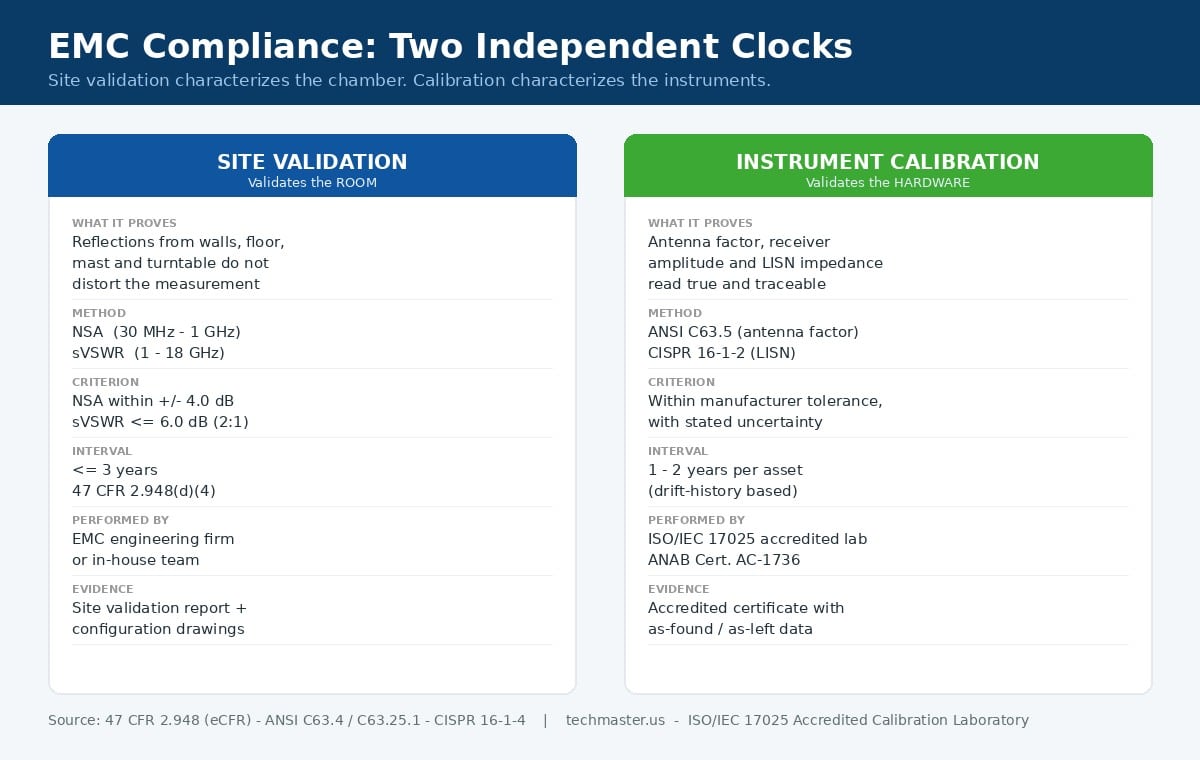
EMC chamber site validation proves the room behaves like free space; calibration proves the instruments read true. They are separate obligations. Under 47 CFR 2.948, a validated radiated-emissions site must be revalidated at least every three years, but the antennas, receiver, and LISNs inside it need their own ISO/IEC 17025 calibration cycle.
Every EMC quality manager eventually gets the same assessor question, and it is rarely the one they prepared for. Not “is the chamber validated?”, the site validation report is in the binder. The question is: “Your normalized site attenuation report is dated. Your biconical antenna was recalibrated eight months ago. Which document governs the data you shipped last quarter?”
That question exposes a gap that sits in a lot of otherwise well-run EMC labs. Site validation and instrument calibration are treated as one line item on a compliance calendar, when in fact they answer different questions, run on different clocks, and are performed by different parties. This article separates them cleanly, using the actual regulatory text and the actual acceptance criteria.
Site validation vs. calibration, what is the difference?
Think of it as two independent error paths feeding the same number on your test report. When you report a radiated emission in dBµV/m, that figure is the sum of the receiver reading, the antenna factor, the cable loss, the preamplifier gain, and the site’s own deviation from ideal free-space behavior. Site validation bounds the last term. Calibration bounds the others.
The distinction matters practically because the two are procured differently. Site validation is a measurement campaign performed in your chamber, usually by an EMC engineering firm or an in-house team, producing a site attenuation or sVSWR report. Instrument calibration is a service you send equipment out for, or have performed on site, by an ISO/IEC 17025 accredited calibration laboratory whose scope actually covers antenna factor, RF power, and impedance parameters.
One does not substitute for the other, and an accreditation assessor will not accept a recent site validation report as evidence that your antenna set is traceable.
How often must an EMC chamber site validation be renewed?
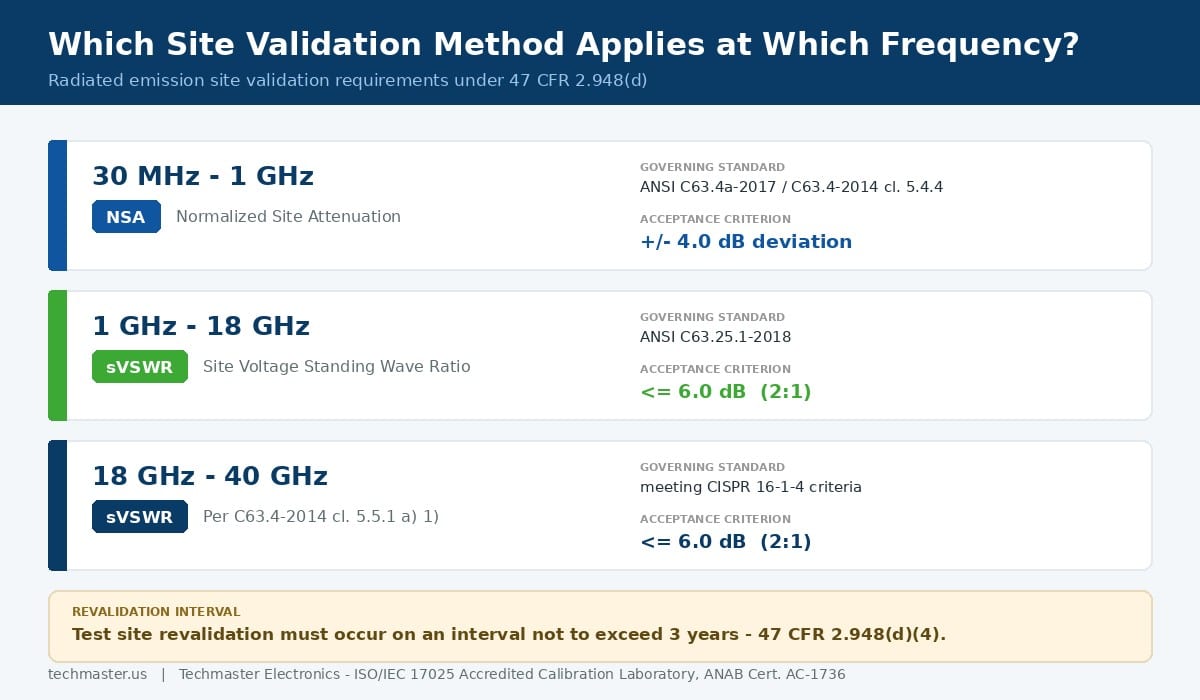
The three-year figure is a ceiling, not a recommendation. It is written into the Federal Communications Commission’s measurement facility rule at 47 CFR 2.948, which also specifies which standard applies to which frequency band. Labs that make physical changes to a chamber, new absorber, a replaced turntable, a relocated mast, revalidate sooner, because the rule assumes the site configuration described in the report still exists.
The two-year accreditation reassessment in paragraph (e) is a different obligation entirely: it is the ISO/IEC 17025 surveillance cycle run by a Commission-recognized accreditation body, itself operating under ISO/IEC 17011. A lab can be inside its three-year site validation window and still fall out of compliance because its accreditation lapsed.
| Frequency range | Required validation method | Governing standard cited by the FCC | Typical acceptance criterion |
|---|---|---|---|
| 30 MHz – 1 GHz | Normalized site attenuation (NSA), or reference site method | ANSI C63.4a-2017, or ANSI C63.4-2014 clause 5.4.4 | Measured NSA within ±4.0 dB of theoretical |
| 1 GHz – 18 GHz | Site voltage standing wave ratio (sVSWR) / time-domain site method | ANSI C63.25.1-2018 | sVSWR ≤ 6.0 dB (2:1) |
| 18 GHz – 40 GHz | Site validation per C63.4-2014 clause 5.5.1 a) 1) | ANSI C63.4-2014, meeting CISPR 16-1-4:2010-04 criteria (the edition the FCC incorporates by reference) | sVSWR ≤ 6.0 dB (2:1) |
| All bands | Revalidation interval | 47 CFR 2.948(d)(4) | Not to exceed 3 years |
| Facility | Accreditation reassessment | 47 CFR 2.948(e) / ISO/IEC 17025 | Not to exceed 2 years |
What does normalized site attenuation (NSA) actually measure?
The arithmetic is deliberately simple so the failure modes stand out. You measure site attenuation with a transmit antenna at a fixed position and a receive antenna scanned over the specified height range, in both horizontal and vertical polarization, at the standard positions across the volume of the equipment under test. Then:
NSA = Vdirect − Vsite − AFtransmit − AFreceive − ΔAFtotal
Look at what that equation depends on. Two of its five terms are antenna factors, numbers that come off a calibration certificate, not out of the chamber. If your biconical or log-periodic antenna factors are stale, drifted, or calibrated by a method that does not match the geometry in your validation, the NSA result inherits that error directly. A site can “fail” validation purely because the antenna factor data is wrong, and labs have chased phantom absorber problems for weeks over exactly this.
This is why antenna factor traceability is upstream of site validation, not parallel to it. The ANSI C63.5 antenna factor calibration procedure exists precisely to give NSA a defensible input.
When do you need an sVSWR test instead of NSA?
The physical intuition is straightforward. Move a source slightly and, on a perfect site, the received level changes only by the inverse-distance factor you can calculate. On a real site, absorber gaps, cable trays, camera housings, lighting fixtures, and the mast itself create secondary paths. Those paths interfere constructively and destructively with the direct path, so the received level ripples as the source moves. The peak-to-trough spread of that ripple, corrected for the distance change, is the site VSWR.
A 6.0 dB limit is not generous. It translates to a 2:1 voltage ratio, which for an emissions measurement near a limit line is the difference between a pass and a failure. CISPR 16-1-4:2025, the current fifth edition of the IEC antennas-and-test-sites standard, carries the specifications for antennas and test sites across 9 kHz to 18 GHz and is the international counterpart to the ANSI documents the FCC cites.
Practically: labs testing only below 1 GHz need NSA. Labs doing radiated spurious emissions on wireless products, which routinely extends to the 10th harmonic and therefore well into the gigahertz, need both.
Which chamber instruments still need ISO/IEC 17025 calibration?
Here is where the two-clock problem becomes concrete. Your site validation is good for three years. Your antenna factors are typically good for one or two. A quality system that syncs them into a single annual event is over-servicing the chamber; one that syncs them to three years is under-servicing the antennas.
| Asset | Validated or calibrated? | Key parameter | Typical interval | Evidence you must hold |
|---|---|---|---|---|
| Chamber / test site | Validated | NSA deviation, sVSWR | ≤ 3 years (FCC ceiling) | Site validation report with configuration drawings |
| Biconical & log-periodic antennas | Calibrated | Antenna factor (dB/m) | 1–2 years | ISO/IEC 17025 certificate per ANSI C63.5 |
| Horn antennas (1–18 GHz) | Calibrated | Antenna factor, gain | 1–2 years | Accredited certificate with uncertainty |
| EMI receiver / spectrum analyzer | Calibrated | Amplitude accuracy, detector response | 1 year | Accredited certificate, as-found & as-left data |
| Preamplifier | Calibrated | Gain flatness, 1 dB compression | 1 year | Accredited certificate |
| RF cables & attenuators | Calibrated | Insertion loss vs. frequency | 1 year, or on damage | Loss table used in the correction factors |
| LISN / AMN | Calibrated | Impedance magnitude & phase, division factor | 1 year | Accredited certificate per CISPR 16-1-2 |
| Turntable & antenna mast | Verified | Positional accuracy, height repeatability | 1 year (in-house acceptable) | Intermediate check record |
Two entries on that table are the ones labs most often let slip. RF cables get replaced after a technician damages a connector, and the new cable’s loss table never makes it into the correction factors. And LISN impedance verification under CISPR 16-1-2 is skipped because a LISN “has no moving parts”, but its network components age, and a LISN that has drifted out of its 50 Ω/50 µH envelope biases every conducted emission result taken through it.
Across the 381,916 calibrations Techmaster has recorded over the last ten years, spanning 4,913 distinct manufacturers, the pattern that shows up repeatedly in RF and EMC assets is not catastrophic failure, it is slow amplitude drift that stays inside the manufacturer’s tolerance until it doesn’t. That is exactly the failure mode an annual accredited calibration is designed to catch and a three-year site validation is not.
What invalidates a site validation before three years are up?
47 CFR 2.948(b)(1) is specific about what the facility description must contain: location, a physical description with photographs, a drawing showing dimensions and all structures within five times the antenna-to-EUT distance, a description of support structures, a list of measuring equipment, and calibration information for that equipment. That last item is worth re-reading, the FCC bundles calibration status into the facility description itself.
Common triggers for early revalidation:
- Absorber replacement or relocation. Even swapping degraded ferrite tiles changes the reflection environment.
- New mast or turntable. Different metal, different scattering.
- Structural work near the chamber. New HVAC ducting, a relocated lighting grid, added cable trays.
- Change in measurement distance. Moving from 3 m to 10 m is a different site.
- Absorber degradation. Foam pyramids sag and absorb humidity; ferrite tiles crack.
- Failed intermediate check. If a reference radiator check drifts, investigate before the calendar says to.
How do you build a compliant EMC validation and calibration schedule?
A workable structure for a mid-size EMC lab:
Track 1, Site validation (3-year ceiling)
Schedule the campaign at 30 months, not 36, so a failure leaves six months to diagnose and remediate absorber or structural issues without suspending FCC work. Tie the trigger to the configuration change log as well as the calendar, whichever comes first.
Track 2, Accredited instrument calibration (1–2 years)
Stagger the antenna set so the chamber is never without a working biconical. Send the EMI receiver during a scheduled shutdown, and keep every asset on one provider’s ISO/IEC 17025 accredited calibration program so the uncertainty framework is consistent. Ask for as-found data on every certificate, without it, you cannot assess whether work performed during the prior interval was affected, and you cannot do a defensible calibration recall if something is found out of tolerance.
Track 3, Intermediate checks (monthly to quarterly)
A comb generator or reference radiator run at fixed positions, logged and trended, is the cheapest insurance in an EMC lab. It catches a damaged cable, a failed preamp, or a receiver attenuator problem within weeks rather than at the next annual calibration. ISO/IEC 17025:2017 clause 6.4.10 expects this, and assessors increasingly ask to see the trend chart, not just the last data point.
For labs whose EMC instruments overlap into RF and microwave, horn antennas, preamplifiers, power sensors, signal generators, it is worth consolidating those assets with a single accredited provider so the correction factors all trace through one uncertainty framework. Techmaster’s EMC-EMI calibration services and RF and microwave calibration services are delivered under the same ISO/IEC 17025 accreditation, ANAB Certificate AC-1736, which covers Techmaster’s laboratories in Vista and Santa Clara, California; Orlando, Florida; and San Antonio, Texas, calibrating electronic test equipment since 1989.
- Site validation ≠ calibration. One bounds the chamber’s error contribution; the other bounds the instruments’. Both are required.
- Three years is a ceiling, not a target. 47 CFR 2.948(d)(4) caps revalidation at three years; schedule at 30 months to leave remediation room.
- Two clocks run in parallel. Site revalidation ≤ 3 years; accreditation reassessment ≤ 2 years under 47 CFR 2.948(e).
- NSA depends on antenna factors. Stale ANSI C63.5 antenna factor data can fail a perfectly good chamber.
- Above 1 GHz, sVSWR governs, ANSI C63.25.1-2018, limit 6.0 dB (2:1).
- Configuration changes reset the clock. Absorber, mast, turntable, distance, or nearby structures.
- LISNs and cables are the usual gaps. Verify LISN impedance per CISPR 16-1-2; re-measure cable loss after every replacement.
Frequently asked questions
Does an ISO/IEC 17025 accredited calibration certificate cover my EMC chamber?
No. An accredited calibration certificate covers the specific instrument listed on it, an antenna, a receiver, a LISN, and states the measured values and uncertainties for that instrument. It makes no statement about the chamber’s reflection environment. Site validation is a separate measurement campaign producing a separate report, and an assessor will ask for both.
How often does the FCC require EMC test site revalidation?
47 CFR 2.948(d)(4) states that test site revalidation must occur on an interval not to exceed three years. Separately, 47 CFR 2.948(e) requires that reassessment of the test facility by its Commission-recognized accreditation body occur on an interval not to exceed two years. Both deadlines apply independently.
What is the acceptance criterion for an sVSWR site validation?
The site voltage standing wave ratio must not exceed 6.0 dB, equivalent to a 2:1 voltage ratio, measured across the frequency range and at each of the defined positions and polarizations. Above 1 GHz the FCC points to ANSI C63.25.1-2018; the international equivalent criteria appear in CISPR 16-1-4.
Can a bad antenna factor cause a site validation to fail?
Yes, and it is a common false alarm. Normalized site attenuation is calculated by subtracting both antennas’ factors from the measured insertion loss, so antenna factor error propagates directly into the NSA result. Labs have replaced absorber chasing a problem that was actually a drifted or wrongly-applied antenna factor. Confirm antenna calibration currency before diagnosing the chamber.
Do I need to revalidate after replacing absorber in my chamber?
In practice, yes. The rule does not name absorber explicitly, but the FCC facility description must include a drawing of the site and all structures within five times the measurement distance, and absorber is part of that configuration. Replacing, relocating, or removing absorber changes the reflection environment the validation report characterized, so the existing report no longer describes your site.
Which EMC instruments should be on an annual calibration cycle?
EMI receivers and spectrum analyzers, preamplifiers, attenuators, RF cables, and LISNs are typically annual. Measurement antennas are commonly one to two years depending on handling and history. Turntables and masts are usually verified in-house annually. Base every interval on documented drift history rather than a default, and adjust when as-found data justifies it.
Need accredited calibration for the antennas, receivers, and LISNs that feed your site validation? Techmaster Electronics has been calibrating electronic test equipment since 1989 under ISO/IEC 17025 accreditation, ANAB Certificate AC-1736.
Request a calibration quoteSources: 47 CFR 2.948, Measurement facilities (eCFR) · CISPR 16-1-4:2025, antennas and test sites for radiated disturbance measurements (IEC) · ANSI National Accreditation Board (ANAB).

Khanh Nguyen is the Marketing Manager at Techmaster Electronics, a B2B marketing leader covering the test, measurement, and ISO/IEC 17025 accredited calibration industry in the United States.