DC Power Supply Buying Guide: How to Choose a DC Power Supply
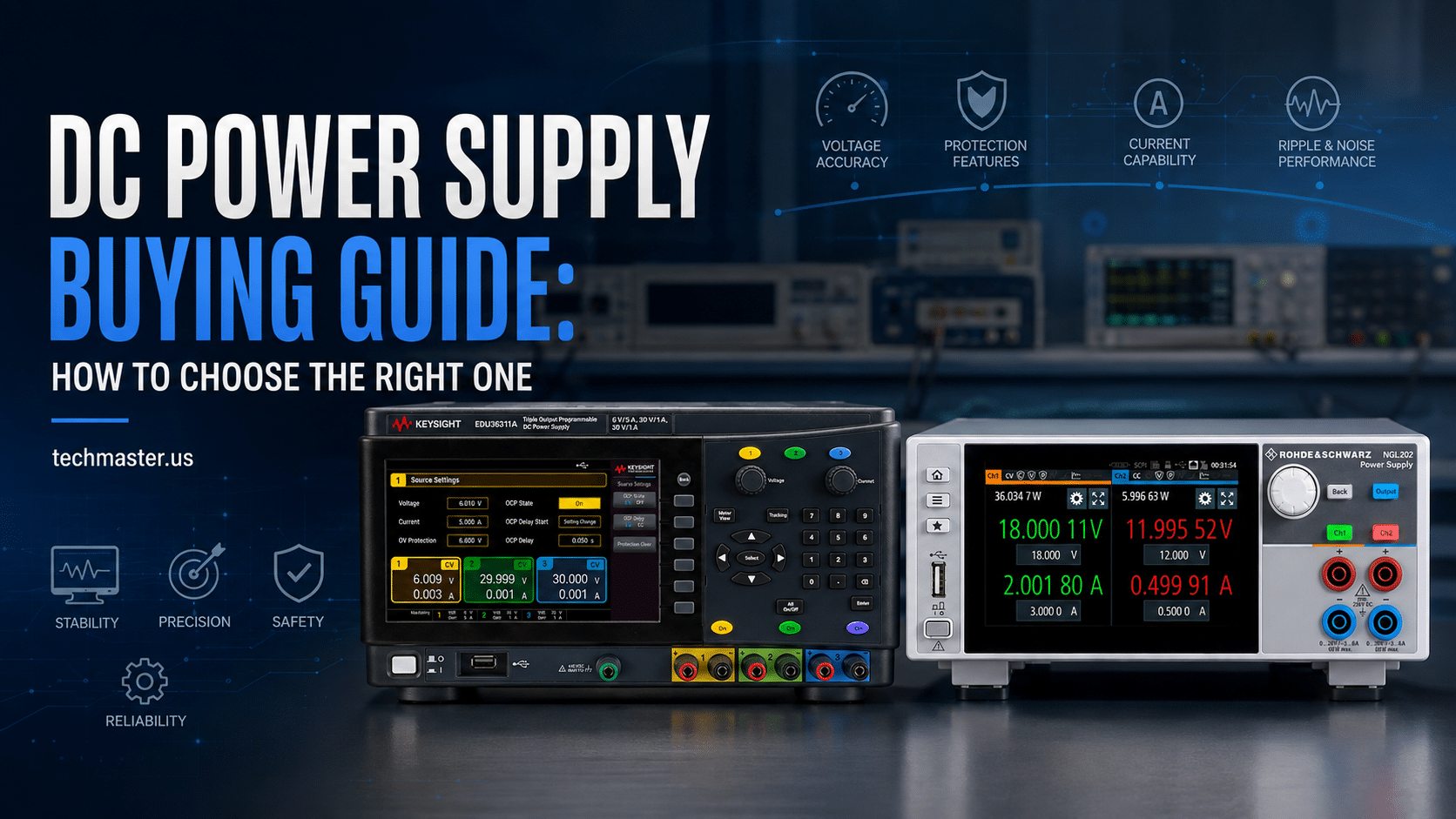
Today, testing modern parts is harder than ever. Because of this, poor power is a huge risk. Therefore, finding a stable power source is key. Otherwise, a bad source can hide product flaws. In fact, it might even break a costly prototype. For this reason, knowing how to choose a dc power supply is a vital skill. Mainly, lab managers and engineers need this knowledge to succeed.
Choosing the right gear takes time. First, you cannot just look at basic voltage limits. Instead, you must check load traits and noise levels. Also, you must think about future tests. In addition, you have to plan for routine upkeep. This guide explains these key details in full. In the end, we will help you find the best setup for your lab. Thus, you can test with total trust.
1. What Is a DC Bench Power Supply?
To begin with, a bench power supply is a vital test tool. Specifically, it delivers a steady direct current (DC) voltage to a device. Experts use these tools mostly in research, design, and factory testing. In simple terms, these tools change wall power into safe DC power.
Today, units come in many shapes and sizes. For example, some are simple and only have one output. Meanwhile, others are highly complex. In fact, high-end units can mimic battery drains or grid shifts. Plus, they can run self-guided tests. Thus, finding the exact match for your needs is crucial.
2. Why Knowing How to Choose a DC Power Supply Matters
Above all, accurate testing starts at the power source. For instance, if your tool outputs 5.2V instead of 5.0V, your data is wrong. As a result, bad products might pass their final checks. Consequently, choosing the right tool matters for several reasons:
-
Clear Tracking: First, high-quality units give exact readings. Therefore, you do not need extra meters on your desk.
-
Lower Risks: Second, many fields demand strict rules, like ISO 13485. Thus, using the correct tool keeps you safe during audits.
-
Better Products: Also, clean power stops stress on parts. In turn, only flawless items reach your buyers.
-
Long-term Uptime: Finally, a strong unit lasts for years. Hence, it will not break down or lose its true setting.
3. Key DC Power Supply Specifications to Consider
4. The Value of a Programmable DC Power Supply
Today, modern test setups run on computers. For this reason, a programmable DC power supply is a great asset. Unlike older tools, these units link right to your PC. Specifically, they use ports like USB or LAN.
Because of this, engineers can write code to run tests. For instance, the unit can ramp up power slowly on its own. In addition, it can log data without a human present. As a result, test speeds go way up. Most importantly, it stops human errors on the factory floor.
5. Flexible Solutions: Consider Equipment Renting Services
Sometimes, buying new gear costs too much money. For example, you might only need a high-end tool for one month. Or, you might need a spare unit while your main one is fixed. Therefore, what should you do?
In these cases, renting is a very smart choice. Namely, renting gives you access to the best tech right away. Plus, it saves your company cash. In fact, all rented tools arrive fully checked and ready to go. Thus, you can finish your project on time and under budget. Techmaster offers great renting deals for all lab types.
6. Common Applications
7. Calibration Standards and Traceability
Even the best tool loses its exact edge over time. Mainly, parts inside the unit wear out. Because of this, power supply calibration is clearly needed.
Above all, you must follow strict rules like ISO/IEC 17025. This rule ensures that your tool’s readings link back to exact national standards. For example, experts use NIST standards in the US. In short, a proper check includes full paperwork. Thus, you can prove your tests are always valid.
8. Common Issues Found During Calibration
During a normal check, experts often find hidden problems. For instance, these flaws can ruin your daily tests.
-
Setting Drift: Most often, the true output slowly drifts away from the screen setting. As a result, you might apply too much power.
-
Wrong Screen Data: Sometimes, the screen shows the right number, but the real power is wrong. Usually, this means the internal meter is broken.
-
Extra Noise: Also, old parts can let too much noise slip through. Thus, your fine sensors will fail their tests.
-
Slow Reaction: Finally, the tool might take too long to fix sudden power drops.
9. How Often Should This Equipment Be Calibrated?
Typically, most quality guides say to check units once a year. However, the best schedule depends on a few things.
-
Maker Rules: First, always check what the brand suggests.
-
Daily Use: Next, tools used all day might need a check every six months. Therefore, they stay within strict limits.
-
Work Space: In addition, dusty or hot rooms ruin tools faster. Thus, you must check them more often.
-
Sudden Shocks: Finally, if a tool drops on the floor, check it right away.
10. What to Look for in a Calibration Provider
Finding a good lab is just as vital as finding a good tool. Therefore, you must look for a few key traits.
-
Strict Rules: First, choose a lab with active ISO/IEC 17025 status. This proves they know exactly what they are doing.
-
Right Skills: Second, make sure they can test your exact power limits.
-
Clear Paperwork: Next, they must give you clear data sheets. Specifically, ask for before and after numbers.
-
Quick Service: Finally, look for teams that work fast. As a result, your lab avoids costly downtime.
11. Why Choose Techmaster Electronics?
For many years, Techmaster Electronics has been a top choice for labs. Specifically, we help teams that need exact and ready-to-audit results. In fact, our labs across the US follow strict ISO/IEC 17025 rules. Because of this, we offer the best Calibration service for all your test gear.
In addition, we promise clear data and fast returns. Whether you need a quick repair, a steady check, or a rented tool, we can help. In short, our experts know how to support the most demanding fields. In the end, we keep your daily tests running without a hitch.
12. Conclusion
In closing, finding the right bench tool takes clear thought. First, you must check voltage rules and design types. Next, you should think about writing auto test scripts. Finally, keeping your gear exact via routine checks is a must. By doing this, you protect your final products. Also, you stop costly errors on the floor.
13. FAQ Section
Frequently asked questions
What is dc power supply calibration?
DC Power Supply Calibration is the documented comparison of a DC power supply against NIST-traceable reference standards under ISO/IEC 17025. It quantifies the DC power supply’s error and measurement uncertainty and confirms it performs within tolerance, with as-found and as-left data on the certificate.
How often should a DC power supply be calibrated?
Most quality systems calibrate a DC power supply every 12 months, or sooner after repair, overload, or before critical measurements. Set your interval from the manufacturer spec and your ISO 9001 / 13485 / AS9100 program and drift history.
Is Techmaster’s DC power supply calibration ISO 17025 accredited?
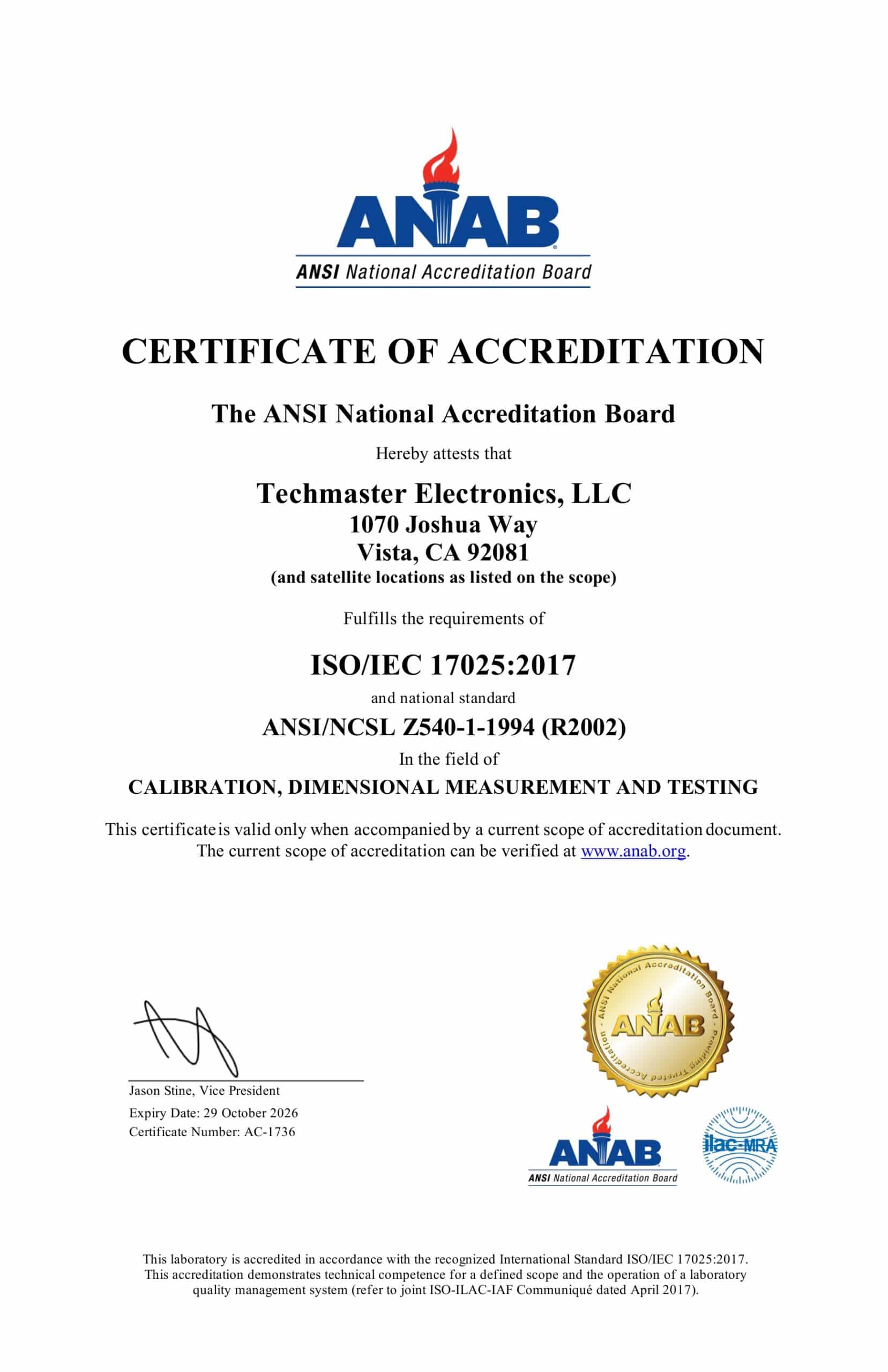
Yes. Techmaster Electronics is ISO/IEC 17025:2017 accredited by ANAB (Certificate AC-1736). Every DC power supply calibration is NIST-traceable and issued with a full measurement-uncertainty budget.
What is the turnaround for DC power supply calibration?
Standard turnaround is 5 business days, with 1–2 business-day expedite available. On-site calibration removes shipping time entirely for DC power supplys that can’t leave the floor.
Do you calibrate DC power supplys on-site or in-lab?
Both. Techmaster runs five US labs (Vista CA, Santa Clara CA, Orlando FL, San Antonio TX, Holly Springs NC) and offers nationwide on-site DC power supply calibration to minimize downtime.
References & industry standards
- ISO/IEC 17025 testing & calibration laboratory requirements
- NIST calibration services and measurement traceability
- NIST Fundamental Electrical Measurements
- A2LA / ANAB accreditation for calibration laboratories
External standards bodies. Techmaster Electronics is an ISO/IEC 17025-accredited, NIST-traceable calibration laboratory.

Khanh Nguyen is the Marketing Manager at Techmaster Electronics, a B2B marketing leader covering the test, measurement, and ISO/IEC 17025 accredited calibration industry across the US and Vietnam markets.