
How Often Should You Calibrate a DC Power Supply?
Reliable power builds the foundation of any electronic testing process. Consequently, your test equipment must deliver exact voltage and current. Over time, all electronic components degrade. This degradation naturally leads to measurement drift and output inaccuracies.
For what the calibration itself involves, see how to calibrate a DC power supply.
This calibration falls under our electrical calibration service.
Quality managers must balance equipment reliability with operational costs. Therefore, they frequently ask how often calibrate dc power supply units to maintain strict compliance. Establishing the correct maintenance interval ensures your instruments meet manufacturer specifications. In addition, this vital process safeguards your products from costly defects.
Additionally, equipment downtime causes major concerns during mandatory service cycles. To solve this specific problem, Techmaster Electronics offers a convenient test equipment renting service. We ensure you always have accurate instruments on hand. Meanwhile, our expert technicians service your primary assets without halting production.
1. What Is a DC Power Supply?
A benchtop DC power supply operates as a crucial laboratory measurement instrument. Specifically, it provides a stable direct current (DC) voltage to a device under test (DUT). These instruments convert alternating current (AC) from a wall outlet into a precise DC output.
Modern Programmable Features
Modern programmable units let engineers set precise voltage limits. Also, manufacturers equip them with digital readouts and remote programming interfaces. They also include protective features like over-voltage protection (OVP). Because these devices act as measurement tools, their internal sensors must remain highly accurate. Therefore, technicians rely on these sensors to monitor the exact current drawn by the DUT.
2. Why “How Often Calibrate DC Power Supply” Matters
Why Ongoing Calibration Matters
Calibration compares a measuring instrument against a known standard. Subsequently, metrologists perform this process to determine accuracy. This ongoing maintenance matters for several critical reasons.
Measurement Accuracy and Stability
A programmable power supply measures the exact power it outputs. If the internal voltmeter drifts, significant discrepancies occur. For example, a display might read 12.0V when the actual output hits 12.5V. Consequently, this voltage error can easily destroy sensitive microprocessors. Regular DC power supply calibration effectively prevents these damaging output discrepancies.
Regulatory Compliance and Traceability
Aerospace companies operate under strict regulatory frameworks. Thus, using uncalibrated equipment violates quality management systems like AS9100. In addition, proper NIST-traceable calibration guarantees that your equipment maintains legally documented accuracy. Auditors actively look for these unbroken chains of traceability during facility inspections.
Risk Reduction and Quality Control
When equipment falls out of tolerance, defective products might pass quality control. Industry experts typically call this a false pass. Alternatively, you might reject perfectly good products due to a false failure. Proper Calibration service minimizes these operational risks. In the end, accurate testing saves your company from costly product recalls.
3. Common Applications
DC power supplies serve fundamental roles in testing environments. Therefore, companies rely on them across a broad spectrum of industries.
Industrial Use Cases
-
Electronics Manufacturers: First, engineers power printed circuit boards (PCBs) during end-of-line testing. They verify that consumer devices operate correctly.
-
Aerospace and Defense: Second, technicians simulate aircraft battery systems. They test critical avionics components under varying voltages to ensure safety.
-
Telecommunications: Third, network operators test RF amplifiers. These communication systems strictly require low-noise DC power.
-
Automotive Industry: In addition, mechanics validate engine control units (ECUs). They also test electric vehicle (EV) battery management systems.
-
Pharmaceutical Facilities: Finally, quality teams ensure electronic monitoring devices function correctly. They test these instruments before approving them for laboratory use.
4. Calibration Standards and Traceability
Strict Metrological Standards
When you calibrate test equipment, you must follow strict metrological standards. Consequently, laboratories must adhere to specific industry rules to ensure valid results.
ISO/IEC 17025 Accredited The Gold Standard
The gold standard for laboratories remains an active ISO/IEC 17025 accreditation. Specifically, this international standard ensures the laboratory possesses necessary technical competence.
✓ Additionally, it verifies that the facility maintains proper environmental controls for accurate metrology work.
NIST-Traceable Calibration Unbroken Chain
All electrical measurements require strict NIST-traceable calibration. Therefore, an unbroken chain of documented comparisons links your equipment to national standards.
Metrologists calculate measurement uncertainty, typically requiring a 4:1 Test Uncertainty Ratio (TUR) for reliable results.
5. Common Issues Found During Calibration
Routine calibration uncovers hidden issues inside your testing environment. For instance, technicians frequently identify several common electrical problems during annual service.
Equipment Degradation and Drift
-
Voltage and Current Drift: First, thermal stress affects internal operational amplifiers. This aging process causes the output to drift away from programmed values.
-
Display Inaccuracies: Second, the digital front-panel display can lose synchronization with the physical output.
-
Degraded Ripple and Noise: Third, internal capacitors dry out over years of use. Consequently, this degradation increases AC ripple on the DC output.
-
Current Limit Failures: In addition, an out-of-tolerance protection circuit might fail during a short circuit. This specific failure allows excessive current to flow.
-
Load Regulation Issues: Finally, the power supply might deliver accurate voltage at a low current draw. However, it may drop voltage significantly when the load increases.
6. How Often Should This Equipment Be Calibrated?
Determining Calibration Intervals
Determining how often calibrate dc power supply units requires careful analysis. Therefore, lab managers must evaluate several operational factors to set correct schedules.
The Standard 12-Month Interval
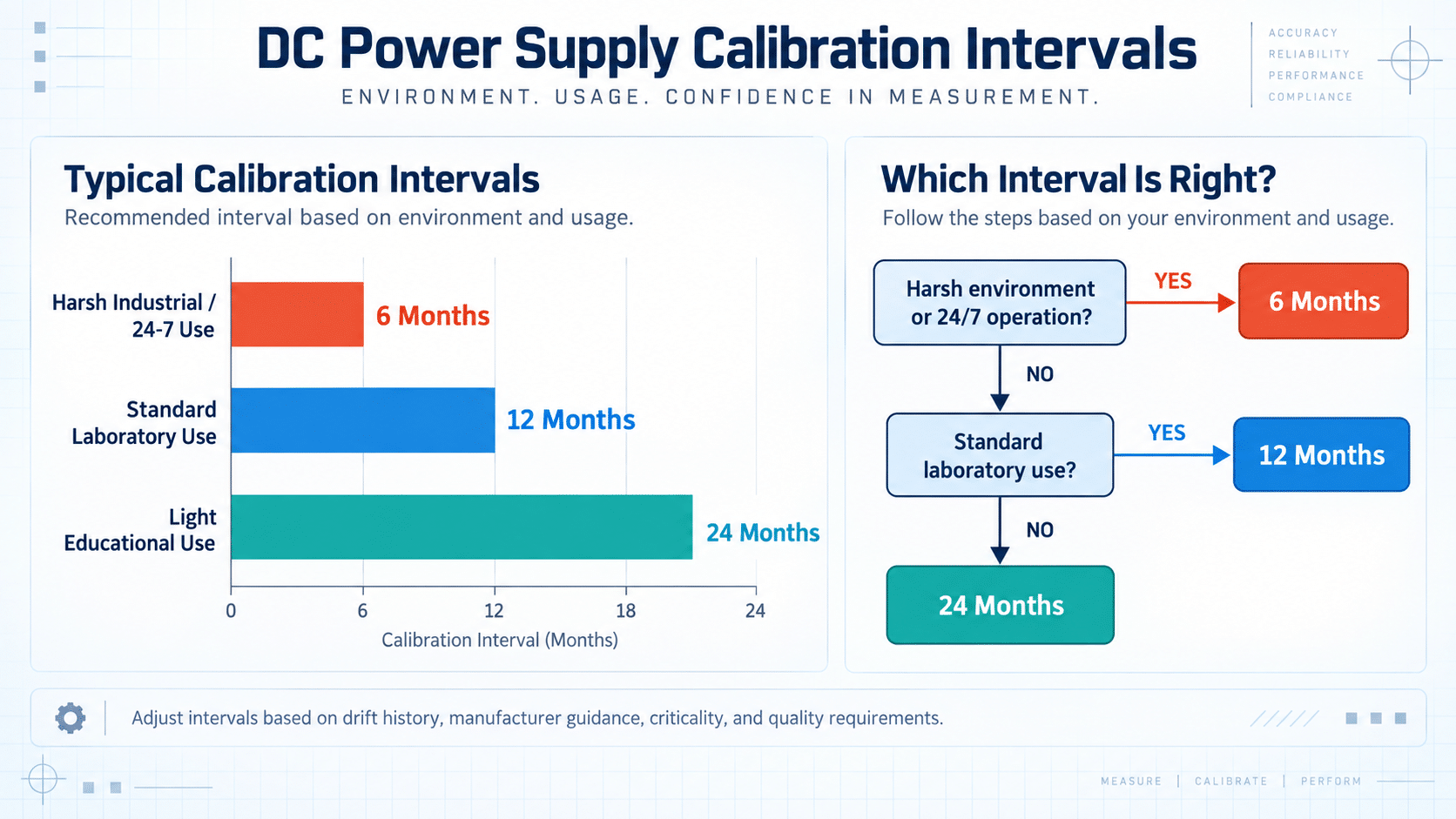
For most test equipment, a 12-month calibration interval acts as the baseline. Most original equipment manufacturers (OEMs) guarantee their published specifications for one year. However, specific facility conditions often justify modifying this standard timeframe.
Usage Frequency
A power supply running continuously experiences intense thermal cycling. As a result, this constant operation accelerates internal component wear. Therefore, high-usage environments often dictate a shorter calibration interval, such as every six months.
Environmental Conditions
Temperature fluctuations and airborne dust accelerate the degradation of electronic components. Consequently, equipment operating in harsh industrial environments requires more frequent calibration. On the other hand, units kept in climate-controlled labs can safely follow standard annual schedules.
Historical Performance Data
An established quality management system lets you adjust intervals using historical data. For example, if a specific power supply consistently passes annual calibration, you might extend its interval. Conversely, frequent internal adjustments mean you must shorten the calibration cycle.
7. What to Look for in a Calibration Provider
Not all calibration labs offer the exact same level of technical expertise. Thus, you must choose a qualified laboratory to service your valuable instruments.
Key Selection Criteria
-
Accreditation Status: First, verify the lab operates as an ISO/IEC 17025 accredited laboratory. Always check their specific scope of technical capabilities.
-
Technical Capability: Next, ensure the lab possesses high-precision digital multimeters. They need these exact standards to test your voltage ranges.
-
Turnaround Time: Additionally, lengthy equipment downtime costs your business money. Look for efficient service that returns equipment within five business days.
-
Documentation Quality: In addition, expect a detailed, compliant calibration certificate. This document must feature verified measurement instrument accuracy data.
-
On-Site Service: Finally, choose a provider that dispatches technicians for on-site calibration. This convenient service saves significant shipping costs.
8. Why Choose Techmaster Electronics?
Techmaster Electronics serves as a highly trusted partner for demanding businesses. Specifically, we bring over 30 years of specialized experience to the industrial metrology sector.
Our laboratories hold full ISO/IEC 17025 accreditation. Therefore, we guarantee that every service meets the highest international quality standards. Also, we utilize automated testing procedures to deliver highly accurate results. We proudly support aerospace companies and industrial quality assurance teams across the United States.
We understand that test equipment downtime actively disrupts your production schedules. To solve this problem, Techmaster Electronics offers robust equipment renting options. Consequently, you can maintain full operational capacity while our metrologists service your primary instruments. In the end, choose us for professional support that keeps your operations running smoothly.
9. Conclusion
Accurate DC power supplies play a key role in maintaining product quality. Therefore, you must establish proper calibration intervals to ensure regulatory compliance. While a 12-month interval works for standard laboratories, you should adjust this schedule based on usage. In addition, partner with an accredited metrology lab to protect your equipment investments. Proactive maintenance schedules ultimately uphold the integrity of your entire manufacturing process.
10. FAQ Section
Frequently Asked Questions
Frequently asked questions
What is dc power supply calibration?
DC Power Supply Calibration is the documented comparison of a DC power supply against NIST-traceable reference standards under ISO/IEC 17025. It quantifies the DC power supply’s error and measurement uncertainty and confirms it performs within tolerance, with as-found and as-left data on the certificate.
How often should a DC power supply be calibrated?
Most quality systems calibrate a DC power supply every 12 months, or sooner after repair, overload, or before critical measurements. Set your interval from the manufacturer spec and your ISO 9001 / 13485 / AS9100 program and drift history.
Is Techmaster’s DC power supply calibration ISO 17025 accredited?
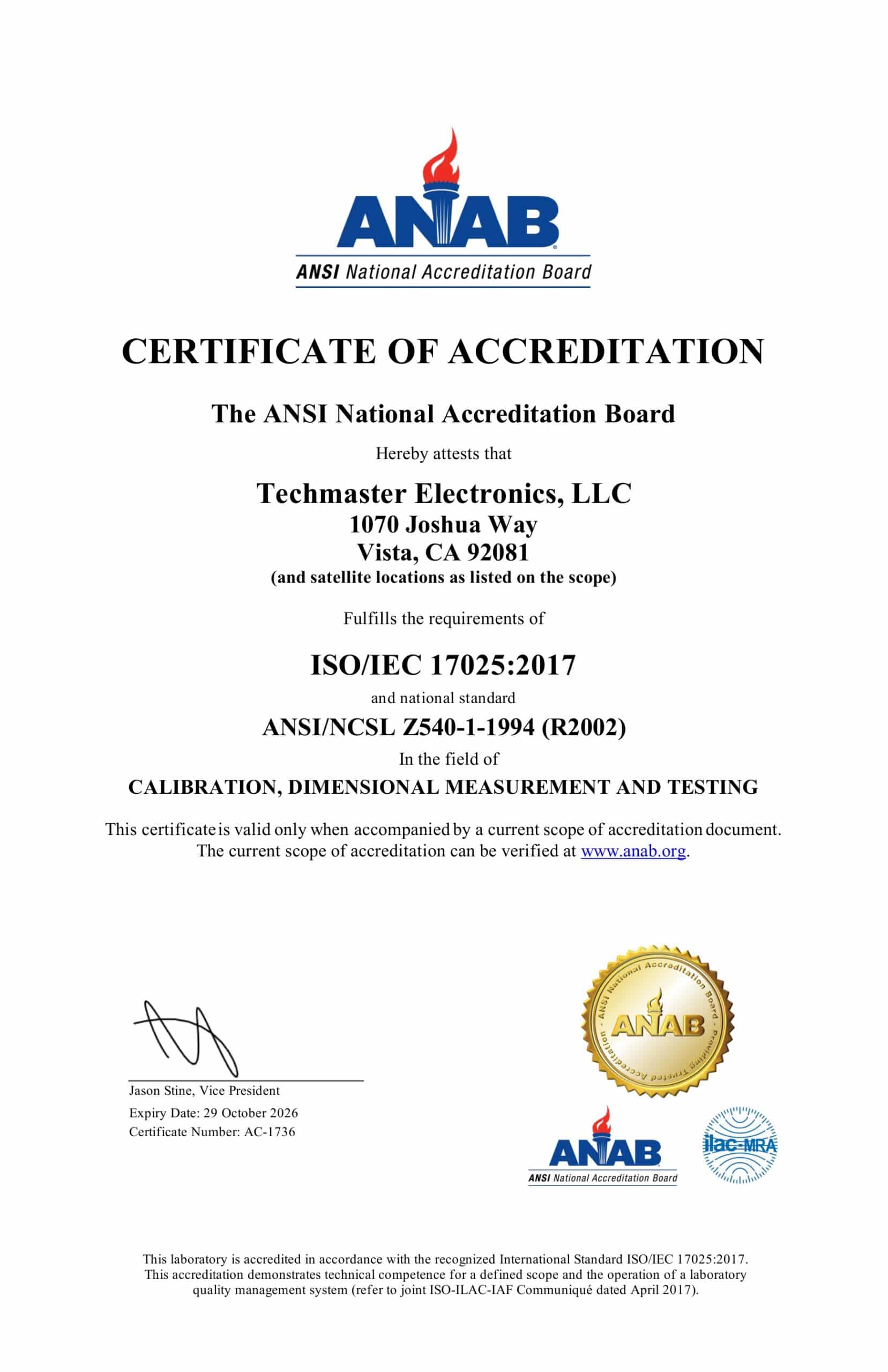
Yes. Techmaster Electronics is ISO/IEC 17025:2017 accredited by ANAB (Certificate AC-1736). Every DC power supply calibration is NIST-traceable and issued with a full measurement-uncertainty budget.
What is the turnaround for DC power supply calibration?
Standard turnaround is 5 business days, with 1–2 business-day expedite available. On-site calibration removes shipping time entirely for DC power supplies that can’t leave the floor.
Do you calibrate DC power supplies on-site or in-lab?
Both. Techmaster runs five US labs (Vista CA, Santa Clara CA, Orlando FL, San Antonio TX, Holly Springs NC) and offers nationwide on-site DC power supply calibration to minimize downtime.
References & industry standards
- ISO/IEC 17025 testing & calibration laboratory requirements
- NIST calibration services and measurement traceability
- NIST Fundamental Electrical Measurements
- A2LA / ANAB accreditation for calibration laboratories
External standards bodies. Techmaster Electronics is an ISO/IEC 17025-accredited, NIST-traceable calibration laboratory.

Khanh Nguyen is the Marketing Manager at Techmaster Electronics, a B2B marketing leader covering the test, measurement, and ISO/IEC 17025 accredited calibration industry in the United States.