
Hook Ammeter Calibration
Accuracy across the range
How Hook Ammeter calibration works
- Intake & visual inspection
- Environmental stabilization
- As-found measurement
- Comparison to NIST-traceable standards
- Adjustment if required
- As-left results & certificate
Your calibration, covered
In-lab vs on-site calibration
In-lab calibration
- Accredited bench with full reference standards
- Best achievable measurement uncertainties
- Pickup & return logistics handled
- Ideal for precision and reference work
On-site calibration
- We calibrate the Hook Ammeter at your facility
- No shipping risk or transit downtime
- As-found data captured before any move
- Ideal for fixed, large or sensitive assets
In-depth guide
Hook Ammeter Calibration: Maintaining Current Measurement Precision
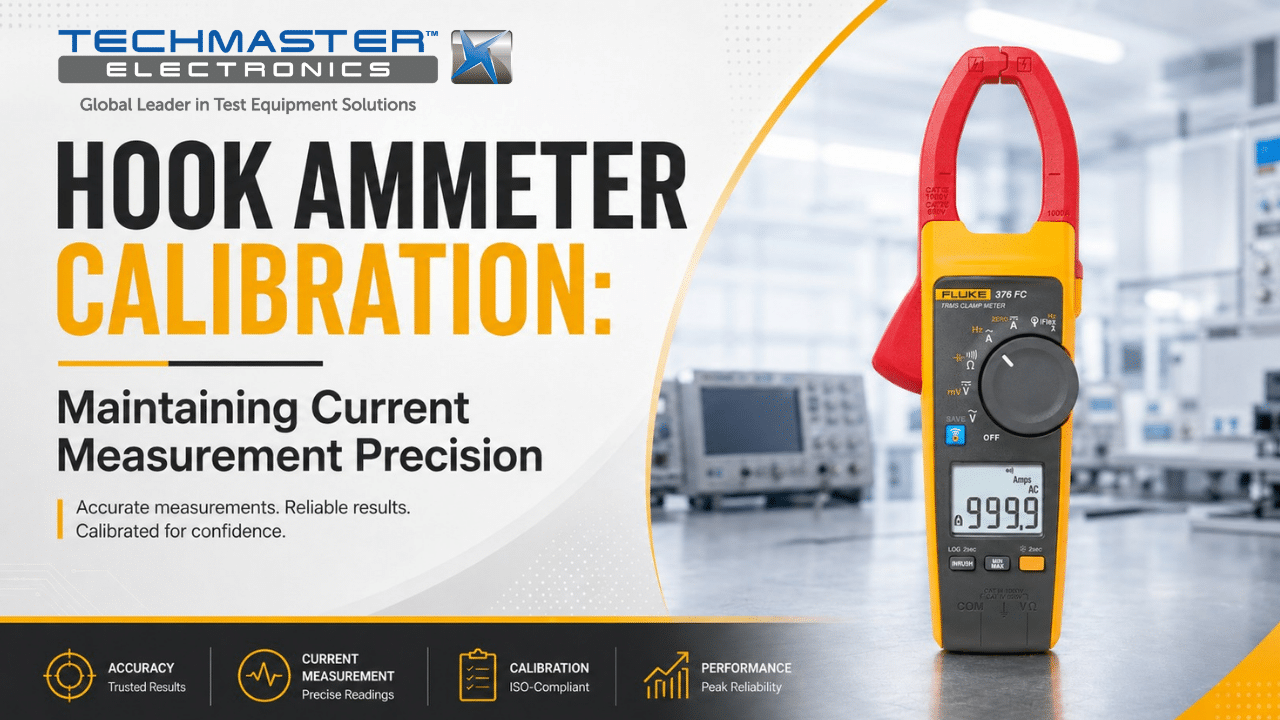
In industrial plants, data centers, and power grids, engineers must measure current accurately to keep systems safe. The hook ammeter (or clamp meter) is a vital tool for these workers. It measures current by sensing the magnetic field around a wire without breaking the circuit. To ensure systems remain safe, technicians rely on these precise readings. Because of this, regular hook ammeter calibration is necessary. It confirms that the internal magnetic sensors and electronics stay within the correct ranges.
Over time, these tools suffer from mechanical wear, high-current spikes, and temperature changes. These factors cause “measurement drift.” During drift, the internal Hall-effect sensors or current transformers lose their accuracy. An uncalibrated ammeter might show values that seem correct, but these numbers can be significantly wrong. This leads to dangerous mistakes, such as wrong load calculations or failing to spot fire risks. Accredited calibration is the only way to prove your equipment provides data that is both accurate and linked to international standards.
1. Technical Principles: Magnetic Sensing and Signal Transformation
1.1. How does a hook ammeter work?
Hook Ammeter Calibration verifies that a clamp-style current meter works against known, traceable current sources. This process checks the magnetic sensing core, the internal circuitry, and how the system handles different frequencies.
1.2. The Mechanism of Flux Induction and Drift
Most modern hook ammeters use one of two methods: current transformers for AC or Hall-effect sensors for AC and DC. Drift usually happens for two reasons. First, the “hook” jaws might not close perfectly, which stops the magnetic field from flowing correctly. Second, the semiconductor sensors age because they face constant electromagnetic interference. Furthermore, the internal processor that turns the signal into a number can experience heat-related drift. During professional calibration, technicians send a precise, known current through a reference wire. Then, they check that the meter shows the exact same value across its entire range.
2. Industrial Applications: Why Precision Matters
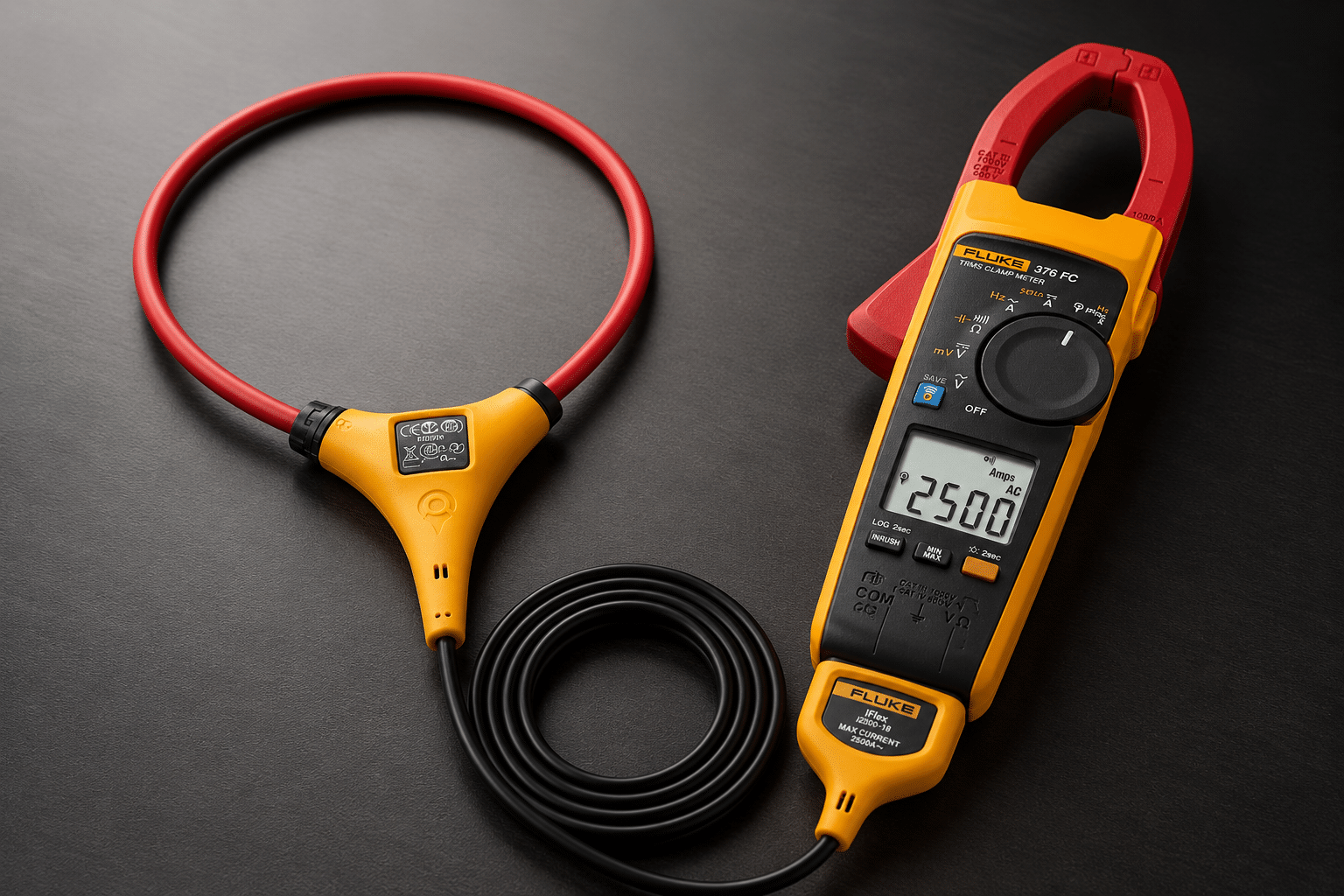
How does accurate calibration improve industrial safety?
Validating your current measurement tools gives you the confidence to manage electrical loads, find efficiency losses, and ensure equipment runs safely.
-
Power Distribution Monitoring: Accurate measurements are critical when balancing power in high-voltage panels. If an ammeter is not calibrated, it may hide phase imbalances. Consequently, transformers might overheat and fail much sooner than expected.
-
Predictive Maintenance: Technicians use clamp meters to watch motor current. Reliable data helps them spot early signs of bearing wear or insulation breakdown before a system crashes.
-
Energy Auditing: In modern factories, managers use current measurements to calculate power costs. Without a calibrated tool, energy reports will be wrong. As a result, companies might miss chances to save money on electricity.
3. The Calibration Pillar: Traceability and Compliance
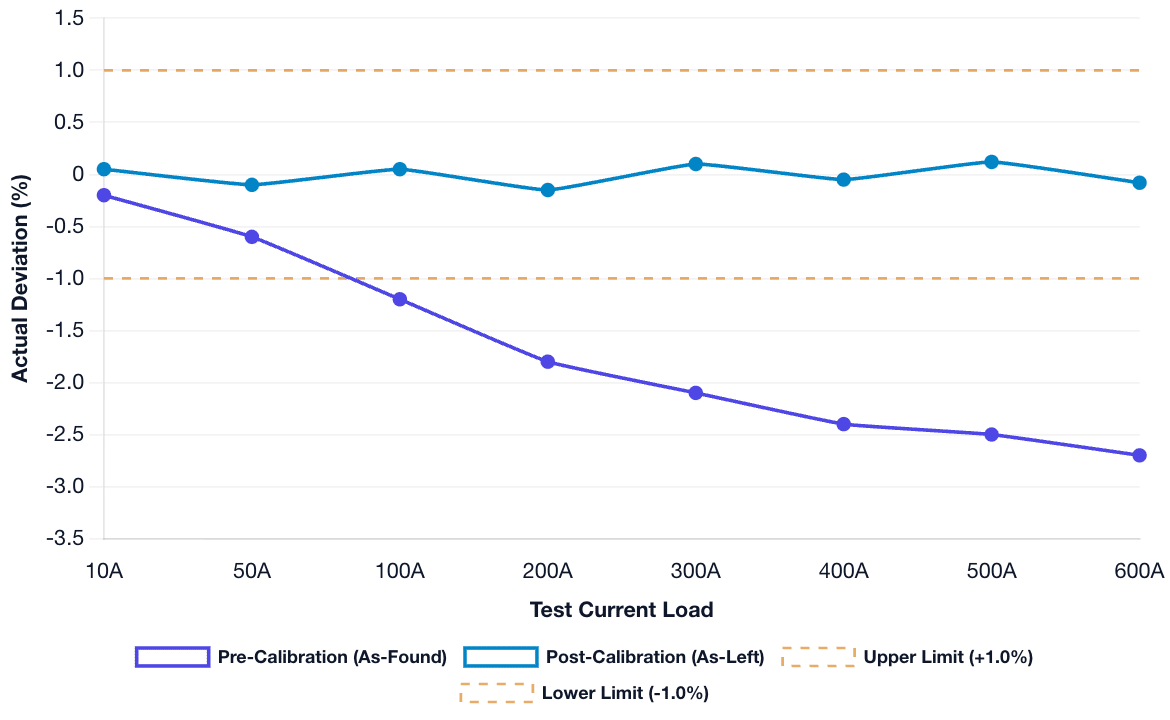
Linearity Error Curve
compares measurement accuracy across standard testing nodes (10A to 600A). Tracing the uncalibrated (As-Found) deviation, calibrated adjustment (As-Left), and standard industrial tolerance limits (pm 1%).
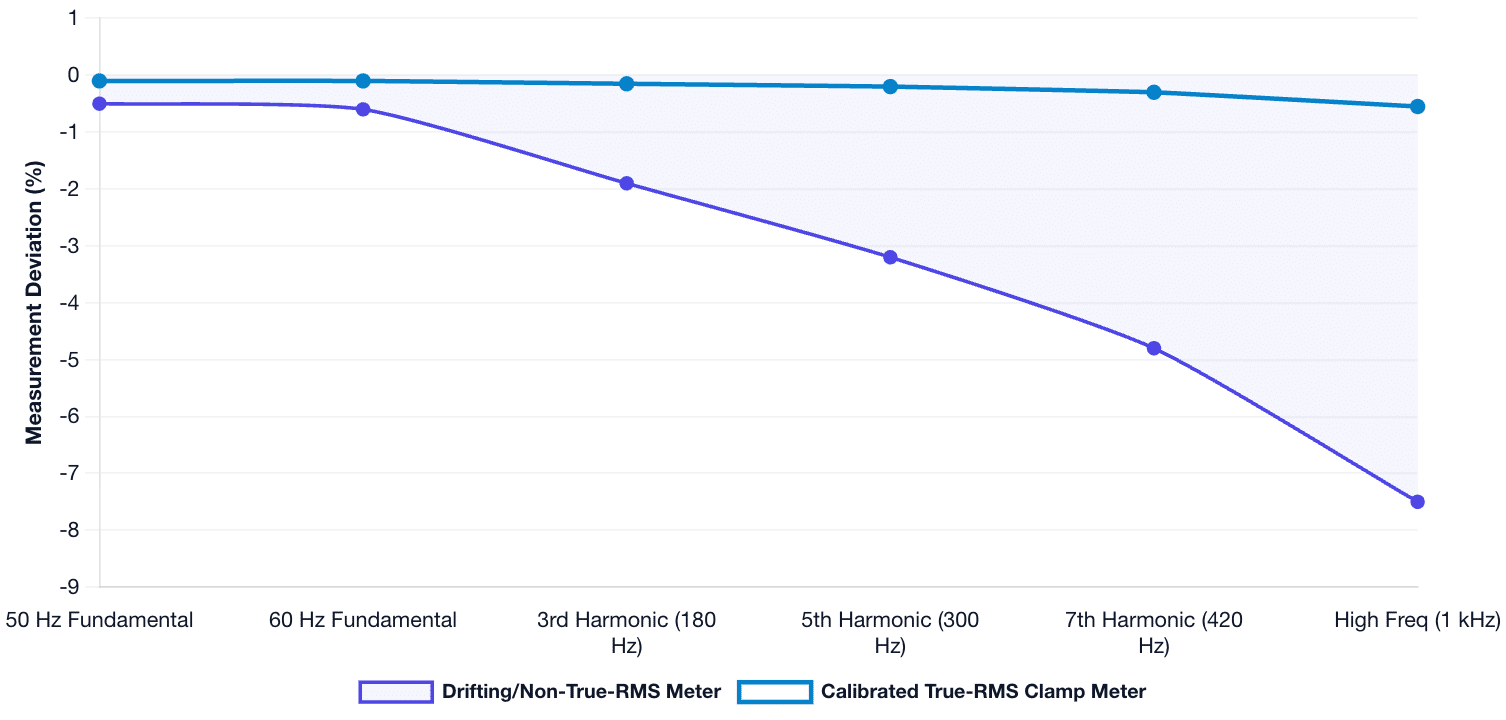
Frequency Response & Harmonic Distortion Curve
Industrial VFD systems introduce heavy high-order harmonics. Meters with degraded bandwidths or uncalibrated True-RMS modules fail to track high-frequency current signatures accurately. This chart tracks deviation up to a 1kHz frequency threshold.
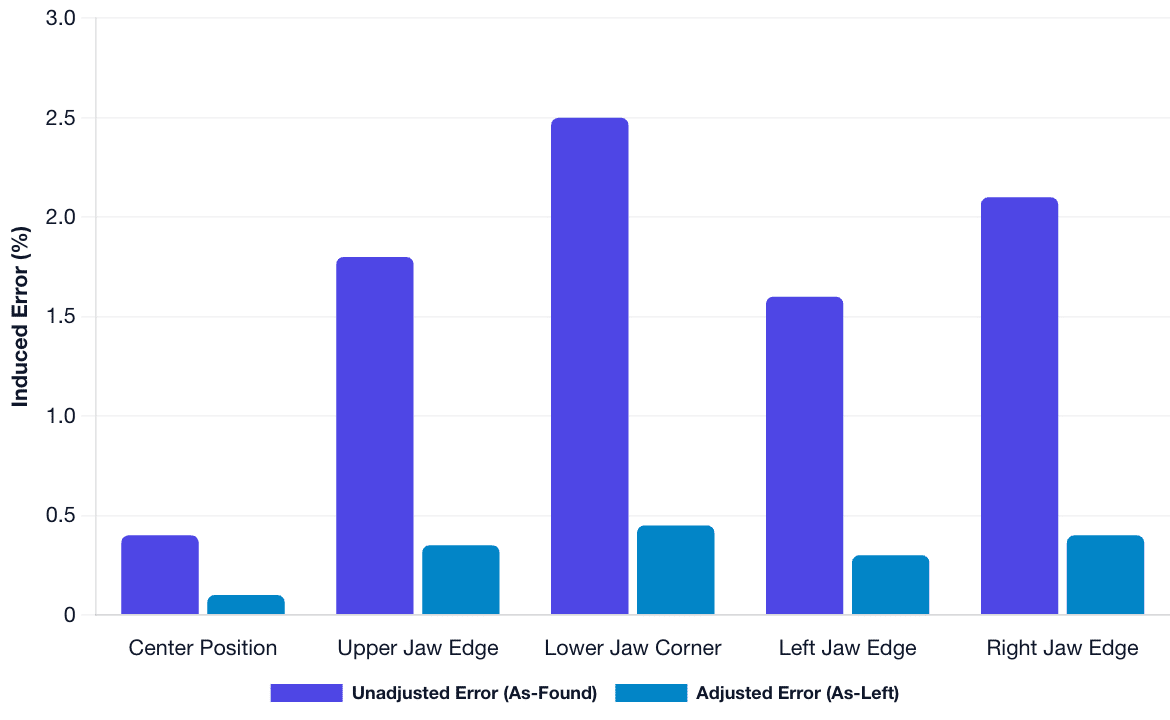
Conductor Positioning Error
Electromagnetic fields are non-uniform. Moving the wire away from the geometric center of the jaws dramatically spikes the error rate. Calibration offsets this vulnerability.
Why is traceable testing mandatory for your tools?
Accredited hook ammeter calibration connects your tool directly to national standards. This rigorous process determines measurement uncertainty and provides the confidence needed for ISO/IEC 17025 audits.
Operating with uncalibrated electrical tools brings significant risk to your maintenance program. Since measurement drift happens gradually, you might not notice it until a major problem occurs. For instance, a breaker might trip when it shouldn’t, or worse, a wire might overload without triggering a safety device.
Implementing an ISO/IEC 17025 accredited calibration schedule mitigates these risks. By providing an official certificate of accuracy, the lab proves that your diagnostic equipment is trustworthy. By verifying the tool’s response against a national standard, you ensure that every reading provides accurate, useful data for your maintenance team.
4. How to Prepare Your Hook Ammeter
Follow this checklist to get your equipment ready for a fast and accurate calibration.
1. Inspect the Magnetic Jaws
Check the jaws for damage, rust, or dirt. The surfaces must meet perfectly to ensure a consistent magnetic path. If there is a gap, the meter will not be accurate.
2. Verify Battery Power
Replace old batteries or ensure the power source is stable. Voltage drops cause inconsistent processing errors, which mimic measurement drift.
3. Ensure Ambient Stabilization
Let the device reach room temperature in the lab before testing starts. If you bring it in from the cold or heat, the magnetic core might expand or shrink, which changes the readings.
4. Provide Operational Baseline
Tell the lab which ranges or frequencies you use most often. This allows the technician to perform targeted testing that matches your specific daily work.
Techmaster US: Your Calibration Partner
Why Choose Techmaster US?
-
Full ISO/IEC 17025 Accreditation: All procedures follow the strict quality governance of our ANAB cert AC-1736 framework.
-
Rapid On-Site Calibration: We bring mobile laboratories to your site to verify your systems, which minimizes equipment downtime.
-
Comprehensive Scope: Our expertise spans advanced electronics, thermodynamics, dimensional parameters, and mechanical systems.
Frequently Asked Questions (FAQs)
1. How often should a hook ammeter be calibrated?
We usually recommend annual hook ammeter calibration to ensure reliability. However, if you use the device daily in harsh industrial conditions, a six-month interval is often a better choice.
2. What is the difference between a clamp meter and a multimeter?
A hook ammeter uses a magnetic jaw to measure current safely without breaking the circuit. In contrast, a multimeter usually requires you to open the circuit to pass current through the test leads, which is impractical for high-load diagnostics.
3. Why do readings drift over time?
Even if you handle the meter carefully, internal magnetic parts and sensors react to aging, thermal cycling, and humidity. Consequently, all these factors contribute to gradual measurement drift.
4. Is ISO/IEC 17025 accreditation required?
Yes, accreditation provides evidence that your calibration used repeatable procedures and traceable standards. It is essential for companies that undergo quality management audits.
5. How can I identify if my ammeter is giving inaccurate readings?
If the meter fails to return to zero when the jaws are closed, or if you consistently measure current values that do not match known loads, your ammeter likely needs professional recalibration.
Secure the Safety of Your Current Audits
Ensure your maintenance fleet delivers reliable diagnostics. Partner with Techmaster US to perform accredited, ISO/IEC 17025 current calibrations.
CONTACT USFrequently asked questions
What is Hook Ammeter Calibration?
How often should a Hook Ammeter be calibrated?
What standards apply to Hook Ammeter Calibration?
What is included on the certificate?
Can you calibrate the Hook Ammeter on-site?
Need Hook Ammeter calibration?
ANAB-accredited, NIST-traceable, fast turnaround — in-lab or on-site across the USA.
Contact us for a quoteReferences & industry standards
- ISO/IEC 17025 testing & calibration laboratory requirements
- NIST calibration services and measurement traceability
- NIST Fundamental Electrical Measurements
- A2LA / ANAB accreditation for calibration laboratories
External standards bodies. Techmaster Electronics is an ISO/IEC 17025-accredited, NIST-traceable calibration laboratory.
Related reading: Rogowski coil calibration: why flexible AC current probes drift

Khanh Nguyen is the Marketing Manager at Techmaster Electronics, a B2B marketing leader covering the test, measurement, and ISO/IEC 17025 accredited calibration industry across the US and Vietnam markets.