
What does frequency counter calibration actually verify?
A modern reciprocal counter such as a Keysight 53230A or a Tektronix FCA3100 displays 12 digits of frequency per second of gate time. That resolution tempts users into believing the instrument is accurate to 12 digits. It is not. Every reading is scaled by the internal 10 MHz reference, so if that oscillator is off by 1×10⁻⁷, every displayed value, whether you are counting 32.768 kHz watch crystals or a 6 GHz microwave source, is off by the same fractional amount.
That is why an accredited calibration focuses on quantifying the time base offset first, then confirms channel sensitivity, trigger level accuracy, and (on timer models) time-interval accuracy. In Techmaster’s 10-year calibration dataset, 381,916 accredited calibrations across 4,913 manufacturers, frequency counters from Keysight, Fluke, Tektronix, and Pendulum consistently show the same pattern: the instrument that “fails” is almost never broken. Its oscillator has simply aged out of specification.
Why does the time base decide your counter’s accuracy?
The classic error model for a frequency measurement is:
Δf/f = time base error + resolution error + trigger error
Work one real example. A counter with a standard temperature-compensated crystal oscillator (TCXO) specified at ±1×10⁻⁶ per year of aging measures a nominal 10 MHz signal:
- Time base term: 1×10⁻⁶ × 10 MHz = ±10 Hz
- Resolution term (1 s gate, 12 digits): around ±0.00001 Hz
- Trigger term on a clean signal: sub-millihertz
The time base contributes more than 99.9% of the error budget. At 1 GHz the same 1 ppm oscillator error becomes ±1 kHz. No amount of gate time, averaging, or extra digits recovers accuracy the reference does not have, the same reason a GPS-disciplined oscillator still needs documented ISO/IEC 17025 traceability even though GPS steers it.
There is one practical exception: the external reference input. Feed your counter a calibrated 10 MHz house standard and the internal oscillator is bypassed, the counter inherits the accuracy of the external reference. Labs that own a rubidium or GPSDO house standard routinely run every counter on external reference for exactly this reason, but the counter itself still needs periodic calibration to prove the input channels, trigger circuits, and prescalers measure correctly.
TCXO vs OCXO vs rubidium: how far does your counter drift in a year?
Every frequency counter time base falls into one of four classes, and the option you bought determines both your achievable accuracy and your calibration economics:
| Time base class | Typical aging rate | Approx. drift at 10 MHz after 1 year | Typical temperature effect (0–50 °C) | Warm-up to spec |
|---|---|---|---|---|
| Standard TCXO | ~1×10⁻⁶/year | ±10 Hz | ~1×10⁻⁶ | Minutes |
| OCXO (ovenized) | ~10⁻⁷ to 10⁻⁸/year | ±0.1 to ±1 Hz | ~10⁻⁹ | 15–30 min |
| Rubidium | ~5×10⁻¹⁰/year | ±0.005 Hz | ~10⁻¹⁰ | ~30 min |
| GPSDO (steered) | ~10⁻¹² averaged daily (while locked) | , | , | Hours to full lock |
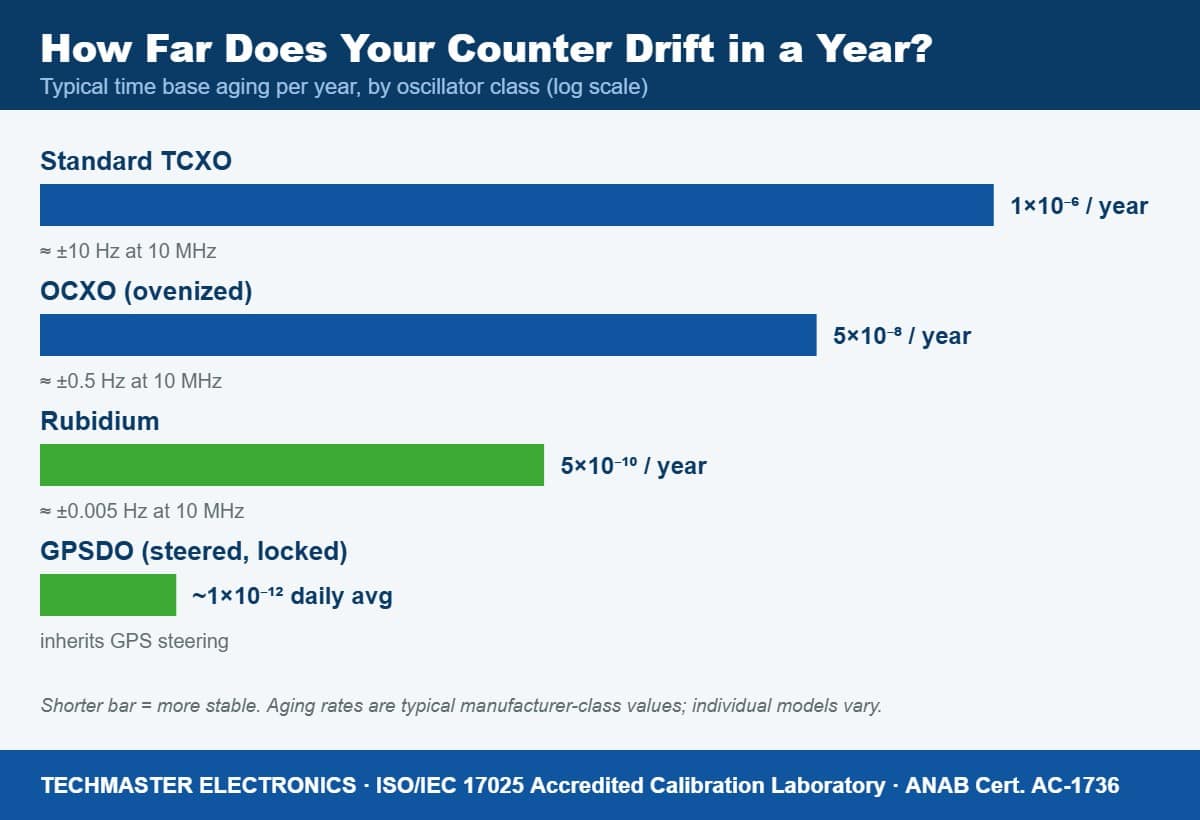
Two consequences follow. First, if your work only needs 4–5 digits of confidence, a TCXO counter on an annual cycle is perfectly adequate, the drift stays comfortably inside a ±1×10⁻⁶ specification when it is adjusted at each calibration. Second, if you bought an OCXO or rubidium option because a test procedure demands parts in 10⁸ or better, the calibration interval and the quality of the reporting matter far more: an OCXO that ages 5×10⁻⁸ in a year has consumed its entire specification budget by the time it comes due.
How is a frequency counter calibrated in an ISO/IEC 17025 lab?
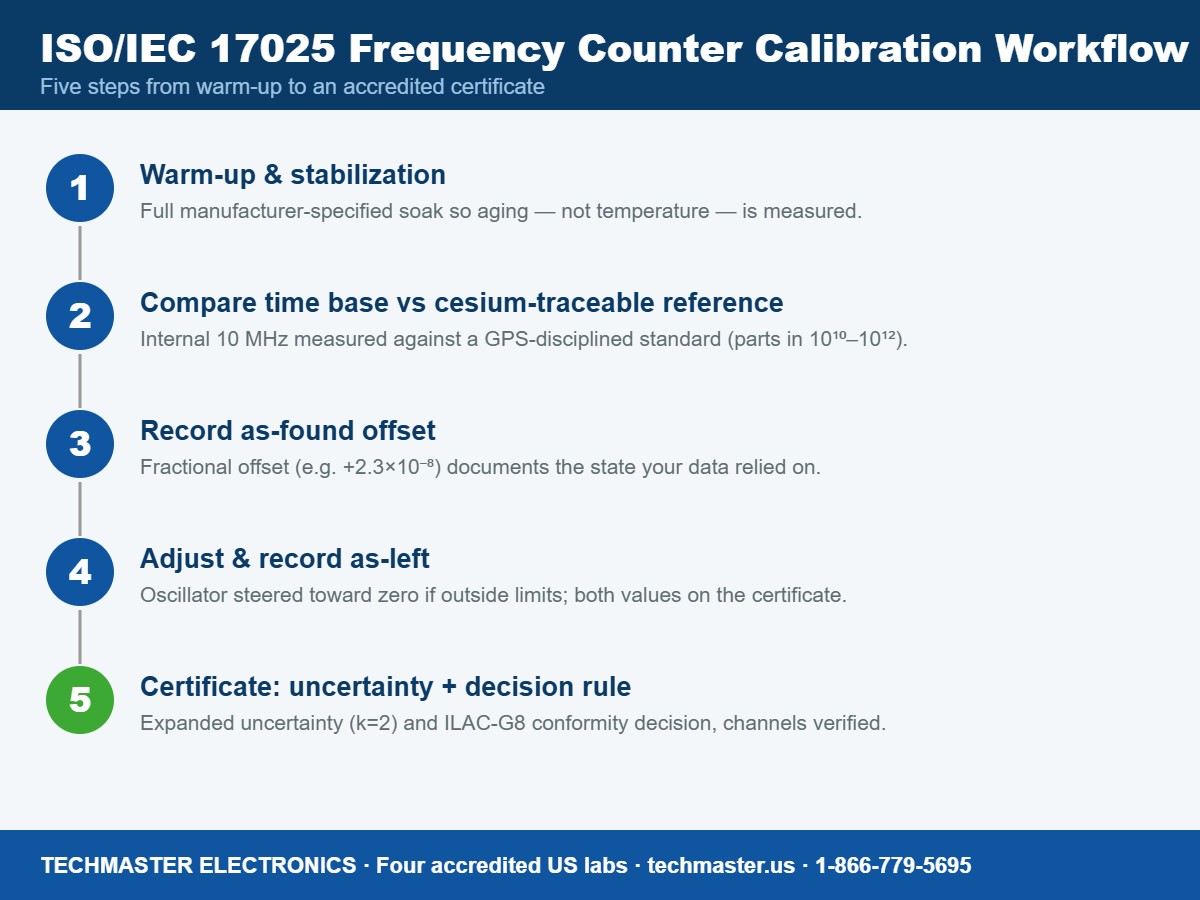
The core steps at Techmaster’s time and frequency calibration laboratories follow this sequence:
- Stabilization. The counter powers up and soaks, ovenized time bases get their full manufacturer-specified warm-up so aging, not temperature, is what gets measured.
- As-found time base measurement. The internal reference output is compared against the lab’s cesium-traceable standard. Reference uncertainties reach parts in 10¹⁰–10¹², so even a rubidium counter enjoys a comfortable test uncertainty ratio, see how that feeds a conformity statement in our guide to calibration decision rules and guardbanding.
- Adjustment (if needed). If the as-found offset exceeds limits, the oscillator is electronically adjusted toward zero and an as-left value is recorded. Both numbers belong on the certificate, the as-found value is what tells you whether the measurements you made last year were valid.
- Channel and function verification. Input sensitivity across the band, trigger level accuracy, attenuator and coupling checks, and time-interval accuracy on counter/timer models.
- Reporting. An accredited certificate lists measured values, expanded uncertainty (k=2), and conformity decisions per ILAC-G8 guidance on decision rules.
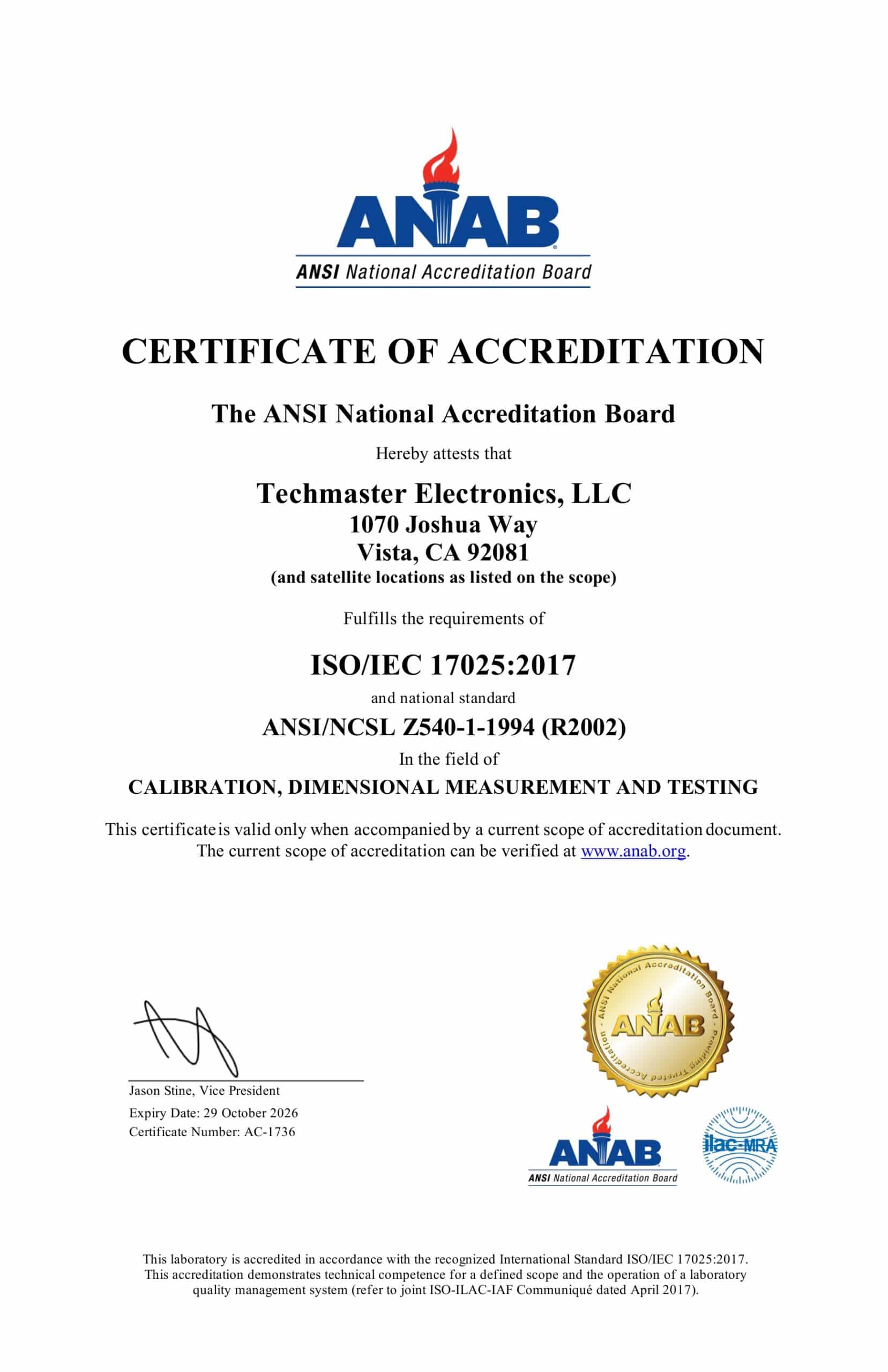
Traceability behind the bench flows from the SI second, realized by cesium fountain clocks operated by national metrology institutes such as NIST’s Time and Frequency Division in Boulder, Colorado, through continuously monitored GPS-disciplined standards into the working references on the bench. Techmaster Electronics, founded in 1989, performs accredited time and frequency calibration under ISO/IEC 17025:2017, ANAB certificate AC-1736, at laboratories in Vista CA, Santa Clara CA, Orlando FL, and San Antonio TX.
How do you read a frequency counter calibration certificate?
A typical accredited certificate line might read: nominal 10 000 000 Hz, measured 10 000 000.23 Hz, offset +2.3×10⁻⁸, expanded uncertainty 5×10⁻¹¹ (k=2), specification ±1×10⁻⁷, Pass. Three reading tips:
- Convert the offset to your working frequencies. A +2.3×10⁻⁸ offset means readings at 1 GHz run +23 Hz high. If you certify transmitter frequencies against a ±100 Hz license limit, that bias eats a quarter of your tolerance.
- Check the uncertainty against your needs, not just the spec. The lab’s uncertainty must be small relative to the counter’s specification for a clean conformity decision, that is the test uncertainty ratio conversation, and it is where a low-cost, non-accredited “cal tag” quietly fails you.
- Use as-found data to defend past measurements. If the as-found offset was inside specification, every measurement back to the previous calibration stands. If it was out, you need the magnitude to run a reverse-traceability impact review.
How often should you calibrate a frequency counter?
Interval setting should be evidence-based, not habit-based. ILAC-G24 describes reactive and interval-analysis methods that use exactly the as-found data your certificates already contain, our walkthrough of setting calibration intervals with ILAC-G24 methods shows how to apply them. For frequency counters specifically:
- Annual suits general-purpose bench use where 10⁻⁶ accuracy is sufficient.
- Semi-annual or quarterly suits counters certifying against tight regulatory limits (avionics, licensed transmitters) on TCXO time bases.
- Continuous external reference + annual verification is the strongest scheme: run all counters from one calibrated house standard, and calibrate the counters annually for channel integrity.
Standard turnaround at Techmaster is 5 business days, with 1–2 day expedite options, free local pickup and delivery in Silicon Valley, Southern California, and Orlando, and on-site calibration for racks that cannot leave the floor.
Key Takeaways
- Displayed digits are resolution, not accuracy, the internal time base sets the real accuracy of every reading a counter makes.
- A standard TCXO ages about 1×10⁻⁶ per year (±10 Hz at 10 MHz; ±1 kHz at 1 GHz); OCXO and rubidium options age 10 to 2,000 times slower.
- Accredited calibration measures the time base against a cesium-traceable reference with uncertainty in parts in 10¹⁰ or better, then verifies channels and trigger accuracy.
- As-found data is your legal defense for last year’s measurements, insist on as-found and as-left values on every certificate.
- Twelve months is the evidence-backed starting interval; tighten it only when your tolerance-to-drift margin demands it, per ILAC-G24.
- Techmaster Electronics (founded 1989) calibrates frequency counters under ISO/IEC 17025, ANAB cert AC-1736, at four accredited US laboratories.
Frequently Asked Questions
What reference standard is used to calibrate a frequency counter?
Accredited labs use a 10 MHz reference traceable to the SI second, usually a GPS-disciplined oscillator or rubidium standard that is continuously compared against national time scales maintained by institutes like NIST. Reference uncertainty reaches parts in 10¹⁰ to 10¹², far beyond any bench counter’s specification.
Does using the external reference input eliminate the need for calibration?
No. An external 10 MHz reference bypasses the internal time base, so frequency accuracy follows the house standard. But the counter’s input channels, trigger circuits, attenuators, and time-interval function still require periodic verification, and the house standard itself needs accredited calibration to close the traceability chain.
My counter displays 12 digits. Why is it only accurate to 6 or 7?
Twelve digits describe resolution, how finely the instrument can subdivide a reading. Accuracy is capped by the time base offset, which for a standard TCXO is around 1×10⁻⁶ within a year of calibration. The last five or six displayed digits of an absolute frequency reading carry no metrological weight unless the time base justifies them.
Can I check my frequency counter in-house with a GPS-disciplined oscillator?
Yes, as an intermediate check, comparing your counter against a GPSDO between calibrations is excellent practice and catches gross drift early. It does not replace accredited calibration, because a GPSDO’s health must itself be demonstrated and documented, and channel-level verification needs calibrated signal sources.
What accuracy can a calibration lab actually achieve on a frequency counter?
Against a standard TCXO specification of ±1×10⁻⁶, a reference at parts in 10¹⁰ gives a test uncertainty ratio in the thousands, effectively ideal. The demanding cases are rubidium-equipped counters, where specifications of parts in 10¹⁰ require the lab’s best references and longer averaging to keep the decision risk low.
What turnaround should I expect for frequency counter calibration?
Techmaster’s standard turnaround is 5 business days after receipt, with expedite service of 1–2 business days available on many models. Free local pickup and delivery run in Silicon Valley, Southern California, and Orlando, Florida, and on-site calibration can be scheduled for equipment that cannot leave your facility.
Need an accredited frequency counter calibration?
ISO/IEC 17025 accredited · ANAB Cert. AC-1736 · Four US laboratories · 5-day standard turnaround
Request a Calibration Quote
Khanh Nguyen is the Marketing Manager at Techmaster Electronics, a B2B marketing leader covering the test, measurement, and ISO/IEC 17025 accredited calibration industry across the US and Vietnam markets.