
Metrology guide · ISO/IEC 17025 · ANAB-accredited
Rubidium Standard Calibration
Rubidium Standard Calibration verifies a Rubidium Standard against NIST-traceable standards under ISO/IEC 17025. Techmaster performs a documented multi-point check, reports measurement uncertainty, and issues an ANAB-accredited certificate, in-lab or on-site across the USA.
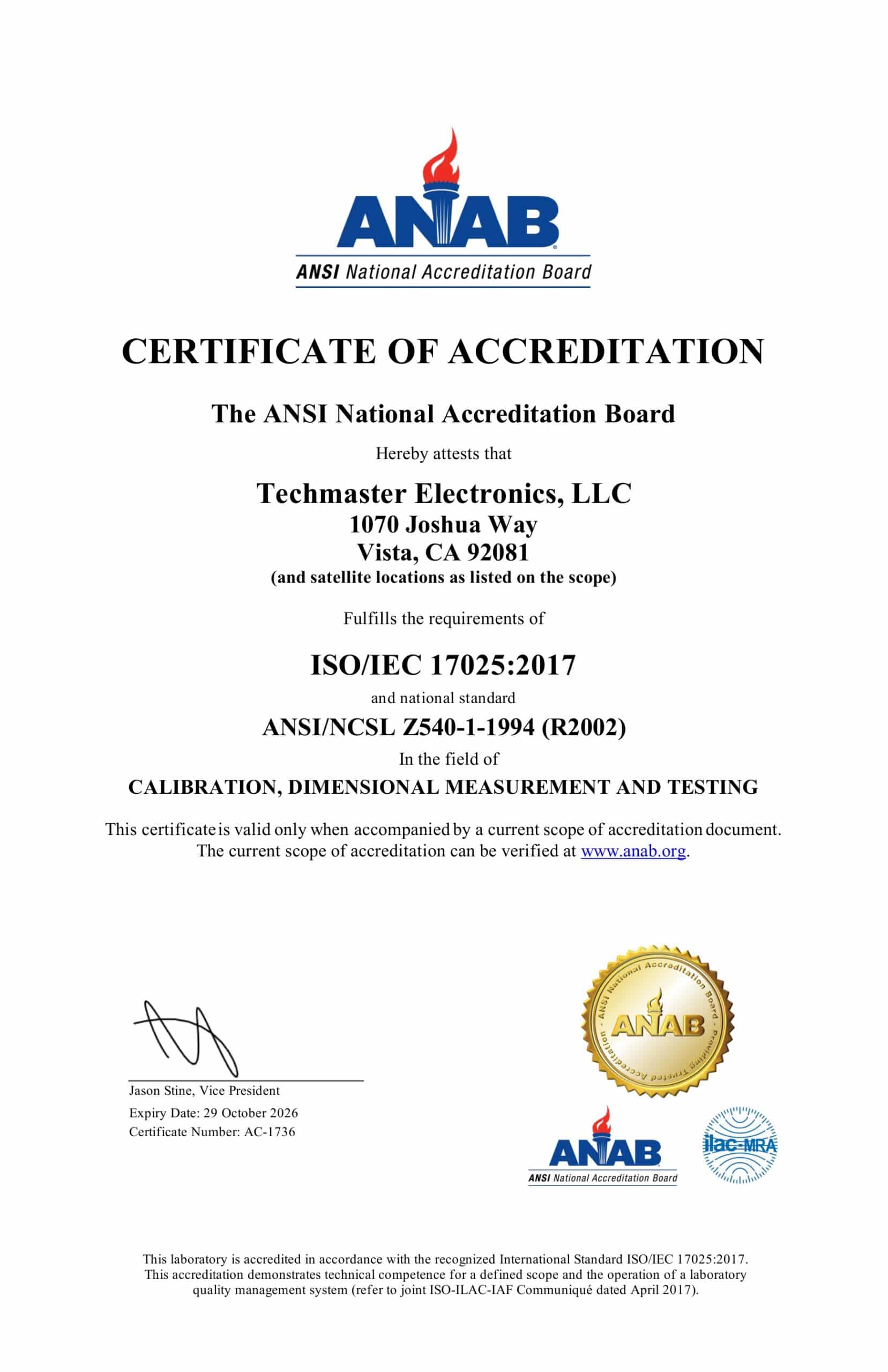
ANAB accredited ISO/IEC 17025 NIST traceable
ISO 17025Accredited method
NISTTraceability
12 moTypical interval
ANABAccreditation
In this guide
Frequency response at a glance
Typical response: output stays flat across the usable band and rises near resonance, calibration maps the curve and reports the reference value.
How Rubidium Standard calibration works
- Intake & visual inspection
- Environmental stabilization
- As-found measurement
- Comparison to NIST-traceable standards
- Adjustment if required
- As-left results & certificate
Your calibration, covered
In-lab calibrationAccredited bench service with pickup
On-site calibrationWe calibrate at your facility
Expedited turnaroundRush options to cut downtime
Accredited certificateANAB ISO 17025 with uncertainty
In-lab vs on-site calibration
In-lab calibration
- Accredited bench with full reference standards
- Best achievable measurement uncertainties
- Pickup & return logistics handled
- Ideal for precision and reference work
On-site calibration
- We calibrate the Rubidium Standard at your facility
- No shipping risk or transit downtime
- As-found data captured before any move
- Ideal for fixed, large or sensitive assets
In-depth guide
Rubidium Standard Calibration: The Foundational Pillar for 5G Network Accuracy
The global rollout of 5G has begun a new era of connectivity. It promises blazing fast speeds. It also offers a future with low latency and massive device capacity. These new capabilities rely on one hidden factor: perfect time synchronization. Every part of the 5G network must work in harmony. They must achieve nanosecond precision. This is a huge engineering challenge. Conventional timing sources cannot meet it. The Rubidium standard is a compact atomic clock. It is the master timekeeper for this synchronized network. It ensures every data packet, signal, and communication link is perfectly aligned. However, this master clock’s reliability is not guaranteed. It must be maintained. This is where Rubidium standard calibration becomes essential. It is a critical link. It guarantees the fundamental accuracy of the entire 5G infrastructure. By doing so, it protects the network from failure. It also secures the promise of next-generation connectivity.
1. 5G’s Demand for Precise Timing
To understand why Rubidium standard calibration is vital, you must grasp 5G’s core demands. The network’s promise is directly tied to its ability to manage time.1.1. Why Nanosecond Precision Matters
Precision timing in 5G comes from key innovations.- Massive MIMO and Beamforming: 5G uses many antennas. These antennas create focused data “beams.” They can hit many users at once. This boosts network capacity and data rates. Think of a symphony orchestra: every instrument must play in perfect time. Similarly, the antennas’ timing must be perfect. If it is off by a few nanoseconds, signals can clash. This lowers data speed and hurts network performance.
- Ultra-low Latency for Critical Apps: Many future 5G apps need instant communication. For instance, self-driving cars talk to traffic lights. Surgical robots are controlled remotely. Delays of just a few milliseconds can cause a major incident. The network’s components must sync perfectly to prevent any lag.
- Smooth Handovers: A mobile device moving between cell sites needs a smooth “handover.” This prevents dropped calls. This process needs perfect timing synchronization between the two sites. A timing mismatch can disrupt the handover. This results in a poor user experience.
2. The Rubidium Standard: The Master Clock for 5G

2.1. The Science of Stability
A Rubidium standard is a small atomic clock. It uses the natural frequency of rubidium atoms. This frequency is very stable. It does not change with time or environment. This makes it an ideal reference. In a 5G base station, it acts as a local master clock. It provides a stable signal. This is a crucial backup if the GPS signal is lost. This “holdover” stability is a key benefit. It maintains accurate time even when the main signal is gone. This is a common issue in cities or indoors. The Rubidium standard reduces this risk.2.2. Its Role in Network Design
Rubidium standards are a core part of 5G network design. You find them in base stations and core network elements. They are also in transport networks and data centers. These devices share their precise timing signal. They often use protocols like PTP (Precision Time Protocol). PTP delivers very accurate timing over Ethernet. As a local, stable, and independent time source, Rubidium standards help the network stay strong. It works well even in tough conditions.3. The Essential Role of Rubidium Standard Calibration
Rubidium standards are not flawless. They are precise, but they need regular maintenance. Rubidium standard calibration is a must for the nanosecond accuracy that 5G demands.3.1. Finding and Fixing Frequency Drift
Frequency drift is a natural quality of all oscillators. Over time, parts age and the environment changes. The output frequency can slowly change. This drift is small, but it adds up. A small, uncorrected drift can cause a big timing error. This pushes network timing out of sync. It then harms network performance. Rubidium standard calibration is a proactive process. It finds this drift. It then makes the needed changes to restore the device’s accuracy.3.2. The Calibration Process and Traceability
A specialized, accredited lab must calibrate a Rubidium standard. This is a key step. The lab compares the standard’s frequency to its own master standards. These are usually Cesium clocks. These master standards are traceable to national and international standards. This creates a clear chain of metrological traceability. This is a must for all professional calibration services. An ISO/IEC 17025 accredited lab guarantees the highest standards. This makes the results reliable and globally recognized.3.3. Calibration’s Direct Impact on Operations
Professional calibration of Rubidium standards directly impacts a 5G network’s performance.- Improved Reliability: Calibration ensures all timing sources are accurate. This prevents many timing-related failures. It leads to fewer outages. It also makes the network more stable.
- Optimized Data Throughput: Perfect timing lets technologies like Massive MIMO work at full power. This boosts data transfer speeds and network capacity.
- Ensuring Compliance: Telecom authorities set strict rules for network timing. Regular calibration provides documented proof of compliance. This helps avoid fines and legal issues.
4. Choosing the Right Calibration Service
For a telecom provider or equipment maker, choosing a professional Rubidium standard calibration service is a smart business choice.4.1. Expertise and Specialized Equipment
Most companies do not have the internal expertise. They also lack the highly accurate equipment needed to calibrate an atomic clock. Professional calibration labs have these specialized, more accurate tools. They also employ metrologists who are experts in atomic clock technology. This partnership ensures that experts handle a company’s most important timing assets.4.2. The Cost of Inaccuracy
The cost of professional calibration is small. The potential cost of network failure is huge. An inaccurate calibrator can cause dropped calls and corrupted data. It can lead to service outages and penalties. In the competitive 5G world, network reliability is key. A single big outage can harm a company’s reputation. It can also cause customers to switch providers. Therefore, calibration is a smart risk management strategy. It is an investment in long-term network health and business success.Conclusion
The 5G revolution is changing our lives. Its success depends on precise time synchronization. Rubidium standards are the key guardians of this precision. They are the master clocks that power the entire network. However, their true value comes from Rubidium standard calibration. This process must be regular, professional, and accredited. It is not just a technical need, it is a vital investment in the integrity and efficiency of 5G. It also builds a strong foundation for the smooth connectivity that will define our future.Frequently asked questions
What is Rubidium Standard Calibration?
Rubidium Standard Calibration is the documented comparison of a Rubidium Standard against NIST-traceable reference standards under ISO/IEC 17025, measuring its error and measurement uncertainty and confirming it performs within tolerance.
How often should a Rubidium Standard be calibrated?
Most quality systems calibrate a Rubidium Standard every 12 months, and sooner after repair, overload or heavy use. Follow the manufacturer specification and your ISO 9001/13485/AS9100 program.
What standards apply to Rubidium Standard Calibration?
Calibration is performed under ISO/IEC 17025 with NIST-traceable references and the relevant manufacturer specification. Techmaster is ANAB-accredited.
What is included on the certificate?
An ANAB-accredited ISO/IEC 17025 certificate with as-found and as-left results and the measurement uncertainty for each point.
Can you calibrate the Rubidium Standard on-site?
Yes. Techmaster offers in-lab calibration with pickup and on-site service across the USA to minimize downtime.
Need Rubidium Standard calibration?
ANAB-accredited, NIST-traceable, fast turnaround, in-lab or on-site across the USA.
Contact us for a quoteReferences & industry standards
- ISO/IEC 17025 testing & calibration laboratory requirements
- NIST calibration services and measurement traceability
- NIST Time and Frequency Division
- A2LA / ANAB accreditation for calibration laboratories
External standards bodies. Techmaster Electronics is an ISO/IEC 17025-accredited, NIST-traceable calibration laboratory.
This calibration falls under our time and frequency calibration service.

Khanh Nguyen is the Marketing Manager at Techmaster Electronics, a B2B marketing leader covering the test, measurement, and ISO/IEC 17025 accredited calibration industry in the United States.