
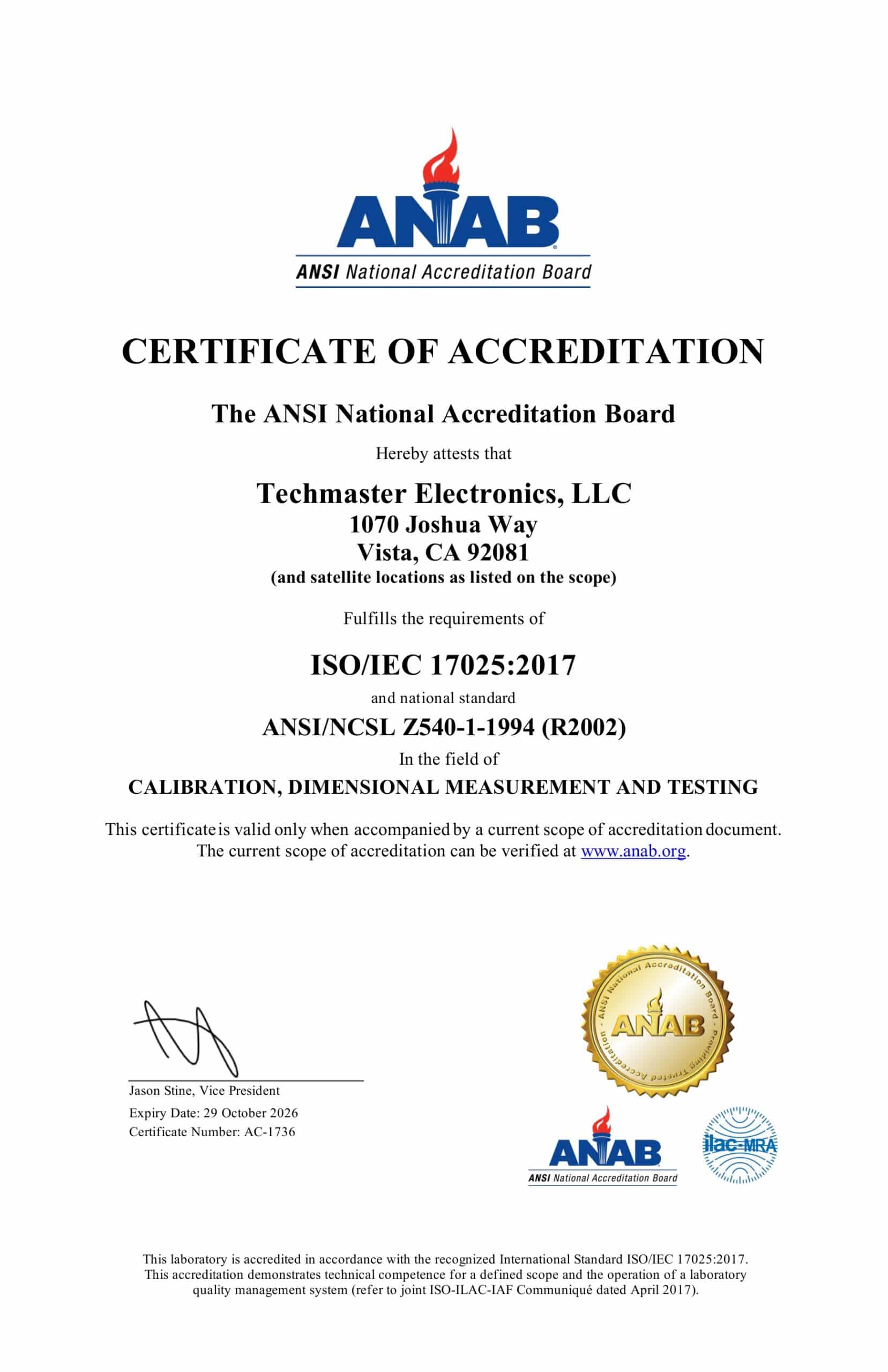
Trusted Frequency Calibration
Frequency response at a glance
How Trusted Frequency calibration works
- Intake & visual inspection
- Environmental stabilization
- As-found measurement
- Comparison to NIST-traceable standards
- Adjustment if required
- As-left results & certificate
Your calibration, covered
In-lab vs on-site calibration
In-lab calibration
- Accredited bench with full reference standards
- Best achievable measurement uncertainties
- Pickup & return logistics handled
- Ideal for precision and reference work
On-site calibration
- We calibrate the Trusted Frequency at your facility
- No shipping risk or transit downtime
- As-found data captured before any move
- Ideal for fixed, large or sensitive assets
In-depth guide
In high-precision industries, accuracy isn’t optional, it’s essential. Frequency calibration plays a vital role in applications like aerospace, telecom, defense, and manufacturing. However, accurate measurements are only trusted when they’re traceable to a national standard.
That’s where NIST traceability in frequency calibration comes in.
What Is Frequency Calibration?

Frequency calibration ensures that electronic devices, such as signal generators, frequency counters, and oscillators, output or measure frequencies accurately.
Over time, these instruments may drift due to component aging, temperature variations, or environmental stress. Regular calibration corrects this drift and aligns measurements with a defined standard.
Why Does Traceability Matter?
Calibration without traceability is like navigation without a map.
Traceability ensures that each measurement result can be linked to a recognized national or international standard in the U.S., that’s NIST (National Institute of Standards and Technology).
Traceability provides:
-
Confidence in measurements
-
Compliance with regulatory bodies
-
Legal defensibility in audits or disputes
-
Consistency across labs and global operations
What Is NIST Traceability?

NIST traceability means that the calibration process has a documented, unbroken chain of comparisons to NIST-maintained standards, each with known uncertainties.
For a calibration to be NIST-traceable:
-
The reference standard used must itself be calibrated against a higher standard.
-
Each step must include a documented uncertainty.
-
The process must follow ISO 17025 or equivalent quality systems.
-
All results must be verifiable by audit or inspection.
This chain ensures every measurement is scientifically valid and legally defensible.
Who Requires NIST-Traceable Frequency Calibration?
Industries with zero tolerance for error depend on NIST traceability, including:
-
Aerospace & Defense: for radar systems, avionics, and missile guidance.
-
Telecommunications: to maintain signal integrity and timing accuracy.
-
Medical Devices: where life-critical signals depend on exact frequencies.
-
Semiconductors: for RF circuit validation and chip testing.
-
Calibration Labs: as a baseline for further calibration services.
Whether you’re producing, maintaining, or auditing complex systems, NIST-traceable results protect your reputation and operations.
What Happens Without Traceability?
Operating without NIST traceability increases your exposure to:
-
Audit failures
-
Regulatory noncompliance
-
Measurement disputes with customers or partners
-
Uncertainty in research, development, and production outcomes
-
Safety or mission failures in critical systems
Without a traceable standard, any measurement could be called into question, especially during ISO, FDA, or DoD audits.
How Techmaster Ensures NIST Traceability
At Techmaster, we provide ISO 17025-accredited frequency calibration services with full NIST traceability.
Our process includes:
-
Use of primary and secondary standards calibrated directly by NIST or NIST-traceable labs.
-
Documentation of the full calibration chain and uncertainty budgets.
-
Calibration of a wide range of devices including frequency counters, RF generators, synthesizers, and more.
-
Delivery of calibration certificates with traceability statements and compliance with ANSI/NCSL Z540.3.
Whether in-lab or onsite, Techmaster delivers confidence, compliance, and precision, backed by NIST.
Benefits of Choosing a NIST-Traceable Calibration Partner
When you choose a lab like Techmaster, you get more than just calibration. You gain:
- Compliance – With ISO, FAA, FDA, DoD, and OEM standards
- Audit Readiness – With traceable documentation for every instrument
- Risk Reduction – From product defects, safety incidents, and legal disputes
- Global Consistency – Across all measurement activities and facilities
- Technical Support – From experts who understand your industry’s needs
Conclusion
NIST traceability in frequency calibration is not optional, it’s essential. It’s the foundation of accurate, defensible, and compliant measurement systems in high-stakes industries.
If your operations depend on frequency accuracy, don’t risk uncertainty. Partner with Techmaster to ensure your calibration is fully traceable, audit-ready, and performance-focused.
Frequency Counter Calibration: Why the Time Base Decides Your Accuracy
A frequency counter is only as accurate as its internal time base. Learn how ISO/IEC...
Sep
Does a GPS-Disciplined Oscillator Need Calibration? GPS Lock vs ISO/IEC 17025 Traceability
GPS lock makes a GPSDO accurate, but not traceable. What ISO/IEC 17025 assessors require: the...
Aug
Allan Deviation Explained: Measuring Oscillator & Frequency Stability
Allan deviation (ADEV) is the standard metric for oscillator and frequency-standard stability. Learn how to...
Jul
Audio Analyzer Calibration: Stop Costly Measurement Drif
1Unnoticed drift during testing often leads to compliance failures and false-positive quality passes on highly...
Jun
Digital Tachometer Calibration: Stop Costly RPM Errors
1 Metrology guide · ISO/IEC 17025 · ANAB-accredited Digital Tachometer Calibration Digital Tachometer Calibration verifies...
May
Tachometer Calibration Guide: ISO 17025 Standards & RPM Accuracy
1 Metrology guide · ISO/IEC 17025 · ANAB-accredited Tachometer Calibration Tachometer Calibration verifies a Tachometer...
Apr
Digital Circuit Breaker Timer Calibration: Principles & Roles
1 Metrology guide · ISO/IEC 17025 · ANAB-accredited Digital Circuit Breaker Timer Calibration… Digital Circuit...
Apr
Stop Watch Calibration: Guide to Precise Time Measurement
1 Metrology guide · ISO/IEC 17025 · ANAB-accredited Stop Watch Calibration Stop Watch Calibration verifies...
Mar
Frequently asked questions
What is Trusted Frequency Calibration?
How often should a Trusted Frequency be calibrated?
What standards apply to Trusted Frequency Calibration?
What is included on the certificate?
Can you calibrate the Trusted Frequency on-site?
Need Trusted Frequency calibration?
ANAB-accredited, NIST-traceable, fast turnaround, in-lab or on-site across the USA.
Contact us for a quoteReferences & industry standards
- ISO/IEC 17025 testing & calibration laboratory requirements
- NIST calibration services and measurement traceability
- NIST Time and Frequency Division
- A2LA / ANAB accreditation for calibration laboratories
External standards bodies. Techmaster Electronics is an ISO/IEC 17025-accredited, NIST-traceable calibration laboratory.

Khanh Nguyen is the Marketing Manager at Techmaster Electronics, a B2B marketing leader covering the test, measurement, and ISO/IEC 17025 accredited calibration industry across the US and Vietnam markets.