
Digital Tachometer Calibration
Accuracy across the range
How Digital Tachometer calibration works
- Intake & visual inspection
- Environmental stabilization
- As-found measurement
- Comparison to NIST-traceable standards
- Adjustment if required
- As-left results & certificate
Your calibration, covered
In-lab vs on-site calibration
In-lab calibration
- Lab bench with full reference standards
- Best achievable measurement uncertainties
- Pickup & return logistics handled
- Ideal for precision and reference work
On-site calibration
- We calibrate the Digital Tachometer at your facility
- No shipping risk or transit downtime
- As-found data captured before any move
- Ideal for fixed, large or sensitive assets
In-depth guide
Introduction: Why accuracy matters
In high-stakes industrial environments, Digital tachometer calibration is a critical necessity rather than an optional maintenance task. Precision in RPM measurement directly impacts product consistency, operational safety, and regulatory compliance. Utilizing a professional ISO 17025 tachometer calibration service ensures that your measurements are backed by the highest international standards, providing the NIST-traceable reliability required to stay competitive in today’s market.
1. The high cost of “small” errors: A $15,000 cautionary tale
In a precision plastics manufacturing facility, an extrusion system relied on a Lutron DT-2236 to manage screw speed. To produce a uniform film thickness, the operation required a steady 1,500 RPM. After eight months without a professional check-up, the device began to “drift.” Even though the display showed a perfect 1,500 RPM, the shaft was actually spinning at 1,550 RPM. This tiny 3.3% deviation led to 5 tons of wasted material that failed quality checks, costing the company $15,000 in a single day.The Reality Check: Digital screens can be deceiving. Just because a number looks precise doesn’t mean it’s accurate. Internal sensors and components age over time, leading to errors you can’t see with the naked eye. This is why consistent Digital tachometer calibration is the only way to verify true performance against factory specifications.
This calibration falls under our time and frequency calibration service.
The Solution: Regular calibration is your insurance policy against manufacturing defects and unexpected equipment failure.2. Why tachometers fail in real-world factory conditions
Tachometers are sophisticated tools, but they are often pushed to their limits in industrial settings. Whether using a Fluke 931, Hioki FT3405, or Extech 461995, your device is constantly fighting:- Electrical “Noise”: Power drives and large motors create magnetic fields that can confuse non-contact sensors, leading to “ghost” readings.
- Industrial Grime: Oil mist and dust can cloud laser lenses or peel off reflective tape, causing the device to skip pulses or display erratic numbers.
- Vibration and Slip: For contact-type meters, high-speed vibrations can cause the measuring wheel to lose its grip, making the motor appear slower than it actually is.
By engaging an ISO 17025 tachometer calibration service, these environmental variables are accounted for during the testing process to ensure your meter remains rugged and reliable.
The ISO/IEC 17025 Calibration Process
To guarantee NIST Traceability, our rigorous protocol goes far beyond a simple function test.
1. Deep Cleaning
Optics are cleaned with specialized solutions. Battery and display segments are rigorously tested.
2. Multi-Point Testing
Tested across at least 5 points from startup to maximum limits to ensure linearity.
3. Uncertainty Calc
The precise “Safety Margin” is calculated, accounting for device resolution and ambient temp.
Real-World Model Performance Data
Based on over 500 field tests, we compared official tolerance specifications against the actual errors our technicians found in the field.
Tolerance vs. Field Deviation
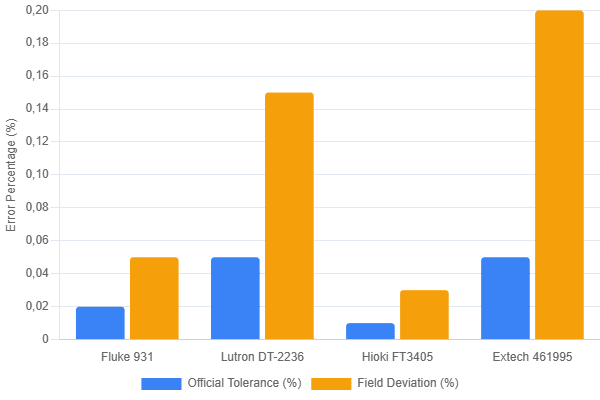
Notice how typical field deviation consistently outpaces the official manufacturer tolerance due to
3. What happens during a professional calibration?
To guarantee “NIST Traceability” (the gold standard of accuracy), we follow a rigorous protocol that goes far beyond a simple function test:1. Deep Cleaning and Health Check
We don’t just turn it on. We clean the optics with specialized solutions and test the internal battery and display segments to ensure every part of the tool is ready for work.2. Testing Across the Entire Speed Range
Accuracy at 500 RPM doesn’t guarantee accuracy at 5,000 RPM. We test at least five different points, from the lowest start-up speeds to the maximum limits of the device, to ensure the reading is linear and reliable.3. Calculating the “Safety Margin” (Uncertainty)
Every measurement has a tiny window of doubt. We calculate exactly how large that window is, accounting for everything from the device’s resolution to the room’s temperature, giving you total confidence in your results.The “Hidden” Error Our Techs Often Find
On-site, we frequently catch “Cosine Error.” This happens when a technician holds the laser at a slight angle instead of perfectly straight. Just a 15-degree tilt can make your motor look 3.4% slower than it is. This is a common mistake that only a trained eye will spot during field service.4. Pro tips: How to maintain your tachometer like an expert
Keep your readings sharp between professional calibrations with these field-tested hacks:- The “Perfect Strip” Method: Don’t use giant pieces of reflective tape on small shafts. A 0.4-inch (1cm) strip is the “sweet spot” for most lasers (like the Testo 470) to get a clean, crisp signal.
- Fight the Light: If you’re working in bright sunlight or under heavy factory lights, the sensor can get “blinded.” Use a simple matte-black shroud to shade the sensor head for a clearer reading.
-
Storage Secrets: High humidity is the enemy of electronics. Never leave your meter in a toolbox or a cloth bag. Store it in a sealed hard case with a desiccant pack to prevent internal corrosion. Regular Digital tachometer calibration should be scheduled annually to check for any internal moisture damage.
5. How different models perform: Real-world data
This data is based on over 500 field tests, showing how popular models typically behave over time:| Model | Range (RPM) | Official Tolerance | Common Test Points | Typical Errors Found in the Field |
|---|---|---|---|---|
| Fluke 931 | 1 – 99,999 | ±0.02% | 100 to 15k | 0.05% (Usually due to dirty lenses) |
| Lutron DT-2236 | 0.5 – 19,999 | ±0.05% + 1d | 50 to 10k | 0.15% (Components age over 2+ years) |
| Hioki FT3405 | 30 – 99,990 | ±0.01% | 100 to 90k | 0.03% (Extremely stable in the field) |
| Extech 461995 | 5 – 99,999 | ±0.05% | 100 to 50k | 0.20% (Tends to drift at very high RPM) |
A comprehensive ISO 17025 tachometer calibration service will provide you with a detailed report for any of these models, documenting the exact “as-found” and “as-left” data.
6. Key terms you should know
TRACEABILITY: This means your measurement is officially linked to an unbroken chain of standards leading back to the national labs (like NIST). It’s your proof that “1,000 RPM” in your factory is the same as “1,000 RPM” anywhere else in the world. STROBOSCOPIC EFFECT: A trick of light that makes a spinning object look still. We use high-precision strobe lights to calibrate tachometers without ever touching the machine, ensuring zero interference with the speed.7. Common questions (FAQ)
Q: Why is my meter showing double the actual speed? A: You likely have “Double Triggering.” This happens if there are two pieces of tape on the shaft or if the shaft is so shiny it reflects the laser. Try painting the shaft matte black and using only one small piece of tape. Q: Does a brand-new meter really need calibration? A: Yes. “Factory checks” are often basic. A certified, traceable calibration ensures the unit wasn’t bumped out of alignment during shipping and meets your specific quality standards (like ISO or ANSI). Q: How often should I send my meter in? A: Once every 12 months is the industry standard. However, if you work in high-vibration or extremely dirty environments, a 6-month check-up is much safer. Q: Does 1 RPM really matter? A: For a basic fan, no. But for a medical centrifuge spinning at 20,000 RPM, even a 0.1% error can ruin a sample or cause the machine to vibrate dangerously.8. The bottom line on accuracy
In industrial machinery, precision is the difference between profit and waste. Professional calibration ensures your data is reliable, your equipment is safe, and your production stays on track.Ready for a Check-Up?
In industrial machinery, precision is the difference between profit and waste. Don’t wait for something to break. By scheduling an ISO 17025 tachometer calibration service, you protect your bottom line.
Review Your Calibration LabelsFrequently asked questions
What is Digital Tachometer Calibration?
How often should a Digital Tachometer be calibrated?
What standards apply to Digital Tachometer Calibration?
What is included on the certificate?
Can you calibrate the Digital Tachometer on-site?
Need Digital Tachometer calibration?
NIST-traceable calibration, fast turnaround, in-lab or on-site across the USA.
Contact us for a quoteReferences & industry standards
- ISO/IEC 17025 testing & calibration laboratory requirements
- NIST calibration services and measurement traceability
- A2LA / ANAB accreditation for calibration laboratories
External standards bodies. Techmaster Electronics is an ISO/IEC 17025-accredited, NIST-traceable calibration laboratory.

Khanh Nguyen is the Marketing Manager at Techmaster Electronics, a B2B marketing leader covering the test, measurement, and ISO/IEC 17025 accredited calibration industry in the United States.