
Insulation Tester Calibration
Accuracy across the range
How Insulation Tester calibration works
- Intake & visual inspection
- Environmental stabilization
- As-found measurement
- Comparison to NIST-traceable standards
- Adjustment if required
- As-left results & certificate
Your calibration, covered
In-lab vs on-site calibration
In-lab calibration
- Accredited bench with full reference standards
- Best achievable measurement uncertainties
- Pickup & return logistics handled
- Ideal for precision and reference work
On-site calibration
- We calibrate the Insulation Tester at your facility
- No shipping risk or transit downtime
- As-found data captured before any move
- Ideal for fixed, large or sensitive assets
In-depth guide
Introduction
In electrical maintenance, insulation resistance testing is one of the most critical safety checks. It determines whether equipment insulation can effectively protect users from shock, leakage current, or breakdown.
Over time, even the most reliable insulation testers may drift due to aging components, environmental humidity, or high-voltage stress. When readings are inaccurate, the risk of false pass results increases, potentially leading to unplanned downtime or costly failures.
Regular calibration ensures your insulation tester delivers reliable measurements aligned with international standards and audit requirements.
What Is an Insulation Tester?
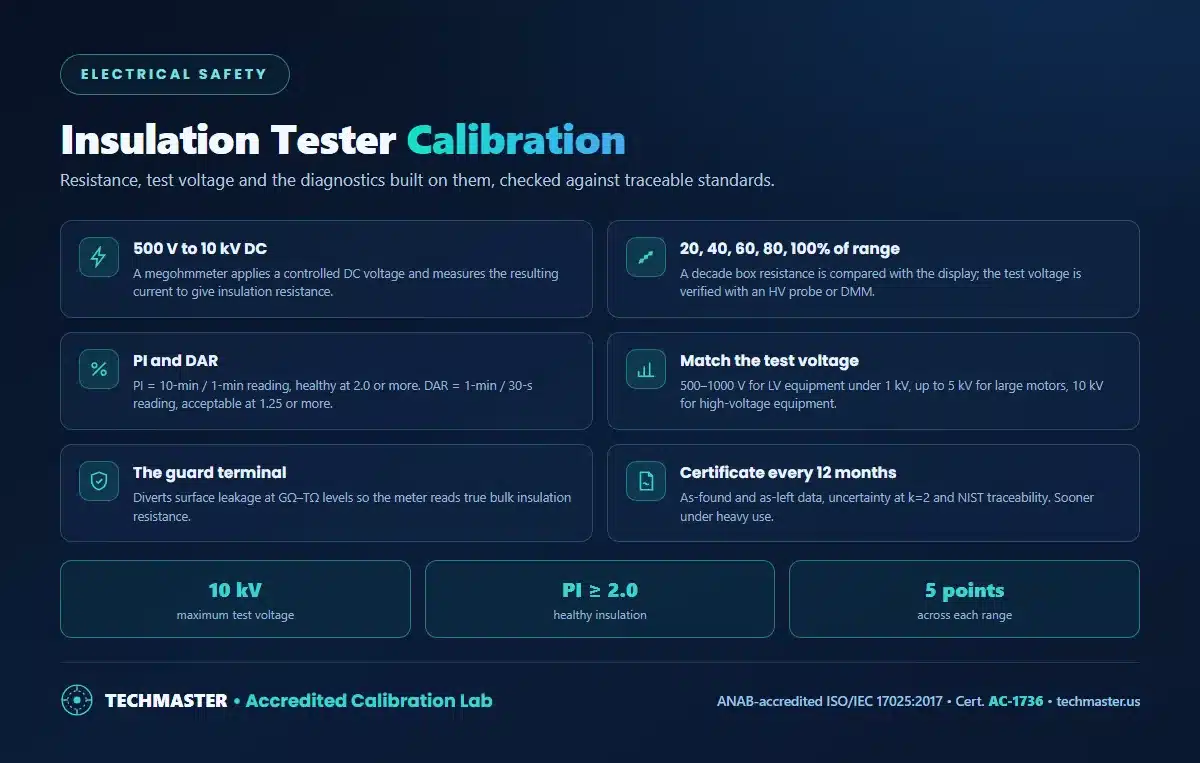
An Insulation Tester (also known as a Megohmmeter or IR Tester) measures the resistance of electrical insulation by applying a controlled DC voltage, typically from 500 V to 10 kV, and detecting the resulting current flow.
It’s widely used in:
-
Electric motor and generator testing
-
Cable insulation checks before energizing
-
Transformer and switchgear verification
-
Predictive maintenance programs
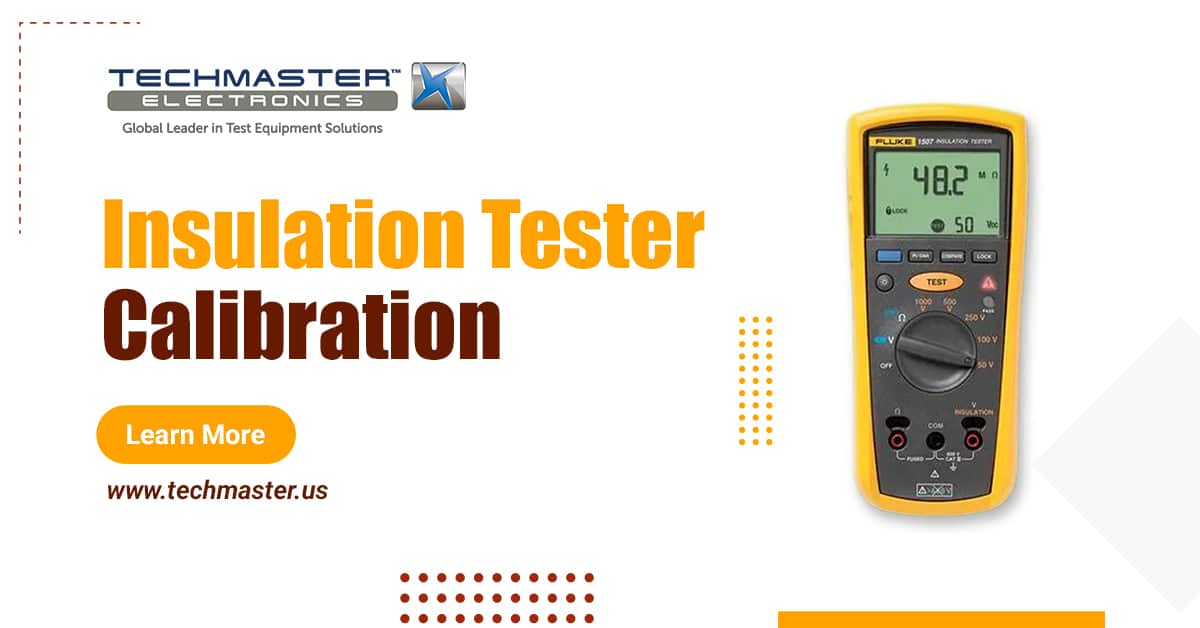
Depending on model, an insulation tester may include single-range handheld instruments (e.g., Fluke 1507) or high-voltage bench units used for industrial and lab applications.
Devices Covered
Our calibration services cover a full range of insulation testers, including:
| Device Type | Typical Models | Test Voltage Range |
|---|---|---|
| Portable Insulation Tester | Fluke 1503, Megger MIT, Kyoritsu 3125A | 500 V – 1 kV |
| High-Voltage Megohmmeter | Fluke 1555, Megger S1 Series | 1 kV – 10 kV |
| Multifunction Testers | Mastech, Metrel MI Series | 0.25 kV – 5 kV |
Each unit is calibrated against high-resistance standards traceable to NIST, ensuring accurate readings across all voltage ranges.
Why Insulation Tester Calibration Is Important
Calibration is not only about accuracy, it’s about safety and trust.
-
Accuracy: Ensure your readings reflect the true insulation condition.
-
Compliance: Meet ISO/IEC 17025 and audit requirements.
-
Safety: Prevent overconfidence in degraded insulation.
-
Consistency: Standardize testing across maintenance teams.
Insulation Tester Calibration Guide
⚡ Standards & Scope
Calibration Scope Covers
- Insulation resistance measurement
- Test voltage output verification
- Continuity testing functions
- Digital display accuracy
- Full range testing (min → max)
- Operational & mechanical checks
🔬 PI / DAR Diagnostics
Ratio of 10-minute to 1-minute insulation resistance readings.
Ratio of 1-minute to 30-second insulation resistance readings.
Compare decade box resistance to tester display; verify test-voltage with HV probe/DMM.
⚙️ Calibration Procedure
- Precision DMM / HV probe
- Decade resistance box
- Precision resistors (1 MΩ, 10 MΩ, 100 MΩ)
📅 Recommended Calibration Interval
- After physical shock/drop
- Extreme temperature/humidity exposure
- Readings appear questionable
- Flooding or moisture ingress
- Ensures measurement accuracy
- Maintains compliance with safety standards
- Prevents failures and downtime
- Protects personnel from electrical hazards
Who Needs This & Typical Scenarios
Insulation testers such as the Fluke 1503 are essential tools for verifying insulation integrity in electrical systems.
Calibration ensures that these measurements remain trustworthy, especially in regulated or safety-critical environments.
Common users include:
-
Maintenance & Reliability Engineers, to trend insulation degradation before breakdowns.
-
QA/QC Inspectors, for ISO 9001 / IEC compliance and traceability in test records.
-
Electrical Contractors, for commissioning or pre-startup checks.
-
Facility EHS & Audit Teams, to verify safety devices prior to annual inspections.
Typical situations calling for calibration:
-
After repairs or component replacement in test equipment.
-
Before scheduled plant shutdown or energy audit.
-
When readings drift, fluctuate, or seem inconsistent across ranges.
-
Prior to third-party or customer audits requiring NIST-traceable proof.
Test Voltage Selection
Choosing the correct test voltage prevents overstressing insulation while providing reliable trending data.
| Equipment Rated Voltage | Typical Test Voltage | Use Case |
|---|---|---|
| < 1 kV (LV motors, cables) | 500 – 1000 V DC | Routine plant checks |
| 1 – 2.5 kV | 1000 – 2500 V DC | Medium-voltage drives |
| 2.5 – 5 kV | 5000 V DC | Motors > 1 MW, power cables |
| > 5 kV | 10 kV DC | High-voltage equipment |
Guard Terminal Explainer
Many engineers overlook the guard terminal, but it’s key to accurate high-resistance measurements.
In simple terms, the guard terminal diverts surface-leakage currents away from the measurement circuit.
When measuring at GΩ – TΩ levels, even a thin film of moisture or dust can create unwanted leakage paths across the insulation surface.
By connecting the guard terminal to that surface (or shield), leakage current bypasses the measurement input, ensuring the meter reads true bulk insulation resistance only.
On-Site vs In-Lab Calibration
| Aspect | On-Site Calibration | In-Lab Calibration |
|---|---|---|
| Turnaround Time | Same day / within 24 h | 2 – 5 business days |
| Downtime Impact | Minimal – no shipping | Requires equipment dispatch |
| Environment Control | Limited (T / RH variable) | Controlled 23 ± 2 °C lab |
| Traceability Level | Field references (verified annually) | Primary standards (NIST-traceable) |
| Best for | Large facilities, critical uptime | Precision verification & accreditation reports |
Both options deliver the same NIST-traceable results.
For instruments like the Fluke 1503, in-lab calibration provides tighter uncertainty and full-range verification, while on-site service minimizes downtime.
Certificate Content
Every calibration certificate includes:
-
As-Found / As-Left results
-
Measurement uncertainty (k = 2)
-
Environmental conditions (T / RH)
-
Technician ID and 17025 stamp
-
NIST traceability statement
-
Verification of PI/DAR timing (if applicable)
Choosing a Qualified Calibration Provider
When selecting a calibration partner, look for:
-
ISO/IEC 17025 accreditation
-
NIST-traceable standards
-
Certified technicians trained in IEC / IEEE methods
-
Transparent turnaround and reporting
Techmaster’s laboratories follow global best practices to ensure each instrument meets its rated performance and safety requirements.
Recert Reminder
To maintain compliance and reliability, schedule insulation tester calibration every 12 months, or more often under heavy use or harsh conditions.
Techmaster offers:
-
Automatic email reminders 30 days before the due date.
-
Calibration labels showing ID, date, and next due date.
-
Optional digital records for ISO and audit traceability.
Add your next calibration date to your maintenance calendar today, avoid last-minute audit stress.
Frequently asked questions
What is Insulation Tester Calibration?
How often should a Insulation Tester be calibrated?
What standards apply to Insulation Tester Calibration?
What is included on the certificate?
Can you calibrate the Insulation Tester on-site?
Need Insulation Tester calibration?
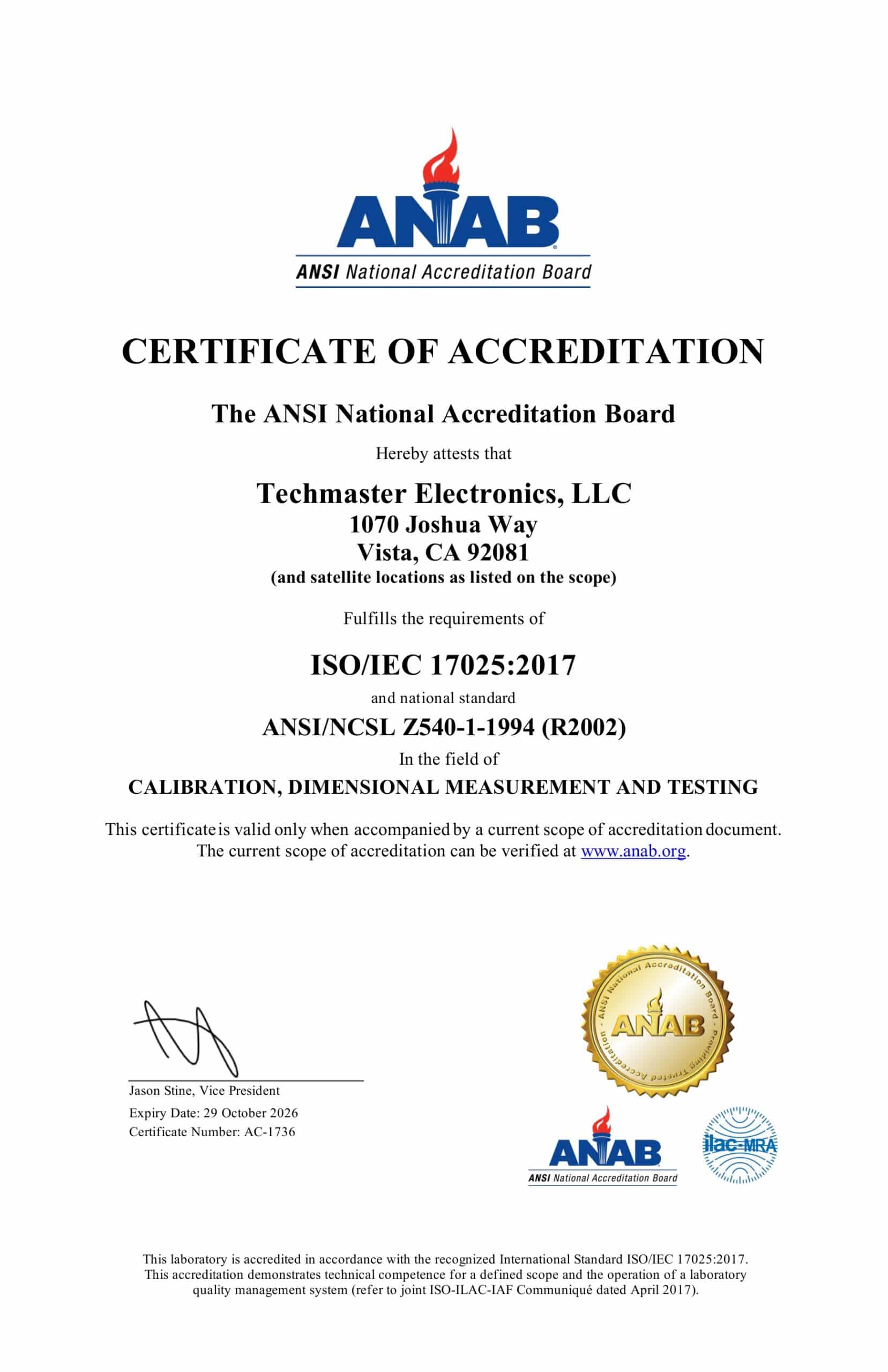
ANAB-accredited, NIST-traceable, fast turnaround, in-lab or on-site across the USA.
Contact us for a quoteReferences & industry standards
- ISO/IEC 17025 testing & calibration laboratory requirements
- NIST calibration services and measurement traceability
- A2LA / ANAB accreditation for calibration laboratories
External standards bodies. Techmaster Electronics is an ISO/IEC 17025-accredited, NIST-traceable calibration laboratory.

Khanh Nguyen is the Marketing Manager at Techmaster Electronics, a B2B marketing leader covering the test, measurement, and ISO/IEC 17025 accredited calibration industry across the US and Vietnam markets.