
Ground Bond Tester Calibration
Accuracy across the range
How Ground Bond Tester calibration works
- Intake & visual inspection
- Environmental stabilization
- As-found measurement
- Comparison to NIST-traceable standards
- Adjustment if required
- As-left results & certificate
Your calibration, covered
In-lab vs on-site calibration
In-lab calibration
- Accredited bench with full reference standards
- Best achievable measurement uncertainties
- Pickup & return logistics handled
- Ideal for precision and reference work
On-site calibration
- We calibrate the Ground Bond Tester at your facility
- No shipping risk or transit downtime
- As-found data captured before any move
- Ideal for fixed, large or sensitive assets
In-depth guide
Accurate ground bond tester calibration is essential for ensuring that protective earth connections in electrical equipment can safely carry fault currents. Without regular calibration, testers may drift over time, leading to false PASS results, hidden safety risks, and costly compliance issues.
By maintaining precise calibration, manufacturers and service providers protect product quality, comply with IEC / UL / CSA standards, and reduce the risk of equipment failures or recalls.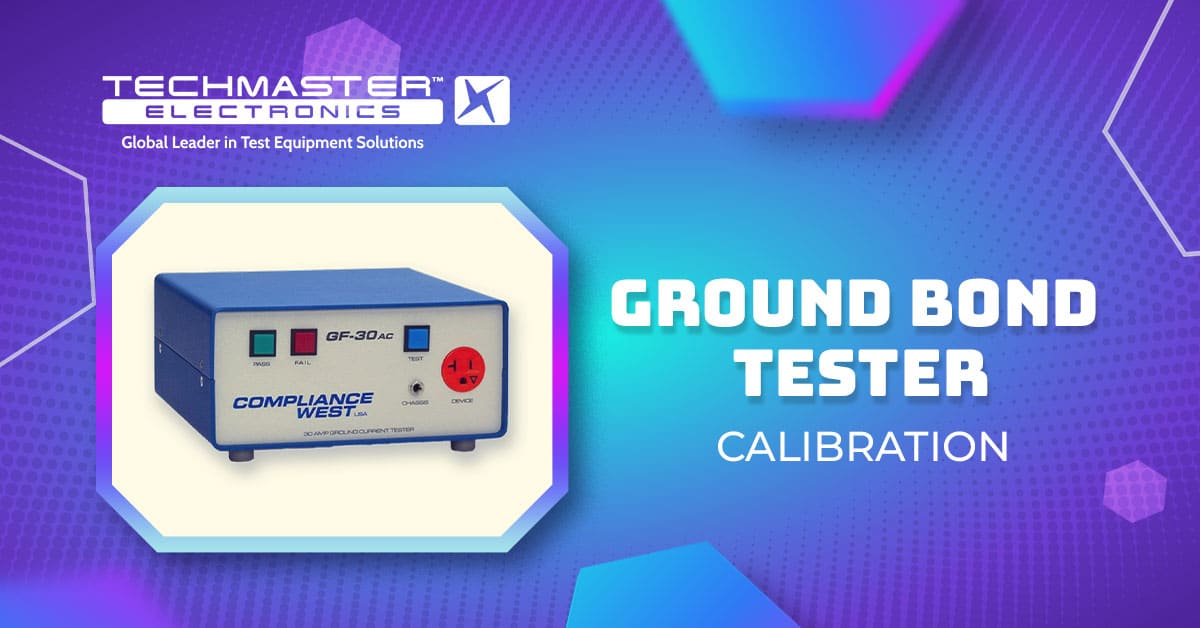
Understanding Ground Bond (High-Current Ground Continuity) Testers
Ground Bond vs. Ground Continuity
-
Continuity testers use a low current (< 1 A) simply to check that a ground path exists.
-
Ground bond testers drive a high current (typically 10–40 A AC) for a few seconds or minutes through the ground circuit to verify it can withstand fault conditions and maintain a low resistance path.
Key Functions
A typical ground bond tester:
-
Supplies a controlled high-current source (e.g., 25 A AC).
-
Measures the resistance of the ground circuit, commonly expecting ≤ 0.1 Ω.
-
Provides pass/fail indication and often logs results for compliance records.
-
Uses Kelvin-lead compensation to exclude the resistance of test leads themselves.
Where They Are Used
-
Production and compliance testing of electrical appliances, tools, industrial machinery.
-
Safety verification of medical devices and laboratory instruments.
-
Field service and periodic inspection in critical facilities (hospitals, datacenters).
Common Brands
Compliance West (GF-30AC-T), Ikonix/Associated Research (HYAMP series), QuadTech/Chroma (Sentry 50 Plus), and similar high-current ground bond testers.
Why Ground Bond Tester Calibration Matters for Compliance and Safety
-
Regulatory Alignment – OSHA’s AEGCP requires proper verification of equipment grounding; IEC/UL 61010 defines safety criteria for test instruments; ISO 9001/13485 and FDA QSR expect traceable measurement.
-
Accurate Test Data – keeps genuine hazards from slipping through and prevents needless product rejects.
-
Lower Total Cost of Ownership – detecting drift early avoids unplanned downtime and expensive rework.
-
Audit-Ready Confidence – calibrated instruments with valid certificates reduce audit stress.
Most OEMs, including Compliance West for the GF-30AC-T, recommend annual (12-month) calibration for production-line instruments.
Calibration Standards and Best Practices
-
ISO/IEC 17025 Accreditation – proof the calibration lab is technically competent and operates a quality system.
-
Traceability to NIST – links every measurement to recognized national standards.
-
Defined Calibration Interval – typically 12 months, adjusted based on usage severity or past stability history.
-
Comprehensive Documentation – calibration certificates must state uncertainty, methods, and traceability.
Choosing a 17025-accredited service provider is crucial, internal checks or third-party “verification” alone rarely satisfy auditors.
Typical Ground Bond Tester Calibration Process
-
Pre-Inspection & Safety Check
Visual examination for damage, lead condition, emergency stop, interlocks. -
Output-Current Verification
Apply test loads at key set-points (e.g., 10 A, 25 A, 30 A) and measure with NIST-traceable current standard. -
Resistance-Threshold Verification
Use precision loads around critical point (e.g., 0.05 Ω, 0.10 Ω, 0.20 Ω) to confirm pass/fail switching. -
Kelvin-Lead Compensation Check
Verify the instrument correctly nulls out lead resistance. -
Functional & Indicator Test
Check alarms, LEDs, buzzers, safety interlocks, error reporting. -
Adjustment (if necessary) & Final Verification
Adjust internal calibration controls; re-test all points. -
Certification & Record-Keeping
Issue ISO/IEC 17025 calibration certificate with measurement uncertainty and NIST traceability for audit files.
Common Issues and Challenges
-
Current-Source Drift over months of use → out-of-tolerance readings.
-
Loose or Corroded Test Leads adding hidden resistance → false failures.
-
Improper Lead-Compensation Settings skewing results.
-
Downtime & Logistics – shipping instruments off-site without fast turnaround can halt production.
Addressing these in the blog shows empathy for the customer’s daily struggles.
Case Study – Compliance West GF-30AC-T
A North-American medical-device manufacturer relies on the GF-30AC-T, a 25 A AC ground bond tester with a 0.1 Ω pass/fail threshold.
After a year of continuous operation, the QA team noticed 3 % drift in the tester’s output current during an internal check.
Left uncorrected, this could have allowed marginal ground connections to pass compliance tests.
Our accredited lab performed:
-
Full current-source verification against NIST-traceable standards.
-
Threshold checks with 0.1 Ω and adjacent resistors.
-
Adjustment of internal reference and re-verification.
-
Issued an ISO/IEC 17025 certificate with uncertainties documented.
Result: the instrument was back in tolerance, production continued without interruption, and the upcoming ISO 13485 audit passed smoothly.
Why Choose Our Calibration Service
-
ISO/IEC 17025 Accredited – recognized competence and impartiality.
-
NIST-Traceable Measurement – confidence in every reported value.
-
Nationwide Pickup & Delivery – logistics made easy.
-
Quick Turnaround (3-5 business days) – minimize production downtime.
-
Experienced Technicians – familiar with all major ground bond tester brands.
Schedule Your Ground Bond Tester Calibration Today
Keep your test data trustworthy, your audits stress-free, and your production safe.
Frequently asked questions
What is Ground Bond Tester Calibration?
How often should a Ground Bond Tester be calibrated?
What standards apply to Ground Bond Tester Calibration?
What is included on the certificate?
Can you calibrate the Ground Bond Tester on-site?
Need Ground Bond Tester calibration?
ANAB-accredited, NIST-traceable, fast turnaround, in-lab or on-site across the USA.
Contact us for a quoteReferences & industry standards
- ISO/IEC 17025 testing & calibration laboratory requirements
- NIST calibration services and measurement traceability
- A2LA / ANAB accreditation for calibration laboratories
External standards bodies. Techmaster Electronics is an ISO/IEC 17025-accredited, NIST-traceable calibration laboratory.

Khanh Nguyen is the Marketing Manager at Techmaster Electronics, a B2B marketing leader covering the test, measurement, and ISO/IEC 17025 accredited calibration industry across the US and Vietnam markets.