TL;DR: Calibration divides into discipline families, electrical (DC/LF), RF and microwave, time and frequency, temperature and humidity, pressure/vacuum/flow, and dimensional/mass/torque. Accreditation is granted by parameter and range within a discipline, not by discipline name, so the scope document is the only reliable answer to “can you calibrate this?” Techmaster’s ANAB-accredited scope covers eight calibration fields centered on electronic, RF and microwave test equipment.
“Do you calibrate this?” sounds like a yes/no question and isn’t. Labs are accredited in slices, a parameter, over a range, to a stated capability. Here’s how the slices are grouped, and what to check inside each.
What are the calibration discipline families?
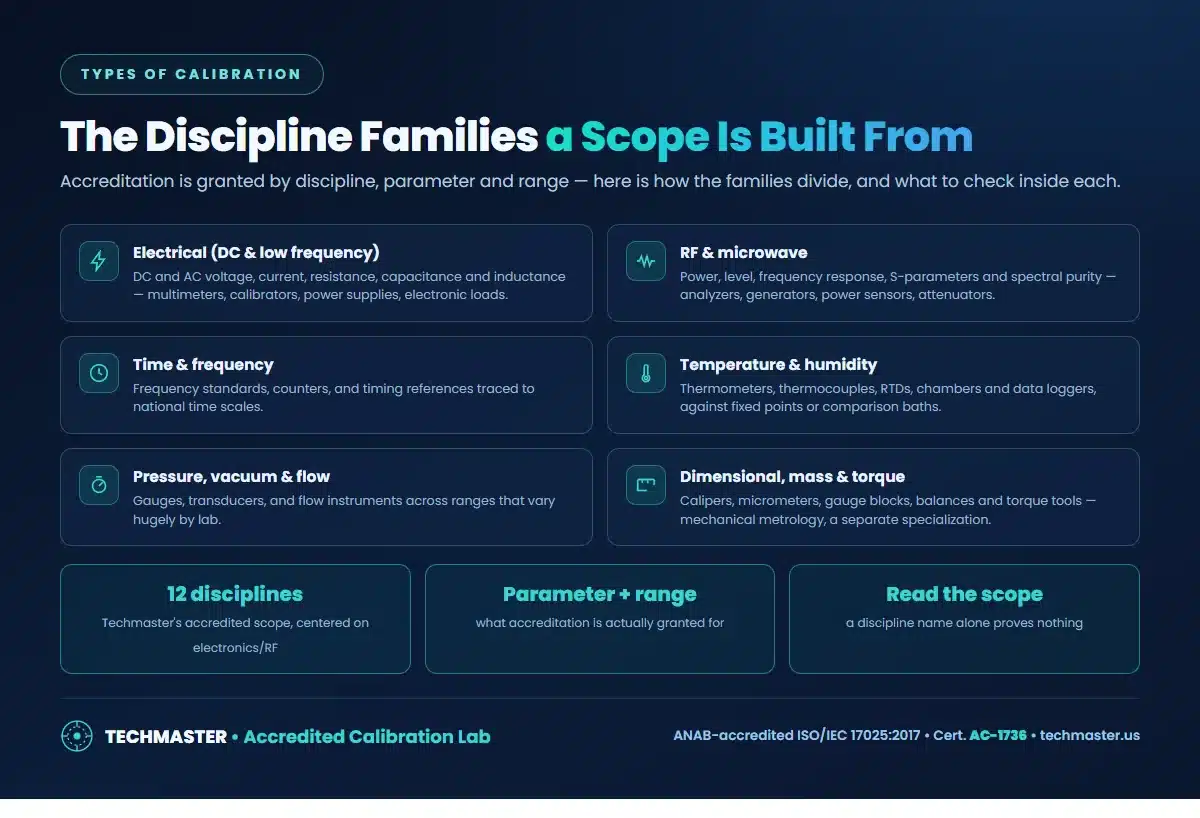
Electrical (DC and low frequency) covers voltage, current, resistance, capacitance and inductance, multimeters, calibrators, power supplies, and electronic loads. RF and microwave covers power, level, frequency response, S-parameters and spectral purity, and needs an entirely different standards chain, explained in RF and microwave calibration. Time and frequency handles standards, counters and timing references. Temperature and humidity, pressure, vacuum and flow, and dimensional, mass and torque round out the common families, the last being mechanical metrology, a genuinely separate specialization with its own standards and technicians.
Why the discipline name isn’t the answer
Accreditation lives at the level of parameter and range, with a CMC attached, the concept explained in measurement uncertainty explained. A lab accredited for “RF power” to 6 GHz cannot give you accredited calibration on a 26.5 GHz sensor. A lab accredited for DC voltage to 1000 V says nothing about your 8.5-digit meter’s tightest range. So the practical test is always the same: open the scope document, find the parameter, confirm the range, compare the CMC to your tolerance. That’s step one of the 12-point checklist for a reason.
Matching your fleet to labs
Most companies end up with one lab covering electronics and RF, where the disciplines share infrastructure, and a second for mechanical work. Consolidating within a family is one of the safe cost levers in the calibration budget guide, since volume within a discipline earns pricing and keeps one recall workflow. Techmaster’s 12 accredited disciplines are built around electronic, RF and microwave test equipment, which is where most electronics fleets concentrate.
Frequently asked questions
What are the main types of calibration?
Calibration divides into discipline families: electrical (DC and low frequency), RF and microwave, time and frequency, temperature and humidity, pressure/vacuum/flow, and dimensional, mass and torque. Accreditation bodies grant accreditation within these families by specific parameter and range, which is why two labs in the same ‘discipline’ can have very different capabilities.
What does ‘eight calibration fields’ mean on a lab’s scope?
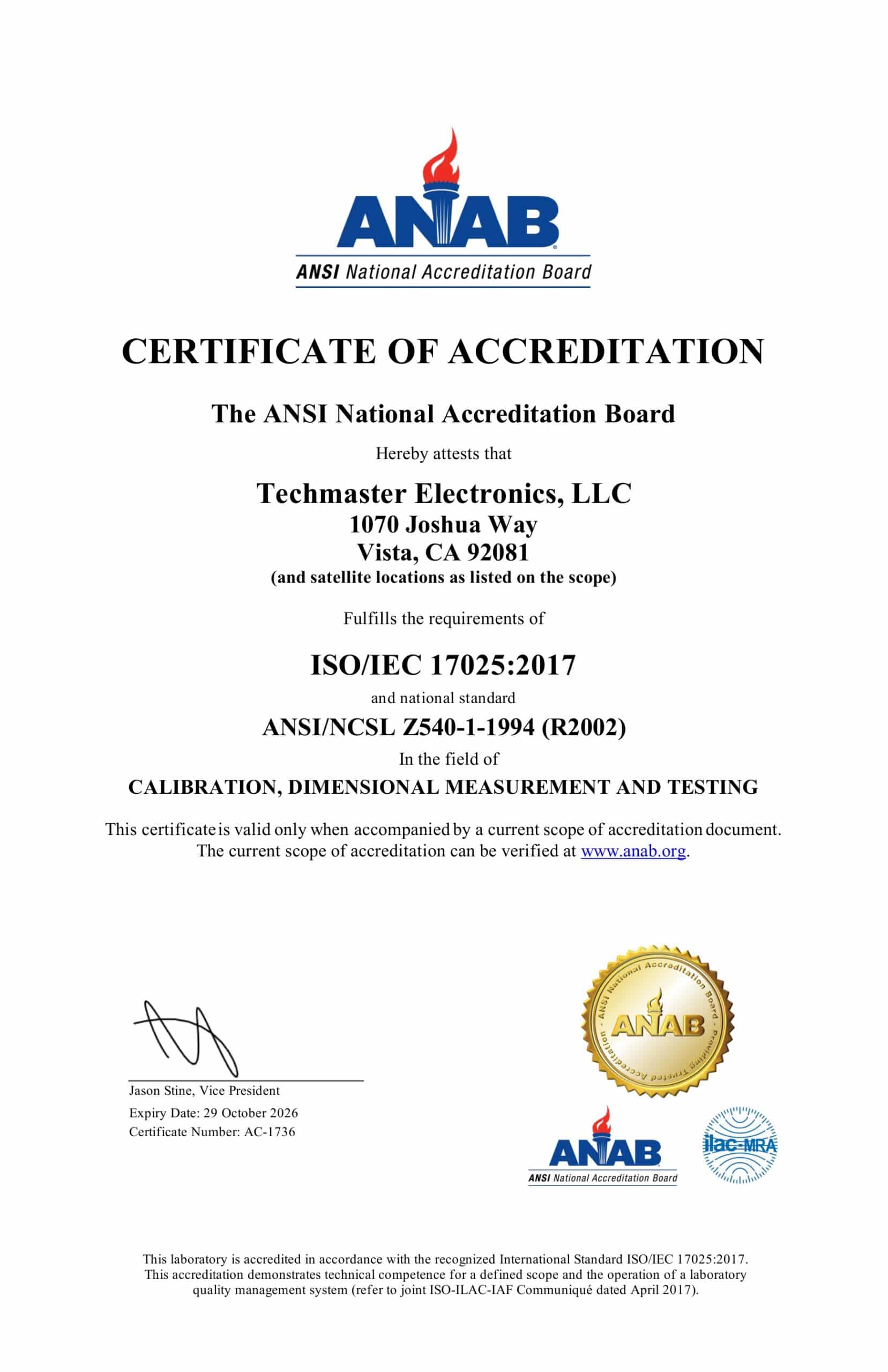
It means the laboratory’s accreditation covers twelve distinct measurement areas. Techmaster’s ANAB-accredited scope (Cert. AC-1736) spans eight calibration fields centered on electronic, RF and microwave test equipment. The count is a useful shorthand, but the scope document, parameter, range and CMC, is what actually tells you whether your instrument is covered.
Can one lab calibrate every type of instrument?
Very few can, and none should claim to without a scope to back it. Electrical and RF work share infrastructure; dimensional, mass and torque are separate specializations with their own standards and technicians. Most companies use one lab for electronics and RF, and a second for mechanical metrology.
How do I know which discipline my instrument falls under?
Go by what the instrument measures, not what it is called. A power meter is RF; a data logger recording temperature is temperature; a source measure unit is electrical. Then check that the lab’s scope lists that parameter across your instrument’s full range.
The bottom line
Classify instruments by what they measure, then verify the lab’s scope covers that parameter across your full range. Everything else, certificate levels, turnaround, price, only matters once the scope answers yes. Verification steps are in what is ISO/IEC 17025 accreditation.
Get an accredited calibration quote
ANAB-accredited ISO/IEC 17025:2017 (Cert. AC-1736) • 5 US labs • 5-day standard, 1–2 day expedite • in-lab or on-site.
Request a quote
Khanh Nguyen is the Marketing Manager at Techmaster Electronics, a B2B marketing leader covering the test, measurement, and ISO/IEC 17025 accredited calibration industry across the US and Vietnam markets.