
How Often Calibrate DC Electronic Load: A Complete Guide
1. What Is a DC Electronic Load?
-
Constant Current (CC): The load pulls a steady current.
-
Constant Voltage (CV): The load changes current to hold a certain voltage.
-
Constant Resistance (CR): The load acts like a fixed resistor.
-
Constant Power (CP): The load pulls a steady amount of power.
2. Why You Must Know How Often Calibrate DC Electronic Load Units
-
False Passes: Bad products pass quality control. The electronic load failed to stress them enough.
-
False Failures: You reject good products and waste money. The load reported the wrong value.
3. Common Applications in Industry
-
Battery Testing: Checking lithium-ion batteries for electric vehicles.
-
Power Supply Validation: Testing AC/DC converters for safety limits.
-
Aerospace: Checking backup power systems in aircraft.
-
Alternative Energy: Testing solar panels and fuel cells.
-
Electronics Manufacturing: Running high-volume production lines.
4. Calibration Standards and Traceability
Essential Calibration Standards
Always use an ISO/IEC 17025 accredited lab. This standard proves the lab has the right skills and quality systems in place.
Your calibration must also connect to NIST. This means a clear paper trail links your tool back to national standards.
A good certificate shows measurement uncertainty. This data tells you the margin of error and proves the lab’s testing gear is much better than your electronic load.
5. Common Issues Found During Electronic Test Equipment Calibration
-
Measurement Drift: Internal sensors drift from heat. Readbacks lose accuracy.
-
Offset Errors: The unit shows current draw even when unplugged.
-
Slow Response: The load responds slowly to quick power changes.
-
Cooling Failures: Technicians often catch broken fans or blocked heatsinks.
6. How Often Calibrate DC Electronic Load Equipment?
How Often Should You Calibrate?
Finding the best schedule is key to reliable testing. Most makers suggest a 12-month schedule. Yet, you must look at a few factors to decide if you need a different plan:
Manufacturer Specs
Check your manual first. Most brands promise accuracy for one year. Running the tool longer increases your risk of bad data.
Usage Frequency
A lab load used twice a week sees little stress. A factory load running 24/7 wears out fast. Heavy use usually needs a 6-month check.
Environment
Dirty, hot, or shaky places harm equipment faster. Clean, climate-controlled rooms keep tools stable longer. Adjust your schedule based on room conditions.
Industry Regulations
Aerospace and medical fields have strict rules. You must obey their specific annual or biannual schedules without exception.
Historical Performance
If your load always passes, you might wait longer next time. If it often fails, you must check it more frequently.
7. Keep Working with Techmaster Equipment Rentals
8. What to Look for in a Calibration Provider
-
Accreditation: Check for active ISO/IEC 17025 accreditation.
-
Technical Skills: The lab needs gear that handles your tool’s max power.
-
Clear Data: Ask for “As Found” and “As Left” data on certificates.
-
Speed: Find a lab that works quickly to reduce downtime.
-
On-Site Help: Big racks are hard to ship. An on-site Calibration service saves money and stops shipping damage.
9. Why Choose Techmaster Electronics?
10. Conclusion
11. FAQ Section
Frequently Asked Questions
Frequently asked questions
What is dc electronic load calibration?
DC Electronic Load Calibration is the documented comparison of a DC electronic load against NIST-traceable reference standards under ISO/IEC 17025. It quantifies the DC electronic load’s error and measurement uncertainty and confirms it performs within tolerance, with as-found and as-left data on the certificate.
How often should a DC electronic load be calibrated?
Most quality systems calibrate a DC electronic load every 12 months, or sooner after repair, overload, or before critical measurements. Set your interval from the manufacturer spec and your ISO 9001 / 13485 / AS9100 program and drift history.
Is Techmaster’s DC electronic load calibration ISO 17025 accredited?
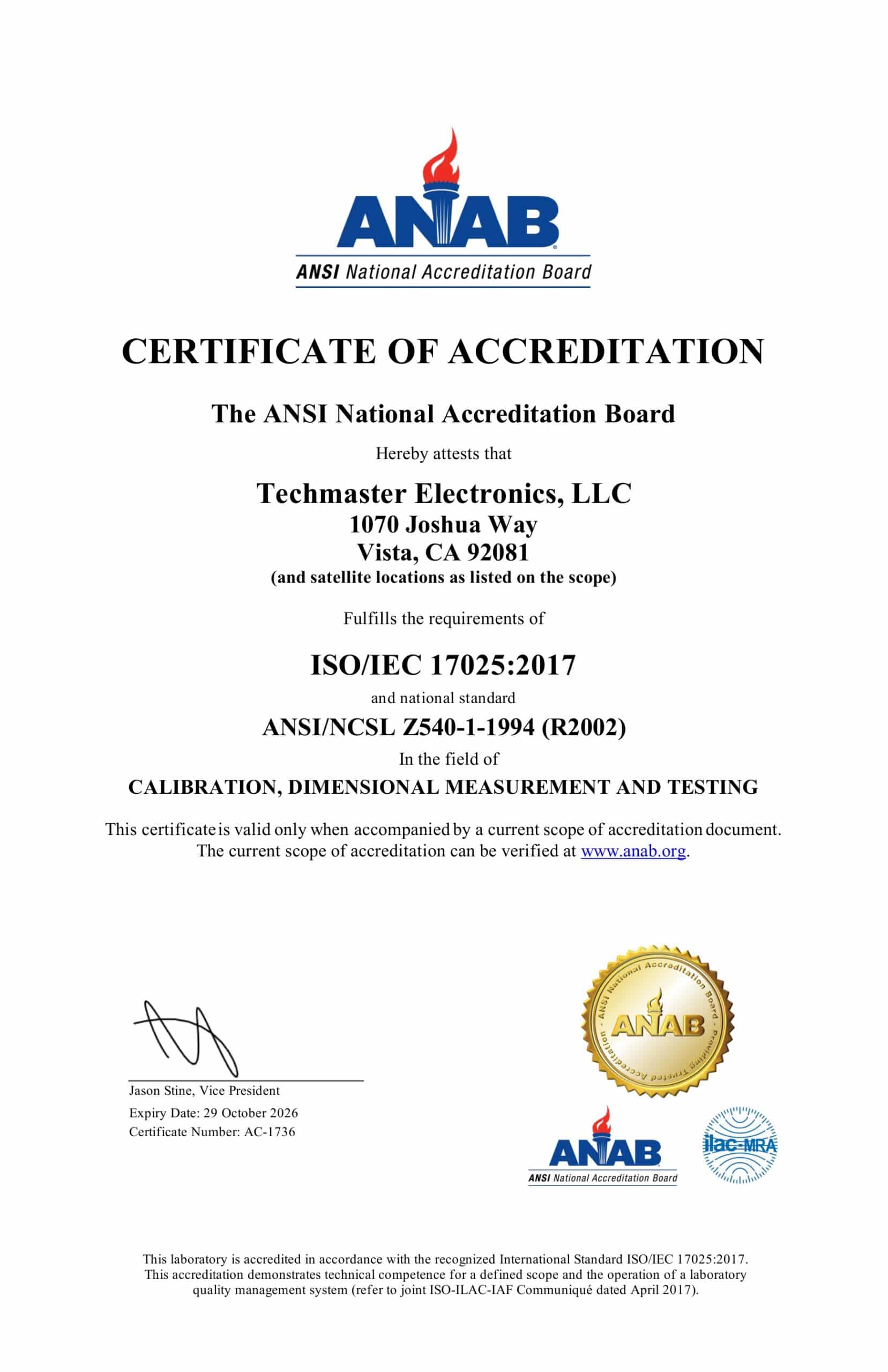
Yes. Techmaster Electronics is ISO/IEC 17025:2017 accredited by ANAB (Certificate AC-1736). Every DC electronic load calibration is NIST-traceable and issued with a full measurement-uncertainty budget.
What is the turnaround for DC electronic load calibration?
Standard turnaround is 5 business days, with 1–2 business-day expedite available. On-site calibration removes shipping time entirely for DC electronic loads that can’t leave the floor.
Do you calibrate DC electronic loads on-site or in-lab?
Both. Techmaster runs five US labs (Vista CA, Santa Clara CA, Orlando FL, San Antonio TX, Holly Springs NC) and offers nationwide on-site DC electronic load calibration to minimize downtime.

Khanh Nguyen is the Marketing Manager at Techmaster Electronics, a B2B marketing leader covering the test, measurement, and ISO/IEC 17025 accredited calibration industry across the US and Vietnam markets.