
Micro-Ohmmeter Calibration
Accuracy across the range
How Micro-Ohmmeter calibration works
- Intake & visual inspection
- Environmental stabilization
- As-found measurement
- Comparison to NIST-traceable standards
- Adjustment if required
- As-left results & certificate
Your calibration, covered
In-lab vs on-site calibration
In-lab calibration
- Accredited bench with full reference standards
- Best achievable measurement uncertainties
- Pickup & return logistics handled
- Ideal for precision and reference work
On-site calibration
- We calibrate the Micro-Ohmmeter at your facility
- No shipping risk or transit downtime
- As-found data captured before any move
- Ideal for fixed, large or sensitive assets
In-depth guide
Micro-Ohmmeter Calibration: The Vital Link in Low-Resistance Measurement Accuracy
In industrial electrical maintenance and power distribution, system reliability is not just about large-scale equipment. Instead, it often hides in the smallest details, such as contact points, busbar joints, and grounding systems. A minor discrepancy at the micro-ohm 10-6 Ω level can easily become the root cause of overheating and catastrophic electrical failures. While a low-resistance ohmmeter (Micro-Ohmmeter) serves as an essential tool for detecting these issues, the integrity of your data depends entirely on one critical process: Micro-Ohmmeter Calibration.
Micro-Ohmmeter Calibration: Ensuring Accuracy in Low-Resistance Measurement
1. Understanding Micro-Ohmmeters and the Necessity of Low-Resistance Testing
4-Wire Kelvin Principle Diagram
*This method ensures that lead resistance does not affect the final calculation.*
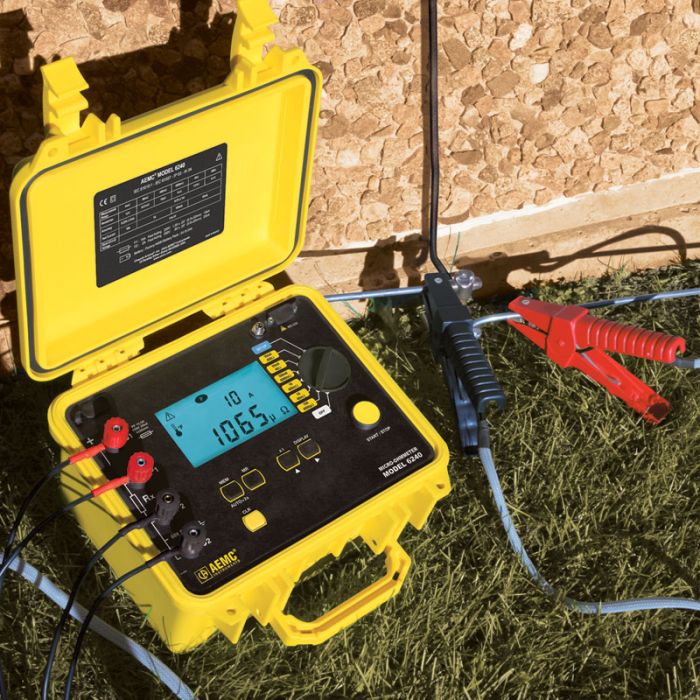
Technically, a Micro-Ohmmeter is a high-precision instrument that engineers use to measure extremely low resistance values. These values typically range from a few micro-ohms to several ohms. Unlike standard multimeters, which lead resistance often hinders, a Micro-Ohmmeter utilizes the 4-wire (Kelvin) measurement method. Consequently, this technique separates the test current from the voltage measurement and effectively eliminates lead resistance errors.
Also, measuring low resistance is vital for determining the physical health of electrical connections. For instance, an unexpectedly high resistance value usually acts as a “red flag” for the following issues:
-
Surface oxidation or corrosion.
-
Insufficient clamping force (loose connections).
-
Degradation of internal contacts in circuit breakers or disconnect switches.
2. Real-World Applications of Low-Resistance Measuring Instruments
Currently, high-quality micro-ohmmeters support many demanding technical sectors. In these fields, a fraction of an ohm can mean the difference between safety and disaster.
2.1. Circuit Breaker and Switchgear Testing
First and foremost, this represents the most common application. Contacts in high-voltage circuit breakers must carry thousands of Amps. However, if contact resistance increases due to repeated switching or wear, the resulting heat ($P = I^2R$) can melt contacts and trigger substation fires.
2.2. Busbar and Cable Joint Inspection
Similarly, in power plants and industrial switchboards, bolts hold copper busbars together. Low-resistance testing ensures the uniformity of the entire conductive path. As a result, engineers can pinpoint potential localized “hot spots” before the system fails.
2.3. Bonding Tests in Aerospace and Oil & Gas
In addition, in aviation, every part of an aircraft must be electrically bonded to safely dissipate lightning strikes. In the oil and gas industry, static bonding prevents sparks in explosive atmospheres. Therefore, a Micro-Ohmmeter provides the sensitivity required to verify these critical safety bonds.
2.4. Motor and Transformer Winding
Additionally, measuring winding resistance helps verify lead quality and winding uniformity. Because of this precision, the device also detects early signs of internal short circuits or open-circuit conditions within the coils.
3. The Core Role of Micro-Ohmmeter Calibration
The Hazard of Stealth Resistance
As current flows through a connection, heat generation increases exponentially. This is governed by Joule’s Law:
Power Loss (Watts) = Current Squared (Amps) × Resistance (Ω)
At a current of 1000A, even a slight increase of 50 μΩ results in 50 additional Watts of localized heat, enough to begin degrading insulation and surface plating.
Why Calibration is Mandatory
Combat Measurement Drift
Corrects inaccuracies caused by temperature, humidity, and component aging over time.
Source Verification
Ensures the unit still delivers its rated 10A or 100A injection current accurately.
ISO 17025 Compliance
Provides the required traceability for industrial maintenance and legal safety audits.
One might wonder why periodic calibration is mandatory rather than optional. To answer that, we must look at the following technical and regulatory drivers:
3.1. Maintaining Accuracy in Sensitive Ranges
Specifically, at the micro-ohm level, environmental factors like temperature and humidity cause electronic components to “drift” over time. Micro-Ohmmeter calibration compares the device against a traceable high-precision Standard Resistor. Thus, the process identifies deviations and brings the unit back to ideal specifications.
3.2. Verifying Current Injection Capability
Because testing low resistance requires injecting significant current (often 10A to 100A), calibration must verify the instrument’s power supply. If the power supply fails to deliver a stable current, the device will produce fundamentally flawed resistance calculations.
3.3. Compliance with ISO/IEC 17025 Standards
Also, most modern infrastructure and FDI projects require maintenance records to include valid calibration certificates. By calibrating at an accredited laboratory like Techmaster, you ensure your equipment meets international standards with full NIST traceability.
3.4. Mitigating Legal and Operational Risks
Finally, using uncalibrated equipment to verify electrical safety creates a major liability. If a false reading leads to a missed fault, contractors may face severe legal consequences in the event of a fire or electrical accident.
4. How Often Should You Calibrate?
Generally, the standard recommended calibration interval is 12 months. However, you should consider earlier service if:
-
You use the device in harsh field environments (high dust/moisture).
-
The unit has suffered a mechanical shock or drop.
-
Readings show unusual fluctuations during routine tests.
5. Conclusion
In the end, investing in a high-tier low-resistance ohmmeter is only the first step toward ensuring system safety and operational reliability. While advanced equipment delivers precise measurements, its long-term accuracy depends heavily on proper maintenance and regular calibration.
Without routine calibration, even the most sophisticated micro-ohmmeter can gradually drift out of specification, leading to measurement errors that may compromise system performance, safety compliance, and project outcomes. For businesses operating in critical environments, this is not just a technical concern, it directly impacts credibility, audit readiness, and overall risk management.
To truly protect your reputation and ensure the safety of your entire facility, maintaining the reliability of your instruments through professional micro-ohmmeter calibration is essential.
Techmaster provides comprehensive calibration services for a wide range of leading brands, helping your equipment perform at peak accuracy. With standardized procedures, reliable results, and full documentation support, we ensure your measurement systems meet the strict demands of modern engineering projects.
Your Partner in Test Equipment Solutions
Techmaster Electronics provides world-class calibration services across the United States.
Frequently asked questions
What is Micro-Ohmmeter Calibration?
How often should a Micro-Ohmmeter be calibrated?
What standards apply to Micro-Ohmmeter Calibration?
What is included on the certificate?
Can you calibrate the Micro-Ohmmeter on-site?
Need Micro-Ohmmeter calibration?
ANAB-accredited, NIST-traceable, fast turnaround, in-lab or on-site across the USA.
Contact us for a quoteReferences & industry standards
- ISO/IEC 17025 testing & calibration laboratory requirements
- NIST calibration services and measurement traceability
- NIST Fundamental Electrical Measurements
- A2LA / ANAB accreditation for calibration laboratories
External standards bodies. Techmaster Electronics is an ISO/IEC 17025-accredited, NIST-traceable calibration laboratory.

Khanh Nguyen is the Marketing Manager at Techmaster Electronics, a B2B marketing leader covering the test, measurement, and ISO/IEC 17025 accredited calibration industry across the US and Vietnam markets.