
Portable Capacitance Meter Calibration…
Accuracy across the range
How Portable Capacitance Meter calibration works
- Intake & visual inspection
- Environmental stabilization
- As-found measurement
- Comparison to NIST-traceable standards
- Adjustment if required
- As-left results & certificate
Your calibration, covered
In-lab vs on-site calibration
In-lab calibration
- Accredited bench with full reference standards
- Best achievable measurement uncertainties
- Pickup & return logistics handled
- Ideal for precision and reference work
On-site calibration
- We calibrate the Portable Capacitance Meter at your facility
- No shipping risk or transit downtime
- As-found data captured before any move
- Ideal for fixed, large or sensitive assets
In-depth guide
1. Introduction
Inaccurate capacitance readings in power electronics or HVAC systems can lead to component failure, safety hazards, and financial losses due to unplanned downtime. Without regular capacitance meter accuracy verification, even a slight drift in your meter might cause you to misdiagnose a failing capacitor, leading to motor burnouts, circuit instability, or inefficient power factor correction. This uncertainty compromises the reliability of high-voltage installations and precision electronic assemblies where component tolerances are tight. Relying on unverified tools is a gamble that risks catastrophic hardware damage and costly emergency repairs. Professional, ISO/IEC 17025 accredited Portable Capacitance Meter Calibration ensures your measurements are traceable, reliable, and compliant with international quality standards, providing the data integrity needed for rigorous preventive maintenance.
2. Overview: The Critical Role of Capacitance Measurement
What is a Portable Capacitance Meter? A portable capacitance meter is a specialized handheld instrument designed to measure the ability of a component to store an electrical charge. These devices are optimized for reactance analysis across various ranges. Why is it Critical? In industrial maintenance and electronics manufacturing, the health of capacitors determines the longevity of the entire system. From power factor correction to signal filtering, these meters identify aging components. Without regular accuracy verification, the integrity of your entire preventive maintenance program is at risk.3. The ISO/IEC 17025 Portable Capacitance Meter Calibration Process
Direct Answer: What does the calibration process involve?
The calibration of a portable capacitance meter involves comparing the device’s readings against a traceable reference standard under controlled environmental conditions. The goal is to quantify any deviation and ensure the device performs within its intended operational requirements.Step-by-Step Calibration Procedure
- Environmental Stabilization: Equipment must be placed in a controlled environment with stable temperature and humidity for a specified period to minimize thermal errors.
- Visual and Functional Inspection: Check for damaged leads, battery integrity, and display clarity.
- Zeroing/Nulling: The meter must be “zeroed” to account for the residual capacitance of the test leads, which is essential for accurate low-range measurements.
- Multi-point Testing: A thorough capacitance meter accuracy verification is performed by taking readings across the dynamic range of the device to verify performance at various scales.
- Data Recording: Compare the Unit Under Test (UUT) reading against the reference standard value.
- Uncertainty Calculation: Apply recognized metrological methodologies to account for factors such as resolution, stability, and reference uncertainty.
Traceability and Measurement Uncertainty
Traceability is the “unbroken chain” of comparisons leading back to SI units. In capacitance, this usually traces back to National Metrology Institutes via high-precision standards. Key Uncertainty Contributors:- Accuracy of the Reference Standard.
- Resolution of the device under test.
- Measurement repeatability.
- Lead effects and contact resistance.
Specific Notes for On-site Services
When performing on-site calibration, metrologists must account for environmental factors like electromagnetic interference (EMI) and ambient temperature fluctuations, which may differ from laboratory settings. Verifying internal self-test routines is a recommended pre-step for many modern portable models.Lab vs. On-Site Dynamics
A capacitance meter operates by analyzing low-voltage charging cycles. External environmental variables can heavily interfere with these sensitive calculations.
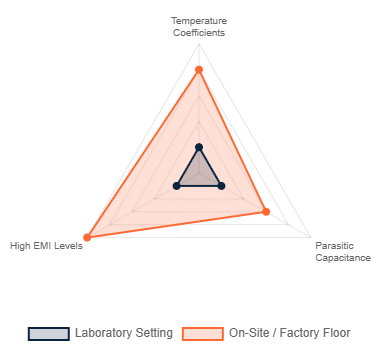
Relative Impact of Variables (Scale 1-5)
Technicians often notice discrepancies between lab-calibrated readings and those taken directly on the factory floor. This is rarely a meter defect, but rather environmental interference.
4. Why Professional Calibration Matters
In precision metrology, “close enough” is not sufficient. As components age, their internal properties change, leading to measurement drift.Expert metrologists distinguish between Calibration (comparing against a standard) and Adjustment (correcting the device). A common mistake is assuming a device is accurate simply because it provides a reading; however, true capacitance meter accuracy verification requires formal comparison against high-precision Decade Capacitors. By adhering to ISO/IEC 17025 benchmarks, we ensure that the measurement results are mathematically sound and legally defensible, meeting the requirements of auditors in sectors like Aerospace, Energy, and Medical Manufacturing.
5. The Impact of Accredited Data on Risk Management
Beyond simple compliance, ISO/IEC 17025 accredited calibration serves as a critical pillar in a robust enterprise risk management strategy. In high-reliability organizations, the “cost of quality” is directly tied to the accuracy of handheld diagnostic tools used daily on the shop floor. Utilizing a meter with unverified drift can lead to a cascade of technical errors: from incorrect power factor correction that inflates energy costs to the premature replacement of expensive capacitor banks. Furthermore, professional calibration provides a formal assessment of the Test Uncertainty Ratio (TUR), ensuring that the laboratory’s standards are significantly more precise than the meter being tested. This rigor eliminates “hidden” measurement errors caused by parasitic capacitance or electromagnetic noise that basic functional checks cannot detect. By documenting these processes in a formal Certificate of Calibration, facilities create a legally defensible data trail. This is essential for incident investigations and quality audits, proving that maintenance decisions were based on verified, laboratory-grade evidence. Ultimately, investing in expert metrology transforms a simple tool check into a proactive defense against intermittent system failures and catastrophic downtime.6. Expert Advice on Maintenance & Reliability
To ensure your meter stays reliable between calibration cycles, follow these best practices for ongoing capacitance meter accuracy verification:
- Discharge Before Testing: Connecting to a charged capacitor can damage the meter’s internal circuitry. Always ensure components are fully discharged before measuring.
- Lead Management: Use high-quality or original leads. Changing lead types can alter stray capacitance and affect measurement accuracy.
- Clean Contacts: Ensure test probes and terminals are clean. Oxidation can introduce errors in the measurement curve.
- Battery Health: Inconsistent power can lead to measurement errors. Replace batteries regularly to ensure stable internal voltage.
- Proper Storage: Use a protective case to prevent mechanical shock and protect internal oscillators from damage.
7. FAQ
Q1: How often should I perform Portable Capacitance Meter Calibration? Expert Answer: While a 12-month interval is standard, meters used in harsh environments or subjected to physical stress should be calibrated more frequently to maintain data confidence. Q2: Can I calibrate my capacitance meter myself? Expert Answer: Without traceable reference standards and controlled conditions, “self-calibration” is merely a functional check. Professional calibration provides the certificate of traceability required for ISO compliance. Q3: Why does my meter read differently on-site compared to the lab? Expert Answer: Differences are typically due to environmental variables like temperature coefficients and EMI, which can interfere with the meter’s charging cycle. Q4: What is the significance of “Zeroing” the meter? Expert Answer: Zeroing removes the inherent capacitance of the test leads and internal circuitry, preventing a positive bias in measurements. Q5: My meter shows an “OL” or unstable reading. Why? Expert Answer: This often indicates a failing component with high resistance or leakage that prevents the meter from completing a stable measurement cycle.8. Conclusion & CTA
Precision in capacitance measurement is about the safety and efficiency of your electrical infrastructure. Routine calibration is the only way to guarantee that your readings are accurate and compliant.Ensure maximum accuracy and ISO compliance with our professional metrology services.
On-site calibration support available for manufacturing facilities.
Frequently asked questions
What is Portable Capacitance Meter Calibration?
How often should a Portable Capacitance Meter be calibrated?
What standards apply to Portable Capacitance Meter Calibration?
What is included on the certificate?
Can you calibrate the Portable Capacitance Meter on-site?
Need Portable Capacitance Meter calibration?
ANAB-accredited, NIST-traceable, fast turnaround — in-lab or on-site across the USA.
Contact us for a quoteReferences & industry standards
- ISO/IEC 17025 testing & calibration laboratory requirements
- NIST calibration services and measurement traceability
- A2LA / ANAB accreditation for calibration laboratories
External standards bodies. Techmaster Electronics is an ISO/IEC 17025-accredited, NIST-traceable calibration laboratory.

Khanh Nguyen is the Marketing Manager at Techmaster Electronics, a B2B marketing leader covering the test, measurement, and ISO/IEC 17025 accredited calibration industry across the US and Vietnam markets.