
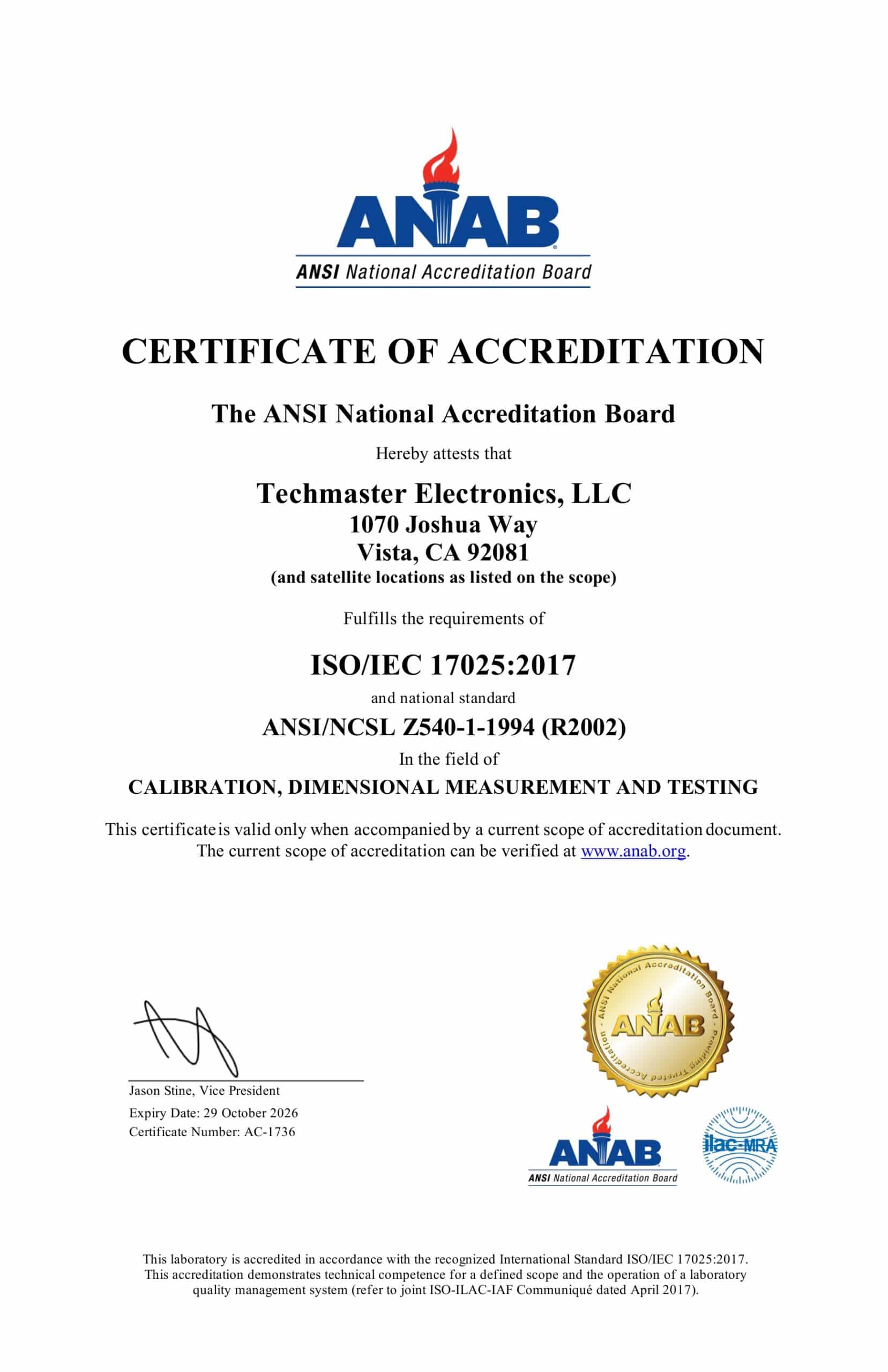
Oil Dielectric Test Set Calibration
Accuracy across the range
How Oil Dielectric Test Set calibration works
- Intake & visual inspection
- Environmental stabilization
- As-found measurement
- Comparison to NIST-traceable standards
- Adjustment if required
- As-left results & certificate
Your calibration, covered
In-lab vs on-site calibration
In-lab calibration
- Accredited bench with full reference standards
- Best achievable measurement uncertainties
- Pickup & return logistics handled
- Ideal for precision and reference work
On-site calibration
- We calibrate the Oil Dielectric Test Set at your facility
- No shipping risk or transit downtime
- As-found data captured before any move
- Ideal for fixed, large or sensitive assets
In-depth guide
1. INTRO: The Risk of “Ghost Data” in Dielectric Testing
Operating high-voltage testing equipment (BDV Testers) without regular calibration leads to the risk of “ghost data”, where the values displayed on the screen do not accurately reflect the actual dielectric strength of the oil. This directly causes the risk of flashovers, potentially leading to million-dollar transformer explosions or unnecessary costs for oil replacement when not required. By utilizing a professional On-site BDV tester calibration service, businesses can mitigate these hazards directly at their facility. In addition, the absence of an ISO/IEC 17025 calibration certificate exposes businesses to severe legal risks and rejection during rigorous audits by partners or regulatory agencies. Calibration is the only solution to control measurement uncertainty and establish traceability, ensuring absolute system safety.
2. Overview of Oil Dielectric Test Sets (BDV Testers)
An Oil Dielectric Test Set (BDV Tester) is a device that generates an increasing AC voltage at a controlled rate to determine the breakdown voltage of an insulating oil sample. The core role of the device is to evaluate the current insulation status of the oil within high-voltage equipment. These devices (such as the DTS series, Megger, or BAUR models) operate on the principle of a step-up transformer. In technical metrology, the accuracy of the device depends not only on the final voltage value but also strictly on the control of the voltage rise rate and the power-off (trip) time after breakdown occurs.3. The ISO/IEC 17025 Standard Oil Dielectric Test Set Calibration Process
The BDV tester calibration process focuses on comparing the machine’s output voltage against a reference standard with higher accuracy, while also verifying the ability to control the voltage rise rate according to international standards such as IEC 60156 or ASTM.Step 1: Visual Inspection and Preparation
- Inspect the physical condition of the test chamber and electrodes to ensure there is no pitting or contamination.
- Thoroughly clean the test cell and all insulating surfaces.
- Establish a secure safety grounding system for both the Unit Under Test (UUT) and the reference standards.
Step 2: Reference Measurement System Setup for Oil Dielectric Test Set Calibration
A calibrated High Voltage (HV) Divider is connected directly to the output terminals of the BDV tester. The scaled-down voltage signal from the Divider is then fed into a reference digital multimeter to read the actual high-voltage value.Step 3: Operational Parameter Evaluation
- Voltage Accuracy: Measure and compare the values displayed on the BDV tester against the values from the reference standard at multiple points across the measurement range.
- Voltage Rise Rate Control: Monitor the change in voltage over time to ensure the machine operates correctly according to the selected standard configuration (e.g., 0.5 kV/s or 2.0 kV/s).
- Switch-off (Trip) Reaction: Verify that the machine can cut off the voltage immediately upon detecting a breakdown current through the test sample.
4. Understanding International Standards: IEC 60156 vs. ASTM D1816/D877
IEC 60156
The dominant global standard for general insulating oil testing. Requires specific algorithmic ramp-up profiles managed by the tester’s internal software.
Electrode Geometry
ASTM D1816 / D877
Widely used and strictly enforced within North American markets. Features distinct stirring requirements and voltage application rules compared to IEC.
Electrode Geometry
Choosing the correct standard during calibration is vital because a BDV tester calibrated solely for IEC 60156 might produce non-compliant results if used for an ASTM D1816 test procedure. The primary difference lies in the electrode geometry, spherical or mushroom-shaped for IEC versus VDE or flat disks for ASTM, and the stirring requirements. A high-authority calibration laboratory providing an On-site BDV tester calibration service will verify not just the voltage output, but the tester’s internal software algorithms that manage these specific ramp-up profiles. Ensuring your device is verified against the specific standard relevant to your region prevents technical discrepancies during international quality inspections. For high-voltage assets, even a slight mismatch in the “Rate of Rise” (e.g., 2.0 kV/s vs 3.0 kV/s) can lead to significantly different breakdown results, potentially misclassifying critical insulating oil as “safe” when it is near the point of failure.
5. Critical Factors in Oil Dielectric Test Set Calibration: Uncertainty & Traceability
Calibration under ISO/IEC 17025 must include a calculation of measurement uncertainty. This value represents the level of confidence in the measurement results, helping maintenance engineers make accurate decisions regarding equipment health. Factors affecting the reliability of results:- Reference Standard Accuracy: The inherent error of the high-voltage divider.
- Environmental Conditions: The impact of temperature and humidity on the dielectric constant of the testing environment.
- Power Supply Stability: Fluctuations in the mains power affecting the stability of the high-voltage output.
6. Expert Advice
Based on 20 years of practical experience in the high-voltage calibration industry, equipment managers should note:- Periodic Electrode Maintenance: Carbon particles generated after each breakdown must be cleaned with a specialized lint-free cloth to prevent premature flashovers in subsequent tests.
- Environmental Control: During an On-site BDV tester calibration service, experts can demonstrate how carbon particles generated after each breakdown must be cleaned with specialized lint-free cloths to prevent premature flashovers.
- Preference for On-site Services: For sensitive high-voltage equipment, long-distance transportation can cause internal connections to loosen or mechanical misalignment. On-site calibration is the optimal choice to ensure the device is tested in its actual operating state.
7. FAQ: Frequently Asked Questions on BDV Calibration
Q1: Why is periodic calibration necessary instead of just checking with standard oil samples?- Expert Answer: Standard oil samples only check the instantaneous operational status. Periodic calibration determines the systematic error of the measuring device and ensures legal traceability.
- Expert Answer: No. Standard measuring devices cannot withstand the high voltage levels of a BDV tester. Attempting this is dangerous for the operator and will result in equipment destruction.
- Expert Answer: This depends on your management’s requirements. However, to ensure the highest legal value and pass international audits, an ISO/IEC 17025 accredited certificate is typically a mandatory requirement.
- Expert Answer: Critically important. If the machine does not trip fast enough, the electric arc will damage the electrode surface and instantly degrade the oil sample being tested.
- Expert Answer: Yes. Any intervention in the control circuit boards or the high-voltage transformer can change the measurement characteristics of the device; therefore, recalibration is required before returning it to service.
8. Conclusion
Ensuring the accuracy of BDV testing equipment is the core solution for maintaining the safety of high-voltage power systems. Investing in a standardized calibration process, ideally through a specialized On-site BDV tester calibration service, not only ensures regulatory compliance but also protects the assets and reputation of the business against operational risks.
Ready for ISO 17025 Compliance?
Don’t let uncalibrated equipment risk your transformer assets. Ensure your BDV tester meets international standards today.
Get Expert ConsultationFrequently asked questions
What is Oil Dielectric Test Set Calibration?
How often should a Oil Dielectric Test Set be calibrated?
What standards apply to Oil Dielectric Test Set Calibration?
What is included on the certificate?
Can you calibrate the Oil Dielectric Test Set on-site?
Need Oil Dielectric Test Set calibration?
ANAB-accredited, NIST-traceable, fast turnaround, in-lab or on-site across the USA.
Contact us for a quoteReferences & industry standards
- ISO/IEC 17025 testing & calibration laboratory requirements
- NIST calibration services and measurement traceability
- A2LA / ANAB accreditation for calibration laboratories
External standards bodies. Techmaster Electronics is an ISO/IEC 17025-accredited, NIST-traceable calibration laboratory.

Khanh Nguyen is the Marketing Manager at Techmaster Electronics, a B2B marketing leader covering the test, measurement, and ISO/IEC 17025 accredited calibration industry across the US and Vietnam markets.