
Tachometer Calibration

Accuracy across the range
How Tachometer calibration works
- Intake & visual inspection
- Environmental stabilization
- As-found measurement
- Comparison to NIST-traceable standards
- Adjustment if required
- As-left results & certificate
Your calibration, covered
In-lab vs on-site calibration
In-lab calibration
- Lab bench with full reference standards
- Best achievable measurement uncertainties
- Pickup & return logistics handled
- Ideal for precision and reference work
On-site calibration
- We calibrate the Tachometer at your facility
- No shipping risk or transit downtime
- As-found data captured before any move
- Ideal for fixed, large or sensitive assets
In-depth guide
1. Introduction: The High Cost of Speed Deviations
In high-speed industrial environments, even a minor deviation in a tachometer’s reading can lead to catastrophic motor failure or significantly degraded product quality. Uncontrolled RPM inaccuracies don’t just stay on the display; they manifest as excessive vibration, overheating, and eventually lead to unplanned production line shutdowns. In addition, failing safety audits due to imprecise measurement tools can result in massive legal liabilities and financial losses. This expert guide provides a comprehensive framework for tachometer calibration according to ISO 17025 standards, ensuring your rotational speed measurements remain traceable, precise, and audit-ready at all times.2. Overview: The Critical Role of Tachometers in Modern Industry
A tachometer is a fundamental instrument used to measure the rotation speed of a shaft or disk, typically expressed in revolutions per minute (RPM). Within the Time and Frequency metrology category, these devices act as “gatekeepers” for mechanical efficiency, safety monitoring, and preventive maintenance across sectors such as aerospace, automotive, and power generation. Precision in RPM measurement is the backbone of synchronized production lines. Whether utilizing contact or non-contact (optical/laser) methods, the device must provide a linear response with high repeatability. If a tachometer’s calibration drifts, the control system receives false data, forcing motors to operate at unintended speeds. This “silent drift” is often the root cause of mechanical fatigue failures that engineers struggle to diagnose until a major breakdown occurs.Classification of Tachometers in Industrial Use
To ensure effective monitoring, engineers must select the appropriate type of tachometer based on the application environment. Generally, these devices are categorized into three main types:- Contact Tachometers: These require physical contact with the rotating shaft using a wheel or tip. They are highly reliable for low-speed measurements but may suffer from slippage or introduce drag on small motors.
- Non-Contact (Optical) Tachometers: These use a light source (LED) to detect pulses from a reflective mark on the rotating object. They are ideal for high-speed shafts where physical contact is dangerous or impossible.
- Laser Tachometers: A high-precision subset of non-contact devices that use a laser beam instead of standard light. Laser models offer a much longer operating distance and superior targeting accuracy, even in bright industrial lighting conditions.
The primary limitation of contact tachometers is mechanical friction. Non-contact variants safely measure much higher rotational speeds without influencing the target’s momentum.
This calibration falls under our time and frequency calibration service.
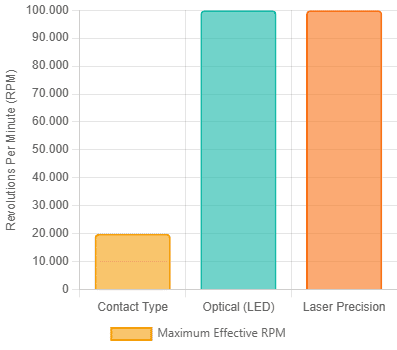
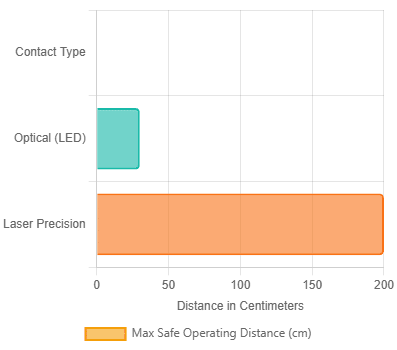
Proximity to moving machinery presents significant safety hazards. Laser tachometers provide a vast improvement in safe standoff distances compared to standard LED optical models.
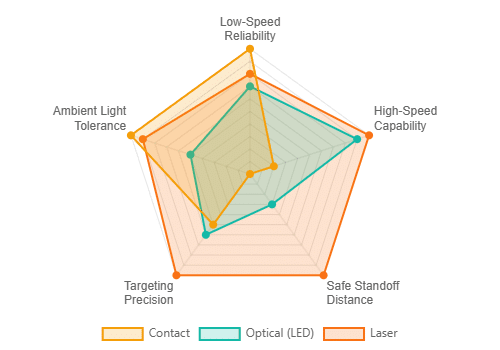
Selecting the right tool requires balancing multiple operational needs. This radar chart visualizes the relative strengths of each tachometer classification across key performance indicators. Laser tachometers excel in precision and range, while contact tachometers retain dominance purely in low-speed reliability.
3. Calibration Process According to ISO/IEC 17025 Standards
A professional Tachometer calibration process involves comparing the Unit Under Test (UUT) against a traceable reference standard, such as a high-precision frequency generator or a master stroboscope, across the device’s entire operational range. Performing a certified ISO 17025 tachometer calibration ensures the instrument meets its stated accuracy class and maintains measurement traceability to the International System of Units (SI).
Step 1: Visual Inspection and Cleaning
Before performing any measurements, the device must be thoroughly cleaned. For optical tachometers, the lens must be free of dust and debris. For contact types, the measurement wheels or tips must be inspected for wear. Any physical defects can introduce signal noise, leading to erratic or “jittery” RPM readings.Step 2: Environmental Stabilization
Metrology laboratories must maintain strict environmental controls. Tachometers are highly sensitive to temperature fluctuations, which can affect the internal quartz oscillators used in digital models. We allow the equipment to stabilize in a standard lab environment for several hours before testing to ensure electronic components reach thermal equilibrium.Step 3: Reference System Setup (Master Source)
We utilize multi-function calibrators or specialized tachometer testers capable of generating extremely stable pulses or physical rotations. The reference standard must possess accuracy significantly superior to the device being tested to ensure the measurement uncertainty remains within the acceptable limits of the quality control process.Step 4: Multi-Point Testing
Calibration is performed at multiple points distributed across the full range of the device. This process helps detect non-linear deviations in the sensor’s response. At each test point, we perform multiple repeat measurements to calculate the device’s repeatability and hysteresis, providing a holistic view of the instrument’s “health.”Step 5: Adjustment and Final Verification
If the “As-Found” data falls outside the permissible limits, technical adjustments are performed (if the device supports it). Following adjustment, an “As-Left” verification step is mandatory to confirm that the device is now operating stably and reliably before being returned to the production line.4. Analyzing Traceability and Measurement Uncertainty
Traceability ensures that your RPM measurement is linked to national or international standards through an unbroken chain of comparisons. Measurement Uncertainty reflects variables such as resolution, reference stability, and environmental factors, creating a “confidence interval” that defines the reliability of the measurement result.In the field of Time and Frequency, measurement uncertainty is often the deciding factor between a legally valid calibration certificate and a mere check sheet. Choosing a formal ISO 17025 tachometer calibration provides specific calculated values for the potential margin of error. Understanding this value is critical for high-precision applications where a small deviation can be the boundary between a compliant batch and a rejected one.
5. The Importance of Maintaining Metrological Traceability
In quality management, owning an expensive measurement device is not enough. Metrological traceability is the guarantee that the “1000 RPM” displayed on your machine is exactly the same as the global standard value. Without this link, all data collected from the production line becomes meaningless when compared against the technical requirements of international partners. This is particularly vital in supporting industries, where components must fit perfectly based on strictly controlled rotational parameters.6. Expert Advice on Maintenance & Tachometer Calibration Frequency
- Reflective Tape Quality: For optical tachometers, the quality of the reflective tape is often overlooked. Use high-contrast tape with sharp edges. Avoid applying it to surfaces that are too curved or rough, as this can cause light scattering and distort the feedback signal.
- Angle of Attack: Always ensure the laser beam is perpendicular to the target. An angled measurement can cause “cosine error,” making the displayed RPM appear lower than the actual speed.
- Battery/Power Status: Low voltage in handheld meters can cause “lag” in the microprocessor or weaken the laser intensity. Always check and replace batteries periodically before critical measurement sessions.
- Contact Tip Protection: Keep contact measurement tips in a padded protective case. Even a tiny nick on a contact wheel will change its actual circumference, directly affecting the calculation of surface velocity (m/min).
- Equipment Logging: Maintain a calibration logbook for every device. Tracking drift trends over several years through consistent ISO 17025 tachometer calibration will help you predict the ideal Tachometer calibration frequency for your specific environment before the device actually fails.
7. FAQ: Frequently Asked Questions – Expert Answers
Q: How often should I calibrate my tachometer? A: The standard interval is usually 12 months. However, if the device is used daily in harsh environments or plays a critical role in safety systems, we recommend shortening the interval to 6 months to minimize the risk of drift. Q: Can I calibrate the tachometer myself at the factory? A: Only if you possess a higher-accuracy reference standard, traceability, and a strictly controlled environment. Without ISO 17025 accreditation, your self-calibration results may not be accepted during third-party quality audits or national safety inspections. Q: What is the difference in accuracy between contact and non-contact methods? A: The non-contact (optical) method is generally more stable at high speeds because it does not apply a physical “load” to the rotating shaft. Contact tips can slip or create friction, which might slightly slow down small-capacity motors, leading to systematic errors. Q: My meter displays “OL”, what does that mean? A: “OL” stands for Overload. This means the actual rotation speed exceeds the measurement range of the device. Continuing to measure in this state can damage internal sensors and invalidate previous calibration results. Q: How do I choose between a laser and an LED tachometer? A: Laser tachometers are superior for long-distance measurements and provide an extremely precise target point. LED models are often lower in cost but require the operator to be much closer to the target.8. Conclusion & Advice
Precision in rotational speed measurement is not a luxury; it is a mandatory requirement for industrial safety and operational efficiency. By adhering to a rigorous ISO 17025 calibration schedule, you not only protect machinery from premature wear but also ensure that the production line always operates at its most optimal state.Given the unique requirements of high-precision optics, the technical nuances of laser tachometer calibration deserve special attention. Ensure all instruments adhere to ISO/IEC 17025 standards to maintain traceability and production safety.
Get A Quote NowFrequently asked questions
What is Tachometer Calibration?
How often should a Tachometer be calibrated?
What standards apply to Tachometer Calibration?
What is included on the certificate?
Can you calibrate the Tachometer on-site?
Need Tachometer calibration?
NIST-traceable calibration, fast turnaround, in-lab or on-site across the USA.
Contact us for a quoteReferences & industry standards
- ISO/IEC 17025 testing & calibration laboratory requirements
- NIST calibration services and measurement traceability
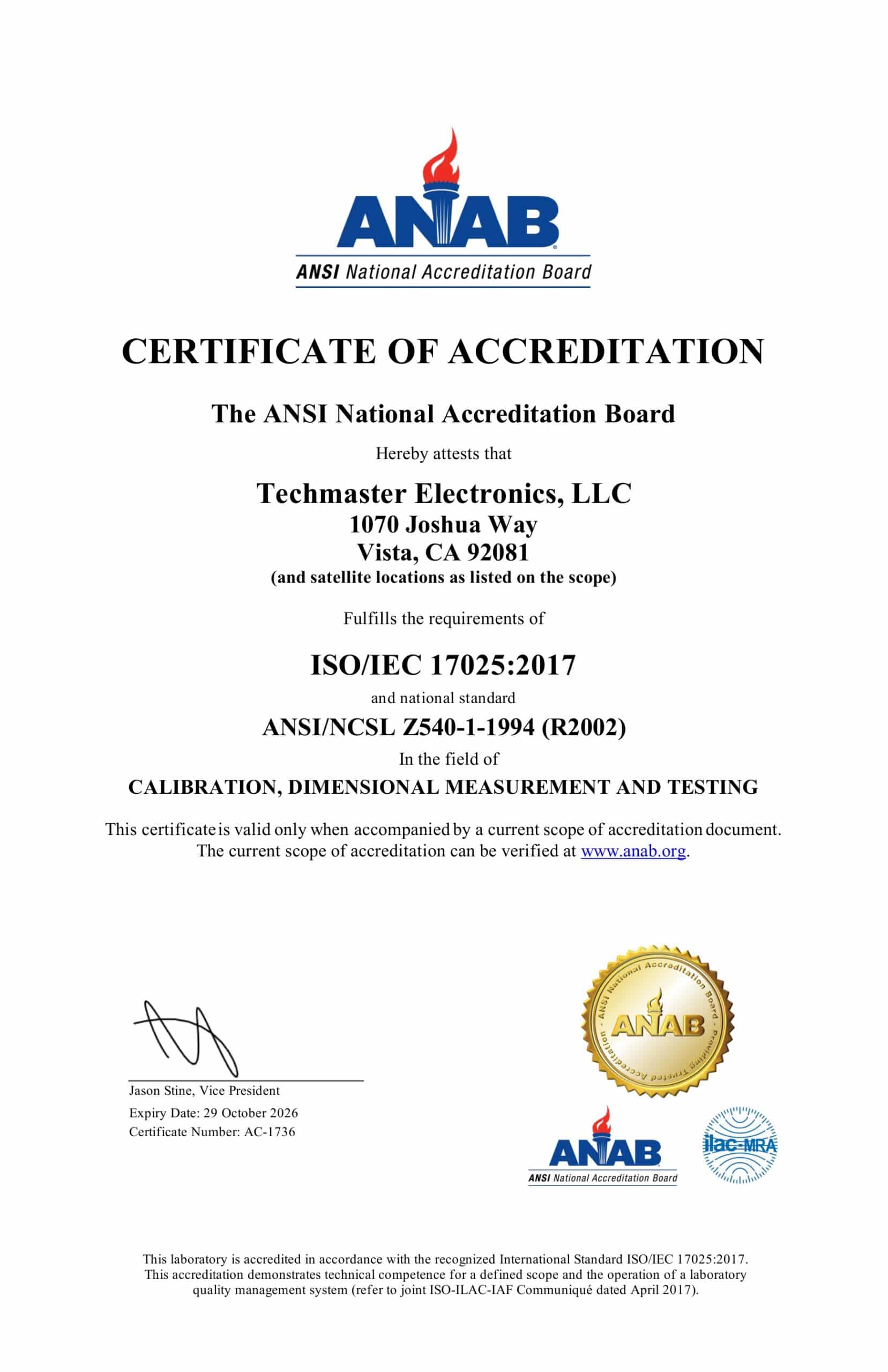
- A2LA / ANAB accreditation for calibration laboratories
External standards bodies. Techmaster Electronics is an ISO/IEC 17025-accredited, NIST-traceable calibration laboratory.

Khanh Nguyen is the Marketing Manager at Techmaster Electronics, a B2B marketing leader covering the test, measurement, and ISO/IEC 17025 accredited calibration industry in the United States.