
What is an ESU analyzer and why does its calibration matter?
Electrosurgical units (ESUs) deliver radio-frequency energy — typically in the 300 kHz to 5 MHz range — to cut and coagulate tissue in the operating room. Generators such as the Medtronic (Covidien) Valleylab FT10 and ForceTriad, Conmed System 5000, Erbe VIO, and Bovie units are workhorses of every surgical suite, and hospitals verify them on a scheduled preventive-maintenance cycle.
The instrument doing that verification is the ESU analyzer: Fluke Biomedical’s QA-ES III, BC Group’s ESU-2400 series, and Datrend’s vPad-RF are the models we see most often in U.S. hospitals and independent service organizations. The analyzer presents a non-inductive test load to the generator, measures the delivered HF power and current, and checks the contact-quality-monitor (CQM/REM) circuit that alarms when a patient return electrode starts to peel.
Here is the part quality managers sometimes miss: the analyzer is itself a measuring instrument with its own drift mechanisms — power-load resistors that age under repeated thermal stress, current transformers, and high-voltage dividers whose frequency response shifts over time. A clinical engineering department that would never skip a defibrillator analyzer calibration should treat the ESU analyzer with the same rigor, because it occupies the identical position in the traceability chain.
Which parameters does an ISO/IEC 17025 ESU analyzer calibration verify?
A proper calibration is not a single power check. Modern ESU analyzers integrate several measurement subsystems, and each needs independent verification:
| Measurement function | What it verifies on a generator | Why it drifts |
|---|---|---|
| HF power (W) | Delivered cut/coag power into the rated load — the headline reading on every PM report | Load resistors age under repeated high-power thermal cycling, shifting the derived power value |
| RF current (mA) | Output current across the operating range, including low-current modes | Current-transformer response and burden changes with age and temperature |
| Peak voltage / crest factor | Waveform classification that separates pure-cut from high-crest coag modes | High-voltage divider frequency response degrades, skewing peak readings |
| Load resistance (Ω) | The non-inductive test load — from tens of ohms up to several kilohms — that the power reading depends on | Any load-bank error propagates directly into the displayed power |
| CQM / REM resistance | The variable resistance that exercises return-electrode alarm thresholds | Resistor-network drift can let a generator pass a CQM check it should fail |
| Leakage functions | HF leakage measurement paths used in IEC 60601-2-2 test setups | Low-level signal paths are sensitive to connector wear and component aging |
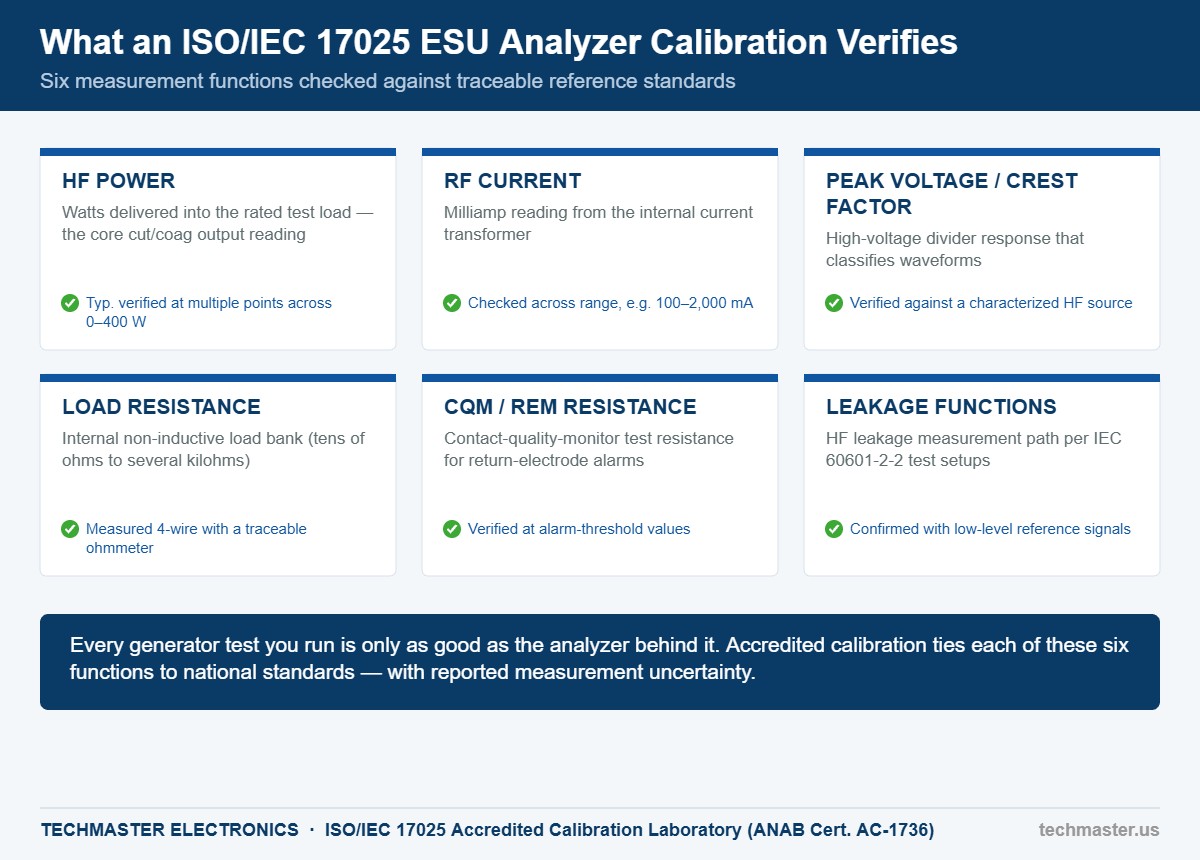
On an accredited certificate you should see each function listed with the applied reference value, the analyzer’s reading, the manufacturer tolerance, and the laboratory’s measurement uncertainty. If your current provider returns a one-line “calibrated to manufacturer specifications” statement with no data, read our guide on FDA-compliant medical device calibration — auditors increasingly reject certificates without quantitative results.
Which standards govern electrosurgical testing and analyzer accuracy?
Three layers of requirements meet at the ESU analyzer:
Device standard. IEC 60601-2-2 — Particular requirements for the basic safety and essential performance of high frequency surgical equipment — is the standard your generator tests trace back to. It treats output accuracy as essential performance (manufacturers commonly specify delivered power within ±20 percent of the front-panel setting into rated load) and drove the requirement for contact-quality-monitoring neutral electrodes. When a biomedical technician runs a power-distribution curve or a REM alarm check, the acceptance limits ultimately derive from this standard and the generator manufacturer’s service manual.
Laboratory standard. ISO/IEC 17025 accreditation is what makes the analyzer’s own calibration defensible. An accredited laboratory must demonstrate traceability to the SI through national standards, estimate and report measurement uncertainty, and operate under a surveilled quality system. Accreditation bodies such as ANAB audit the lab annually and publish the exact parameters the lab is accredited to calibrate — Techmaster’s scope is held under ANAB Cert. AC-1736.
Regulatory layer. For device manufacturers and their service arms, FDA’s Quality Management System Regulation (21 CFR Part 820) — which now incorporates ISO 13485:2016 — requires that measuring equipment used in servicing be calibrated, traceable, and controlled. Hospitals answer to accreditation surveyors who expect medical equipment testing to be performed with calibrated instruments; an ESU analyzer with an expired or unsupported certificate is low-hanging fruit in an equipment-management review.
How often should you calibrate an ESU analyzer?
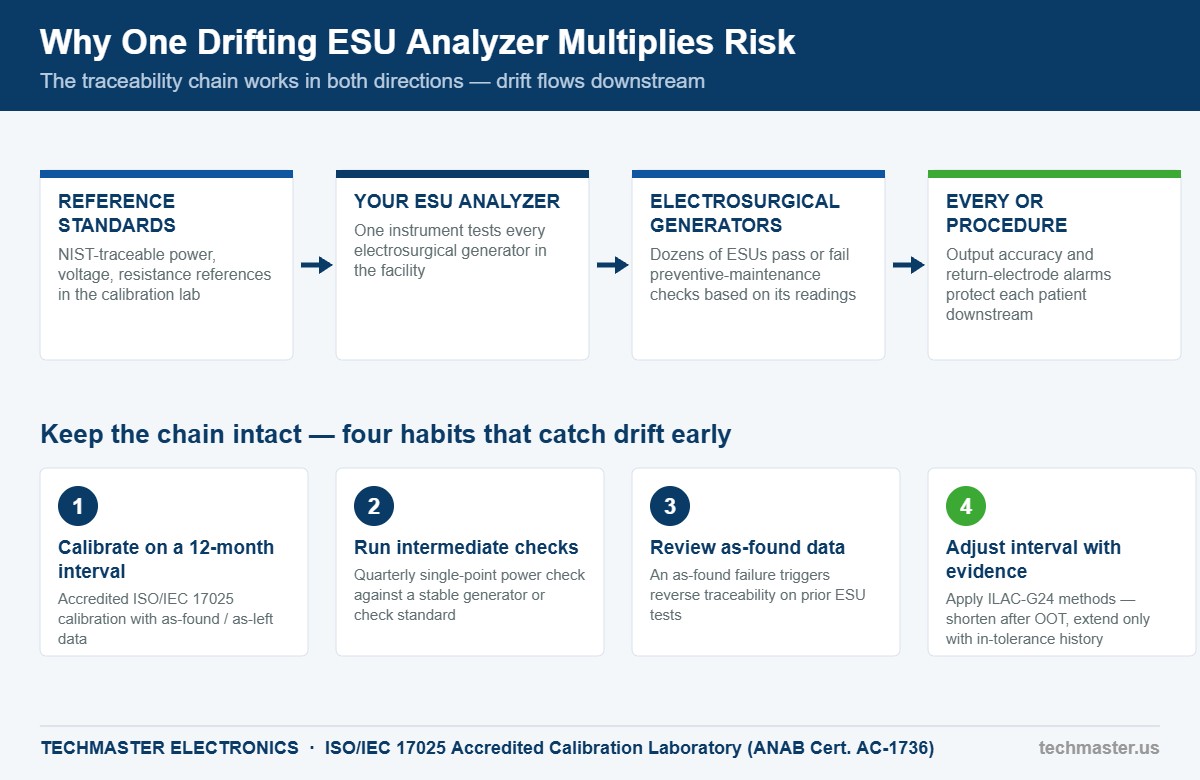
Twelve months is the right starting point for three reasons. First, analyzer manufacturers including Fluke Biomedical and BC Group recommend annual calibration for their ESU analyzer lines. Second, the instrument’s duty cycle is harsh — absorbing hundreds of watts of RF power repeatedly during PM season stresses the load bank in a way benchtop DMMs never experience. Third, the consequence of undetected drift is unusually expensive: a reverse-traceability review across every generator tested since the last good calibration.
Interval adjustment should be evidence-based, not budget-based. Our walkthrough of setting calibration intervals with ILAC-G24 methods covers the reliability-target math; the same logic applies here, with guidance available in the ILAC guidance series. In practice we see biomedical departments hold ESU analyzers at 12 months and add a quarterly intermediate check: a single-point power reading against a stable, recently calibrated generator or an in-house check standard, trended on a control chart. That habit catches a failing load resistor months before the annual calibration would.
What happens when an ESU analyzer drifts out of tolerance?
The as-found data on the calibration certificate is what makes this manageable. Suppose the analyzer’s power function reads 6 percent low at 300 W as-found, against a ±5 percent acceptance limit. Generators tested with it may have been passed while actually delivering less power than displayed — or a marginal generator may have been failed and pulled from service unnecessarily. The impact assessment asks: which generators, which modes, how close were their results to the limits, and does the analyzer error change any pass/fail decision?
Three practices keep that assessment small and defensible. Keep the analyzer’s certificate history in one place, so the “since when” question has a documented answer. Record the actual measured values from every generator PM, not just pass/fail — you cannot re-evaluate a checkbox. And insist on as-found/as-left data from your calibration provider, because a certificate that only shows post-adjustment values destroys the evidence you need. The same discipline applies to your electrical safety analyzer calibration — any shared-fleet test instrument multiplies its own error across the whole fleet.
How does Techmaster calibrate ESU analyzers?
Techmaster has calibrated test and measurement equipment since 1989 — our 10-year production dataset spans 381,916 calibrations across 4,913 manufacturers, and biomedical test equipment calibration — for ESU analyzers, defibrillator analyzers, electrical safety analyzers, and patient simulators — is a steady part of that mix. Work is performed at our medical equipment calibration laboratory capability within four ISO/IEC 17025 accredited labs: Vista and Santa Clara in California, Orlando in Florida, and San Antonio in Texas, with additional laboratory capacity in Holly Springs, North Carolina.
Standard turnaround is 5 business days, with expedite options of 1–2 days on many instruments and free local pickup and delivery in Silicon Valley, Southern California, and Orlando. If your fleet includes a mix of biomedical and general-purpose instruments, our full range of ISO/IEC 17025 accredited calibration services covers electrical, RF, thermodynamic, and dimensional disciplines under one certificate format — one vendor, one audit trail.
Key takeaways
- An ESU analyzer is a measuring instrument, not a tester accessory — it needs scheduled, traceable calibration just like the generators it checks.
- Accredited calibration verifies six functions: HF power, RF current, peak voltage/crest factor, load resistance, CQM/REM resistance, and leakage paths.
- IEC 60601-2-2 sets the generator requirements your tests trace to; ISO/IEC 17025 makes the analyzer’s calibration defensible; 21 CFR Part 820 makes it mandatory for device servicing under FDA jurisdiction.
- Start at a 12-month interval, add quarterly intermediate checks, and adjust only with documented evidence (ILAC-G24 methods).
- Demand as-found/as-left data with measurement uncertainty — it is your only defense when an analyzer turns up out of tolerance.
Frequently asked questions
What is an ESU analyzer?
An ESU analyzer is a biomedical test instrument that verifies electrosurgical generators. It presents a non-inductive load to the generator and measures delivered HF power, RF current, and peak voltage, and it exercises the contact-quality-monitor (CQM/REM) alarm circuit. Common models include the Fluke Biomedical QA-ES III, BC Group ESU-2400, and Datrend vPad-RF.
How often should an ESU analyzer be calibrated?
Every 12 months is the standard interval recommended by major analyzer manufacturers and used in most hospital test-equipment programs. Shorten the interval after any out-of-tolerance result, and extend it only with documented in-tolerance history using a recognized interval-adjustment method such as those described in ILAC-G24.
Does an ESU analyzer calibration need to be ISO/IEC 17025 accredited?
Accredited calibration is the defensible choice. ISO/IEC 17025 accreditation guarantees NIST traceability, reported measurement uncertainty, and an independently audited quality system. FDA’s Quality Management System Regulation and ISO 13485 both require calibrated, traceable test equipment, and hospital surveyors increasingly ask for accredited certificates on biomedical test instruments.
What is CQM or REM testing on an ESU analyzer?
CQM (contact quality monitor), also called REM (return electrode monitoring), is the generator safety circuit that measures the impedance of the patient return electrode and alarms if contact degrades. The ESU analyzer presents calibrated resistance values to exercise those alarm thresholds, so the analyzer’s internal resistance network must itself be verified during calibration.
What should I do if my ESU analyzer fails calibration?
Use the as-found data to quantify the error, then perform a reverse-traceability impact assessment: identify every generator tested since the last in-tolerance calibration and evaluate whether the analyzer’s error could change any pass/fail decision. Document the assessment, re-test affected generators where needed, and consider shortening the calibration interval.
Can Techmaster calibrate Fluke Biomedical QA-ES analyzers?
Yes. Techmaster Electronics calibrates ESU analyzers including the Fluke Biomedical QA-ES series, along with defibrillator analyzers, electrical safety analyzers, and patient simulators, through its ISO/IEC 17025 accredited laboratories under ANAB Cert. AC-1736, with standard 5-business-day turnaround and expedite options.
Put your ESU analyzers on a defensible calibration program
ISO/IEC 17025 accredited calibration with as-found/as-left data and reported uncertainty — from the team that has performed 381,916 calibrations over the past decade.
Request a Calibration QuoteRelated reading: infusion pump analyzer calibration under ISO/IEC 17025

Khanh Nguyen is the Marketing Manager at Techmaster Electronics, a B2B marketing leader covering the test, measurement, and ISO/IEC 17025 accredited calibration industry across the US and Vietnam markets.