
How Often Should You Calibrate a Battery Analyzer? Calibration Intervals, Accuracy & Compliance Guide
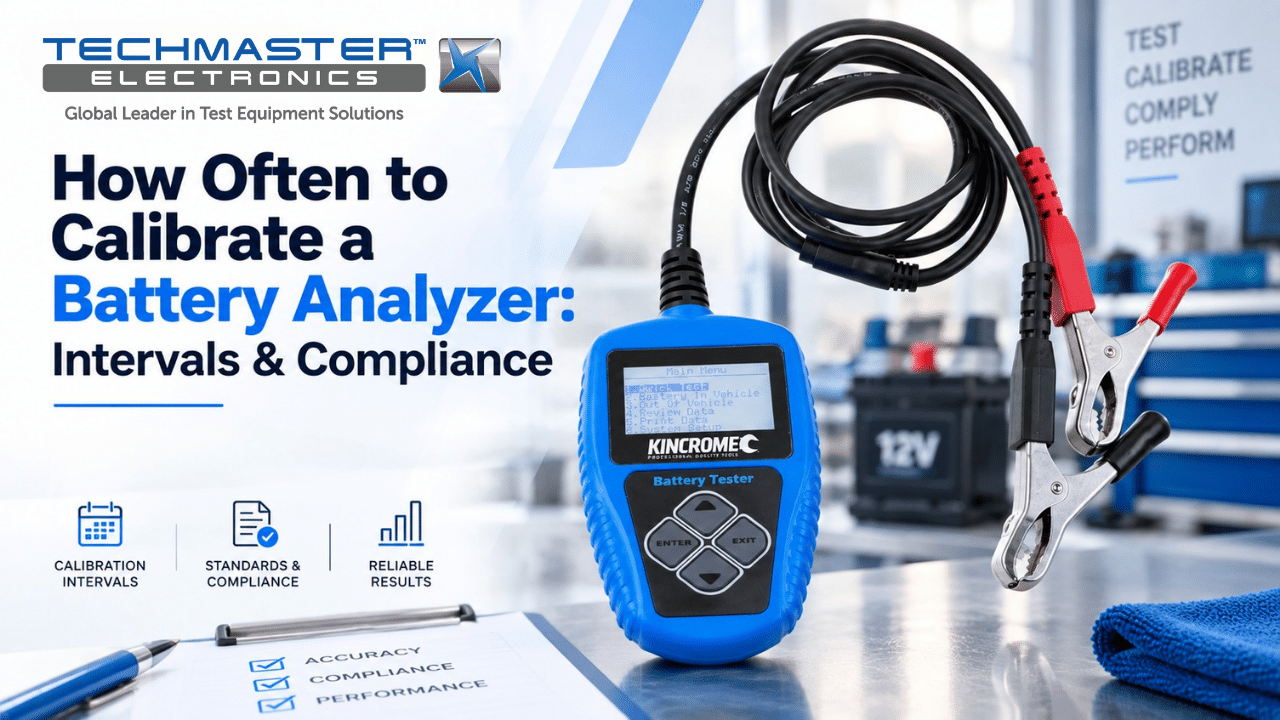
Knowing how often to calibrate a battery analyzer is important for field technicians, fleet managers, and laboratory teams. These users rely on battery analyzers to check DC voltage, internal resistance, battery condition, and other key values. Over time, however, electronic parts can drift. For example, ADC reference circuits can change with age and temperature. In addition, clamp cables can wear, while current shunts can change after repeated heating and cooling. Therefore, regular calibration helps confirm that the battery analyzer continues to provide reliable results. An ISO/IEC 17025 accredited laboratory can also provide documented measurement results and traceability within its accredited scope. However, ISO/IEC 17025 does not set one fixed calibration interval for every battery analyzer. Instead, each organization should set its interval based on equipment use, manufacturer guidance, operating conditions, previous calibration results, and measurement risk.
1. The Calibration Pillar: ISO/IEC 17025 Compliance and Risk Management
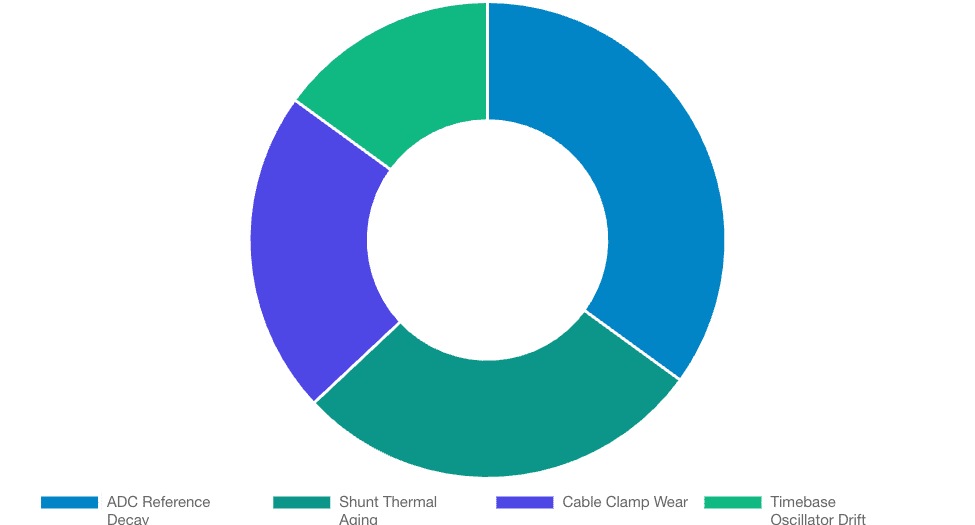
A built-in zero function helps operators check basic instrument performance. Likewise, a simple battery check can help identify obvious problems. However, these checks do not replace a full calibration.
For example, an internal zero function may correct certain lead or offset effects. However, it may not detect errors in voltage references, gain, resistance measurement, or other internal circuits.
By comparison, an ISO/IEC 17025 accredited calibration laboratory uses suitable reference standards and documented procedures. The laboratory reports the measurement results and uncertainty according to the applicable calibration scope.
In addition, the calibration process can establish measurement traceability to national or international standards when the laboratory’s scope supports that claim. In the United States, this may include traceability to NIST.
Regular calibration also helps reduce two common measurement risks:
- False Pass Results: If a tester reports lower resistance than the actual value, a weak battery may appear to meet the test limit. As a result, technicians may keep a battery in service when it needs further review.
- False Fail Results: If a tester reports higher resistance than the actual value, a good battery may fail the test. Therefore, the organization may spend money replacing a battery that still meets its requirements.
For this reason, calibration supports both measurement quality and better maintenance decisions.
2. How to Determine Battery Analyzer Calibration Intervals

There is no single interval that fits every battery analyzer. Instead, use a risk-based approach to set the calibration cycle.
1. Review Manufacturer Guidance
First, check the battery analyzer manufacturer’s calibration recommendations. The manufacturer may provide a suggested interval based on the instrument design, accuracy level, and expected use.
However, do not treat the manufacturer’s interval as the only factor. Also review your own measurement history and quality requirements.
2. Review Equipment Use and Environment
Next, consider how often and where you use the analyzer. For example, frequent testing, high-current measurements, temperature changes, humidity, vibration, dust, or chemical exposure can increase wear.
Therefore, an analyzer used every day in a production or fleet environment may need closer monitoring than an analyzer used only a few times each month.
3. Review Previous Calibration Results
After each calibration, compare the new results with earlier results. If the analyzer shows very little change over several calibration cycles, your quality team may decide that the current interval remains suitable. On the other hand, repeated drift can support a shorter interval.
This approach gives you a clear record for future calibration decisions.
4. Consider Repair, Damage, or Relocation
A battery analyzer may need an extra check after repair, physical damage, overload, or major relocation.
For example, a damaged clamp or test cable can affect resistance measurements even when the main instrument still works correctly.
Therefore, inspect the instrument and perform the required verification before returning it to critical testing.
3. A Practical Calibration Interval Guide
The following approach can help organizations set an initial schedule:
| Operating Condition | Suggested Approach |
|---|---|
| Normal laboratory or field use | Start with a 12-month interval if supported by manufacturer guidance and risk review |
| Frequent production testing | Consider a shorter interval based on use and calibration history |
| Heavy current testing | Review drift more often and shorten the interval if results support it |
| Harsh temperature or humidity | Increase checks and consider a shorter calibration cycle |
| Repeated calibration drift | Shorten the interval based on documented results |
| After repair or damage | Perform appropriate verification or calibration before critical use |
Importantly, a 12-month interval does not apply automatically to every instrument. Likewise, a 6-month interval is not a universal ISO/IEC 17025 requirement.
Instead, organizations should use equipment history, risk, manufacturer guidance, and customer or quality requirements to set the interval.
4. How to Verify Battery Analyzer Accuracy
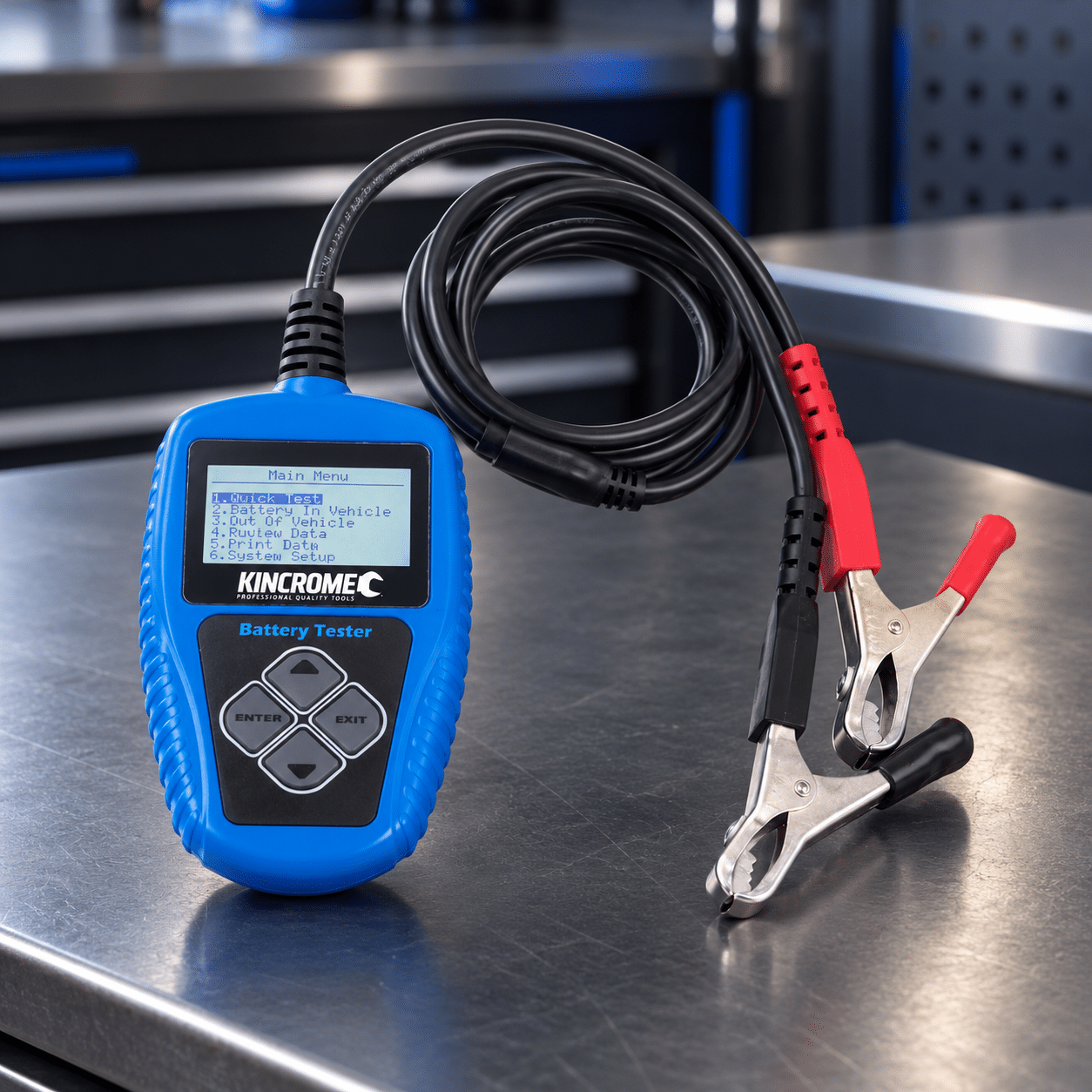
In addition to formal calibration, operators can perform routine checks between calibration events.
1. Inspect the Test Leads
First, inspect the battery analyzer cables and clamps.
Look for:
- Damaged insulation
- Loose connectors
- Worn clamp surfaces
- Corrosion
- Dirt or residue
- Broken strain relief
Clean suitable contact surfaces according to the manufacturer’s instructions.
2. Perform the Required Zero Adjustment
Next, perform the analyzer’s zero or lead-compensation function when the manufacturer requires it. This check can reduce certain lead and connection effects.
However, zero adjustment does not replace calibration. It only addresses the effects that the instrument’s zero procedure can correct.
3. Check DC Voltage
Then, compare the analyzer’s voltage reading with a suitable calibrated reference. For example, a calibrated DMM can provide a reference when the test setup and voltage range are appropriate.
You can check several points across the analyzer’s operating range. A multi-point check can reveal offset or range-related errors more clearly than a single-point check.
4. Check Internal Resistance
Next, check the resistance measurement function with suitable low-resistance standards.
Depending on the analyzer, a laboratory may use standards such as:
- 1 mΩ
- 10 mΩ
- 100 mΩ
The exact values should match the analyzer’s range and the applicable calibration procedure.
Because low-resistance measurements are sensitive to contact quality, use clean connections and the correct Kelvin setup.
5. Why 4-Wire Kelvin Testing Matters
Low-resistance battery measurements can easily pick up resistance from cables and contacts.
A 4-wire Kelvin connection solves much of this problem by separating the current path from the voltage-sense path.
As a result, the sense circuit measures the voltage at the test point with much less effect from lead resistance.
Therefore, Kelvin testing can improve the repeatability of milliohm measurements.
However, Kelvin connections do not remove every source of error. Probe pressure, terminal condition, temperature, battery state of charge, and analyzer performance can still affect the result.
Frequently Asked Questions (FAQs)
1. How often should you calibrate a battery analyzer?
You should calibrate a battery analyzer at least once every 12 months under standard operating conditions. If the tester is used daily in high-volume production, harsh field environments, or industrial fleet maintenance, a 6-month calibration interval is strongly recommended to prevent voltage and resistance measurement drift.
2. What factors dictate how often to calibrate a battery analyzer?
Calibration frequency depends on usage intensity, environmental exposure (temperature swings, humidity, acid fumes), historical drift trends, physical wear on Kelvin test leads, and industry compliance standards such as ISO 9001, IATF 16949, or NERC PRC-005.
3. Can you calibrate a portable 12V battery analyzer in-house?
No, in-house zeroing adjustments only compensate for test lead baseline resistance and do not constitute full calibration. Complete calibration requires specialized, NIST-traceable precision standards, low-inductance micro-ohm resistors, and an ISO/IEC 17025 accredited laboratory environment.
4. What happens if a battery analyzer is used past its calibration interval?
Using an uncalibrated battery analyzer increases the risk of measurement drift, leading to false pass readings that leave degraded batteries in service or false fail readings that cause healthy batteries to be scrapped unnecessarily. It also results in non-compliance during quality management audits.
5. What parameters are verified during accredited battery analyzer calibration?
Accredited calibration verifies open-circuit DC voltage accuracy across operating ranges, 4-wire AC/DC internal resistance (mΩ) measurement linearity, Cold Cranking Amps (CCA) conversion accuracy, temperature sensing channels, and timer/timebase integration accuracy.
6. Does Techmaster US offer on-site calibration for battery analyzers?
Yes, Techmaster Electronics provides ISO/IEC 17025 accredited on-site calibration for handheld battery analyzers, benchtop testers, and electrical test instruments across the United States. Our mobile calibration teams bring NIST-traceable standards directly to your facility to eliminate equipment downtime.
How Often Should You Calibrate a Battery Analyzer?
Comprehensive technical guide on calibration intervals, electronic reference drift, Cold Cranking Amps (CCA) accuracy, NERC PRC-005 utility compliance, and ISO/IEC 17025 accredited metrology.
CONTACT USFrequently asked questions
What is battery analyzer calibration?
Battery Analyzer Calibration is the documented comparison of a battery analyzer against NIST-traceable reference standards under ISO/IEC 17025. It quantifies the battery analyzer’s error and measurement uncertainty and confirms it performs within tolerance, with as-found and as-left data on the certificate.
How often should a battery analyzer be calibrated?
Most quality systems calibrate a battery analyzer every 12 months, or sooner after repair, overload, or before critical measurements. Set your interval from the manufacturer spec and your ISO 9001 / 13485 / AS9100 program and drift history.
Is Techmaster’s battery analyzer calibration ISO 17025 accredited?
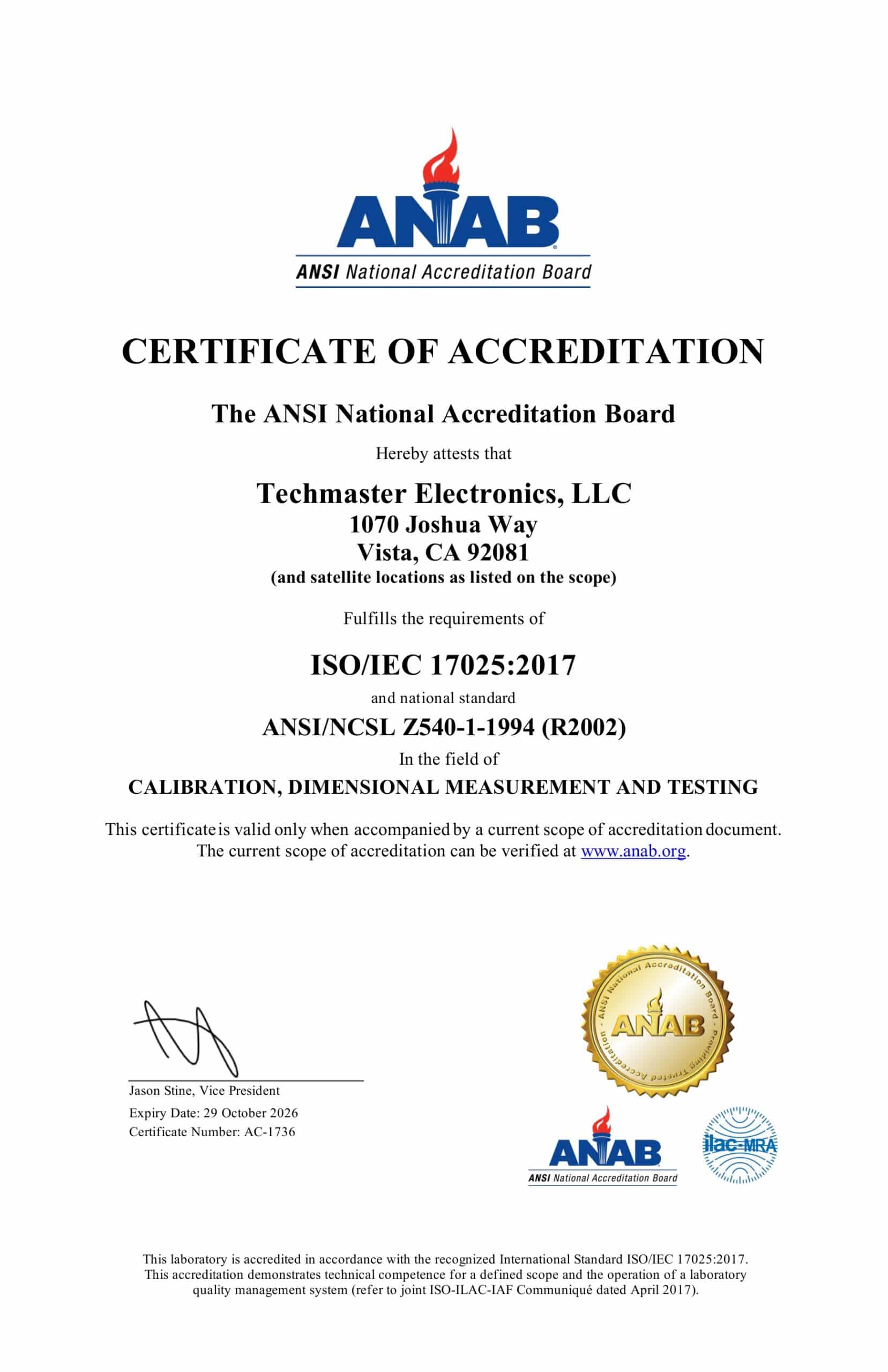
Yes. Techmaster Electronics is ISO/IEC 17025:2017 accredited by ANAB (Certificate AC-1736). Every battery analyzer calibration is NIST-traceable and issued with a full measurement-uncertainty budget.
What is the turnaround for battery analyzer calibration?
Standard turnaround is 5 business days, with 1–2 business-day expedite available. On-site calibration removes shipping time entirely for battery analyzers that can’t leave the floor.
Do you calibrate battery analyzers on-site or in-lab?
Both. Techmaster runs five US labs (Vista CA, Santa Clara CA, Orlando FL, San Antonio TX, Holly Springs NC) and offers nationwide on-site battery analyzer calibration to minimize downtime.

Calibration engineer at Techmaster Electronics, ISO/IEC 17025 accredited laboratory with 35+ years of metrology expertise.