
TL;DR: A megohmmeter rental starts with a distinction people get wrong: insulation resistance testing is not dielectric withstand testing, and a hipot will not satisfy a standard written for a megohmmeter. Specify the test voltage the standard requires (250–500 V for low-voltage wiring, commonly 2.5–5 kV for motors and cables), check the resistance ceiling rather than the range, confirm the instrument can run timed PI and DAR sequences, and insist on a guard terminal. High-resistance measurement is accredited to 10 PΩ at San Antonio only.
What is a megohmmeter used for?
A megohmmeter, often called an insulation tester or by the trade name megger, applies a DC test voltage across insulation and measures the resulting resistance, the standard way to establish whether cable, motor, generator or switchgear insulation has degraded before it fails in service. It reports a value, in megohms or higher, rather than the pass/fail verdict a dielectric withstand test gives.
Insulation and high-voltage test instruments formed a consistent cluster in the requests reaching our laboratories over the last quarter, split between calibration of owned instruments and short-term access for acceptance and maintenance campaigns.
Why is a megohmmeter not a hipot tester?
Because they answer different questions. A megohmmeter measures how good the insulation is and gives you a number to trend; a hipot tester stresses the insulation at a much higher voltage and tells you whether it broke down. A procedure calling for an insulation resistance value cannot be satisfied by a withstand test, and a withstand requirement cannot be met by a resistance reading.
Both instruments have their own calibration requirements, set out in megohmmeter calibration and hipot tester calibration, with the safety-tester variant in AC hipot safety tester calibration. If the work is genuinely a withstand test, rent that instrument instead.
What has to be right on a rented megohmmeter?
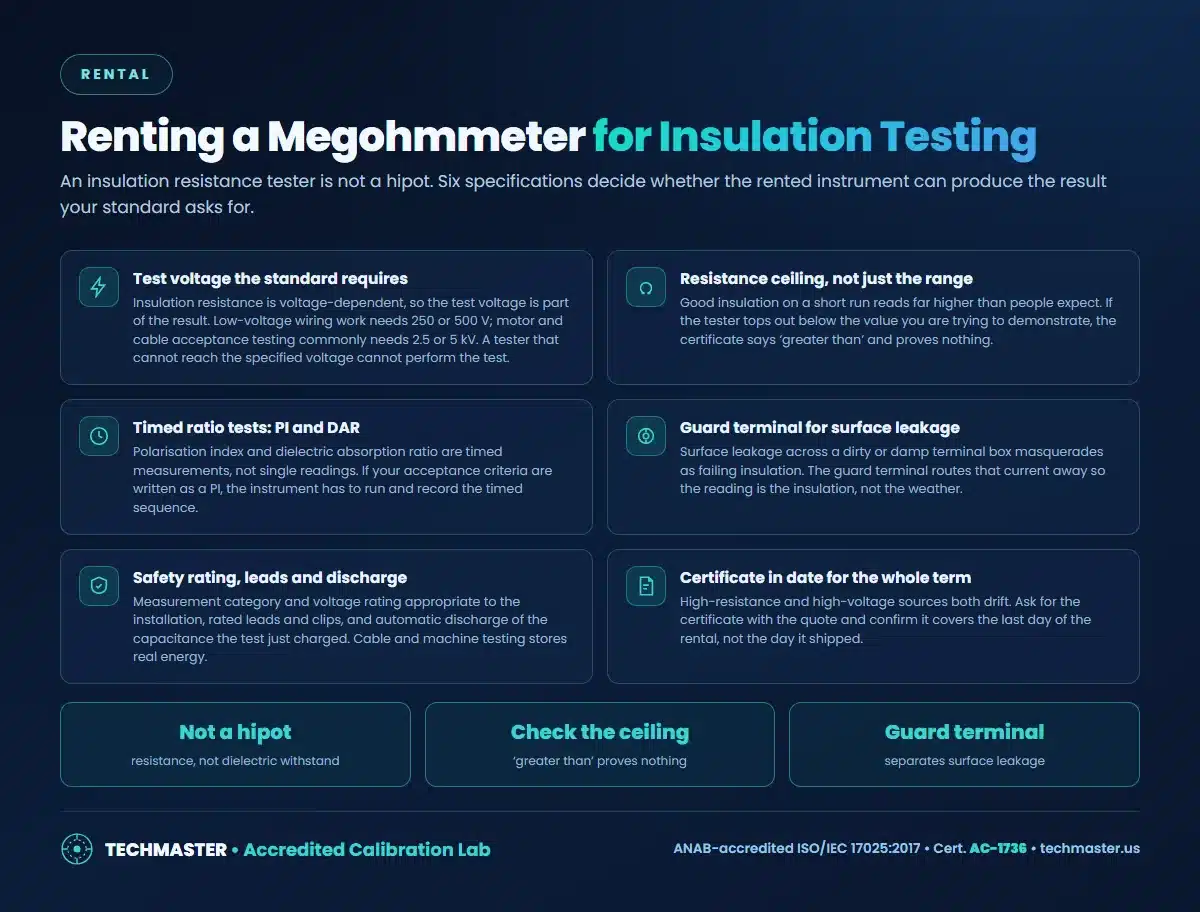
The test voltage your standard specifies, a resistance ceiling above the value you are trying to demonstrate, the ability to run timed polarisation index and dielectric absorption ratio sequences if your criteria are written that way, a guard terminal for surface leakage, an appropriate safety rating with rated leads and automatic discharge, and a calibration certificate in date for the last day of the rental.
Why check the ceiling rather than the range?
Because good insulation on a short run reads far higher than people expect, and an instrument that tops out below your acceptance value can only report “greater than” its own limit. That is not a measurement, and it cannot demonstrate compliance with a criterion expressed as a number.
This is where the calibration of the rented instrument stops being a formality. High-resistance sources drift, and a certificate has to cover the decade you are actually working in. Techmaster’s accredited high-resistance capability extends to a 10 PΩ tera-ohmmeter, held at the San Antonio, Texas laboratory only; the DC and AC high-voltage capability behind withstand work is accredited to 100 kV at Vista, California and 150 kV at San Antonio.
Which test does your standard actually ask for?
| What the procedure says | Instrument | What it produces |
|---|---|---|
| Insulation resistance in MΩ or GΩ at a stated voltage | Megohmmeter | A resistance value you can trend over time |
| Polarisation index, or a 1-minute to 10-minute ratio | Megohmmeter with timed test modes | Two timed readings and their ratio |
| Dielectric absorption ratio (DAR) | Megohmmeter with timed test modes | A 30-second to 60-second ratio |
| Dielectric withstand, or ‘hipot at’ a voltage | Hipot tester | A pass/fail verdict plus leakage current |
| Protective earth or bonding continuity | Ground or bond tester | A low-resistance value at high test current |
| Insulation resistance on a working multimeter range | Insulation multimeter | A combined meter and insulation function |
The last two rows matter because they are the substitutions people reach for when the right instrument is unavailable. Continuity work is covered in ground tester calibration, and the combined instruments in insulation multimeter calibration and its error limits in the insulation multimeter error-limit guide. General insulation tester requirements sit in insulation tester calibration.
What about safety and discharge?
Insulation testing charges the capacitance of whatever it is connected to, and cable and machine windings store real energy. Confirm the instrument’s measurement category and voltage rating suit the installation, that the leads and clips are rated and undamaged, and that automatic discharge works. Ask us about availability, delivery and terms for the voltage and ceiling your procedure requires, and read the certificate that arrives with it, how to read an ISO/IEC 17025 calibration certificate covers what each field commits the laboratory to.
Frequently asked questions
What is the difference between a megohmmeter and a hipot tester?
A megohmmeter applies a DC test voltage and measures insulation resistance, reporting a value in megohms, gigohms or higher. A hipot tester applies a much higher dielectric withstand voltage and asks a pass/fail question about breakdown and leakage current. They answer different questions, they are specified differently, and one will not satisfy a standard written for the other.
What test voltage do I need for insulation resistance testing?
Whatever the standard or procedure you are working to specifies, because insulation resistance is voltage-dependent and the test voltage is part of the result. Low-voltage wiring work commonly calls for 250 or 500 V, while motor, generator and cable acceptance testing frequently needs 2.5 or 5 kV. A tester that cannot reach the specified voltage cannot perform the test at all.
What is a polarisation index test?
A timed insulation resistance measurement: the resistance is recorded after one minute and again after ten, and the ratio between them describes how the insulation behaves under sustained voltage. Because it is a timed sequence rather than a single reading, the instrument has to be able to run and record it – a plain spot-reading megohmmeter cannot produce a polarisation index.
Why does a megohmmeter need a guard terminal?
Because surface leakage across a dirty or damp terminal box flows in parallel with the insulation you are trying to measure, and it makes sound insulation look like it is failing. The guard terminal routes that surface current away from the measuring circuit so the reading describes the insulation rather than the weather.
The bottom line
Read the procedure before you book. If it names a voltage and expects a resistance value, you need a megohmmeter that reaches that voltage and a ceiling above your acceptance limit. If it expects a ratio, you need timed test modes. And if it says hipot, you need a different instrument entirely.
Need a quote, a rental, or a repair evaluation?
Techmaster Electronics, ISO/IEC 17025 accredited calibration laboratory, ANAB Cert. AC-1736, founded 1989. Four accredited US labs, 5-day standard turnaround, 1–2 day expedite.
Request a quote →Techmaster Electronics, LLC is an independent ISO/IEC 17025:2017 accredited calibration laboratory. We are not affiliated with, authorized by, or endorsed by any manufacturer named on this page. All product names and model designations are trademarks of their respective owners and are used here only to identify the equipment we calibrate, repair, or rent. Confirm that our accredited scope covers your instrument’s parameters and ranges before shipping, ask us and we will check it against your model list.

Khanh Nguyen is the Marketing Manager at Techmaster Electronics, a B2B marketing leader covering the test, measurement, and ISO/IEC 17025 accredited calibration industry in the United States.