

In industrial and laboratory settings, “close enough” is never sufficient when it comes to temperature. Whether you are monitoring a cold chain for life-saving vaccines or managing a high-heat chemical reaction, the integrity of your data rests entirely on Calibrator-Thermometer calibration. Precision is not a one-time setup; it is a continuous cycle of verification. This guide explores the essentials of temperature calibrator adjustment, the necessity of NIST traceable thermometer calibration, and how to find the right thermometer calibration services near me.
What is a Calibrator-Thermometer?
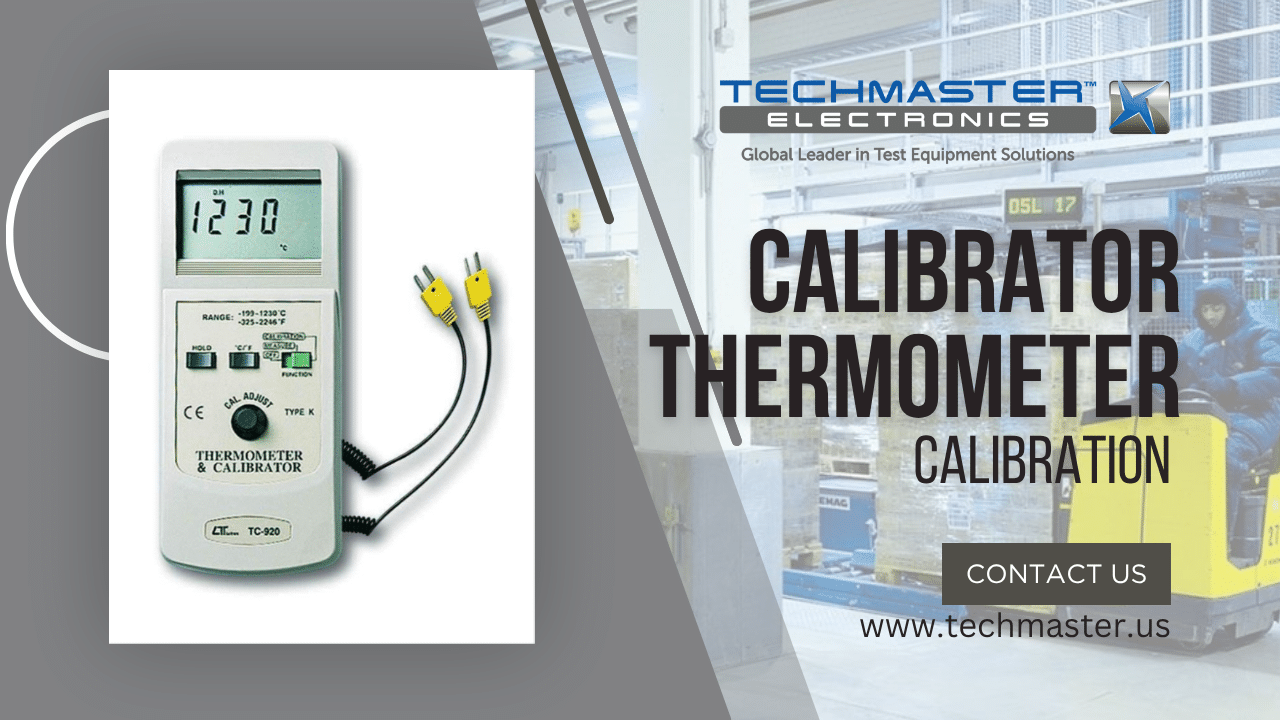
A Calibrator-Thermometer is a high-precision instrument designed to act as a reference standard for other temperature-sensing devices. Unlike a standard digital thermometer used for general purposes, these devices are engineered with high stability and low drift rates.
Common types of calibrators include:
- Dry-Block Calibrators: Portable units that use a heated or cooled metal block to provide a stable temperature environment.
- Micro-Baths: Fluid-based systems that offer superior uniformity and are ideal for oddly shaped sensors.
- Infrared Calibrators: Specifically designed for non-contact thermometers (pyrometers) using blackbody radiation sources.
Core Applications in Industry
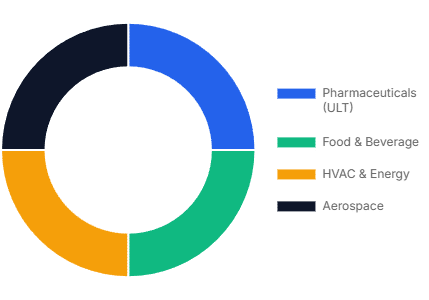
The application of these devices spans across various critical sectors:
- Pharmaceuticals: Maintaining the exact temperature of bioreactors and storage freezers (Ultra-Low Temperature – ULT).
- Food & Beverage: Ensuring pasteurization temperatures are met to kill pathogens while maintaining flavor profile.
- HVAC & Energy: Calibrating building management systems (BMS) to optimize energy consumption and occupant comfort.
- Aerospace: Testing thermal sensors used in engine components where extreme heat resistance is mandatory.
The Danger of Sensor Drift
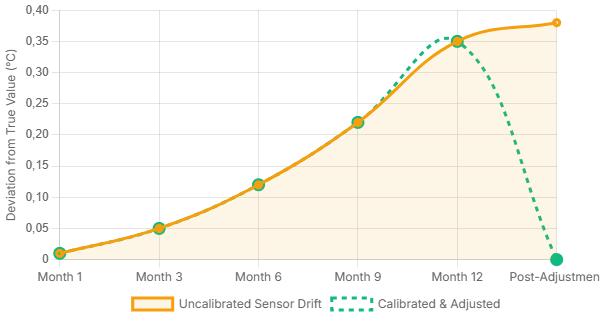
Even gold-standard reference tools drift due to environmental factors, stress, or sensor aging. Regular calibration is mandatory for regulatory compliance (ISO/IEC 17025), safety, and cost efficiency.
Fact: Without annual verification, accumulated drift can compromise entire batches of pharmaceutical or food products.
Why Calibrator-Thermometer Calibration Matters
The 5-Step Professional Adjustment Process
Clean & Inspect
Check physical damage affecting thermal conductivity.
Stabilization
Allow 30-60 mins to reach thermal equilibrium.
Multi-Point Test
Test across minimum, midpoint, and maximum ranges.
Hysteresis Check
Analyze approach from below vs. above setpoints.
Correction
Apply firmware offset & final verification.
A thermometer is only as good as the device used to verify it. A “Calibrator-Thermometer” (often a high-precision dry block or liquid bath) acts as the gold standard. However, even these reference tools drift over time due to environmental factors, mechanical stress, or sensor aging.
Regular calibration ensures:
- Regulatory Compliance: Meeting ISO/IEC 17025 or FDA requirements.
- Safety: Preventing overheating or spoilage in critical processes.
- Cost Efficiency: Reducing waste from inaccurate readings.
The Process of Temperature Calibrator Adjustment
When a reference device shows a deviation from the actual temperature (the “True Value”), a temperature calibrator adjustment is required. This is more than just a measurement; it is the physical or software-based alignment of the device to match a known standard.
Advanced Steps in Professional Adjustment:
- Preliminary Cleaning & Inspection: Checking for physical damage to probes or inserts that could affect thermal conductivity.
- Stabilization: Allowing the calibrator to reach thermal equilibrium at specific setpoints for a minimum of 30 to 60 minutes.
- Multi-point Testing: Testing across the full functional range—typically at the minimum, midpoint, and maximum operating temperatures.
- Hysteresis Analysis: Checking if the device reads differently when approaching a temperature from below versus from above.
- Correction & Final Verification: Applying digital offset values to the internal firmware and performing a second round of measurements to confirm the error has been eliminated.
Core Industry Applications
Key Terminology
Calibration
Measuring and documenting the difference between a device and a standard. Does not involve correction.
Adjustment
The physical or software-based alignment of the device to match the standard. Requires pre- and post-calibration.
NIST Traceability
An unbroken chain of comparisons back to national standards, ensuring EEAT (Trustworthiness).
The Gold Standard: NIST Traceable Thermometer Calibration
For industries where audit trails are mandatory, NIST traceable thermometer calibration is the only acceptable benchmark. NIST (National Institute of Standards and Technology) traceability means that the calibration of your thermometer can be traced back to the national standard through an unbroken chain of comparisons.
This certification provides the “Trustworthiness” pillar of EEAT, proving to auditors and customers that your temperature data is backed by scientific rigor.
Choosing Thermometer Calibration Services Near Me
Finding a local laboratory is essential for minimizing downtime and reducing the risk of precision loss during long-distance shipping. When searching for thermometer calibration services near me, evaluate these critical factors:
- ISO/IEC 17025 Accreditation: This is the international standard for testing and calibration laboratories. If a lab lacks this, their “NIST Traceability” claims may not be verified.
- Scope of Calibration: Check if the lab can handle your specific temperature range (e.g., from -196°C Cryogenic to 1200°C High-Heat).
- Uncertainty Budgets: A professional lab will provide a detailed “Uncertainty of Measurement” on their certificates.
- Turnaround & Logistics: Local services often offer 24-48 hour returns or on-site calibration, where technicians bring the NIST-traceable equipment directly to your facility.
FAQ: Frequently Asked Questions
What is the difference between calibration and adjustment?
Calibration is the act of measuring and documenting the difference between a device and a standard. Adjustment is the act of correcting that device to align with the standard. You can have calibration without adjustment, but you should never have adjustment without a pre-and-post calibration.
How often should I calibrate my temperature calibrator?
Most professional standards (and manufacturers) recommend an annual cycle. However, if the device is dropped, exposed to extreme temperatures beyond its range, or used in highly regulated environments, semi-annual calibration is advised.
Can I perform NIST traceable calibration myself?
Technically, yes, but only if you own a “Primary Standard” (like a Fixed-Point Cell), possess a documented ISO 17025 quality manual, and participate in proficiency testing. For 99% of businesses, third-party services are significantly more cost-effective.
What is the difference between ice point and boiling point calibration?
Ice point calibration uses a $0^\circ\text{C}$ ($32^\circ\text{F}$) mixture for precision at freezing, while boiling point calibration ($100^\circ\text{C}$) adjusts for high-heat accuracy. Both are vital for temperature calibrator adjustment. (198 ký tự)
How often should I calibrate my industrial temperature sensor?
Most standards require NIST traceable thermometer calibration annually. However, high-stress environments or critical FDA/ISO processes may demand quarterly checks to prevent accuracy drift. (196 ký tự)
Which temperature calibrator is best for food safety monitoring?
Dry-block calibrators are ideal for food safety. They offer fast Calibrator-Thermometer calibration without liquid contamination, ensuring sensors meet HACCP and stringent hygiene requirements. (197 ký tự)
Why is my digital thermometer showing a different reading than my reference calibrator?
Discrepancies often stem from sensor drift, improper immersion depth, or electromagnetic interference. Professional thermometer calibration services near me can recalibrate and fix these offsets.
Conclusion: Securing Your Accuracy
Precision in temperature measurement is more than a technical requirement; it is the foundation of modern quality control and consumer safety. By prioritizing Calibrator-Thermometer calibration and ensuring your devices undergo regular temperature calibrator adjustment, you effectively insulate your organization from costly legal liabilities, financial losses due to spoiled batches, and critical safety risks. In an era where data integrity is scrutinized by global regulators, staying ahead of sensor drift is not optional—it is a competitive advantage.
Ready to ensure your measurement accuracy is beyond reproach and fully compliant with ISO/IEC 17025 standards? Do not leave your results to chance. Contact an accredited laboratory today for professional NIST traceable thermometer calibration and expert thermometer calibration services near me. Taking this proactive step now will keep your high-precision operations running at peak performance and guarantee peace of mind for every reading you take.
