


Digital Circuit Breaker Timer Calibration: The Gold Standard for Power System Reliability
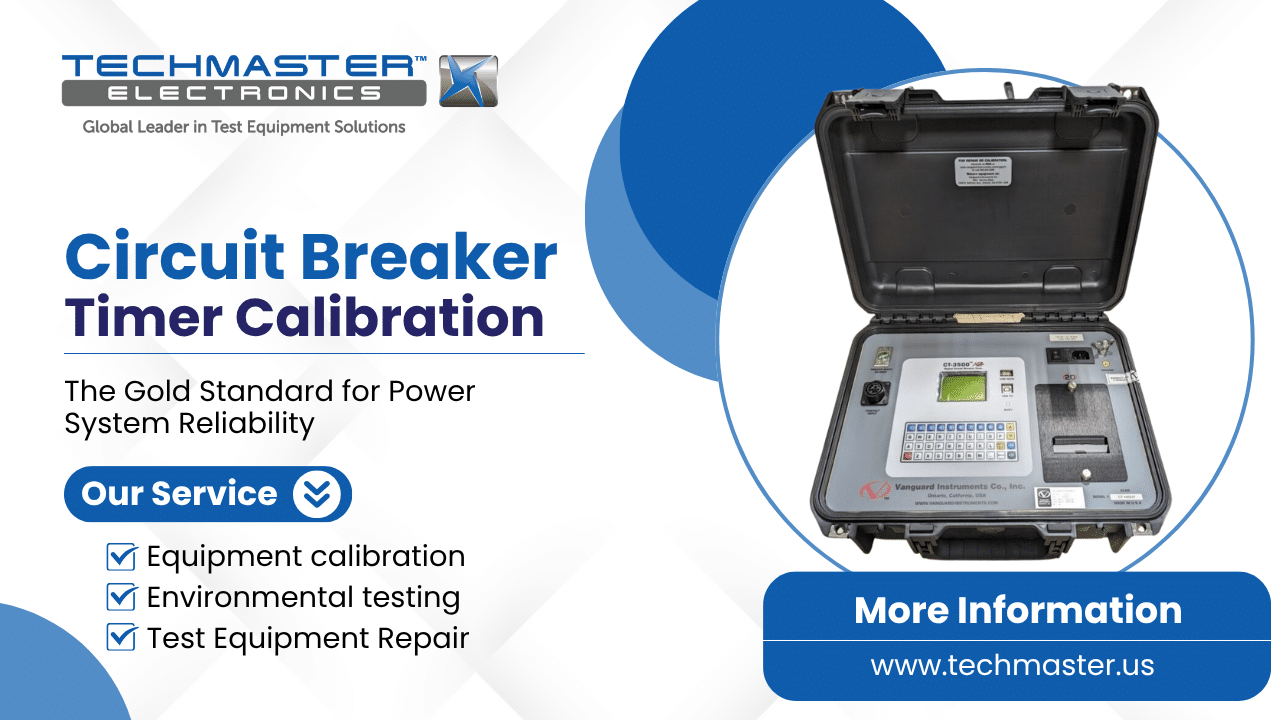
In the complex architecture of modern electrical grids, the Circuit Breaker (CB) stands as the most critical safety component. It is designed to interrupt massive fault currents within milliseconds to protect multi-million dollar transformers and generators. However, the performance of a circuit breaker is only as good as the instrument used to test it. This is why Digital Circuit Breaker Timer Calibration is not just a routine maintenance task—it is the foundation of high-voltage system integrity.
1. Operating Principle: How Precision Timing is Captured
⏱️ Quartz-Based Precision
The core of the timer is a Quartz Oscillator generating pulses at MHz frequency. Upon a trigger (Close/Open command), the device counts pulses ($n$) until the contact state changes.
To appreciate the necessity of Digital Circuit Breaker Timer Calibration, one must understand the micro-level physics the device monitors. A digital timer doesn’t just “start and stop”; it manages high-speed data acquisition.
1.1. The Internal Time Base
The core of a digital timer is a Temperature-Compensated Crystal Oscillator (TCXO). This component generates a continuous stream of pulses. For instance, a 1MHz oscillator provides a pulse every 1 microsecond. Calibration ensures that this “internal clock” does not drift due to aging or the intense electromagnetic fields found in high-voltage substations.
1.2. Sensing the “Moment of Truth”
The timer detects changes in contact state through two primary methods:
-
-
Dry Contact Sensing: The timer supplies a sensing voltage. When the CB contacts touch, the circuit closes, and the timer records the exact pulse count at that microsecond.
-
Transducer Inputs: For advanced analysis, timers use motion transducers to convert linear or rotary movement into electrical signals, allowing the device to calculate velocity and acceleration.
-
Critical Measurement Parameters
Pole Synchronization (ms)
Red bar indicates an out-of-sync phase causing mechanical stress.
2. Critical Applications in Electrical Infrastructure
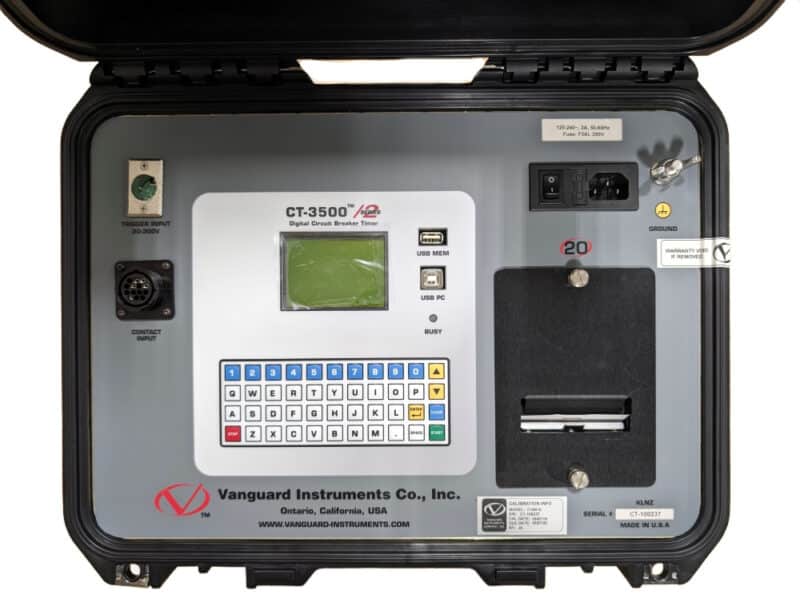
A Digital Circuit Breaker Timer is used throughout the lifecycle of a circuit breaker, from factory acceptance tests (FAT) to routine field maintenance.
2.1. Timing Measurements (Open/Close/Trip)
The primary application is measuring the “Trip Time” and “Close Time.” If a breaker is rated for 3 cycles (approx. 50ms at 60Hz) but takes 60ms to open, the arc duration increases, leading to contact erosion or, in worst-case scenarios, a catastrophic explosion of the breaker housing.
2.2. Pole Synchronization (Simultaneity)
In a three-phase system, all three poles must close or open at nearly the exact same time. The “Delta” (difference) between the first and last pole to operate should typically be less than 1/6th of a cycle (approx. 2-3ms). Digital Circuit Breaker Timer Calibration ensures that the instrument can accurately distinguish these tiny time differences, which are critical for preventing transient overvoltages.
2.3. Contact Bounce Analysis
When mechanical contacts slam together, they often “bounce” before settling. Excessive bouncing causes secondary arcing and pits the contact surface. A calibrated digital timer captures these millisecond-long bounces, allowing engineers to diagnose weakened springs or mechanical misalignment.
3. Why Digital Circuit Breaker Timer Calibration is Mandatory
🔗
📈
Error Accumulation Over 12 Months
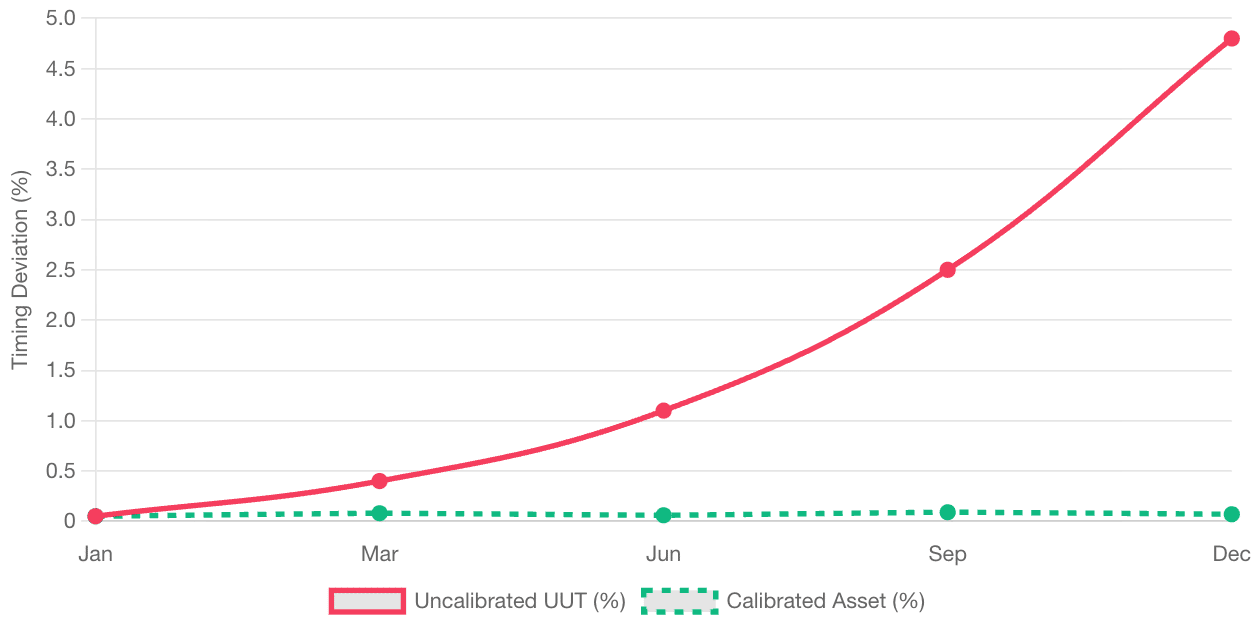
Measurement drift is an inevitable reality. In the power industry, where “close enough” is never enough, calibration provides three vital layers of protection:
3.1. Mitigating the Impact of Harsh Environments
Substations are “electrically noisy” environments. High-frequency interference and extreme temperature fluctuations can affect the internal circuitry of digital timers. Regular calibration identifies if the device’s filtering and timing components are still performing within the manufacturer’s specified tolerances.
3.2. Ensuring Traceability for Quality Audits
In the event of a grid failure, forensic investigators look at maintenance records. If the timer used to verify the breaker was not calibrated, the test results are legally and technically invalid. Digital Circuit Breaker Timer Calibration provides a documented “Paper Trail” to national standards (NIST, VMI, etc.), proving that your maintenance data is irrefutable.
3.3. Reliability in Smart Grid Integration
As we move toward Smart Grids and automated switching, the margin for error shrinks. Precise timing is required for “Point-on-Wave” switching, where breakers are timed to close exactly at the voltage zero-crossing to minimize inrush current. This level of precision is impossible without a calibrated, high-accuracy timer.
4. The Techmaster Calibration Protocol: A Detailed Walkthrough
At Techmaster, our Digital Circuit Breaker Timer Calibration service follows a rigorous, multi-step procedure aligned with ISO/IEC 17025 standards.
1. Pre-Calibration Inspection
We check the physical integrity of the unit, including the high-voltage input ports and transducer connectors. Dirty or oxidized connectors can introduce millisecond delays, leading to “false” failures in the field.
2. Time Base Verification
Using a Rubidium frequency standard or a high-stability pulse generator, we verify the timer’s internal clock. We test the device across multiple ranges, from ultra-fast (5ms) to long-duration (10 seconds) operations.
3. Trigger Level Sensitivity
We calibrate the “trigger” thresholds. This ensures the timer correctly identifies the difference between a “closed” contact and a “high-resistance” contact, which is crucial for identifying worn-out breaker tips.
4. Uncertainty Calculation
We don’t just provide a “Pass/Fail.” We calculate the Uncertainty of Measurement (UoM). This tells the client exactly how much confidence they can have in their field readings, which is a requirement for advanced asset management.
5. Benefits for Asset Managers and Field Engineers
Investing in Digital Circuit Breaker Timer Calibration yields significant ROI:
-
Extended Asset Life: By accurately identifying mechanical slow-downs early, you can perform targeted lubrication or adjustment instead of expensive full replacements.
-
Reduced Liability: Calibrated data protects the utility or service company from litigation following power quality issues.
-
Safety Assurance: Knowing that your protection equipment will operate within the required window provides peace of mind for the personnel working near high-voltage gear.
Conclusion
The reliability of the modern electrical grid hinges on the speed and precision of circuit breakers. However, these breakers are only as reliable as the digital timers used to monitor them. Digital Circuit Breaker Timer Calibration is the critical link that transforms raw data into actionable intelligence. By maintaining a strict calibration schedule with a certified laboratory like Techmaster, you ensure that your protection systems are ready to act in the blink of an eye—accurately, every time.
Digital Circuit Breaker Timer
Techmaster Calibration Services
At Techmaster, we go beyond measurement — we deliver confidence. As a trusted partner in testing, calibration, and industrial solutions, we provide the expertise and precision needed to support critical electrical systems and ensure long-term operational reliability.
