
Metrology guide · ISO/IEC 17025 · ANAB-accredited
FDA-Compliant Medical Device Calibration…
FDA-Compliant Medical Device Calibration verifies a FDA-Compliant Medical Device against NIST-traceable standards under ISO/IEC 17025. Techmaster performs a documented multi-point check, reports measurement uncertainty, and issues an ANAB-accredited certificate, in-lab or on-site across the USA.
ANAB accredited ISO/IEC 17025 NIST traceable
ISO 17025Accredited method
NISTTraceability
12 moTypical interval
ANABAccreditation
In this guide
Why calibration intervals matter
Uncorrected drift creeps toward the tolerance limit over time; scheduled calibration resets it before measurements fall out of spec.
How FDA-Compliant Medical Device calibration works
- Intake & visual inspection
- Environmental stabilization
- As-found measurement
- Comparison to NIST-traceable standards
- Adjustment if required
- As-left results & certificate
Your calibration, covered
In-lab calibrationAccredited bench service with pickup
On-site calibrationWe calibrate at your facility
Expedited turnaroundRush options to cut downtime
Accredited certificateANAB ISO 17025 with uncertainty
In-lab vs on-site calibration
In-lab calibration
- Accredited bench with full reference standards
- Best achievable measurement uncertainties
- Pickup & return logistics handled
- Ideal for precision and reference work
On-site calibration
- We calibrate the FDA-Compliant Medical Device at your facility
- No shipping risk or transit downtime
- As-found data captured before any move
- Ideal for fixed, large or sensitive assets
In-depth guide
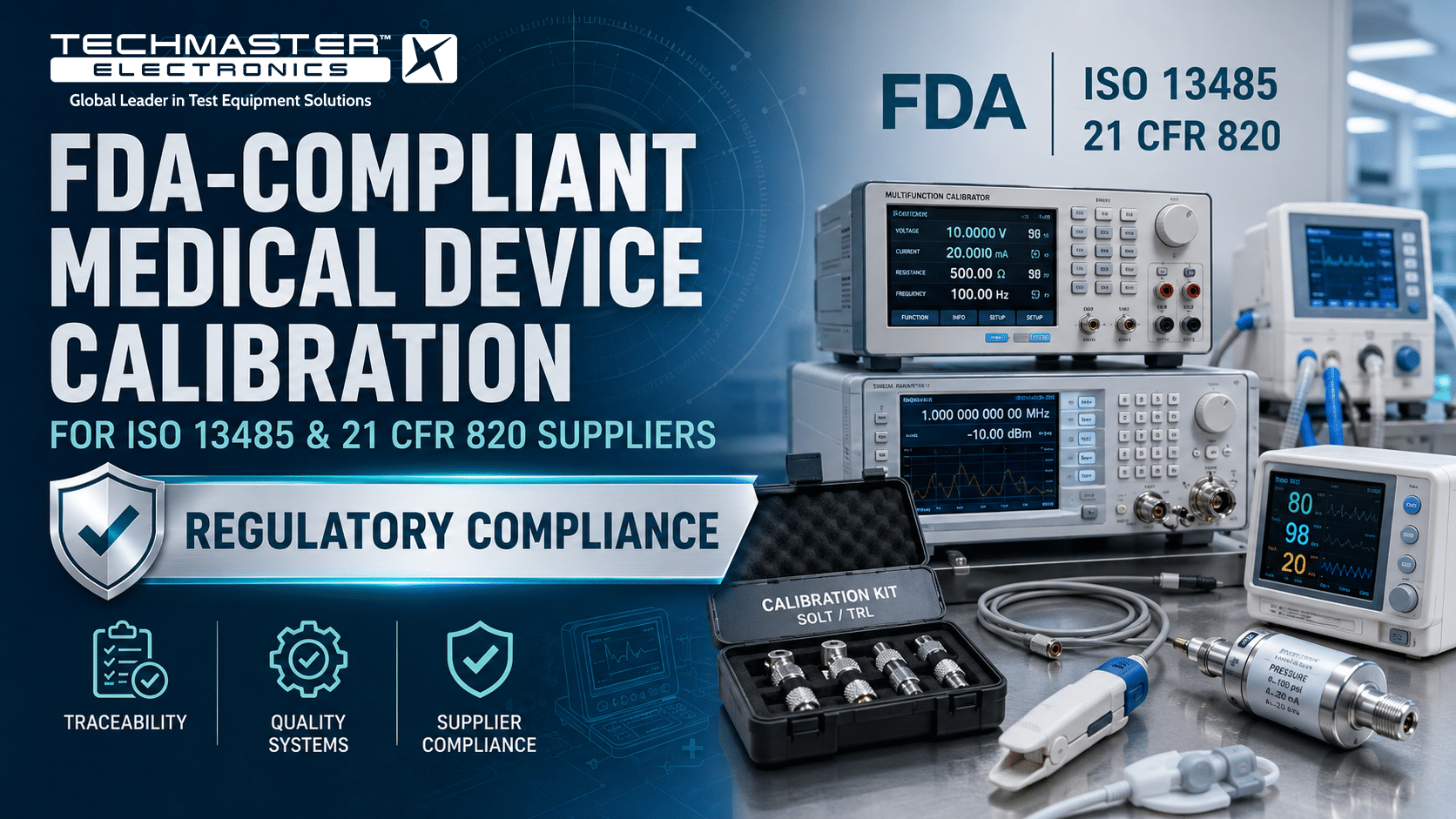
FDA-Compliant Medical Device Calibration: A Buyer’s Checklist for ISO 13485 and 21 CFR 820 Suppliers
TL;DR, Medical device manufacturers, contract manufacturers, and in vitro diagnostic (IVD) companies regulated under FDA 21 CFR 820.72 and ISO 13485:2016 clause 7.6 are required to calibrate measurement and test equipment against standards that are traceable to national or international references. In US practice, that means ISO/IEC 17025 accredited calibration with documented uncertainties. Hospitals and healthcare systems also benefit from NIST-traceable RTLS certification when their location-tracking systems support Joint Commission or CMS compliance.
What does FDA 21 CFR 820 require for measurement equipment calibration?
21 CFR 820.72(b), the Production and Process Controls section of the Quality System Regulation, requires medical device manufacturers to control inspection, measuring, and test equipment so that it is “suitable for its intended purposes and is capable of producing valid results.”
The regulation specifically requires:- Calibration procedures that include specific directions and limits for accuracy and precision
- Provisions for handling, preservation, and storage that protect the equipment from damage
- Calibration that is traceable to national or international standards (or documentation of an in-house standard if no national standard exists)
- Identification of the device’s calibration status
- Documentation of the calibration
Which equipment in a medical device workflow needs accredited calibration?
The answer depends on what role the instrument plays. If it produces a measurement that influences product acceptance, in-process control, design verification, or post-market surveillance, it needs accredited calibration. Typical medical device manufacturing environments include:- Electrical safety analyzers (Fluke ESA612, ESA620, ESA710, Rigel Uni-SiM, BC Group)
- Patient simulators (Fluke ProSim 8, ProSim SPOT Light, Rigel SP-SIM)
- Defibrillator analyzers (Fluke Impulse 7000DP, Rigel Uni-Pulse 400)
- Infusion device analyzers (Fluke IDA-1S, IDA-5)
- Ventilator analyzers (Fluke VT900, VT650, IMT FlowAnalyser PF-300)
- Pulse oximetry analyzers (Fluke ProSim SPOT Light)
- Temperature monitoring and incubator validation systems for cell culture and reagent storage
- Pipettes, balances, and dispensers for IVD reagent preparation
- Pressure transducers, gauges, and manometers for fluid-handling test fixtures
- Multimeters, oscilloscopes, and power supplies for circuit-level acceptance testing
- Environmental chambers for shelf-life and accelerated aging studies
The medical-device calibration buyer’s checklist
Use this seven-point checklist when evaluating a calibration laboratory for your medical device or IVD program.1. ISO/IEC 17025:2017 accreditation verified by accreditor
Verify the certificate number directly on the ANAB or A2LA website. Do not rely on a PDF emailed by the lab.2. Scope coverage for medical-specific parameters
The most common gap is biomedical-specific scope. Many general-purpose calibration labs do not have ESA, defibrillator analyzer, infusion pump analyzer, or ventilator analyzer parameters on their scope. Confirm the lab’s scope PDF lists the specific make, model, or parameter category you need.3. Documented uncertainty and Test Uncertainty Ratio (TUR)
For an FDA-regulated product, you need a defensible decision rule. Most QA programs target a 4:1 TUR or better against the product tolerance. If the lab cannot show CMC uncertainties for your parameter, you cannot calculate TUR.4. Calibration data report, not just a pass/fail certificate
FDA inspectors increasingly ask to see “as-found” and “as-left” measurement data, not just a certificate. Your calibration partner should provide a full data report on every certificate, with reference standard identification.5. Records that survive a 21 CFR 820.180 records review
Calibration records must be readable, retrievable, and retained for the lifetime of the product plus two years. Confirm the lab’s records retention policy and whether their records survive a subpoena-level inspection.6. Pickup, delivery, and on-site calibration capability
Hospital biomedical departments and contract manufacturers often need on-site calibration for fixed equipment (incubators, autoclaves, biosafety cabinets, MRI peripheral systems). Confirm on-site capability and travel terms before signing.7. Demonstrated medical-device experience
Ask for two references from current medical device customers. A lab that has been audited by a notified body (BSI, TÜV SÜD, TÜV Rheinland, DEKRA) alongside a customer has demonstrated audit-readiness in a way an unaudited lab has not.A note on hospitals and healthcare systems: RTLS NIST certification
Beyond device manufacturers, hospital systems using Real-Time Location Systems (RTLS) for asset tracking, hand-hygiene monitoring, patient flow, or temperature monitoring have a related calibration need. When an RTLS supports clinical workflow decisions or compliance reporting, for example, demonstrating to The Joint Commission that hand-hygiene events were captured at a specific point of care, or proving to CMS that pharmaceutical refrigeration was within tolerance during a deviation, the RTLS itself becomes a measurement instrument. The location data needs to be traceable. Techmaster offers Healthcare RTLS NIST Certification, independent third-party validation of an RTLS’s positional and temporal accuracy against NIST-traceable standards. This is a smaller scope than ISO/IEC 17025 calibration but plays the same role: providing documented, defensible evidence that the system is fit for purpose.Three common 21 CFR 820 findings tied to calibration
These are the recurring inspection observations we see in medical device customers’ Form 483 history:- “Calibration records do not document traceability to a national standard.” A certificate references “traceable to NIST” but provides no reference standard identification, no calibration laboratory accreditation, and no measurement uncertainty.
- “Calibration was performed by a laboratory whose accreditation scope does not cover the parameter calibrated.” The lab is ISO/IEC 17025 accredited but for a different parameter range than the one used. Auditors increasingly cross-reference scopes against the certificate.
- “Calibration recall intervals are not documented or justified.” Equipment is assigned a default 12-month interval with no underlying analysis of usage, environment, or stability.
Where Techmaster Electronics fits
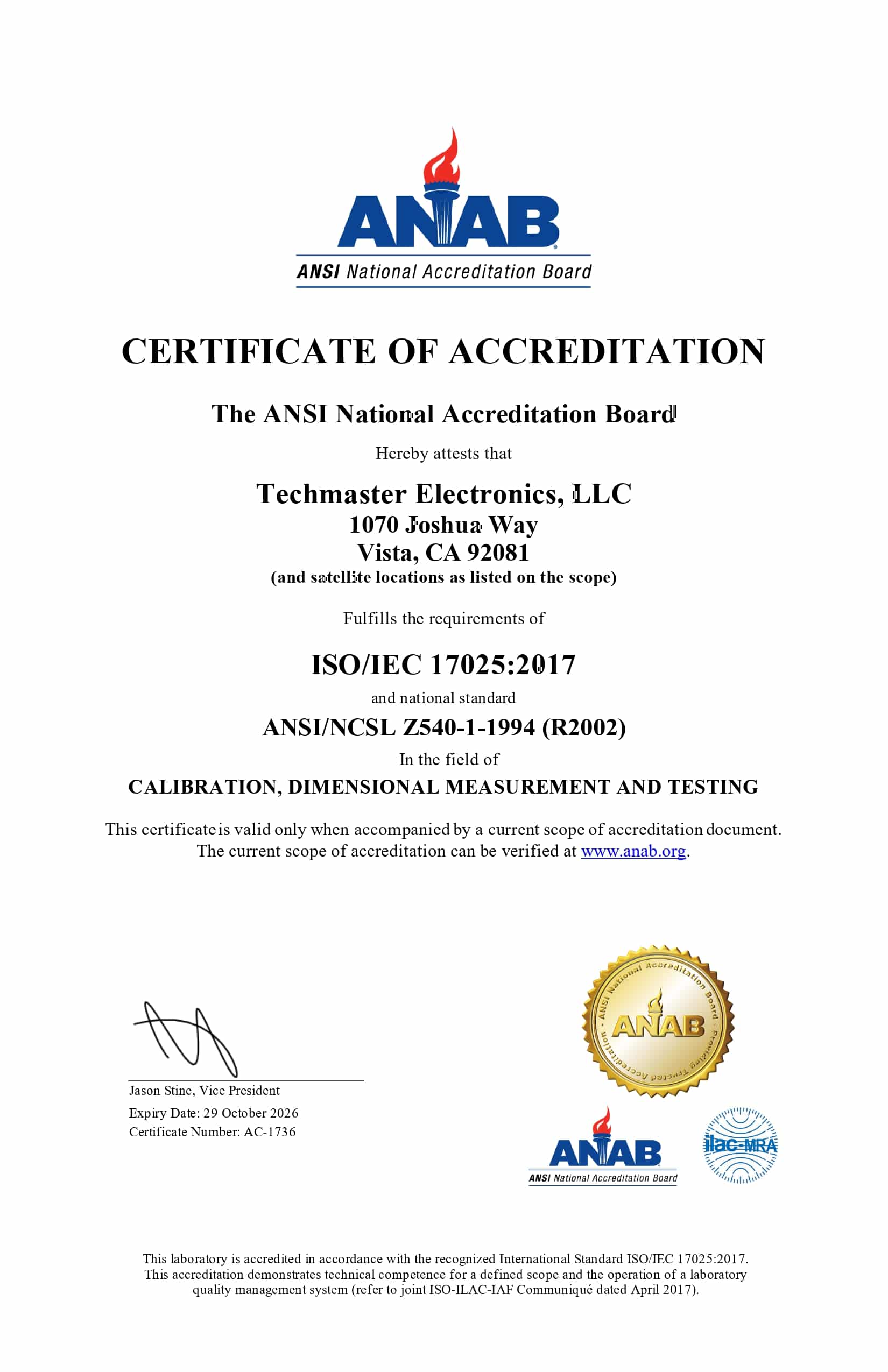
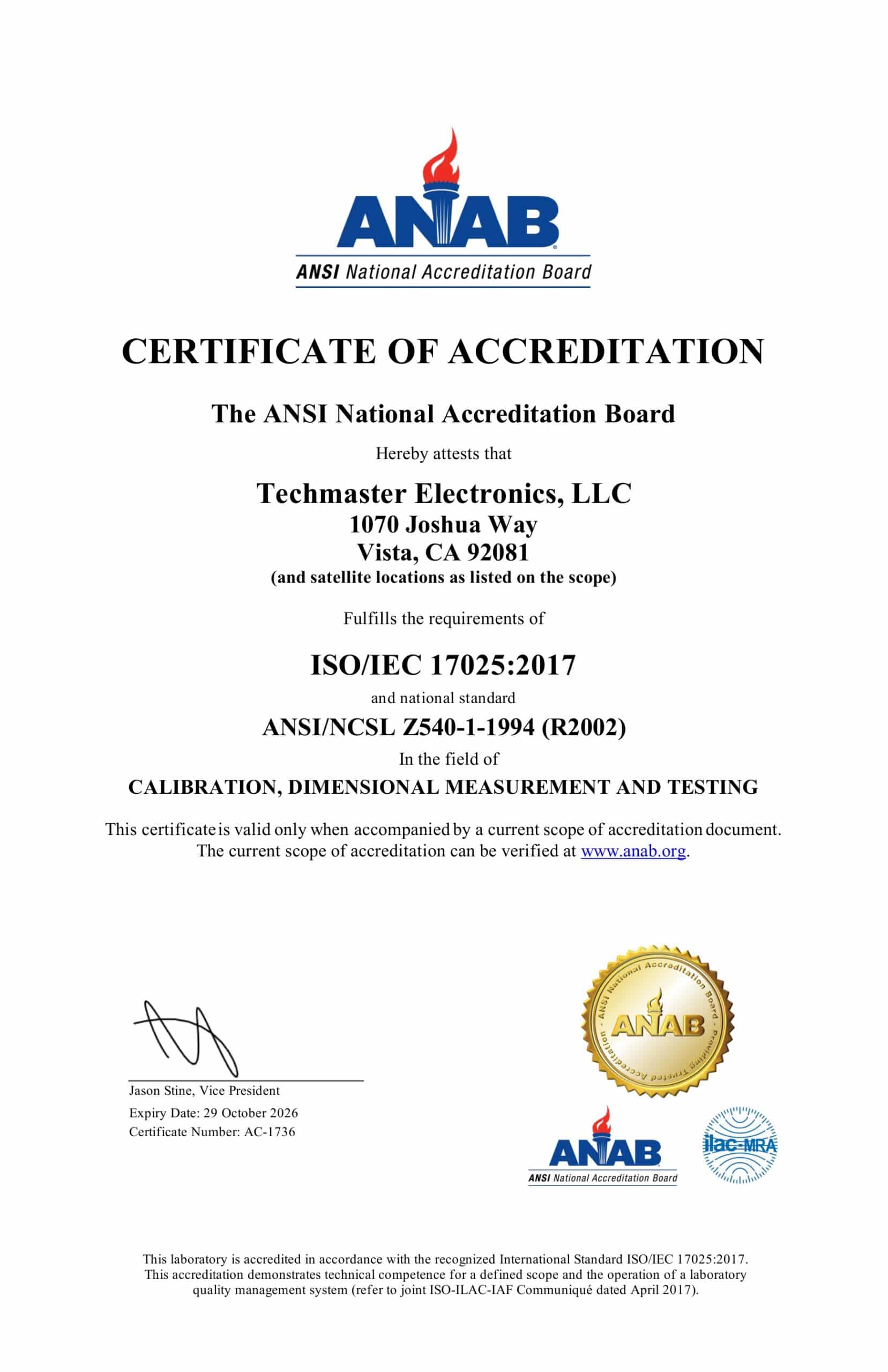
Techmaster Electronics, LLC is an ISO/IEC 17025 accredited calibration laboratory under ANAB certificate AC-1736 (valid through October 2026), with 35+ years of medical-device calibration experience. Our scope covers the biomedical analyzers, electrical safety equipment, and dimensional/thermal/electrical standards medical device customers rely on. We operate five accredited laboratories across the United States, Vista, CA, Santa Clara, CA, Orlando, FL, San Antonio, TX, and Holly Springs, NC, with a corporate office in Henderson, NV. Standard turnaround is 5 business days; expedited 1-2 business day service is available on most biomedical instruments. For hospitals and healthcare systems, our Healthcare RTLS NIST Certification service supports Joint Commission and CMS audit-readiness for location-dependent compliance workflows.Frequently asked questions
What is the difference between FDA 21 CFR 820.72 and ISO 13485 clause 7.6 for calibration?
Both require calibration traceable to national or international standards, documented procedures, and records. ISO 13485:2016 clause 7.6 adds explicit language around software used for measurement validation. In US medical-device practice, complying with one essentially complies with the other.Does Techmaster calibrate Fluke biomedical analyzers?
Yes. Our scope under ANAB AC-1736 covers electrical safety analyzers, defibrillator analyzers, patient simulators, infusion device analyzers, and ventilator analyzers from Fluke, Rigel, BC Group, and other major biomedical instrument manufacturers.Can you calibrate equipment for an IVD manufacturer under 21 CFR 809?
Yes. IVD manufacturers fall under the same 21 CFR 820 quality system regulation as other device makers, with additional 21 CFR 809 labeling and performance characteristics requirements. The calibration substrate is identical.Do you provide on-site calibration for hospital biomedical departments?
Yes. Contact sales@techmaster.us for on-site calibration scheduling. On-site fees may apply depending on travel and equipment volume.How does your Healthcare RTLS NIST Certification differ from a routine calibration?
RTLS NIST Certification validates a deployed real-time location system against NIST-traceable positional and temporal standards in the hospital environment where it operates. It produces evidence the RTLS is accurate for clinical and compliance use, calibration of the underlying transponders alone does not provide that evidence.What is your standard turnaround time?
Five business days from receipt at the calibration laboratory. Expedited 1-2 business day service is available on most biomedical analyzers.Talk to a medical device calibration specialist
If you are a medical device or IVD manufacturer preparing for an FDA inspection or notified body audit, or you are evaluating a new calibration partner after a quality finding, Techmaster’s quality team is available at quality@techmaster.us or +1-866-779-5695.- Request a calibration quote
- Explore medical calibration services
- Healthcare RTLS NIST Certification
- View all 12 calibration disciplines
- Find your closest Techmaster laboratory
Frequently asked questions
What is FDA-Compliant Medical Device Calibration?
FDA-Compliant Medical Device Calibration is the documented comparison of a FDA-Compliant Medical Device against NIST-traceable reference standards under ISO/IEC 17025, measuring its error and measurement uncertainty and confirming it performs within tolerance.
How often should a FDA-Compliant Medical Device be calibrated?
Most quality systems calibrate a FDA-Compliant Medical Device every 12 months, and sooner after repair, overload or heavy use. Follow the manufacturer specification and your ISO 9001/13485/AS9100 program.
What standards apply to FDA-Compliant Medical Device Calibration?
Calibration is performed under ISO/IEC 17025 with NIST-traceable references and the relevant manufacturer specification. Techmaster is ANAB-accredited.
What is included on the certificate?
An ANAB-accredited ISO/IEC 17025 certificate with as-found and as-left results and the measurement uncertainty for each point.
Can you calibrate the FDA-Compliant Medical Device on-site?
Yes. Techmaster offers in-lab calibration with pickup and on-site service across the USA to minimize downtime.
Need FDA-Compliant Medical Device calibration?
ANAB-accredited, NIST-traceable, fast turnaround, in-lab or on-site across the USA.
Contact us for a quoteReferences & industry standards
- ISO/IEC 17025 testing & calibration laboratory requirements
- NIST calibration services and measurement traceability
- A2LA / ANAB accreditation for calibration laboratories
External standards bodies. Techmaster Electronics is an ISO/IEC 17025-accredited, NIST-traceable calibration laboratory.

Khanh Nguyen is the Marketing Manager at Techmaster Electronics, a B2B marketing leader covering the test, measurement, and ISO/IEC 17025 accredited calibration industry across the US and Vietnam markets.