
Metrology guide · ISO/IEC 17025 · ANAB-accredited
RF and Microwave Calibration
RF and Microwave Calibration verifies a RF and Microwave against NIST-traceable standards under ISO/IEC 17025. Techmaster performs a documented multi-point check, reports measurement uncertainty, and issues an ANAB-accredited certificate, in-lab or on-site across the USA.
ANAB accredited ISO/IEC 17025 NIST traceable
ISO 17025Accredited method
NISTTraceability
12 moTypical interval
ANABAccreditation
In this guide
Frequency response at a glance
Typical response: output stays flat across the usable band and rises near resonance, calibration maps the curve and reports the reference value.
How RF and Microwave calibration works
- Intake & visual inspection
- Environmental stabilization
- As-found measurement
- Comparison to NIST-traceable standards
- Adjustment if required
- As-left results & certificate
Your calibration, covered
In-lab calibrationAccredited bench service with pickup
On-site calibrationWe calibrate at your facility
Expedited turnaroundRush options to cut downtime
Accredited certificateANAB ISO 17025 with uncertainty
In-lab vs on-site calibration
In-lab calibration
- Accredited bench with full reference standards
- Best achievable measurement uncertainties
- Pickup & return logistics handled
- Ideal for precision and reference work
On-site calibration
- We calibrate the RF and Microwave at your facility
- No shipping risk or transit downtime
- As-found data captured before any move
- Ideal for fixed, large or sensitive assets
In-depth guide
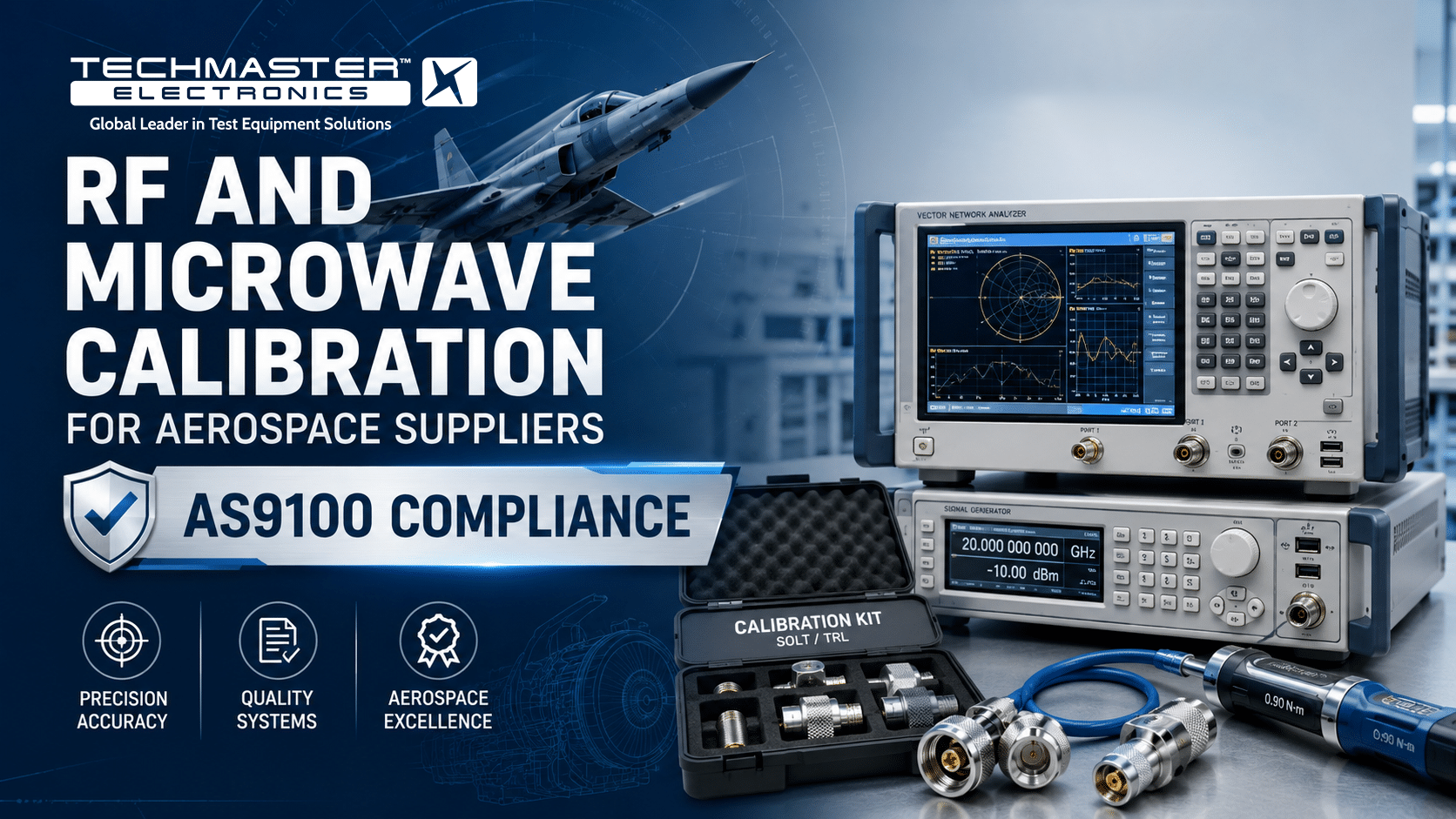
RF and Microwave Calibration for Aerospace Suppliers: AS9100 Compliance and How to Choose the Right Lab
TL;DR, Aerospace component suppliers operating under AS9100 must calibrate their RF and microwave test instruments to ISO/IEC 17025 accredited standards with full NIST traceability and documented measurement uncertainties. A Z540 certificate alone will not satisfy a Boeing, Lockheed, Northrop, or Raytheon supply-chain audit. Choose a laboratory whose ANAB or A2LA scope explicitly covers the frequency and parameter ranges of your specific equipment.
What calibration standards do aerospace component suppliers need?
Aerospace and defense suppliers operating under AS9100D are required to control their inspection, measurement, and test equipment (IM&TE) per clause 7.1.5.2. In practice, every prime contractor, Boeing, Lockheed Martin, Northrop Grumman, Raytheon Technologies, BAE Systems, L3Harris, and Collins Aerospace, interprets that clause as requiring ISO/IEC 17025:2017 accredited calibration with documented uncertainties for any instrument used to accept product.
For RF and microwave test equipment specifically, that means your spectrum analyzers, network analyzers, signal generators, power meters, frequency counters, and noise figure analyzers must be calibrated by a laboratory whose ISO/IEC 17025 scope covers the frequency range, parameter type, and uncertainty level your test plan demands. A “traceable” calibration certificate is not enough. A Z540.3 calibration is not enough on its own. Your auditor will ask three specific questions:- Is the calibration laboratory ISO/IEC 17025 accredited by ANAB, A2LA, or an ILAC MRA signatory?
- Does the scope of accreditation explicitly cover the parameter and range used to calibrate this instrument?
- Are the measurement uncertainties reported on the certificate small enough to support a valid Test Uncertainty Ratio (TUR) for your tolerance?
Why Z540 alone is not sufficient for AS9100
ANSI/NCSL Z540.3 is an excellent calibration management standard, and many primes still reference it in supplier quality documents. But Z540.3 is a handling and reporting standard, not an accreditation. The laboratory itself still needs to be technically competent, and the way the industry demonstrates competence is ISO/IEC 17025. Practical rule of thumb most aerospace QA managers use:| Calibration level | Use case | AS9100 supply-chain risk |
|---|---|---|
| Traceable (cert only) | Internal floor-level checks of non-critical equipment | High, typically rejected at audit |
| Z540.3 (cert + data report) | Internal calibration programs at primes themselves | Medium, acceptable only if performed by an accredited lab |
| ISO/IEC 17025 (cert + data + uncertainty report) | Acceptance, inspection, and validation equipment | Low, the expected standard |
Which RF and microwave instruments need ISO/IEC 17025 calibration in an aerospace workflow?
If you build, test, or accept any of the following, the upstream RF/microwave test equipment generally requires accredited calibration:- RF assemblies and modules, power amplifiers, low-noise amplifiers, filters, mixers, oscillators
- Antennas and antenna arrays, including beam-steering and phased-array assemblies for radar and SATCOM
- Communications systems, VHF/UHF, HF, SATCOM transceivers, IFF transponders, datalinks
- Radar systems, pulse, FMCW, MTI, AESA hardware
- Electronic warfare components, jammers, ESM/ELINT receivers, RWR
- Test fixtures and load boards that interface with the above
- Spectrum analyzers (Keysight N9020A/B, N9030B, Rohde & Schwarz FSW, Anritsu MS2840A)
- Vector network analyzers (Keysight PNA, FieldFox, Anritsu VectorStar)
- Signal generators (Keysight N5181B, N5183B, Rohde & Schwarz SMW200A)
- Power meters and sensors (Keysight U2000 series, N1911A, Anritsu ML2438A)
- Frequency counters (Keysight 53230A, 53220A, Pendulum CNT-91)
- Noise figure analyzers (Keysight N8973B, NFA series)
How to evaluate an aerospace calibration laboratory in the United States
Use this six-point checklist before sending an RFQ. Anything that fails any single point is not a viable supplier.1. ANAB or A2LA ISO/IEC 17025:2017 accreditation, verify the certificate number
Look up the laboratory in the public ANAB directory at anab.ansi.org or A2LA at a2la.org. Do not accept a PDF emailed from the lab, verify against the issuing body’s database. The certificate number, expiration date, and scope file should match exactly.2. Scope coverage for your frequency and parameter range
This is where most suppliers get caught. A lab can be ISO/IEC 17025 accredited and still not be on scope for the parameter you need. Pull the lab’s scope PDF and confirm that:- Your frequency range is inside theirs (a 50 GHz spectrum analyzer cannot be calibrated by a lab whose scope ends at 26.5 GHz)
- The parameter is listed, gain, return loss, noise figure, phase noise, harmonic distortion, EVM, and not just “spectrum analyzer general”
- The Calibration and Measurement Capability (CMC) uncertainty is small enough that your TUR is at least 4:1, ideally 10:1, against your tolerance
3. NIST traceability with unbroken chain of comparisons
Every measurement should be traceable to a national metrology institute (NIST in the United States, NPL in the UK, PTB in Germany). The certificate should list the reference standard’s identification and the laboratory’s own ISO/IEC 17025 cert number.4. Turnaround time and logistics that fit your production schedule
Standard turnaround for RF/microwave calibration is 5 business days. Expedited service should be available at 1-2 business days for the rare unplanned recall. Free pickup and delivery in your region is a strong indicator of an actual logistics operation.5. Multi-site coverage if you have multiple plants
If you have facilities in California, Texas, Florida, and the Mid-Atlantic, a single-site lab will create logistics drag. Suppliers with multiple ISO/IEC 17025 laboratories in the United States can reduce shipping time and currency exposure.6. Counterfeit-mitigation and data security
For ITAR-controlled programs, your calibration partner needs to be a US entity, with documented chain-of-custody and a defensible data-security posture. Ask for their ITAR registration and cybersecurity program documentation before sending anything classified or controlled.Where Techmaster Electronics fits
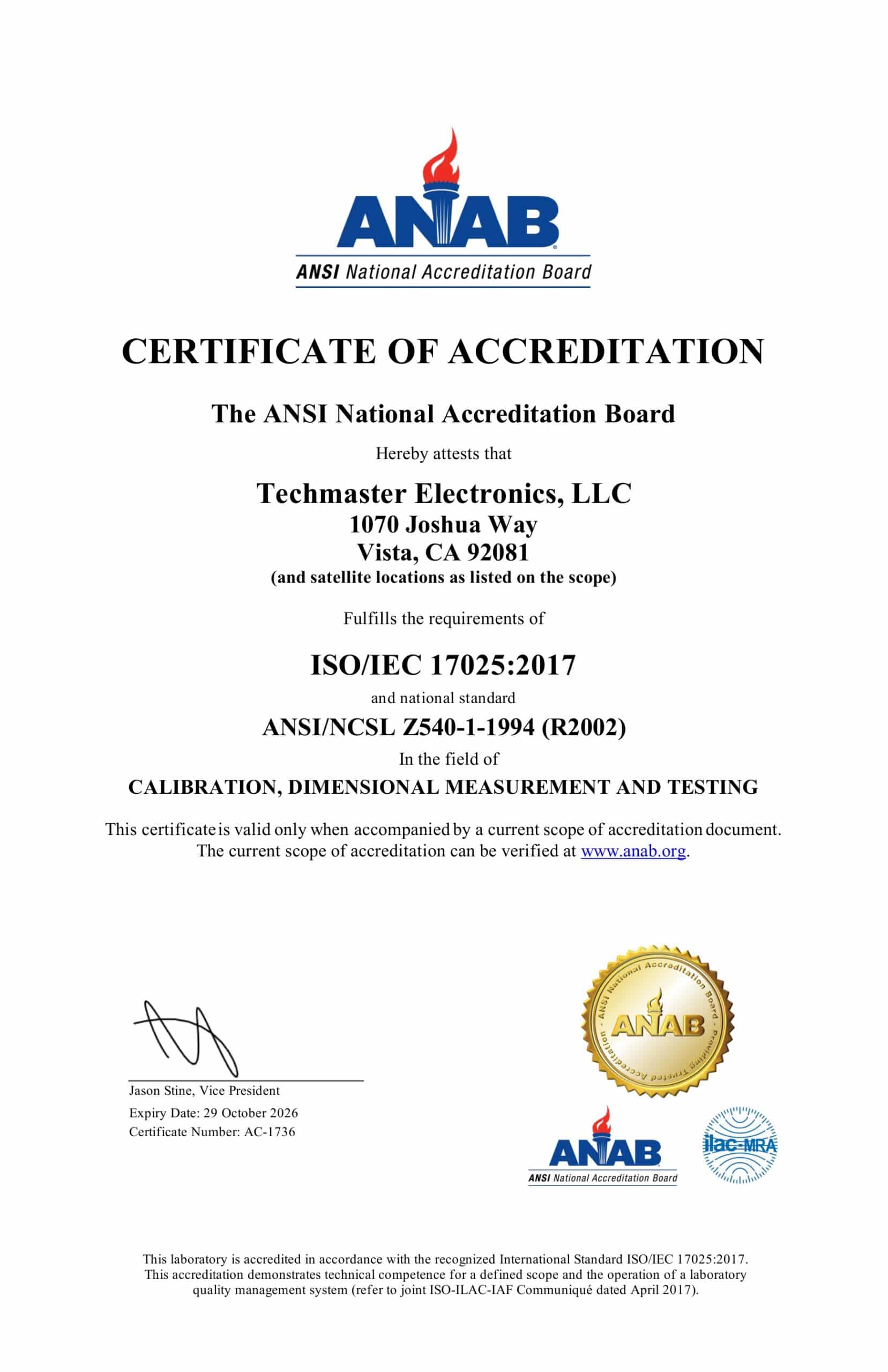
Techmaster Electronics, LLC has operated an ISO/IEC 17025 accredited calibration laboratory in the United States since 1989, accredited by ANAB under certificate AC-1736 (valid through October 2026). Our scope covers RF and microwave parameters across the disciplines aerospace suppliers most often need: gain, attenuation, S-parameters, frequency, power, noise, phase noise, and harmonic distortion. We operate five laboratories (four ISO/IEC 17025 accredited) in the United States, Vista, California (corporate headquarters), Santa Clara, California, Orlando, Florida, San Antonio, Texas, and Holly Springs, North Carolina, with a corporate office in Henderson, Nevada. Aerospace customers in the Southern California aerospace corridor, the Bay Area, Florida’s Space Coast, the Texas defense cluster, and the Research Triangle have local pickup options. Standard turnaround is 5 business days. Expedited 1-2 business day service is available for production-line recalls.Three common AS9100 supplier-quality findings tied to calibration
These are the calibration-related findings we see most often when new customers move to Techmaster from a non-accredited provider:- “Calibration laboratory’s scope does not cover the parameter calibrated.” The lab is ISO/IEC 17025 accredited, but the supplier’s spectrum analyzer was calibrated to 40 GHz using a reference standard whose scope ends at 26.5 GHz. The certificate is technically invalid.
- “TUR not documented or insufficient.” The customer’s tolerance and the lab’s measurement uncertainty are not compared on the work order, or the resulting TUR is less than 4:1 and no risk-based decision rule is recorded.
- “Calibration recall interval not based on documented usage and stability data.” Equipment is on a default 12-month interval with no underlying analysis. AS9100 expects evidence-based intervals.
Frequently asked questions
Does ISO/IEC 17025 calibration cost more than Z540?
In our pricing, the difference between Z540.3 and ISO/IEC 17025 calibration on the same instrument is typically 10-15 percent. The cost of one Major audit finding is substantially more than the lifetime cost difference across your entire fleet.Can you calibrate equipment used on ITAR-controlled programs?
Yes. Techmaster is a US entity with US laboratories. Our calibration data and chain-of-custody documentation are maintained in the United States.What is the difference between AS9100 and ISO 9001 for calibration purposes?
AS9100 inherits all of ISO 9001’s IM&TE control requirements and adds aerospace-specific expectations around configuration management, special process validation, and counterfeit-parts prevention. For calibration specifically, the practical difference is the prime contractors’ expectation of ISO/IEC 17025 accredited calibration with full uncertainty reporting.How often should aerospace RF and microwave equipment be calibrated?
The default interval is 12 months, but AS9100 expects intervals to be based on documented usage, drift history, and stability data. A spectrum analyzer used daily in production may justify a 6-month interval; one used quarterly for incoming inspection may justify 18 months.Do you offer free pickup and delivery?
We offer free local pickup and delivery in Silicon Valley, Southern California, and Orlando, Florida. Contact your account manager at sales@techmaster.us for availability in other regions.What is your standard turnaround time?
Five business days from receipt at the calibration laboratory. Expedited 1-2 business day service is available for many instrument types, contact sales@techmaster.us to confirm availability for your specific model.Talk to an aerospace calibration specialist
If you are an aerospace component supplier preparing for an AS9100 surveillance audit, or you are reviewing your current calibration provider after a supplier-quality finding, Techmaster’s quality team is available at quality@techmaster.us or +1-866-779-5695.- Request a calibration quote
- Explore RF and microwave calibration services
- View all 12 calibration disciplines
- Find your closest Techmaster laboratory
Frequently asked questions
What is RF and Microwave Calibration?
RF and Microwave Calibration is the documented comparison of a RF and Microwave against NIST-traceable reference standards under ISO/IEC 17025, measuring its error and measurement uncertainty and confirming it performs within tolerance.
How often should a RF and Microwave be calibrated?
Most quality systems calibrate a RF and Microwave every 12 months, and sooner after repair, overload or heavy use. Follow the manufacturer specification and your ISO 9001/13485/AS9100 program.
What standards apply to RF and Microwave Calibration?
Calibration is performed under ISO/IEC 17025 with NIST-traceable references and the relevant manufacturer specification. Techmaster is ANAB-accredited.
What is included on the certificate?
An ANAB-accredited ISO/IEC 17025 certificate with as-found and as-left results and the measurement uncertainty for each point.
Can you calibrate the RF and Microwave on-site?
Yes. Techmaster offers in-lab calibration with pickup and on-site service across the USA to minimize downtime.
Need RF and Microwave calibration?
ANAB-accredited, NIST-traceable, fast turnaround, in-lab or on-site across the USA.
Contact us for a quote
Khanh Nguyen is the Marketing Manager at Techmaster Electronics, a B2B marketing leader covering the test, measurement, and ISO/IEC 17025 accredited calibration industry across the US and Vietnam markets.