
Quick answer: As-found calibration data is the condition of your instrument on arrival, before any adjustment; as-left data is its condition after the lab adjusts and re-verifies it. As-found data drives your risk and recall decisions; as-left data confirms the instrument is fit to return to service. ISO/IEC 17025 requires both be reported whenever an adjustment is made.
What is the difference between as-found and as-left calibration data?
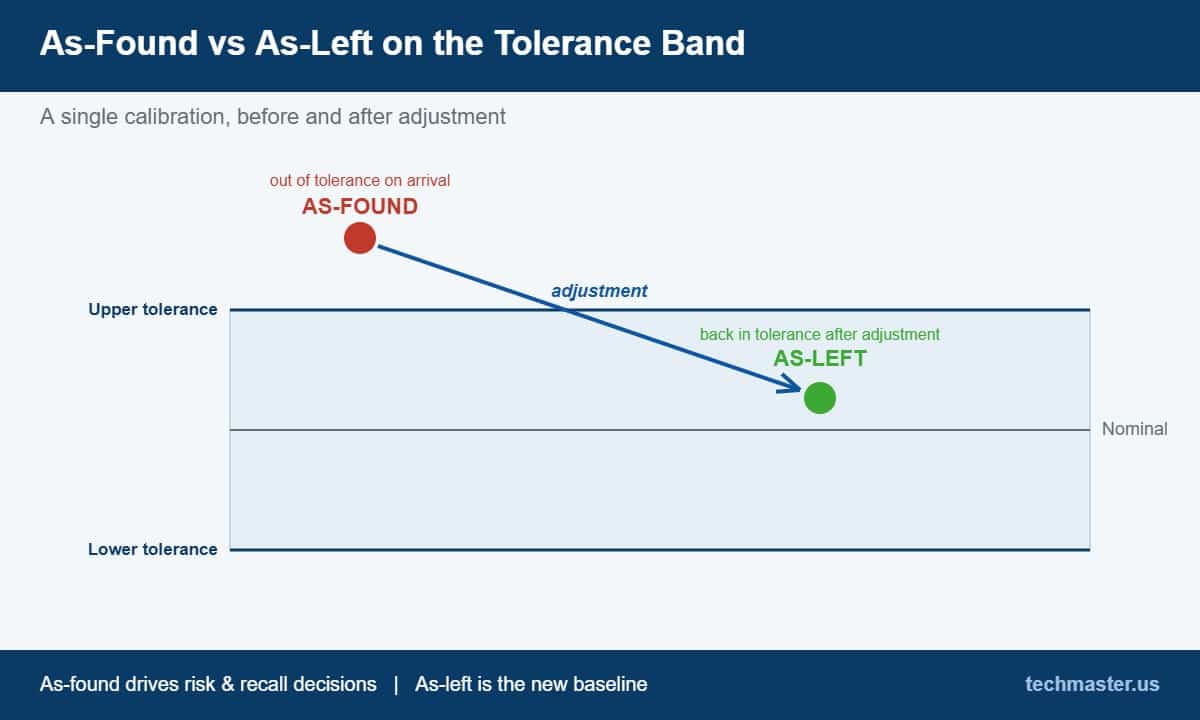
Every accredited calibration is, at its core, a controlled comparison. The lab measures your unit under test against a reference standard of known, traceable uncertainty and records the deviation. When that deviation exceeds the applicable tolerance, the technician may adjust the instrument, and this is exactly where the two data sets diverge.
The as-found reading is a snapshot of reality: it is the only evidence you will ever have of how the instrument was actually behaving while it was in your production or test environment during the interval that just ended. The as-left reading is a forward-looking statement: it certifies the condition in which the instrument is being returned to you, and it becomes the baseline against which the next interval’s drift will be measured.
| Attribute | As-found | As-left |
|---|---|---|
| When it is measured | On receipt, before any adjustment | After adjustment / repair, before return |
| What it tells you | How the instrument behaved during the interval just completed | The condition the instrument is returned in |
| Primary decision it drives | Retrospective risk: were past measurements valid? | Prospective fitness: is it safe to return to service? |
| Who relies on it most | Quality manager, auditor, recall owner | Instrument user, next calibration cycle |
| If no adjustment was made | As-found equals as-left; certificate states “no adjustment required” | |
Why does as-found data matter more than as-left for your quality system?
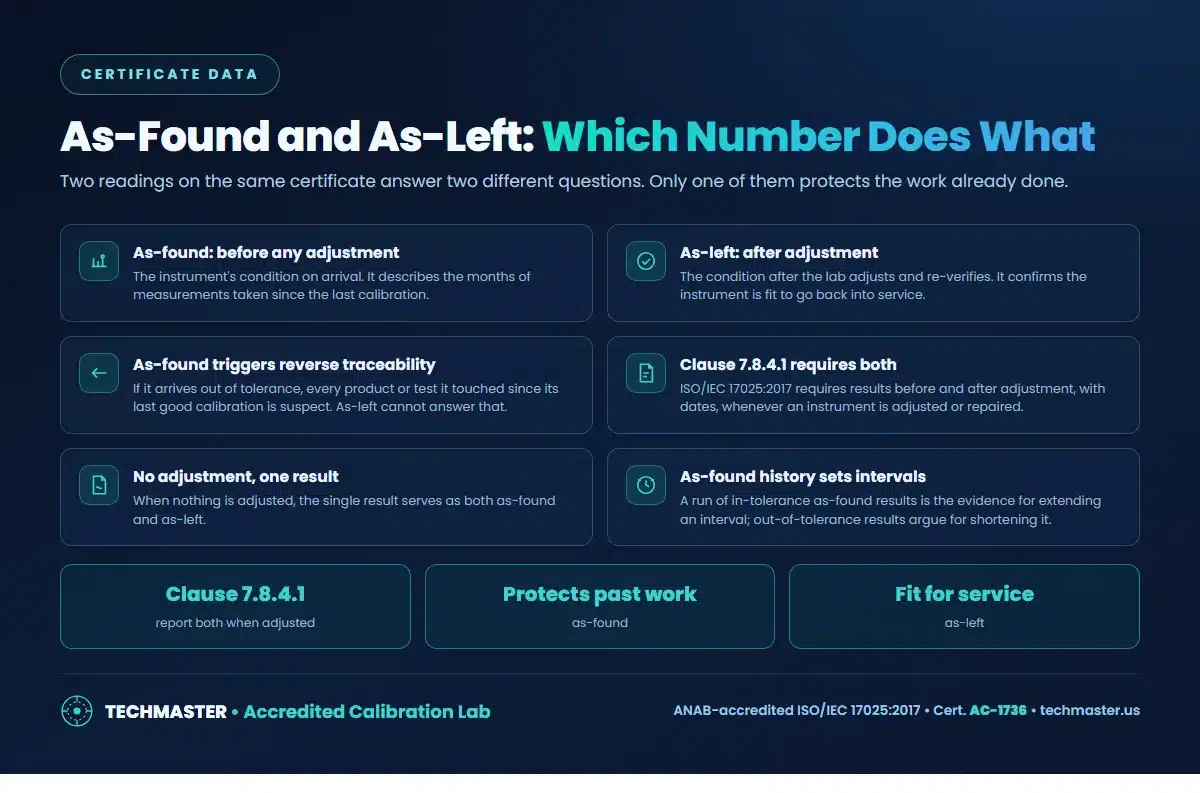
Many quality teams file calibration certificates without reading the as-found column, then discover during an audit that an instrument had been drifting out of tolerance for months. That is a preventable failure. A confirmed out-of-tolerance as-found condition means one thing: measurements made with that instrument during the prior interval may be invalid, and you must decide whether the affected product or data can still be accepted.
This is why as-found data is the starting point of any calibration recall and reverse-traceability impact analysis. The magnitude of the as-found deviation, combined with the tolerance of the parts or tests it verified, determines whether you have a documentation note or a full-blown containment event. As A2LA notes in its guidance on common calibration certificate findings, the before/after relationship is precisely what lets you understand “how things were previously, and where they are at the end of the process.”
As-left data, by contrast, is comparatively low-risk. It confirms the lab did its job and gives you a clean baseline. It rarely surprises anyone. The as-found column is where the money, the risk, and the audit exposure live, and it is the number your calibration provider should surface most clearly.
What does ISO/IEC 17025 require for as-found and as-left reporting?
The requirement lives in Section 7.8, “Reporting of results.” Clause 7.8.4.1(d) specifically addresses the before-and-after case: where an instrument has been adjusted or repaired, the calibration results before and after must both be reported. This is not optional boilerplate, it is one of the most frequently cited certificate non-conformances that assessors find in the field.
Techmaster Electronics has issued calibration certificates under ISO/IEC 17025 continuously since it built its accredited program, the company was founded in 1989 and holds ANAB accreditation under Certificate AC-1736 across its Vista CA, Santa Clara CA, Orlando FL, and San Antonio TX laboratories. Every certificate that involves an adjustment carries distinct as-found and as-left records, because that separation is what makes the certificate defensible in an audit and useful for your reverse-traceability decisions.
For the broader interpretive framework, how decision rules, uncertainty, and statements of conformity interact with these results, the ILAC Guidance (G-Series) documents, particularly G8 on decision rules, are the authoritative international reference. If you are unsure how to read the numbers on your own certificates, our quality manager’s guide to reading an ISO/IEC 17025 calibration certificate walks through each required field.
How should you act on an as-found out-of-tolerance result?
The size of the as-found deviation relative to what the instrument was used to accept is what separates a paperwork note from a containment event. A gauge that reads 0.2 % high when it only ever verified parts with a 5 % tolerance is a very different problem from the same gauge verifying parts with a 0.25 % tolerance. The decision matrix below is the workflow Techmaster recommends to quality managers reviewing an out-of-tolerance return.
| As-found condition | Risk signal | Recommended action |
|---|---|---|
| In tolerance, near-nominal | Low | Accept; log drift trend for interval analysis |
| In tolerance, drifting toward limit | Watch | Accept; flag for possible interval shortening |
| Out of tolerance, deviation < 25% of product tolerance | Moderate | Document impact assessment; likely accept-as-is with justification |
| Out of tolerance, deviation comparable to product tolerance | High | Reverse-traceability recall; quarantine and re-evaluate affected lots |
| Grossly out of tolerance or non-functional on arrival | Critical | Formal nonconformance; full impact analysis, notify affected customers |
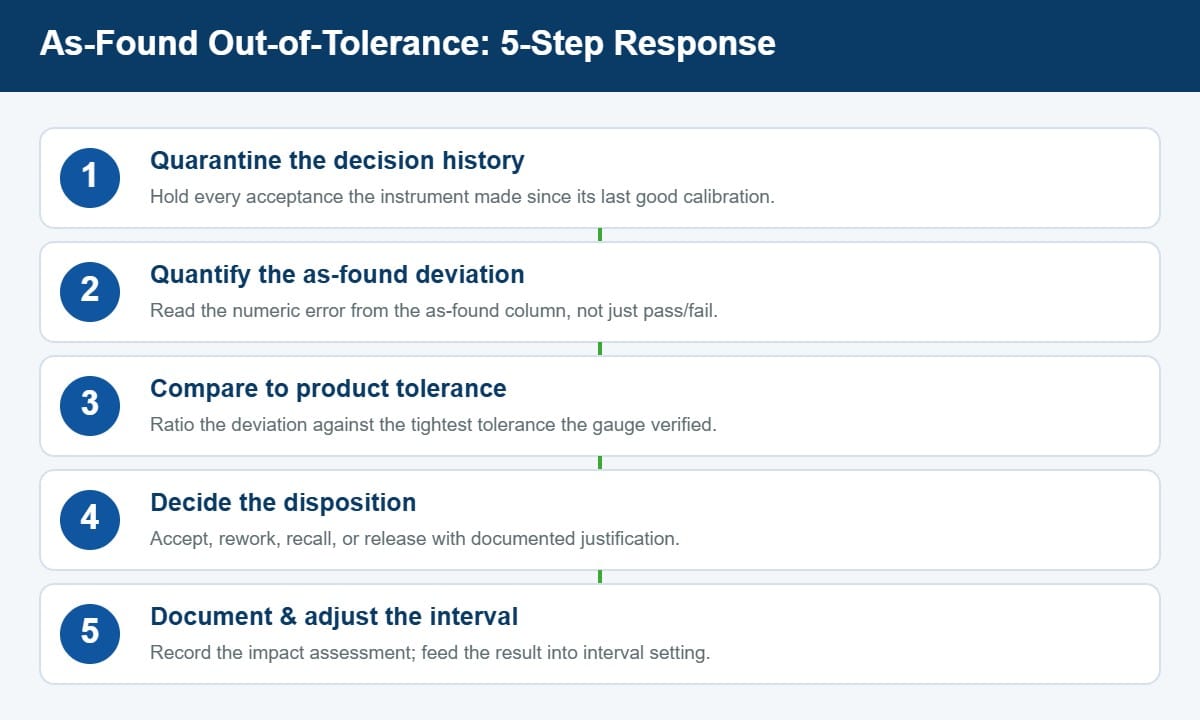
The deviation-to-tolerance comparison here is a close cousin of the test uncertainty ratio and decision-rule logic used inside the calibration itself. For the full end-to-end containment procedure, see our detailed walkthrough of what to do when calibration results come back out of tolerance.
How do as-found records drive your calibration interval decisions?
Calibration intervals should not be set by tradition or by the number on the sticker. They should be driven by evidence, and the evidence is your accumulated as-found record. Each time an instrument returns in tolerance, that is a data point supporting the current or a longer interval. Each out-of-tolerance arrival is a data point demanding a shorter one. Over a fleet, these as-found outcomes form the reliability curve that governs how often calibration is genuinely needed.
This is the approach codified in ILAC G24 on determining recalibration intervals and in NIST’s guidance on metrological traceability: the interval is a controlled variable, adjusted using measured reliability, not a fixed rule. Techmaster’s ten-year internal dataset of 381,916 calibrations across 4,913 manufacturers is exactly this kind of as-found history at scale, it is what lets an accredited lab advise a customer that a given instrument class is a candidate for a longer interval, or a repeat offender that needs a shorter one. Our reliability-based guide to setting and adjusting calibration intervals shows how to turn your own as-found records into interval decisions.
The practical takeaway: as-found data is not a compliance artifact you file and forget. It is a live signal that, read correctly, lowers your calibration cost on stable instruments and raises your protection on unstable ones. Explore the full range of accredited services on our calibration services hub, or review our ANAB accreditation and scope.
Key takeaways
- As-found = arrival condition; as-left = return condition. If nothing was adjusted, the certificate should say so and the two are equal.
- As-found data carries the risk. It is the only evidence of how your instrument behaved during the interval that just ended, and the trigger for reverse traceability.
- ISO/IEC 17025 clause 7.8.4.1 requires both before-and-after results, with dates, whenever an adjustment or repair is performed.
- Judge an out-of-tolerance as-found result by ratio, comparing the deviation to the tightest tolerance the instrument verified, not by the fact of failure alone.
- Feed as-found history into interval decisions. Consistent in-tolerance arrivals justify longer intervals; repeated failures demand shorter ones.
As-found / as-left calibration data FAQ
Does a calibration certificate always show both as-found and as-left data?
Only when an adjustment or repair is performed. If the instrument arrives in tolerance and nothing is changed, ISO/IEC 17025 treats the single reported result as both the as-found and as-left condition, and the certificate should state that no adjustment was required.
What does it mean if as-found and as-left values are identical?
Identical values mean the instrument was not adjusted, it either arrived in tolerance or the lab chose not to adjust it. This is the most common and lowest-risk outcome. The single result documents that the instrument held its calibration across the full interval.
My instrument arrived out of tolerance. Are my past measurements automatically invalid?
Not automatically. An out-of-tolerance as-found reading makes prior measurements suspect, not void. You must compare the deviation to the tolerance of the parts or tests the instrument verified. If the deviation is small relative to that tolerance, a documented impact assessment may support accepting the affected work.
Who is responsible for acting on as-found data, the lab or the customer?
The lab reports the as-found result accurately and, if accredited, applies the agreed decision rule. Acting on it, deciding whether a recall or impact analysis is needed, is the customer’s responsibility, because only the customer knows what the instrument was used to accept.
Can as-found data be used to extend a calibration interval?
Yes. A consistent history of in-tolerance as-found results is the primary justification for extending an interval under a reliability-based program, as described in ILAC G24. A single interval extension should never rest on one result, it should reflect a trend across the instrument or its class.
Is “as-received” the same as “as-found”?
In practice, yes, “as-received” and “as-found” both describe the instrument’s condition on arrival before adjustment. Some labs use “as-received” to emphasize physical/visual receipt condition, but for calibration data the terms are used interchangeably.
Need calibration certificates that make as-found data audit-ready?
Techmaster Electronics reports clear as-found and as-left results on every accredited certificate, under ANAB Certificate AC-1736, from four US laboratories. Founded 1989.
Request a Calibration Quote
Related reading: thermocouple calibration methods and Type K drift
Related reading: Calibration vs Gage R&R (MSA): what’s the difference and do you need both?
Related reading: accelerometer calibration by back-to-back comparison (ISO 16063-21)
Related reading: why as-found data matters on a tensile tester force verification certificate
Related reading: How to run intermediate checks between calibrations under ISO/IEC 17025 clause 6.4.10

Khanh Nguyen is the Marketing Manager at Techmaster Electronics, a B2B marketing leader covering the test, measurement, and ISO/IEC 17025 accredited calibration industry across the US and Vietnam markets.