
What does an infusion pump analyzer actually measure?
Every large-volume pump, syringe pump, and PCA device in a hospital fleet is periodically connected to an analyzer such as a Fluke Biomedical IDA-series, Rigel Multi-Flo, or Datrend Infutest unit. The analyzer draws the pump output through a measurement channel and reports whether the pump is delivering what its front panel claims — including the low flow rates (1–5 mL/h) where drug-delivery errors are most dangerous for neonatal and critical-care patients.
The performance framework comes from IEC 60601-2-24, the particular standard for infusion pumps and controllers, which defines how flow accuracy is characterized — including the familiar start-up and trumpet-curve analysis of flow error over defined observation windows — and how occlusion alarm behavior must perform.
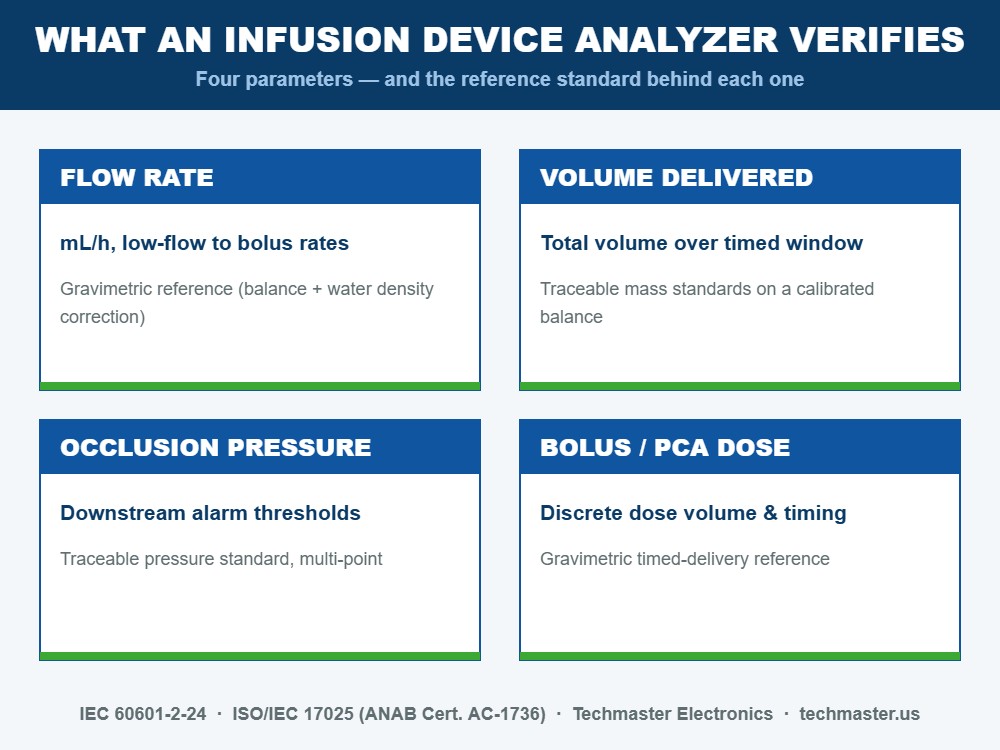
| Analyzer channel | What it checks on the pump | Reference used to calibrate the channel |
|---|---|---|
| Flow rate | Continuous delivery accuracy, typically 0.1–1,000 mL/h | Gravimetric flow reference: calibrated balance, distilled water, density correction |
| Volume | Total volume over a timed window | Traceable mass standards on a calibrated analytical balance |
| Occlusion pressure | Downstream alarm thresholds | Traceable pressure standard at multiple points across the range |
| Bolus / PCA dose | Discrete dose volume and lock-out timing | Gravimetric timed-delivery measurement plus timebase check |
Why does the analyzer itself need accredited calibration?
The FDA’s infusion pump program exists because pump failures cause real patient harm: over-infusion, under-infusion, and missed therapy have been reported across all pump types and manufacturers. Facility-level verification with a properly calibrated analyzer is one of the risk-reduction strategies the FDA describes for infusion pumps. An analyzer with an expired or non-traceable calibration undermines that entire control.
There is also an audit dimension. Joint Commission surveyors and internal quality auditors routinely sample biomedical test equipment records. A calibration certificate from an ANAB-accredited ISO/IEC 17025 laboratory — with uncertainties, as-found/as-left data, and the accreditation symbol — closes the question immediately. A non-accredited “calibrated to manufacturer specs” sticker usually does not. The same logic applies to the rest of the biomed bench: see our guides to ESU analyzer calibration under ISO/IEC 17025 and defibrillator analyzer calibration.
How is an infusion pump analyzer calibrated?
The gravimetric method is the anchor. Water is drawn through the analyzer channel at a controlled rate, collected, and weighed at timed intervals; mass is converted to volume using water density at the measured temperature (about 0.9982 g/mL at 20 °C), with corrections for evaporation and buoyancy at the lowest flows. It is the same first-principles approach used in ISO 8655 gravimetric pipette calibration — mass and time are simply the most defensible route to liquid flow.
Pressure channels are compared against a calibrated reference across the occlusion alarm range at multiple ascending points — the same discipline choice we describe in deadweight testers vs digital pressure calibrators. Finally, because bolus, PCA lock-out, and flow calculations all depend on the analyzer’s internal clock, the timebase is verified against a traceable frequency reference.
A typical accredited procedure at Techmaster runs each flow channel at low, mid, and high rates, verifies volume totalization, sweeps the pressure channel, and documents everything with per-point measurement uncertainty. Where a channel is out of tolerance, we record the as-found condition before adjustment — that data is what lets your quality team run a reverse-traceability impact review on pumps tested since the last calibration.
What accuracy and TUR should you expect?
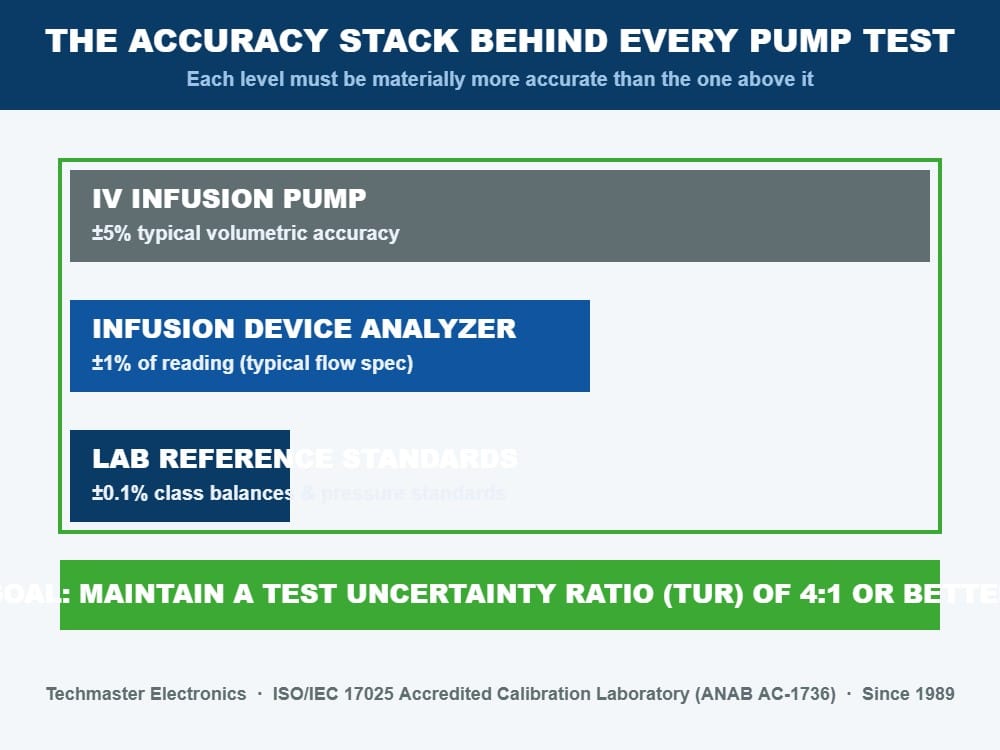
| Level | Typical accuracy | Role |
|---|---|---|
| IV infusion pump | ±5% (large-volume), ±2–3% (syringe) | Device under test in the hospital |
| Infusion device analyzer | ±1% of reading (typical flow spec) | Working standard on the biomed bench |
| Laboratory references | ±0.1% class (balance, pressure standard) | Accredited calibration of the analyzer |
When the analyzer’s specification is tight relative to the pump tolerance, pass/fail decisions stay clean. When it is not — or when the calibration certificate reports uncertainty but your procedure ignores it — false accepts become possible. Our guide to test uncertainty ratios and decision rules explains how to apply guard bands when the ratio slips below 4:1.
How often should you calibrate an infusion pump analyzer?
Interval setting should be evidence-based rather than habit-based: consecutive in-tolerance results can justify keeping 12 months, while any out-of-tolerance event argues for tightening. We cover the methodology — including ILAC-G24 interval-adjustment logic — in how to set calibration intervals. Since 1989, across the 381,916 calibrations in Techmaster’s 10-year service dataset, biomedical test equipment has been among the categories where annual intervals with documented as-found data consistently satisfy auditors.
What should the calibration certificate include?
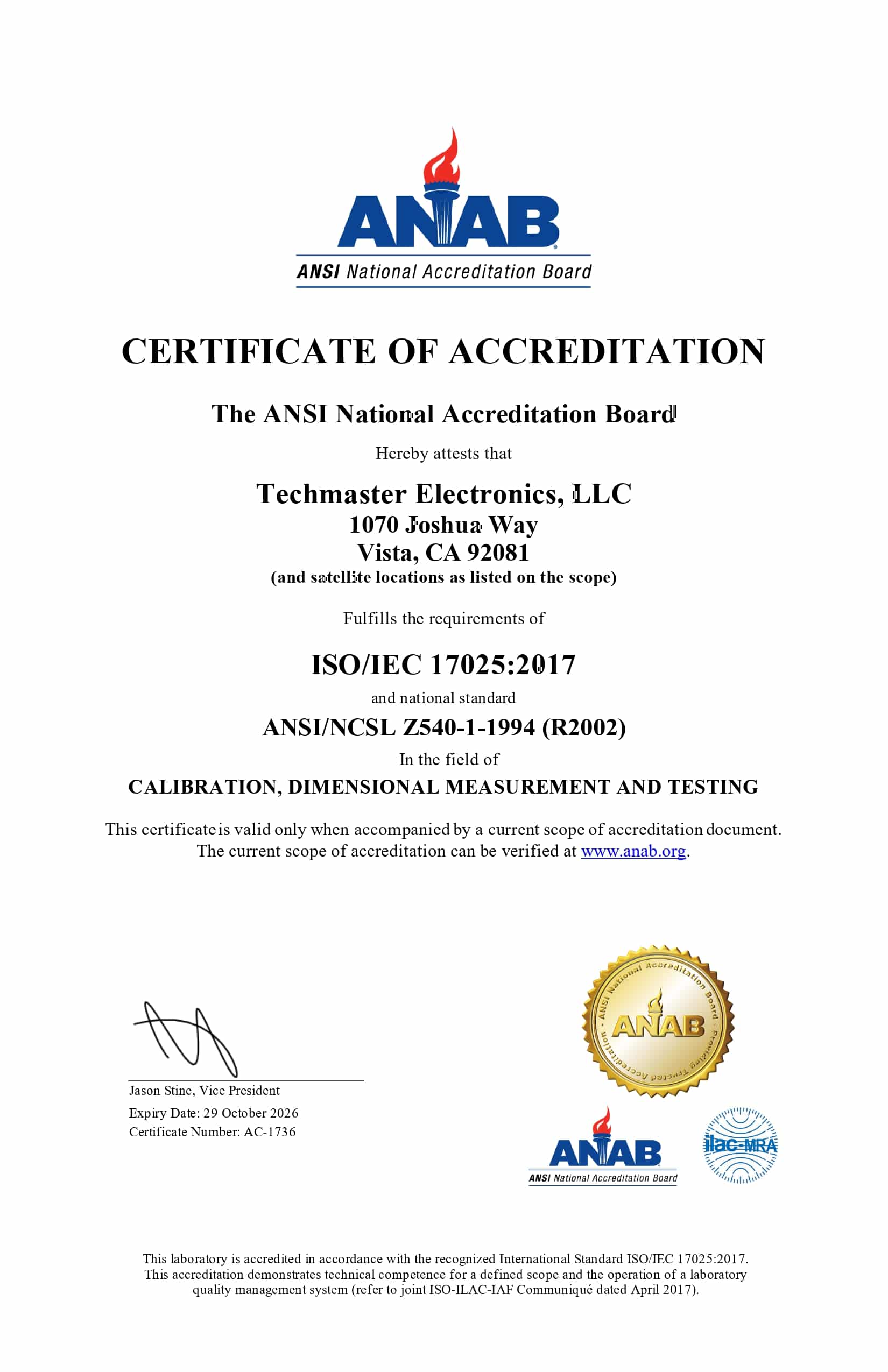
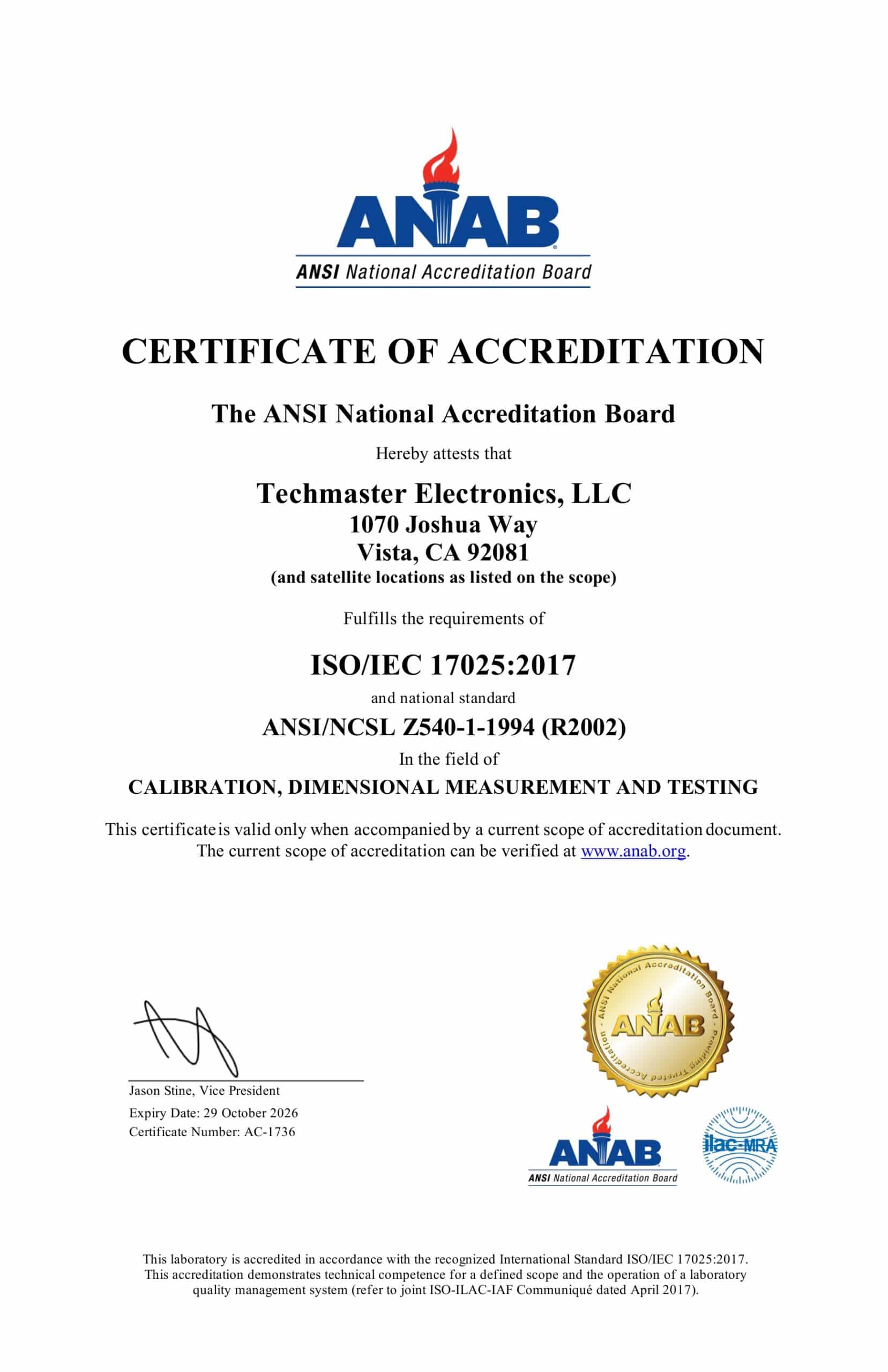
Those elements are what make the certificate defensible during a Joint Commission, FDA, or customer audit — and they are exactly what a bare “certificate of calibration” from a non-accredited provider tends to omit. Techmaster issues ISO/IEC 17025 accredited certificates under ANAB Cert. AC-1736 with full uncertainty reporting and 15-year record retention, from our medical equipment calibration laboratories — part of a calibration service portfolio spanning 12 disciplines at labs in Vista CA, Santa Clara CA, Orlando FL, and San Antonio TX.
Key takeaways
- An infusion pump analyzer verifies flow, volume, occlusion pressure, and bolus/PCA dose — the parameters IEC 60601-2-24 cares about.
- Every pump verification inherits the analyzer’s error: an uncalibrated analyzer can silently pass a drifting pump fleet.
- Calibration is gravimetric for flow and volume, pressure-standard-based for occlusion channels, with a traceable timebase check.
- Keep the accuracy stack near 4:1 TUR — pump ±5%, analyzer ±1%, laboratory references ±0.1% class.
- Calibrate annually at an ISO/IEC 17025 accredited lab and demand as-found/as-left data with uncertainties on the certificate.
Frequently asked questions
What is an infusion pump analyzer?
An infusion pump analyzer (also called an infusion device analyzer or IDA) is a biomedical test instrument that measures the flow rate, delivered volume, occlusion pressure, and bolus dose performance of IV infusion pumps, syringe pumps, and PCA pumps to verify they meet manufacturer and IEC 60601-2-24 performance requirements.
How often should an infusion pump analyzer be calibrated?
Every 12 months is the standard interval recommended by analyzer manufacturers and expected by hospital accreditation programs. Shorten the interval if the unit has out-of-tolerance history, heavy transport between sites, or supports a large pump fleet where undetected drift would trigger an extensive recall review.
How is the flow channel of an infusion pump analyzer calibrated?
Gravimetrically. The laboratory draws distilled water through the channel at controlled rates, weighs the delivered water on a calibrated balance at timed intervals, and converts mass to volume using water density at the measured temperature, with evaporation and buoyancy corrections at low flows.
Do I need ISO/IEC 17025 accredited calibration for a pump analyzer?
If the analyzer supports regulatory or accreditation-facing pump verification — and in a hospital it almost always does — yes. An accredited certificate provides documented traceability, reported measurement uncertainty, and as-found/as-left data that Joint Commission and FDA-facing audits accept without argument.
What accuracy does an infusion pump analyzer have compared to a pump?
Typical analyzers specify about ±1% of reading on flow and volume, while general-purpose IV pumps are specified around ±5% volumetric accuracy. That margin gives roughly a 5:1 test uncertainty ratio, which keeps pump pass/fail decisions reliable.
Which infusion pump analyzers does Techmaster calibrate?
Techmaster Electronics calibrates major infusion device analyzers including Fluke Biomedical IDA-series, Rigel Multi-Flo, and Datrend Infutest instruments, with ISO/IEC 17025 accredited certificates issued under ANAB Cert. AC-1736 and free local pickup and delivery in Silicon Valley, Southern California, and Orlando.
Put a defensible certificate behind every pump test
ISO/IEC 17025 accredited infusion pump analyzer calibration with as-found/as-left data, reported uncertainties, and 15-year record retention — from the accredited calibration laboratory trusted by US hospitals and manufacturers since 1989.
Request a Calibration Quote
Khanh Nguyen is the Marketing Manager at Techmaster Electronics, a B2B marketing leader covering the test, measurement, and ISO/IEC 17025 accredited calibration industry across the US and Vietnam markets.