
Metrology guide · NIST-traceable calibration
Autoclave Calibration
Autoclave Calibration verifies a Autoclave against NIST-traceable standards. Techmaster performs a documented multi-point check, reports measurement uncertainty, and issues a NIST-traceable calibration certificate, in-lab or on-site across the USA.
NIST-traceable certificate Uncertainty reported NIST traceable
As-foundand as-left data
NISTTraceability
12 moTypical interval
UncertaintyReported per point
In this guide
Why calibration intervals matter
Uncorrected drift creeps toward the tolerance limit over time; scheduled calibration resets it before measurements fall out of spec.
How Autoclave calibration works
- Intake & visual inspection
- Environmental stabilization
- As-found measurement
- Comparison to NIST-traceable standards
- Adjustment if required
- As-left results & certificate
Your calibration, covered
In-lab calibrationBench calibration with reference standards
On-site calibrationWe calibrate at your facility
Expedited turnaroundRush options to cut downtime
Calibration certificateNIST-traceable, with uncertainty
In-lab vs on-site calibration
In-lab calibration
- Lab bench with full reference standards
- Best achievable measurement uncertainties
- Pickup & return logistics handled
- Ideal for precision and reference work
On-site calibration
- We calibrate the Autoclave at your facility
- No shipping risk or transit downtime
- As-found data captured before any move
- Ideal for fixed, large or sensitive assets
In-depth guide
The Gold Standard of Sterilization: Autoclave Applications and Why Calibration is Key
1. Diverse Applications: Autoclaves Are Everywhere Sterility is Needed
The autoclave is more than just a hospital device; it supports every industry that requires high hygiene and infection control.Core Applications (Mandatory Sterilization)
🏥
HEALTHCARE & MEDICAL
- ✨ Surgical Instruments
- ☣️ Biohazard Waste Disposal
- 🦷 Dental & Aesthetics
🔬
SCIENCE & RESEARCH
- 🌱 Culture Media Sterilization
- 🧪 Laboratory Equipment Sterility
- 🧬 Biology & Pharma R&D
🏭
INDUSTRY & OTHERS
- 💊 Pharmaceutical Manufacturing (GMP)
- 🥫 Canned Food Sterilization
- 💉 Tattooing (Equipment)
1.1. Core Applications in Healthcare and Patient Safety
Patient safety is the top concern. The autoclave ensures safety in all invasive procedures.- Surgical Instrument Sterilization: This is the most critical use. Staff must sterilize all metal tools, reusable optical devices, and heat-resistant supplies before, during, and after surgery. For example, poor sterilization can lead to Surgical Site Infections (SSIs), which seriously endanger patients.
- Biohazardous Waste Disposal: Facilities use autoclaves to deactivate infectious biohazardous waste. This includes blood samples, culture tubes, contaminated sharps, and tissue. This process is essential for environmental rules and biological safety laws.
- Dental and Aesthetic Practices: All reusable instruments in dental clinics, aesthetic surgery centers, and even tattooing facilities must undergo steam sterilization. This prevents the spread of dangerous diseases like Hepatitis B, C, or HIV.
1.2. Essential Roles in Science and Research
The integrity of scientific results depends on a sterile lab environment.- Culture Media Sterilization: Microbiology labs rely on autoclaves to sterilize liquid media (Broth) or solid media (Agar). Technicians use this sterilized media to grow bacteria, fungi, or cells. Contaminated media can easily spoil the research or diagnostic results.
- Lab Glassware Sterilization: Staff must sterilize test tubes, petri dishes, pipettes, and other glass supplies. This ensures no strange microorganisms interfere with experiments.
- Pharmaceutical and Biological Manufacturing: During the creation of vaccines, sterile injectable drugs, and biological products, autoclaves sterilize equipment, packaging, and sometimes the final product itself.
1.3. Applications in Industry and Other Sectors
Beyond the medical and research worlds, several industries rely on the autoclave’s power for quality control and public safety.- Pharmaceutical Industry: Manufacturers use autoclaves to sterilize equipment and raw materials. This step is mandatory in the production of sterile drugs and injectable medicines.
- Food Industry: Businesses use autoclaves to sterilize certain test samples or processing equipment. This helps ensure food safety and validates testing procedures.
- Tattoo and Aesthetic Services: All reusable needles, tubes, and metal instruments must undergo sterilization. This protects clients from potential infections transmitted through contaminated tools.
2. The Critical Need for Autoclave Calibration
Calibration: Why It Matters?
Autoclave Usage Distribution
Usage percentage by sector.

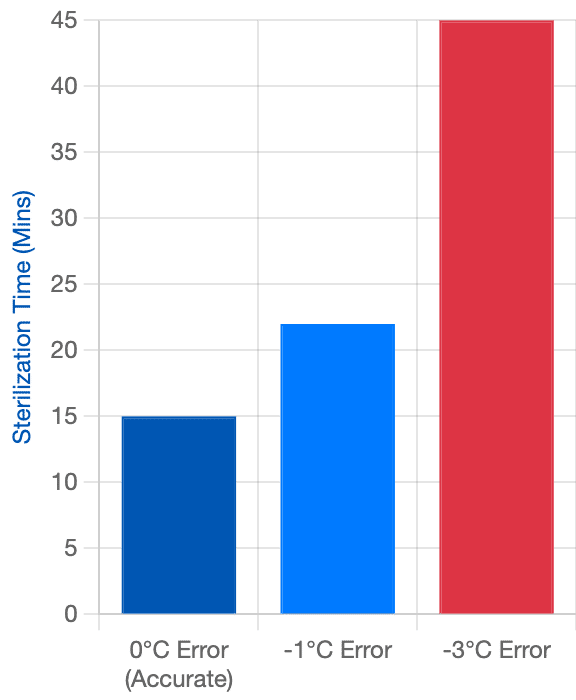
Temperature Error = Time Loss
Even 1°C error significantly increases the sterilization cycle.
Benefits (🟢) vs. Risks (🔴)
BENEFITS (CALIBRATION)
- ✅ Patient Safety (Low HAIs)
- ✅ Regulatory Compliance (FDA/GMP)
- ✅ Increased Efficiency (Energy Savings)
RISKS (NO CALIBRATION)
- ❌ Non-Sterile Products
- ⚠️ Fines / Operational Suspension
- 💰 Wasted Energy & Costs
2.1. Guaranteeing Absolute Biological Efficacy
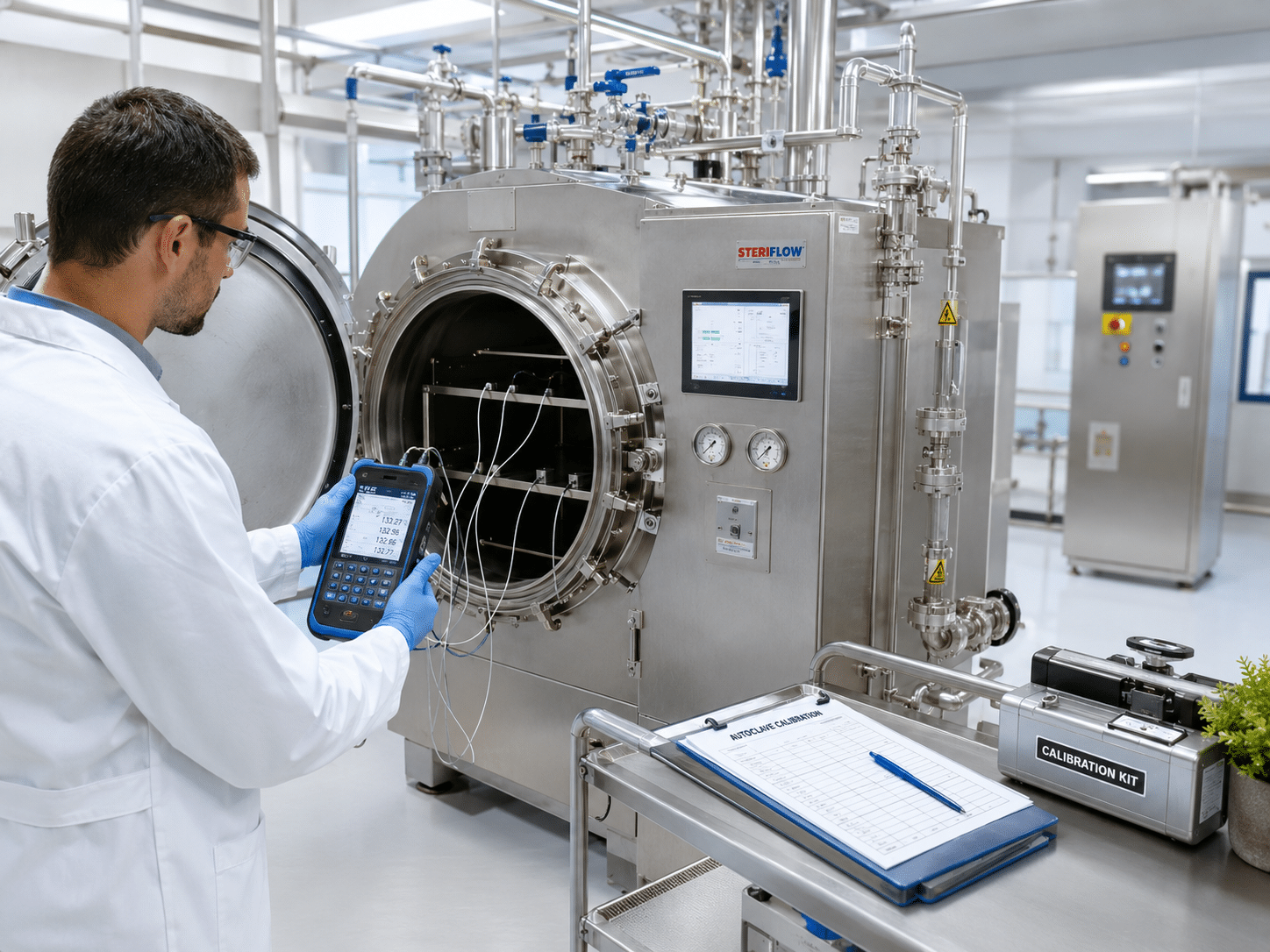
Calibration confirms that the actual temperature and pressure inside the chamber match the values shown on the control panel.- Temperature Control: Standard sterilization temperature usually is (for 15 minutes) or (for 3 minutes). Consider this: If the autoclave’s temperature sensor is wrong by just a few degrees (it shows but only reaches ), the sterilization will fail. Therefore, heat-resistant bacterial spores will survive. Calibration finds and fixes this error.
- Temperature Mapping and Uniformity: Further, advanced calibration includes Temperature Mapping. Technicians place multiple reference sensors (calibrated PRTs or Thermocouples) in many spots inside the chamber. They do this to find any “cold spots” where steam cannot reach properly. This ensures heat spreads evenly across the entire load.
- Pressure Verification: Pressure (usually or above air pressure) is needed to keep water as saturated steam at the required heat. Calibration of the pressure gauge confirms this reading is correct.
2.2. Protecting Tools and Property
- Preventing Device Damage: If the real temperature is higher than the displayed temperature, sensitive tools, medical plastics, or heat-sensitive materials can melt, bend, or break. This results in high replacement costs. Importantly, calibration keeps the temperature within safe limits.
2.3. Legal Compliance and Quality Assurance
In the medical and drug industries, laws mandate calibration for quality control.- Proving Validation: A Calibration Certificate from an ISO/IEC 17025 accredited lab offers solid proof. It proves the facility followed the right steps and the equipment performs to national/international standards (like FDA, cGMP, and ISO rules).
- Staying Ready for Audits: When quality auditors (such as JCI or local health groups) inspect a facility, complete and correct autoclave calibration records are vital. They need this information to keep their operating license.
3. How Autoclave Calibration Works
Calibrating an autoclave is a complex technical process. Specialists carry out this work:- Setting up Standards: The technician places reference temperature and pressure sensors (which trace back to national standards) at key spots inside the chamber.
- Running the Cycle: Technicians run one or more typical sterilization cycles (e.g., ).
- Collecting Data: An external data recorder captures the actual temperature and pressure from the reference sensors throughout the cycle.
- Checking and Fixing: Experts check the data against the set rules and allowed error limits. If the error is too high, the technician adjusts the autoclave’s built-in sensors.
- Giving the Certificate: Finally, the lab issues a detailed Calibration Certificate. This officially confirms the autoclave meets the necessary sterilization standards.
Conclusion
The Autoclave provides the core foundation of biological safety in all sensitive areas. It is used everywhere, from saving lives in the operating room to protecting the data in important research. However, we only keep the autoclave’s power active through regular Calibration. Calibration is not just a technical step; it is a required investment. It helps remove the risk of infection, protect expensive medical property, and keep the facility legally compliant. By making sure truly is , we maintain our promise of absolute safety and quality. Have you checked your facility’s last Autoclave calibration date?Frequently asked questions
What is Autoclave Calibration?
Autoclave Calibration is the documented comparison of a Autoclave against NIST-traceable reference standards, measuring its error and measurement uncertainty and confirming it performs within tolerance.
How often should a Autoclave be calibrated?
Most quality systems calibrate a Autoclave every 12 months, and sooner after repair, overload or heavy use. Follow the manufacturer specification and your ISO 9001/13485/AS9100 program.
What standards apply to Autoclave Calibration?
Calibration is performed with NIST-traceable references and the relevant manufacturer specification. This instrument type is not on Techmaster’s ANAB ISO/IEC 17025 scope, so the certificate is NIST-traceable.
What is included on the certificate?
A NIST-traceable calibration certificate with as-found and as-left results and the measurement uncertainty for each point.
Can you calibrate the Autoclave on-site?
Yes. Techmaster offers in-lab calibration with pickup and on-site service across the USA to minimize downtime.
Need Autoclave calibration?
NIST-traceable calibration, fast turnaround, in-lab or on-site across the USA.
Contact us for a quoteReferences & industry standards
- ISO/IEC 17025 testing & calibration laboratory requirements
- NIST calibration services and measurement traceability
- A2LA / ANAB accreditation for calibration laboratories
External standards bodies. Techmaster Electronics is an ISO/IEC 17025-accredited, NIST-traceable calibration laboratory.

Khanh Nguyen is the Marketing Manager at Techmaster Electronics, a B2B marketing leader covering the test, measurement, and ISO/IEC 17025 accredited calibration industry in the United States.