
Every quality manager responsible for end of support test equipment eventually gets the same email: a production oscilloscope, a spectrum analyzer on an RF test station or a multifunction calibrator has failed, and the manufacturer lists it as discontinued or out of support. The reflex is to buy the current model. Sometimes that is right. Often, though, the purchase price is the smallest part of what replacement costs, and an independent repair keeps a validated test process running for years. This guide gives you a framework to decide whether to repair or replace test equipment once the manufacturer has stepped away, and explains what your quality system needs to document either way.
What does “end of support” actually mean for a test instrument?
End of support means the manufacturer no longer guarantees factory repair, calibration or parts for a model. It usually follows a discontinued or limited-support stage in which new sales stop but service continues while parts last. The instrument does not suddenly become inaccurate; what disappears is the guaranteed path to fix it.
Manufacturers such as Keysight, Tektronix, Fluke and Rohde & Schwarz typically move a model through recognizable lifecycle stages, even though each uses its own labels. Knowing which stage your instrument is in tells you how much time you have to plan, rather than reacting when the unit fails.
| Lifecycle stage | What the manufacturer still offers | What it means for you |
|---|---|---|
| Active | New sales, factory repair, calibration, firmware updates | No action beyond normal calibration intervals |
| Discontinued / mature | No new units; repair and calibration continue | Start budgeting and identify a successor model |
| Limited support | Repair only while parts last, often case by case | Qualify an independent repair source and consider a spare unit |
| End of support / obsolete | No factory repair or calibration guaranteed | Decide repair-or-replace per failure; keep the record trail tight |
Two points are worth separating. First, end of factory support does not end calibration: an accredited laboratory calibrates an instrument against its published specifications, so a working discontinued model can still receive an accredited certificate where the parameters are on the lab’s scope. Second, obsolete test equipment repair is a parts problem more than a skills problem. Many failures in older instruments sit in power supplies, displays, fans, input relays, attenuators and connectors, which an experienced technician can repair at component level.
When does repairing obsolete test equipment still make sense?
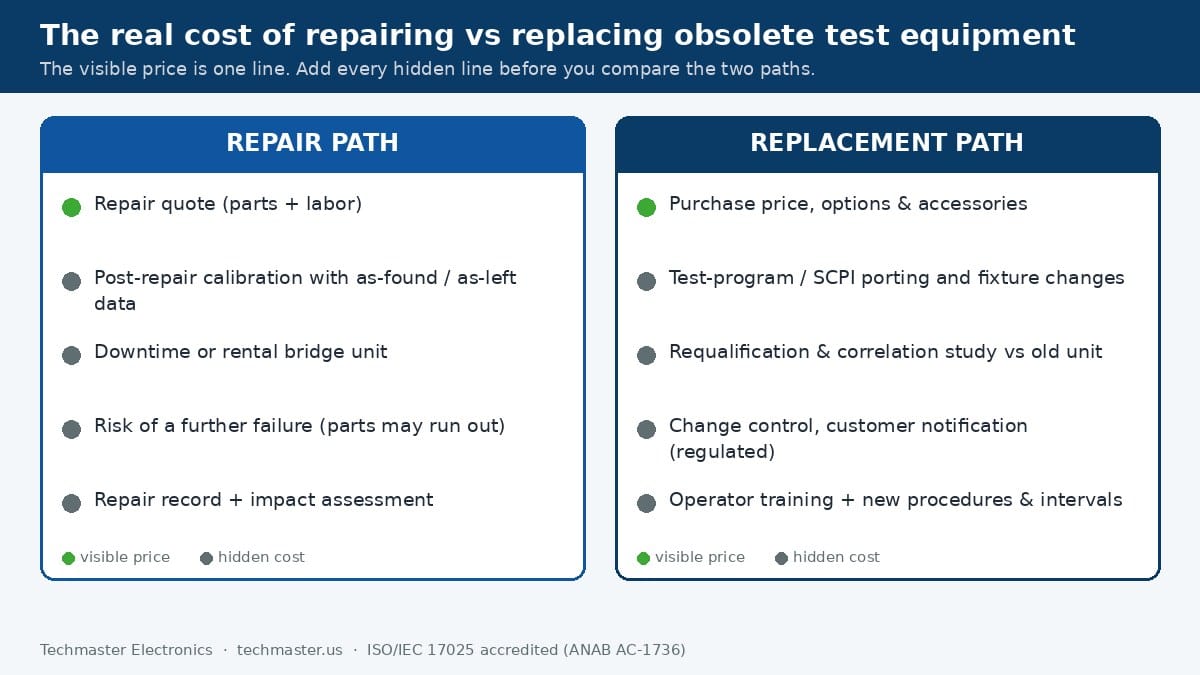
Repairing obsolete test equipment makes sense when the fault is isolated, parts or a donor unit are available, the instrument still meets the specification your process needs, and replacing it would trigger costly test-program changes, re-validation or customer notification. A single failure in an otherwise healthy instrument is usually a repair case.
The strongest repair cases are instruments embedded in a validated process. An automated test station built around a specific analyzer has test software written to its command set, limits derived from its measurement behavior and correlation data tied to it. Swap the instrument and all of that has to be revisited. When the instrument’s accuracy still comfortably supports your tolerances, keeping the same model is often the lowest-risk choice.
Repair also fits when the failure mode is well understood. A dead power supply, a cracked display, a worn front-panel encoder or a damaged RF input connector is very different from intermittent faults spread across several boards. Techmaster’s own oscilloscope repair guide covering common Tektronix and Keysight failures shows how often the fault is a single, replaceable subsystem.
Replacement becomes the better answer when the manufacturer has stopped supplying the parts that fail, the same instrument has needed repeated repairs, the repair quote approaches a large share of a new unit’s price, or the instrument’s specification no longer covers what you need to measure. Instruments that depend on unsupported operating systems may also fail your IT security policy, which can force replacement regardless of how well they measure.
How do you calculate whether to repair or replace test equipment?
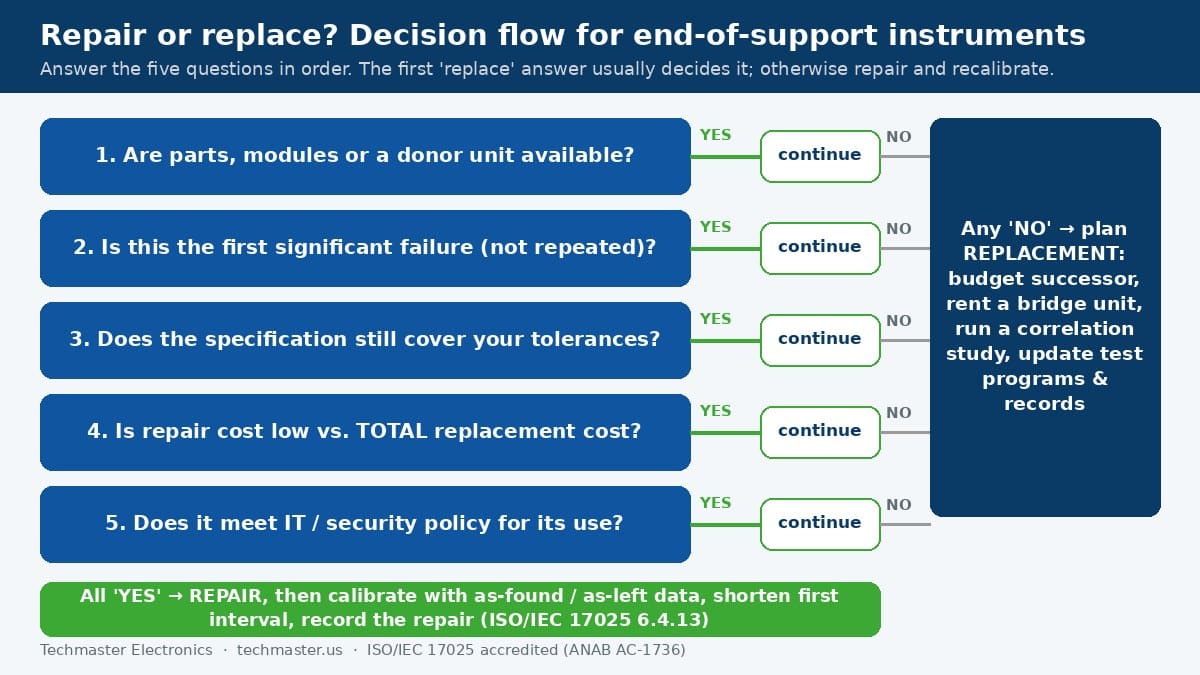
Compare total cost, not sticker prices. For repair, add the repair quote, post-repair calibration, downtime and the chance of another failure. For replacement, add the purchase price, accessories, software and fixture changes, requalification, training and the risk of correlation shifts. The lower total, weighed against risk, is your answer.
The decision matrix below is the checklist we suggest quality and test engineering teams fill in together. Each row pushes the decision one way or the other; most real cases are mixed, which is why writing it down helps.
| Factor | Favors repair | Favors replacement |
|---|---|---|
| Parts availability | Parts, modules or donor units available | Failed part is proprietary and no longer made |
| Failure history | First significant failure | Repeated failures or several boards involved |
| Specification fit | Accuracy and range still support your tolerances | Specification no longer meets your requirements |
| Process integration | Embedded in automated test software or validated method | Stand-alone bench use, easy to substitute |
| Regulatory impact | Change would need customer notification or re-validation | No change-control burden |
| Cost ratio | Repair is a small fraction of total replacement cost | Repair approaches a large share of a new unit |
| IT and security | Instrument is standalone or meets IT policy | Embedded OS is unsupported and network use is required |
Many teams use a rough trigger, such as a repair quote above about half the price of a new unit, to prompt a closer review. Treat that as a prompt, not a rule. A simple illustrative example shows why: a discontinued analyzer needs a repair quoted at a few thousand dollars, while the current model costs several times that. Replacing it also means porting the test program, re-establishing limits, running a correlation study and, for a medical or automotive customer, documenting the change. Once engineering hours and line downtime are included, the replacement path can cost far more than its purchase price suggests.
What risks does an end-of-support instrument add to an ISO 9001 or ISO/IEC 17025 quality system?
The main risks are unplanned downtime, an incomplete record trail and unassessed impact on past results. ISO 9001 clause 7.1.5.2 requires you to judge whether earlier measurements were affected when equipment is found unfit, and ISO/IEC 17025 requires defective equipment to be taken out of service and repairs to be recorded.
Under ISO 9001:2015, clause 7.1.5.2 asks the organization to determine whether the validity of previous measurement results has been adversely affected when measuring equipment is found unfit for its purpose, and to act as needed. For calibration and testing laboratories, ISO/IEC 17025:2017 is more specific. Clause 6.4.9 requires equipment that is defective or outside specified requirements to be taken out of service and the effect of the defect to be examined, and clause 6.4.13 requires records that include any damage, malfunction, modification or repair.
An end-of-support instrument raises the stakes on each of those clauses. A failure can mean weeks of downtime while parts are sourced. If the unit fails without warning, you may have no as-found data, so impact assessment depends on intermediate checks and the previous calibration. And if a component is substituted during repair, the record needs to say so, because the substitution is a modification your auditor will expect to see.
Practical controls reduce that exposure: identify which instruments in your recall system are discontinued or out of support, add intermediate checks to critical ones, decide in advance which would be repaired and which replaced, and consider buying a used same-model unit as a hot spare or donor. Our article on what to do with out-of-tolerance calibration results walks through the impact assessment step in detail.
What calibration should follow the repair of an obsolete instrument?
A repaired instrument should be fully calibrated before it returns to service, with as-left data showing it meets specification. Where the unit still powers up, as-found data should be captured before repair. Many teams also shorten the first interval after a major repair and add intermediate checks until the instrument proves stable.
Repair can change how an instrument measures: a new attenuator, reference oscillator, input relay or power supply rail can shift readings even when the instrument appears to work. That is why Techmaster calibrates every repaired unit before it is returned, with an ISO/IEC 17025 accredited certificate where the parameters fall within our ANAB scope (certificate AC-1736) and a NIST-traceable certificate where they do not. Electrical instruments such as DMMs, oscilloscopes, power supplies and electronic loads are covered by our ISO/IEC 17025 electrical calibration services, and RF and microwave instruments by our RF and microwave calibration services.
The certificate data matters as much as the certificate. As-found readings, taken before any adjustment, tell you whether the failure affected earlier measurements; as-left readings prove the repaired unit meets specification. Our guide to as-found vs as-left calibration data explains how to use both in an impact assessment. After a major repair, treat the instrument almost like a new one: a shorter first interval, intermediate checks against a check standard and a review of drift at the next calibration. ILAC’s interval guidance in the ILAC G-series guidance documents, including ILAC-G24, supports adjusting intervals based on the instrument’s history.
How can you keep testing while an instrument is repaired or replaced?
Rent a calibrated equivalent for the repair period, or keep a same-model spare. A rental bridges downtime without a purchase decision, while a same-model spare also protects your test programs because commands and behavior match. Both buy time to decide repair or replace on facts rather than under production pressure.
For short repairs, renting is usually the simplest bridge. Techmaster’s test equipment sales and rentals include calibrated units from Keysight, Tektronix, Fluke and Rohde & Schwarz, and the rental can cover the repair period or a longer evaluation of a successor model. For instruments embedded in automated test, a used or refurbished unit of the same model is often worth more than its price suggests, because it can run your existing test program while the failed unit is repaired, and it can become a parts donor later.
If you do decide to replace, use the rental period to run the new model side by side with your reference data. A short correlation study on real product, comparing readings from old and new instruments, is the cleanest evidence that the change did not move your pass/fail decisions.
What does a lab need to quote a repair on a discontinued instrument?
Send the make, model, serial number and installed options, a clear description of the fault including error codes, the firmware version if the unit boots, and the accessories in use. Say whether you need an accredited calibration after repair and which ranges matter. This lets the lab confirm parts availability before quoting.
Techmaster Electronics is an independent repair and calibration laboratory, founded in 1989, with four ISO/IEC 17025 accredited laboratories in Vista and Santa Clara, California, Orlando, Florida and San Antonio, Texas. We are not a manufacturer-authorized service center, which is exactly why we work on older and discontinued instruments from Keysight (formerly Agilent), Tektronix, Fluke, Rohde & Schwarz, Anritsu and other manufacturers where parts are available. Our independent test equipment repair services page lists every repair category, from RF analyzers to biomedical analyzers and environmental chambers.
Our dataset of 381,916 calibrations on instruments from 4,913 manufacturers over ten years is a reminder of how long well-built instruments stay in service. A model that left the manufacturer’s catalog years ago can still be one of the most reliable instruments on your floor, provided it is repaired properly, calibrated with full data and recorded the way your quality system requires.
Key Takeaways
- End of manufacturer support ends the guaranteed repair path, not the instrument’s ability to measure or be calibrated.
- Repair or replace test equipment on total cost: include requalification, software changes, correlation and downtime, not just price.
- Repair is strongest for instruments embedded in validated or automated test processes with an isolated fault.
- Replace when parts are gone, failures repeat, the specification no longer fits or the instrument fails IT policy.
- Record every repair and component substitution, as ISO/IEC 17025 clause 6.4.13 requires, and assess impact on past results.
- Calibrate after repair with as-found and as-left data, then shorten the first interval and add intermediate checks.
Frequently asked questions
Can you calibrate test equipment the manufacturer no longer supports?
Yes, in most cases. Calibration depends on the instrument’s published specifications and a suitable procedure, not on factory support status. An accredited laboratory can calibrate a discontinued model as long as it works and the parameters fall within the lab’s scope of accreditation.
Is a repaired instrument as accurate as it was before the failure?
It should meet its published specifications after repair and calibration, and the as-left data on the certificate is your evidence. Replaced components can shift performance, so many quality managers shorten the first calibration interval after a major repair and add intermediate checks.
What share of the replacement cost is too much to spend on a repair?
There is no universal number. Many teams use roughly half the price of a new unit as a trigger for a closer review, but the full comparison should include requalification, software changes, training and downtime, which often make replacement far more expensive than its purchase price.
Do I need to re-validate a test station if I replace an instrument?
Usually some re-validation is needed. A new model may use different commands, ranges or measurement algorithms, so automated test programs, limits and correlation should be checked against the old unit. Regulated industries may also require documented change control or customer notification.
What records does ISO/IEC 17025 require after an instrument is repaired?
Clause 6.4.13 requires equipment records that include details of any damage, malfunction, modification or repair, alongside calibration results and dates. Clause 6.4.9 requires defective equipment to be taken out of service and the effect of the defect on previous results to be examined.
Does Techmaster repair discontinued test equipment?
Yes, where parts are available. Techmaster is an independent laboratory, not a manufacturer-authorized service center, and repairs older and discontinued models from Keysight, Tektronix, Fluke, Rohde & Schwarz, Anritsu and others, then calibrates each unit before it is returned.
Failed instrument, no factory support?
Send the make, model and fault description. Techmaster replies with a repair quote, expected timeline and warranty terms, and calibrates every repaired unit before it ships back.
Request a repair quote
Khanh Nguyen is the Marketing Manager at Techmaster Electronics, a B2B marketing leader covering the test, measurement, and ISO/IEC 17025 accredited calibration industry in the United States.