
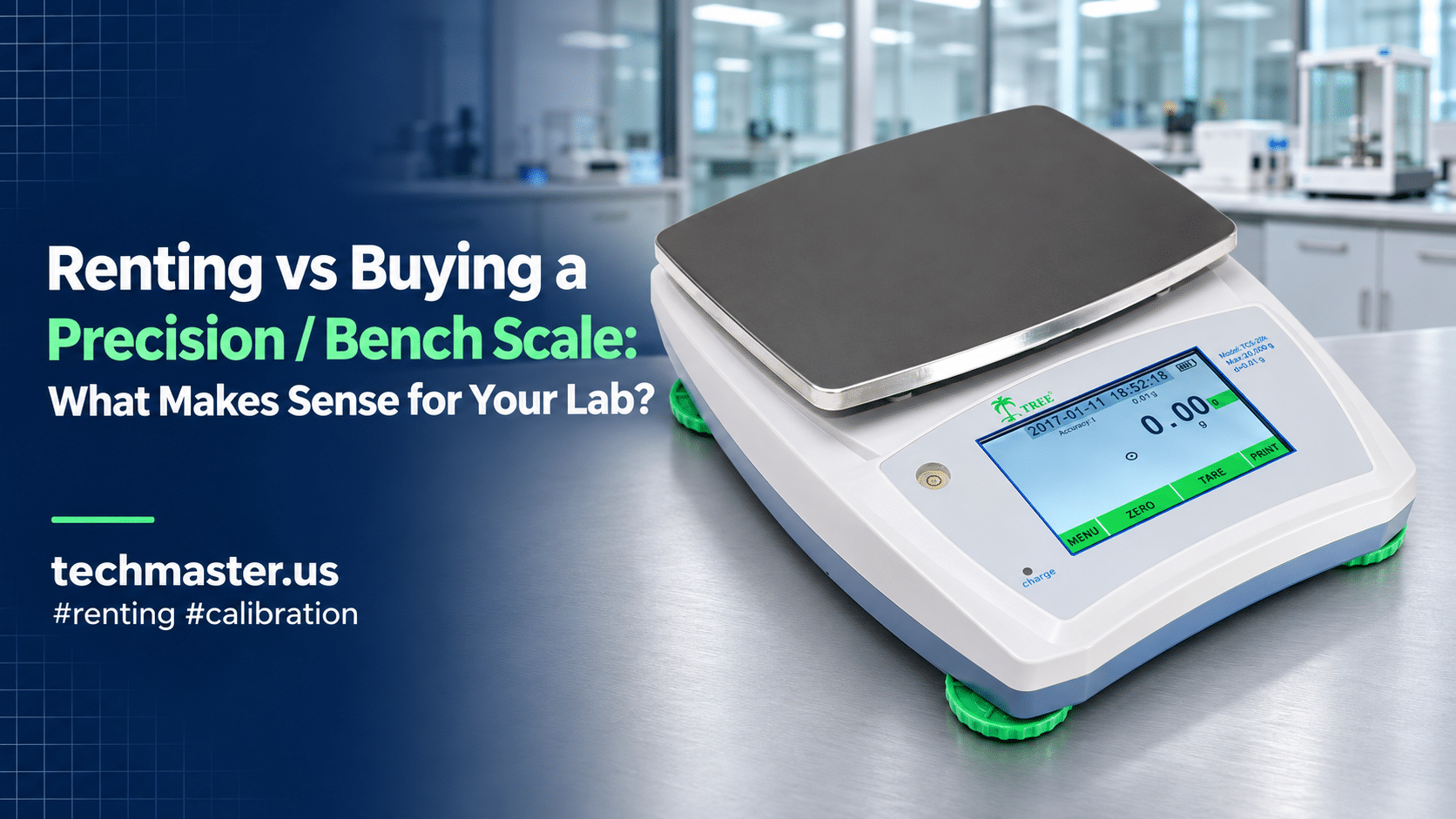
Renting vs Buying a Precision / Bench Scale: What Makes Sense for Your Lab?
Facility managers and quality engineers constantly balance budget constraints with the need for highly accurate measurement equipment. When you face the decision to rent vs buy precision / bench scale equipment, you must carefully evaluate your operational requirements. Choosing the right path ensures that you maintain strict quality control without wasting capital. Furthermore, whether you own or rent, measurement accuracy remains non-negotiable for compliance and product safety.
Therefore, this guide will help you navigate the financial, technical, and compliance factors involved in acquiring and maintaining precision weighing instruments.
1. What Is a Precision / Bench Scale?
A precision bench scale is a compact, highly accurate weighing instrument designed to sit on a workstation or laboratory bench. Manufacturers build these scales to measure mass with exceptional resolution and repeatability. In addition, they typically utilize advanced strain gauge load cells or electromagnetic force restoration technology.
Unlike heavy-duty floor scales, bench scales handle lighter loads ranging from a few grams to roughly 100 kilograms. Consequently, they offer much higher readability, often displaying weights down to fractions of a gram. Technicians rely on these instruments for counting parts, formulating mixtures, and verifying product weights in quality control environments.
2. Why the Rent vs Buy Precision / Bench Scale Decision Matters
Choosing how to acquire your weighing equipment directly impacts your bottom line and your daily operations. First, owning equipment requires a significant initial capital expenditure. You also assume full responsibility for maintenance, repairs, and annual calibration.
Conversely, renting shifts the financial model from a capital expense to an operating expense. Renting protects you from equipment obsolescence. If your production needs change, you can easily swap a rented scale for a different model. Additionally, rented equipment often arrives pre-calibrated, saving you immediate setup time. Ultimately, you must weigh your long-term usage frequency against upfront costs and maintenance burdens to make the smartest financial decision.
3. Common Applications
Critical Industry Applications
Facilities across multiple sectors depend on industrial precision scales to ensure product safety and regulatory compliance. Specific applications vary widely based on the industry.
Manufacturing & Electronics
Pharmaceuticals & Labs
Aerospace & Automotive
4. Calibration Standards and Traceability
Regardless of whether you purchase or lease your equipment, stringent metrological standards govern its use. Organizations must maintain documented measurement traceability to the National Institute of Standards and Technology (NIST).
Specifically, laboratories should insist on ISO/IEC 17025 scale calibration. This international standard dictates the technical competence of testing and calibration laboratories. When a scale is calibrated under this standard, the resulting certificate includes a calculated measurement uncertainty. Consequently, this data proves that the scale performs within acceptable tolerances for your specific process requirements.
5. Common Issues Found During Calibration
Critical Industry Applications
Facilities across multiple sectors depend on industrial precision scales to ensure product safety and regulatory compliance. Specific applications vary widely based on the industry.
Manufacturing & Electronics
Electronics manufacturers use bench scales for parts counting and inventory management. Extremely accurate scales ensure that circuit board components meet strict weight tolerances before final assembly.
Pharmaceuticals & Labs
In laboratories, chemists use precision scales to formulate medications. Even a milligram of error can compromise patient safety or ruin an expensive batch of chemicals. Therefore, strict adherence to measurement protocols is required.
Aerospace & Automotive
Aerospace engineers weigh specialized components to calculate fuel efficiency and structural load. Similarly, automotive manufacturers rely on accurate mass measurements during the quality assurance of engine parts.
Relative Precision Requirements
Sub-milligram (Highest)
Milligram (High)
Tenth-gram (Standard)
6. How Often Should This Equipment Be Calibrated?
Determining the correct calibration interval requires careful analysis of your specific operating environment. First, consult the original equipment manufacturer (OEM) guidelines. Most manufacturers recommend an annual calibration at a minimum.
However, high-volume production lines may require quarterly or even monthly calibrations. If your facility operates in harsh conditions—such as extreme temperatures, high humidity, or heavy dust—you must shorten your calibration intervals. Furthermore, internal quality procedures and industry-specific regulations (like FDA or FAA requirements) often dictate mandatory calibration frequencies to maintain compliance.
7. What to Look for in a Calibration Provider
Selecting the right partner for your calibration needs is just as important as selecting the scale itself. First, verify the provider’s accreditation scope. Ensure they hold active ISO/IEC 17025 accreditation specifically for mass and weighing devices.
Next, evaluate their measurement uncertainty capabilities. The laboratory’s uncertainty must be low enough to support your specific tolerance requirements. Additionally, check their standard turnaround times and inquire if they offer an on-site Calibration service to minimize your operational downtime. Finally, review their documentation practices to guarantee their certificates meet all regulatory audit requirements.
8. Techmaster’s Precision Equipment Renting Service
Flexible Equipment Rental Solutions
If you decide that purchasing a scale does not fit your current budget, Techmaster Electronics provides flexible solutions. We offer comprehensive short-term scale rental programs tailored for busy laboratories and manufacturing floors.
Immediate Deployment
When you rent from Techmaster, the equipment arrives fully tested, configured, and accompanied by a current calibration certificate. Therefore, you can deploy the scale on your production floor immediately.
Affordable & Hassle-Free
Whether you need an instrument for a two-week special project, a seasonal inventory audit, or an interim replacement during repairs, our rental inventory provides an affordable alternative to purchasing.
Rental Advantage Comparison
9. Why Choose Techmaster Electronics?
Techmaster Electronics stands as a premier metrology partner for quality-driven industries. For decades, we have supported manufacturing, aerospace, and pharmaceutical facilities with uncompromising technical excellence.
When you partner with us, you gain access to a highly trained team of metrologists who understand the critical nature of your work. We provide rigorous NIST-traceable scale calibration services that satisfy the strictest external audits. Because we combine expansive technical capabilities with exceptional customer service, businesses trust Techmaster to safeguard their measurement accuracy and operational reliability.
10. Conclusion
Accurate mass measurement drives product safety, financial profitability, and regulatory compliance. Therefore, the choice between renting and buying a precision bench scale requires careful thought regarding your budget, usage frequency, and maintenance capabilities. Whichever route you choose, maintaining strict ISO/IEC 17025 calibration intervals remains essential. By partnering with a qualified metrology laboratory, you ensure your weighing equipment performs flawlessly day in and day out.
11. FAQ Section

Calibration engineer at Techmaster Electronics, ISO/IEC 17025 accredited laboratory with 35+ years of metrology expertise.