
Sound Meter Calibration: Ensuring Precision in Acoustic Measurement
Sound level meters are the critical frontline defense in monitoring noise exposure, industrial compliance, and environmental impact. However, these instruments are highly sensitive to environmental degradation, including humidity, dust, and mechanical fatigue. Which can result in significant decibel measurement drift over time. Sound Meter Calibration is the mandatory process of verifying an acoustic sensor’s sensitivity against a traceable reference sound source. Ensuring that data collected remains accurate, reliable, and legally defensible for regulatory safety audits.
Neglecting periodic calibration leads to compounded errors that threaten occupational safety and environmental monitoring programs. Accurate acoustic data is the foundation of site-wide noise reduction strategies. Therefore, maintaining high-precision performance through accredited calibration services is a critical safeguard against non-compliance risks and inaccurate acoustic reporting.
1. Technical Principles: Acoustic Sensing and Sensitivity
1.1. How do sound level meters maintain measurement fidelity?
Sound Meter Calibration involves stimulating the acoustic microphone with a known, stable sound pressure level (SPL) at specified frequencies. Then adjusting the instrument’s gain to ensure the readout matches the reference standard within defined uncertainty limits.
1.2. Addressing Measurement Drift
Acoustic sensors, specifically condenser microphones, are prone to sensitivity changes due to atmospheric pressure shifts, diaphragm aging, and particulate contamination. A laboratory-grade calibration process rigorously examines the frequency response and linearity of the transducer across its operating range. By establishing a traceable path to NIST or national standards, metrologists ensure the instrument provides consistent decibel accuracy regardless of the measurement environment.
2. Industrial Applications: Where Acoustic Accuracy Matters
Why is precise sound monitoring vital for your operation?
Validating the accuracy of sound level meters is essential to protecting personnel. Meeting legal requirements, and ensuring environmental stewardship.
-
Occupational Safety (OSHA Compliance): Accurate measurement of ambient noise levels is mandatory to define the necessity of hearing protection equipment in industrial workplaces.
-
Environmental Impact Studies: High-reliability sensors are required to document noise levels for urban development projects and industrial site permit renewals.
-
Machinery Maintenance: Changes in the acoustic signature of operating machinery can indicate early-stage mechanical failure. Making precision sound monitoring a key component of predictive maintenance.
-
Product Compliance Testing: Precise acoustic measurement ensures that consumer and industrial products comply with emission standards before reaching the market.
3. The Calibration Pillar: Traceability and Compliance
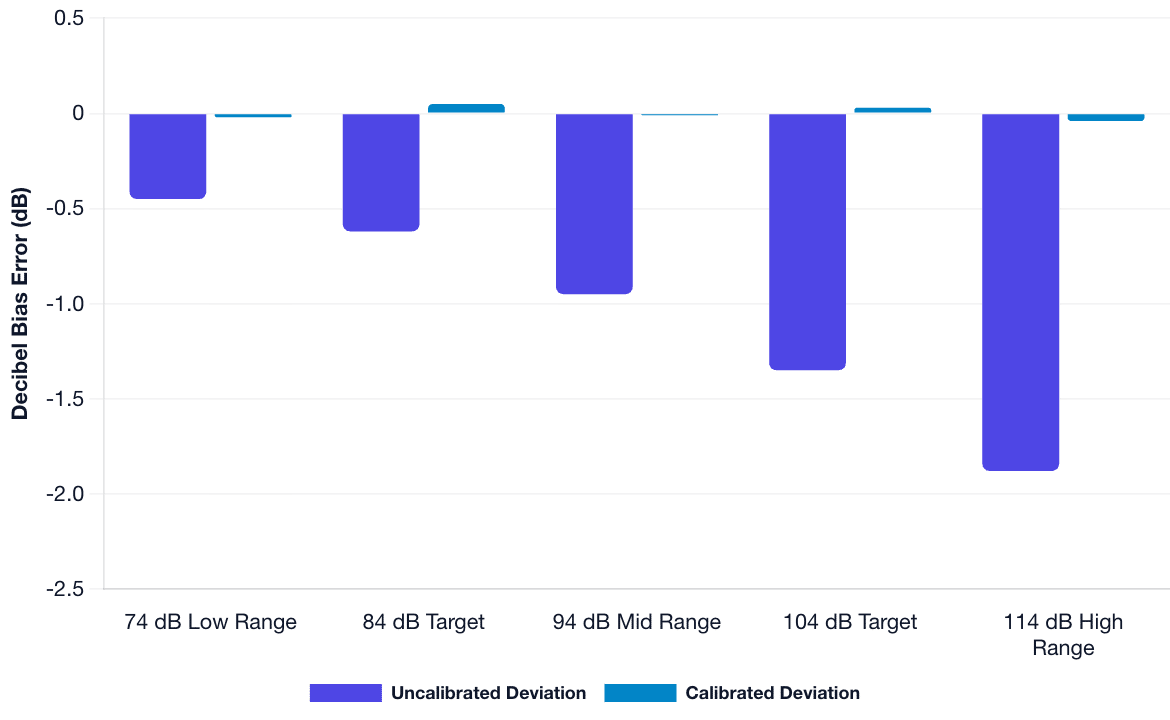
Decibel Linearity Deviation (74 – 114 dB SPL)
Tracks measurement errors across key target volumes. Calibration restores linearity to prevent sound level meters from under-reporting hazardous environmental noise levels.
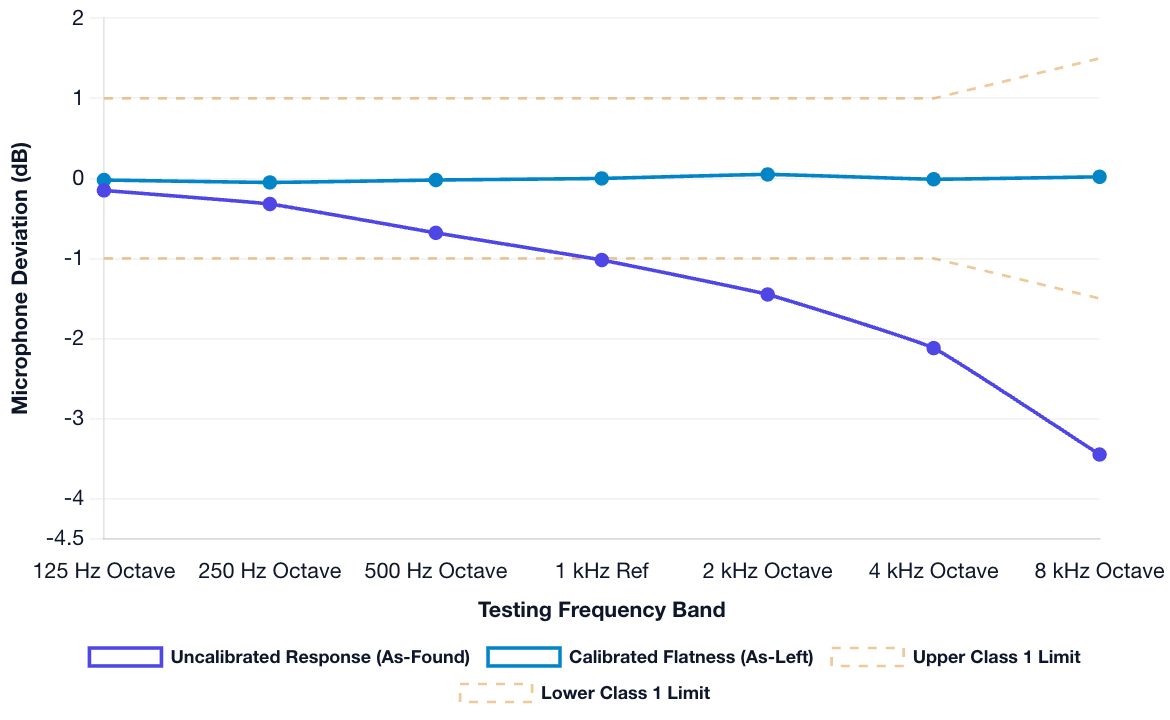
Microphone Frequency Response Curve
compares acoustic response across standard testing octaves (125Hz to 8kHz). Uncalibrated diaphragm drift (As-Found) leads to high-frequency roll-off compared to the calibrated flat baseline (As-Left).
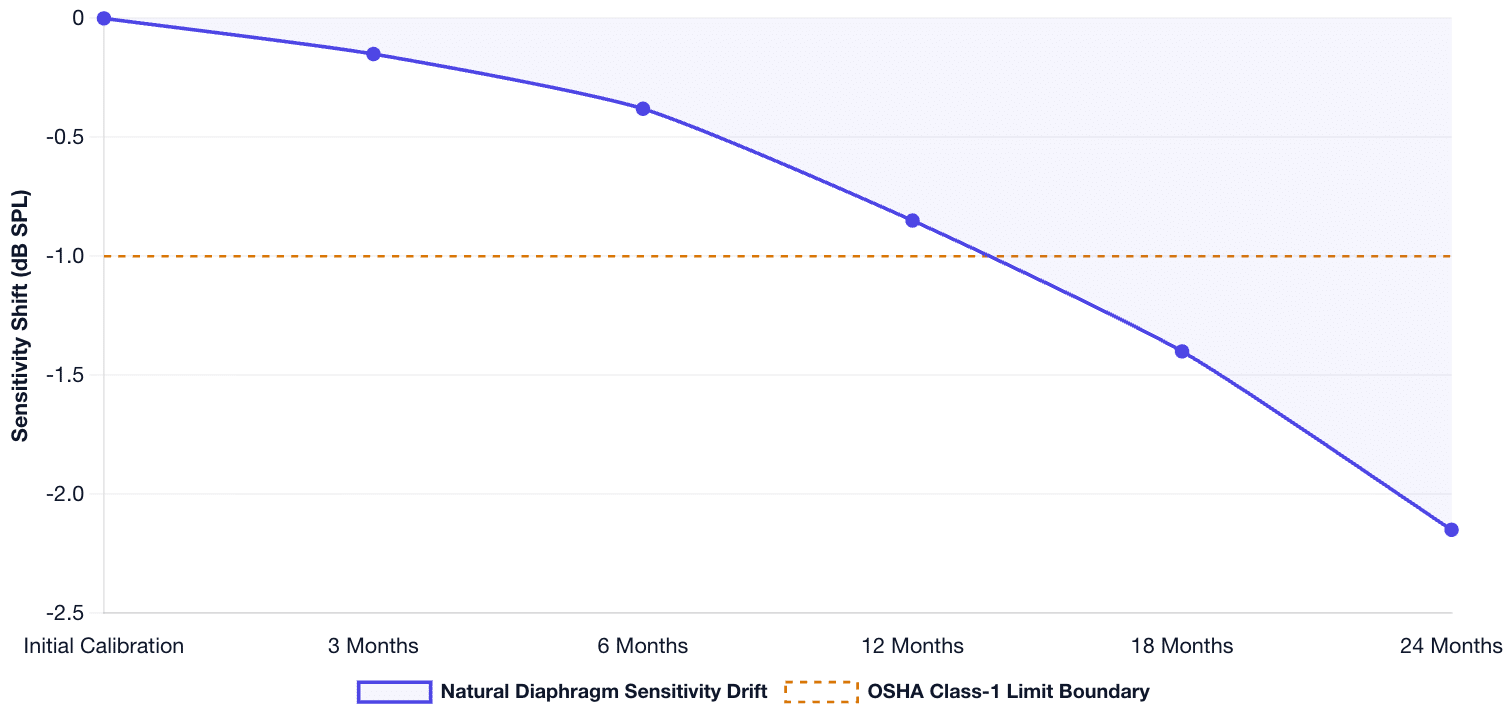
Acoustic Sensitivity Drift Over Time
Capacitive condenser microphone diaphragms naturally lose tension over extended field deployment. This chart maps cumulative sensitivity loss (in decibels) over a 24-month span, emphasizing the safety threshold boundary where errors invalidate regulatory compliance.
Why is accredited testing mandatory for acoustic assets?
Accredited Sound Meter Calibration establishes a verifiable connection to international measurement standards, providing the technical evidence required for ISO/IEC 17025 quality systems and regulatory oversight.
Using a sound meter that has not been calibrated can introduce hidden measurement errors, potentially causing an organization to underestimate noise exposure risks. Which carries significant legal and financial liabilities. Techmaster maintains that an accredited calibration certificate serves as the objective proof that your acoustic data is accurate, consistent, and fully compliant with global metrological standards.
4. How to Prepare Your Sound Meter for Calibration
Follow these steps to ensure your acoustic monitoring assets are ready for a precise and efficient calibration process at Techmaster.
1. First, Verify Microphone IntegrityInspect the microphone capsule for signs of physical damage or debris. Even minor damage to the diaphragm can compromise measurement accuracy and invalidate the calibration process.
2. Next, Document Environmental FactorsIdentify the temperature, humidity, and atmospheric pressure ranges in which your meter is primarily used. This information is important because these conditions directly affect microphone sensitivity and measurement performance.
3. Then, Include Relevant AccessoriesProvide the primary windscreen, preamplifier, and any extension cables used in your standard setup. In addition, these accessories can influence the overall acoustic response of the measurement system.
4. Finally, Provide Previous DataInclude copies of previous calibration reports whenever available. This allows our metrologists to evaluate the instrument’s drift profile over time and identify potential issues related to device aging.
As a result, our team can perform a more efficient calibration and provide results that better reflect your actual operating conditions.Techmaster US: Your Calibration Partner
Techmaster Electronics, LLC is an independent, ISO/IEC 17025 accredited calibration laboratory supporting the United States manufacturing and safety sectors since 1989. Our technical experts operate out of five laboratories (four ISO/IEC 17025 accredited) located in California, Florida, Texas, and North Carolina.
Our metrologists utilize high-precision acoustic standards to perform meticulous Sound Meter Calibration. We bridge the gap between complex industrial requirements and national standards, providing quality managers with instantly verifiable, digitized calibration records that simplify compliance and documentation.
Why Choose Techmaster US?
-
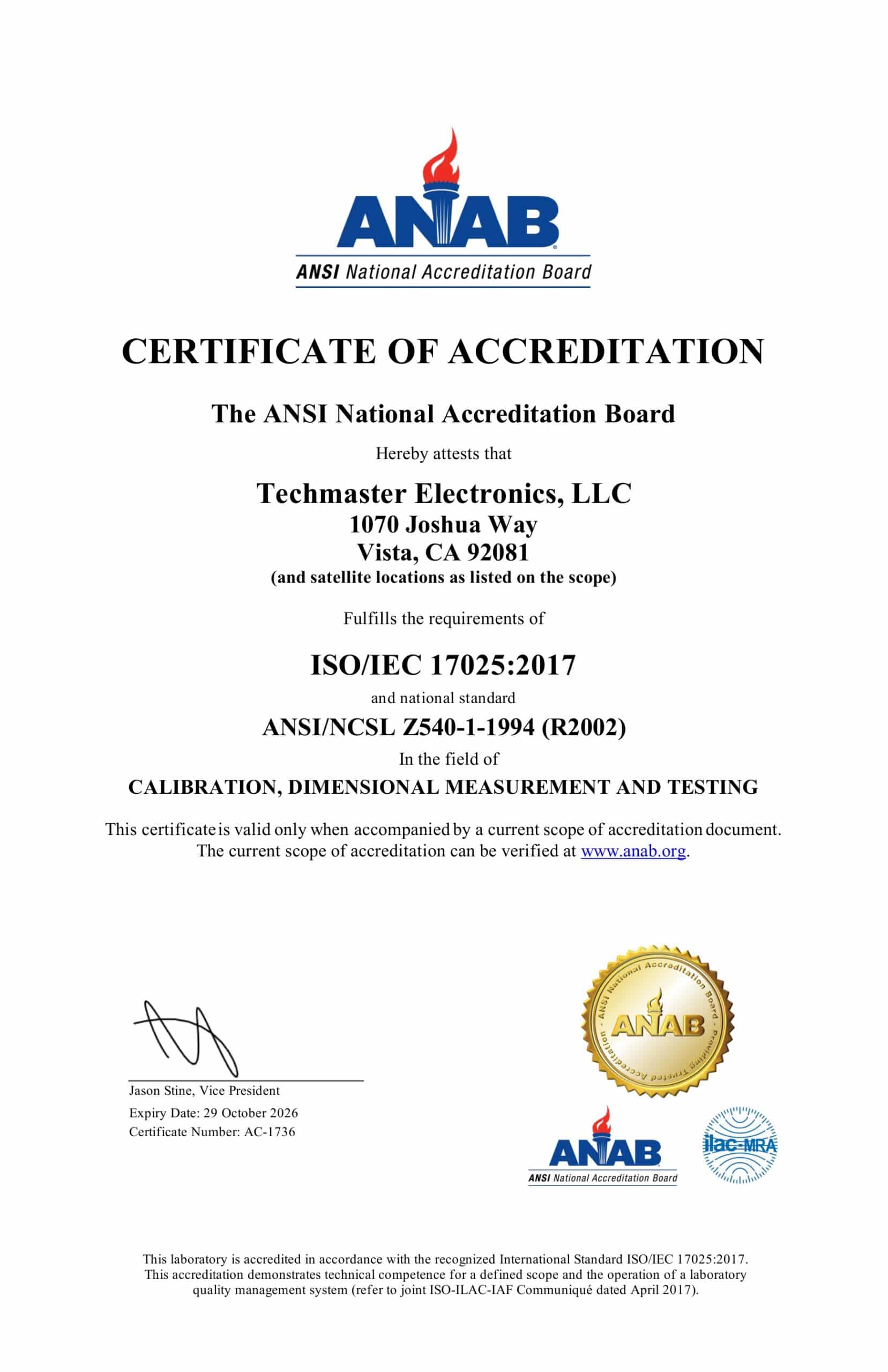
Full ISO/IEC 17025 Accreditation: All calibration procedures strictly adhere to our ANAB cert AC-1736 quality framework.
-
Flexible Service Options: We offer both in-lab and on-site calibration services to minimize your operational downtime.
-
Comprehensive Expertise: Our capabilities cover the full spectrum of industrial disciplines, including electrical, thermodynamic, mass, mechanical, and environmental measurement.
Frequently Asked Questions (FAQs)
1. How often should sound level meters be calibrated?
Annual Sound Meter Calibration is the standard for most occupational and environmental monitoring applications. However, if the instrument is used in mission-critical compliance audits or harsh environmental conditions, semi-annual verification is recommended to monitor for accelerated sensitivity drift.
2. Why do sound level meters lose accuracy over time?
Acoustic meters lose accuracy primarily due to the natural aging of the microphone diaphragm, exposure to environmental contaminants like dust or moisture, and physical impacts that can misalign internal sensitive components.
3. Why is ISO/IEC 17025 accreditation required?
ISO/IEC 17025 is the international benchmark for technical competence, ensuring that your calibration results are traceable, valid, and accepted during rigorous quality and regulatory safety audits.
4. Can I perform sound meter calibration in-house?
No. Accurate calibration requires a precision acoustic calibrator and a controlled environment traceable to national measurement standards, which are not practical to maintain in a standard maintenance facility.
Eliminate Hazardous Noise Measurement Errors
Ensure your environmental metrics and occupational safety programs remain technically and legally defensible. Partner with Techmaster US for certified, ISO/IEC 17025 accredited calibrations.
CONTACT USReferences & industry standards
- ISO/IEC 17025 testing & calibration laboratory requirements
- NIST calibration services and measurement traceability
- NIST Acoustics
- A2LA / ANAB accreditation for calibration laboratories
External standards bodies. Techmaster Electronics is an ISO/IEC 17025-accredited, NIST-traceable calibration laboratory.
Frequently asked questions
What is sound level meter calibration?
Sound Level Meter Calibration is the documented comparison of a sound level meter against NIST-traceable reference standards under ISO/IEC 17025. It quantifies the sound level meter’s error and measurement uncertainty and confirms it performs within tolerance, with as-found and as-left data on the certificate.
How often should a sound level meter be calibrated?
Most quality systems calibrate a sound level meter every 12 months, or sooner after repair, overload, or before critical measurements. Set your interval from the manufacturer spec and your ISO 9001 / 13485 / AS9100 program and drift history.
Is Techmaster’s sound level meter calibration ISO 17025 accredited?
Yes. Techmaster Electronics is ISO/IEC 17025:2017 accredited by ANAB (Certificate AC-1736). Every sound level meter calibration is NIST-traceable and issued with a full measurement-uncertainty budget.
What is the turnaround for sound level meter calibration?
Standard turnaround is 5 business days, with 1–2 business-day expedite available. On-site calibration removes shipping time entirely for sound level meters that can’t leave the floor.
Do you calibrate sound level meters on-site or in-lab?
Both. Techmaster runs five US labs (Vista CA, Santa Clara CA, Orlando FL, San Antonio TX, Holly Springs NC) and offers nationwide on-site sound level meter calibration to minimize downtime.

Khanh Nguyen is the Marketing Manager at Techmaster Electronics, a B2B marketing leader covering the test, measurement, and ISO/IEC 17025 accredited calibration industry across the US and Vietnam markets.