
How to Use an Oscilloscope: Setup, Operation & Best Practices
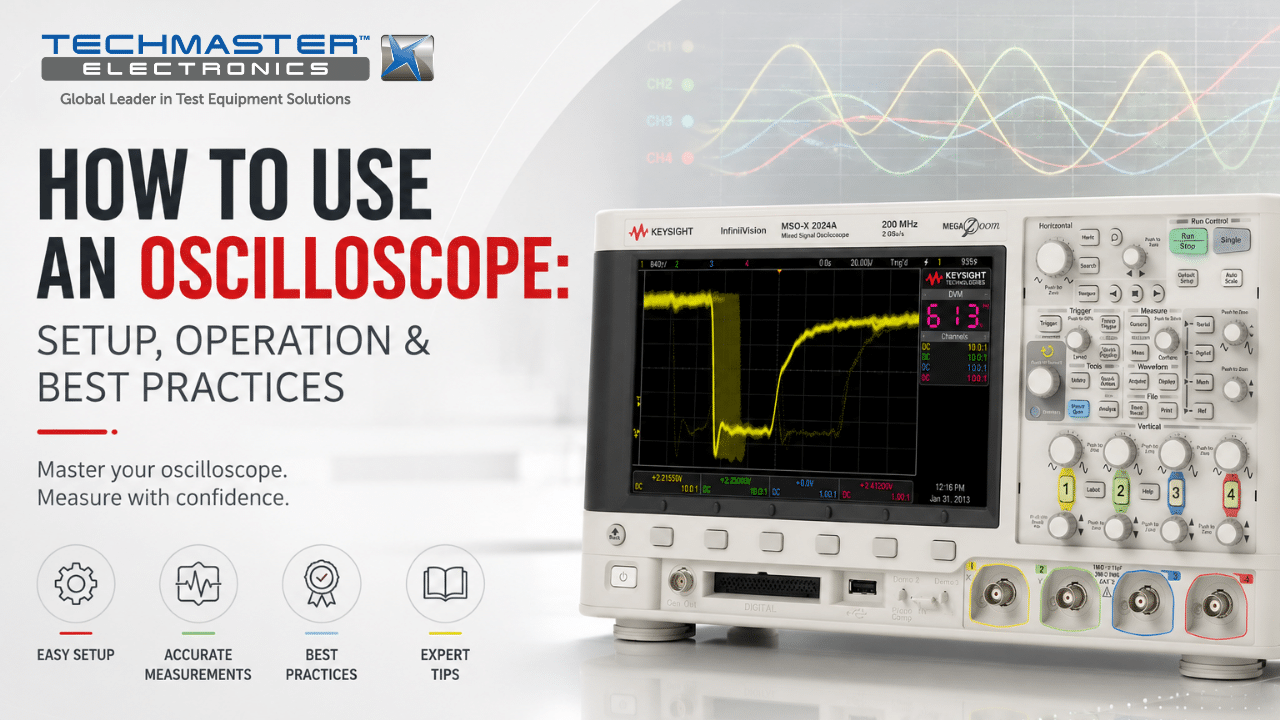
An oscilloscope is the primary diagnostic instrument used to visualize and measure electrical signals over time, serving as the “eyes” of an electronics laboratory. Mastering how to use a oscilloscope is fundamental for engineers to verify signal integrity, troubleshoot complex circuitry, and validate electronic design performance. Without proper setup and understanding of signal acquisition, technicians risk misinterpreting electrical noise, timing jitter, or transient events, which can lead to faulty circuit diagnostics or system failures.
This guide outlines the professional approach to setting up, operating, and performing accurate measurements on modern digital oscilloscopes, ensuring reliable data collection for professional engineering applications.
1. Technical Principles: Signal Acquisition & Scaling
1.1. How does an oscilloscope convert voltage to visual data?
Learning how to use a oscilloscope begins with understanding the acquisition process: the instrument samples incoming analog voltages, digitizes the signal via an Analog-to-Digital Converter (ADC), and maps it onto a display based on defined vertical (voltage) and horizontal (time) scaling factors.
1.2. Critical Operational Concepts
-
Vertical Scaling (Volts/Div): Adjusts the amplitude of the signal on the screen. Proper scaling ensures the waveform occupies the majority of the display without clipping, maximizing ADC vertical resolution.
-
Horizontal Scaling (Time/Div): Adjusts the time window captured by the oscilloscope. This setting is vital for observing frequency, period, and high-speed transients within a signal.
-
Triggering: The mechanism that stabilizes the waveform by starting the capture when the signal meets specific voltage or edge conditions, preventing the signal from “rolling” across the screen.
2. Industrial Applications: Where Oscilloscope Proficiency is Critical
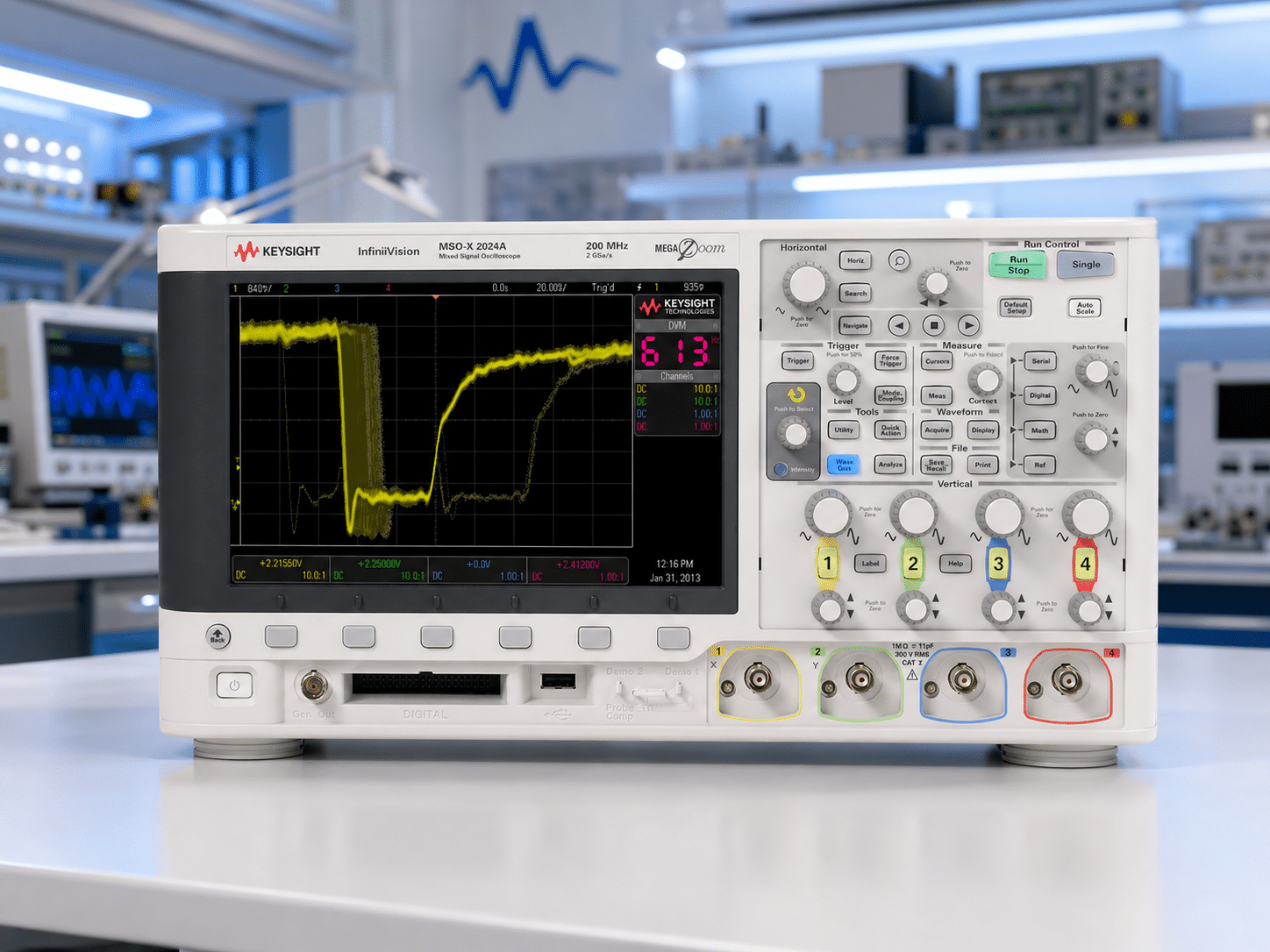
Proficiency in operating oscilloscopes enables engineers and technicians to analyze electrical signals with precision across a wide range of industrial and research environments. As a result, diagnostic data becomes more accurate, reliable, and actionable for troubleshooting, validation, and product development.
- Automotive Electronics: For example, analyzing serial communication protocols such as CAN, LIN, and FlexRay, as well as power delivery systems in modern vehicles, requires precise trigger settings to isolate specific data packets and detect intermittent faults.
- Power Supply Design: Likewise, engineers rely on oscilloscopes to monitor switching transients, ripple voltage, and noise, ensuring stable power delivery and maintaining the integrity of sensitive electronic systems.
- Embedded Systems Debugging: In addition, real-time visualization of I²C, SPI, UART, and other communication protocols is essential for verifying signal timing, debugging firmware, and validating the logical behavior of microcontroller-based circuits.
- Medical Diagnostic Equipment: Finally, oscilloscopes play a critical role in testing and debugging medical electronic devices, where maintaining signal fidelity is essential for ensuring patient safety, regulatory compliance, and reliable equipment performance.
3. The Calibration Pillar: Ensuring Measurement Trust
Why is professional calibration required for oscilloscope users?
Even with expert knowledge on how to use a oscilloscope, accuracy cannot be guaranteed if the instrument itself has drifted; professional Oscilloscope Calibration ensures that amplitude, frequency, and timebase measurements remain within NIST-traceable standards.
Techmaster US emphasizes that periodic calibration, specifically compliant with ISO/IEC 17025, is the only way to verify that the internal attenuation networks and timebase crystals remain stable. Relying on an uncalibrated instrument can lead to hidden measurement errors that compromise design reliability and compliance audits.
4. Performance Factors in Oscilloscope Setup
| Factor | Description | Impact on Measurement |
| Probe Compensation | Matching probe capacitance to the input. | Prevents distortion of square-wave edges. |
| Coupling (DC/AC) | Determining if the DC offset is blocked. | Necessary for isolating AC ripple from DC bias. |
| Bandwidth Limits | Filtering high-frequency noise. | Clean observation of low-frequency signals. |
| Vertical Resolution | ADC bit-depth and quantization. | Accuracy of fine voltage level measurement. |
5. How to Prepare and Use Your Oscilloscope
Follow these professional steps to set up and use an oscilloscope for accurate signal analysis.
1. First, Perform Probe Compensation Connect the probe to the oscilloscope’s built-in square-wave reference signal (typically 1 kHz). Then, adjust the probe’s trimmer capacitor until the displayed square wave has a flat top and clean edges, ensuring accurate measurements.
2. Next, Set the Input Coupling Choose the appropriate input coupling based on your application. For example, use DC coupling to view the complete signal, or AC coupling to block the DC component and focus on small AC variations.
3. Then, Adjust the Vertical and Horizontal Scales Start with a higher voltage range to protect the display from overload. After that, gradually increase the sensitivity until the waveform fits the screen, and adjust the timebase to display one to three complete signal cycles for easier analysis.
4. Finally, Configure the Trigger Settings Select the Edge trigger mode and carefully adjust the trigger level until the waveform becomes stable. As a result, the signal will remain stationary on the display, allowing for accurate observation and analysis.Techmaster US: Your Calibration Partner
Techmaster Electronics, LLC is an independent, ISO/IEC 17025 accredited calibration laboratory supporting the U.S. manufacturing sector since 1989. Our experts operate out of five laboratories (four ISO/IEC 17025 accredited) located in California, Florida, Texas, and North Carolina.
We support the professional community by ensuring that the instruments used to make critical design decisions, like oscilloscopes, are performing within manufacturer tolerances and national standards.
Why Choose Techmaster US?
-
Full ISO/IEC 17025 Accreditation: Procedures strictly adhere to our ANAB cert AC-1736 quality framework.
-
Flexible Service Options: We offer both in-lab and on-site calibration services to minimize operational downtime.
-
Comprehensive Expertise: Our capabilities cover the full spectrum of disciplines, including electrical, RF, mechanical, and environmental measurement.
Frequently Asked Questions (FAQs)
1. What is the most important first step when learning how to use a oscilloscope?
The most important step is probe compensation. Without compensating the probe to match the oscilloscope’s input impedance, the signal will suffer from significant amplitude and frequency distortion, leading to inaccurate readings.
2. How do I stop a waveform from scrolling across the screen?
You must properly configure the “Trigger” system. By selecting an edge trigger and adjusting the trigger level to a point within the waveform’s amplitude, the oscilloscope will synchronize the start of each capture, rendering the display stationary.
3. What is the difference between DC and AC coupling?
DC coupling displays both the AC and DC components of a signal, whereas AC coupling uses a series capacitor to block DC voltage, allowing you to focus on the AC components riding on top of a larger DC offset.
4. Do I need to calibrate my oscilloscope frequently?
Yes, annual calibration is industry standard. While built-in “self-cal” routines are helpful for thermal drift, they do not replace formal ISO/IEC 17025 calibration, which is required to verify your device against traceable external standards.
The Foundation of Measurement Trust
Relying on an uncalibrated instrument can lead to hidden measurement errors that compromise design reliability and compliance audits. Even with perfect setup knowledge, subtle component drift in the oscilloscope’s attenuators or crystal oscillators can distort timing and voltage calculations.
CONTACT USReferences & industry standards
- ISO/IEC 17025 testing & calibration laboratory requirements
- NIST calibration services and measurement traceability
- NIST Fundamental Electrical Measurements
- A2LA / ANAB accreditation for calibration laboratories
External standards bodies. Techmaster Electronics is an ISO/IEC 17025-accredited, NIST-traceable calibration laboratory.
Frequently asked questions
What is oscilloscope calibration?
Oscilloscope Calibration is the documented comparison of a oscilloscope against NIST-traceable reference standards under ISO/IEC 17025. It quantifies the oscilloscope’s error and measurement uncertainty and confirms it performs within tolerance, with as-found and as-left data on the certificate.
How often should a oscilloscope be calibrated?
Most quality systems calibrate a oscilloscope every 12 months, or sooner after repair, overload, or before critical measurements. Set your interval from the manufacturer spec and your ISO 9001 / 13485 / AS9100 program and drift history.
Is Techmaster’s oscilloscope calibration ISO 17025 accredited?
Yes. Techmaster Electronics is ISO/IEC 17025:2017 accredited by ANAB (Certificate AC-1736). Every oscilloscope calibration is NIST-traceable and issued with a full measurement-uncertainty budget.
What is the turnaround for oscilloscope calibration?
Standard turnaround is 5 business days, with 1–2 business-day expedite available. On-site calibration removes shipping time entirely for oscilloscopes that can’t leave the floor.
Do you calibrate oscilloscopes on-site or in-lab?
Both. Techmaster runs five US labs (Vista CA, Santa Clara CA, Orlando FL, San Antonio TX, Holly Springs NC) and offers nationwide on-site oscilloscope calibration to minimize downtime.

Khanh Nguyen is the Marketing Manager at Techmaster Electronics, a B2B marketing leader covering the test, measurement, and ISO/IEC 17025 accredited calibration industry across the US and Vietnam markets.